
Sermorelin vs Ipamorelin
Sermorelin and ipamorelin act on separate receptors, which is why they get used together rather than chosen between. The bigger difference is legal. Sermorelin was an approved drug and can still be made by a compounding pharmacy on prescription. Ipamorelin was turned down by the FDA's advisory committee in October 2024 and cannot.
- Growth hormone
- Different receptors
- One can be compounded, one cannot
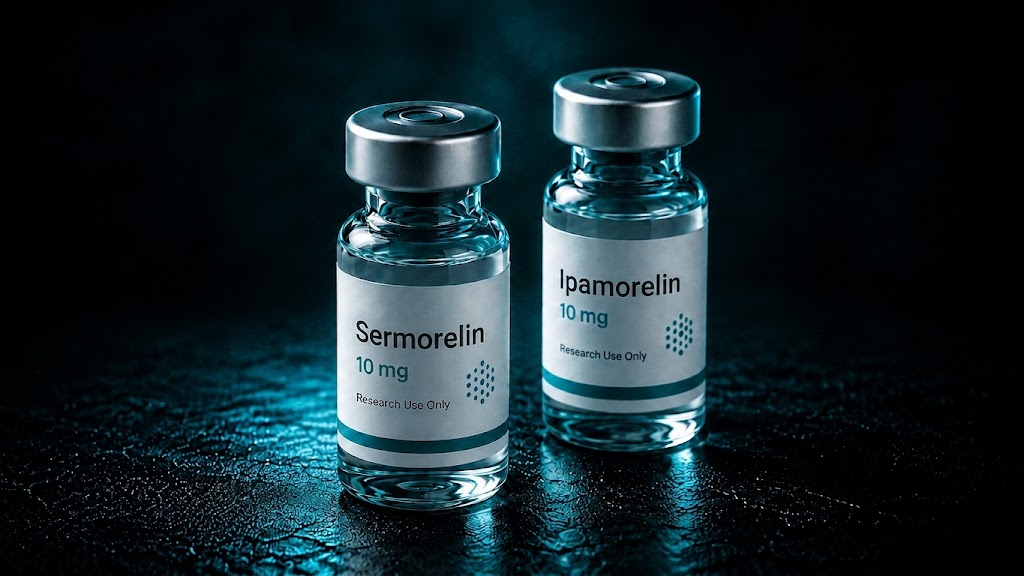
What differs between them, and which number gets quoted wrong?
One tells the pituitary to make more growth hormone. The other tells it to let go of what it already has. Only one of them can be legally dispensed in the US.
| Attribute | Sermorelin | Ipamorelin |
|---|---|---|
| What it is | GHRH 1-29, a natural hormone fragment | 5 amino acids, designed from scratch |
| Receptor | The GHRH receptor | The ghrelin receptor |
| Was ever approved | Yes, 1990 and 1997 [1] | No |
| Can be compounded | Yes, legally [2] | No [8] |
| Human PK study | None found [5] | Yes, half-life about 2 hours [6] |
| Best efficacy trial | 110 children, open label [3] | 114 patients, missed its endpoint [7] |
| Adult trials | Four, and the largest used a different molecule [13][14][15][16] | None |
Compounded sermorelin is not an FDA approved finished product. See the legal section below.
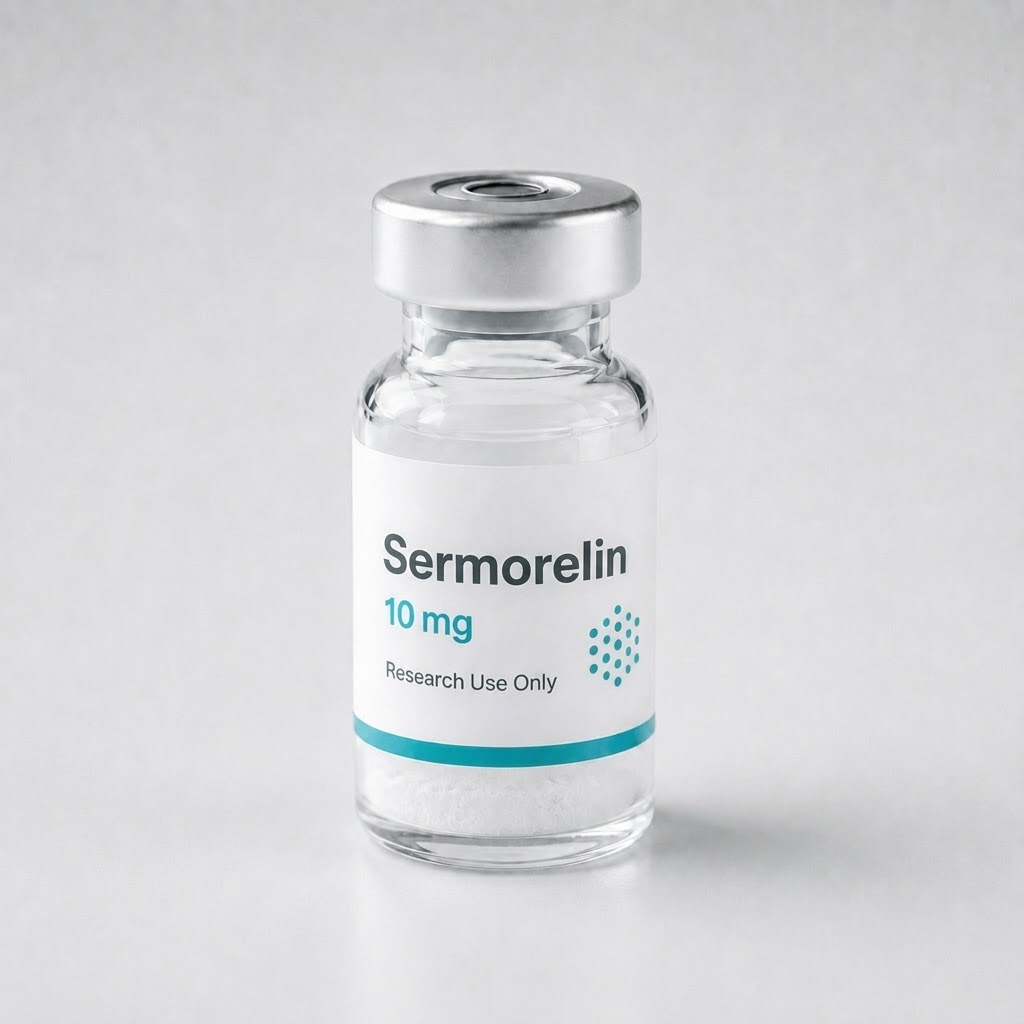
Sermorelin
The first 29 amino acids of GHRH, the hormone your hypothalamus uses to signal the pituitary. Nothing added, nothing swapped. A copy of your body's own instruction to produce growth hormone.
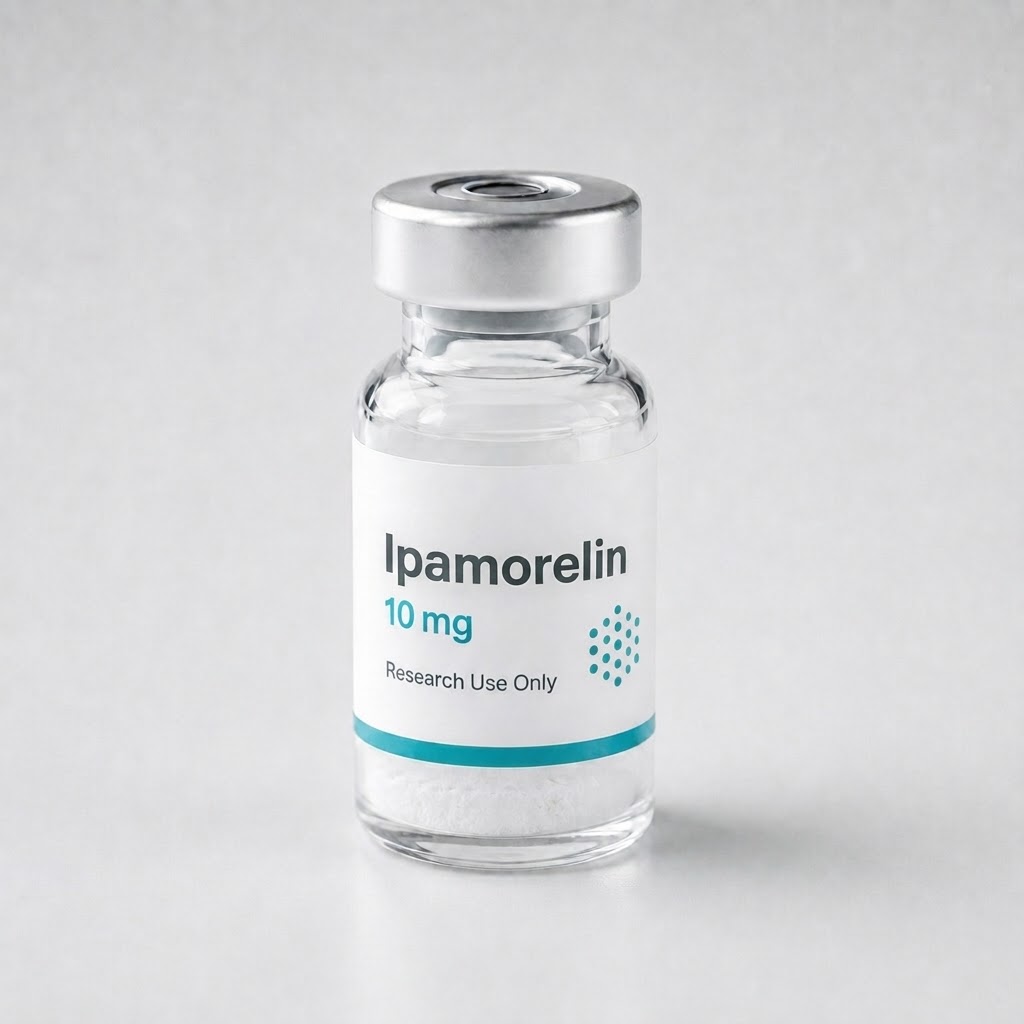
Ipamorelin
Five amino acids, two of which are not standard building blocks, designed to copy ghrelin at one receptor on the pituitary. A synthetic signal telling the gland to release growth hormone it already has.
Is anything about them shared?
Different lengths, different origins, different doors into the same gland. That is also why protocols run both rather than choosing one.
A fragment of human GHRH, unchanged. The shortest piece of that hormone that still does the whole job.
Two of the five are non-standard residues, shown outlined. It copies nothing that exists in the body.
Nothing is shared. Different lengths, different origins, different receptors.
One is a fragment, one is an invention. Sermorelin is a piece of a hormone you already make. Ipamorelin copies nothing that exists.
They are complementary, not alternatives. Which is why protocols use both.
What does the evidence actually show?
Why does the number everyone quotes for sermorelin leave out half the children?
The shortest fragment that still works
Sermorelin is developed as the shortest fragment of GHRH that retains full biological activity, and becomes the first GHRH analog to reach approval.
Geref Diagnostic approved
On 28 December the FDA approves Geref Diagnostic, for testing whether the pituitary is producing growth hormone. [1]
Corpas, ten men, two weeks
GHRH 1-29 twice daily for 14 days in 10 men aged 60 to 78. Growth hormone and IGF-1 rose, with IGF-1 up about 25 percent, bringing the older men close to the range of untreated young controls. [13]
- 10 participants
- 14 days
Geref approved for children
On 26 September the FDA approves Geref for growth failure in children with growth hormone deficiency. The pivotal study was multicentre and open label, with no control group. 110 children received 30 micrograms per kilogram daily. [1][3]
- open label
- no control group
- 54 of 110 excluded from analysis
Khorram, the most cited adult study
19 people aged 55 to 71, four weeks of placebo then sixteen weeks of nightly injections at 10 micrograms per kilogram. Nocturnal growth hormone rose, IGF-1 and IGFBP-3 rose within two weeks, men gained an average of 1.26 kilograms of lean mass, and skin thickness increased in both sexes. Sleep quality was unaffected.
The compound was not sermorelin. It was [Nle27]GHRH-(1-29)-NH2, a modified version with a substitution at position 27. [14]
Vittone, and nothing moved
Single nightly injections of GHRH 1-29 in healthy older men produced no significant change in body weight, BMI, waist to hip ratio, lean body mass or percent body fat. Two of six muscle strength tests improved, along with an endurance measure, and systolic blood pressure fell. [15]
Raun characterizes it at Novo Nordisk
Ipamorelin releases growth hormone without raising cortisol or prolactin, unlike older compounds in its class. Rat pituitary cells and pigs. [9]
- animal and cell work
Prakash and Goa review
Height velocity increases were sustained over 12 months, and data on a small number of children suggested the effect held for 36 months. The effect on final adult height was never determined. [4]
The only human PK study either one has
Gobburu and colleagues report that growth hormone peaks around 30 to 40 minutes and ipamorelin clears with a half-life of about 2 hours. [6]
- human pharmacokinetics
Vitiello, cognition in 89 adults
Six months of GHRH treatment, with improvements in performance IQ and processing speed. Again a GHRH analog rather than sermorelin specifically. [16]
Off the market
EMD Serono withdraws Geref from the US market. The FDA withdraws the approval the following year. [1]
Not withdrawn for safety
A Federal Register determination records that Geref was not withdrawn for reasons of safety or effectiveness. This is what keeps sermorelin compoundable today. [2]
Its only efficacy trial, and it missed
114 patients, testing recovery of gut function after bowel surgery, 0.03 milligrams per kilogram intravenously. Patients tolerated food about seven hours sooner than on placebo, 25.3 hours against 32.6, and it missed its primary endpoint at p = 0.15. Development was discontinued. [7]
- randomized
- placebo controlled
- endpoint missed
Voted against
On 29 October the FDA's advisory committee reviews ipamorelin for growth hormone deficiency and postoperative ileus and votes against adding it to the compounding list. One of four substances turned down that day. [8]
Same shelf, different positions
Sermorelin is prescribed through compounding pharmacies for adult use that was never approved. Ipamorelin has no legal route at all.
You will read that sermorelin increased growth rate in 74 percent of children after six months. That figure is 47 out of 56. 110 were enrolled, and 54 were set aside before the analysis, including 20 removed specifically for failing the efficacy criteria at six months. Against everyone who started, it is 47 of 110. [3]
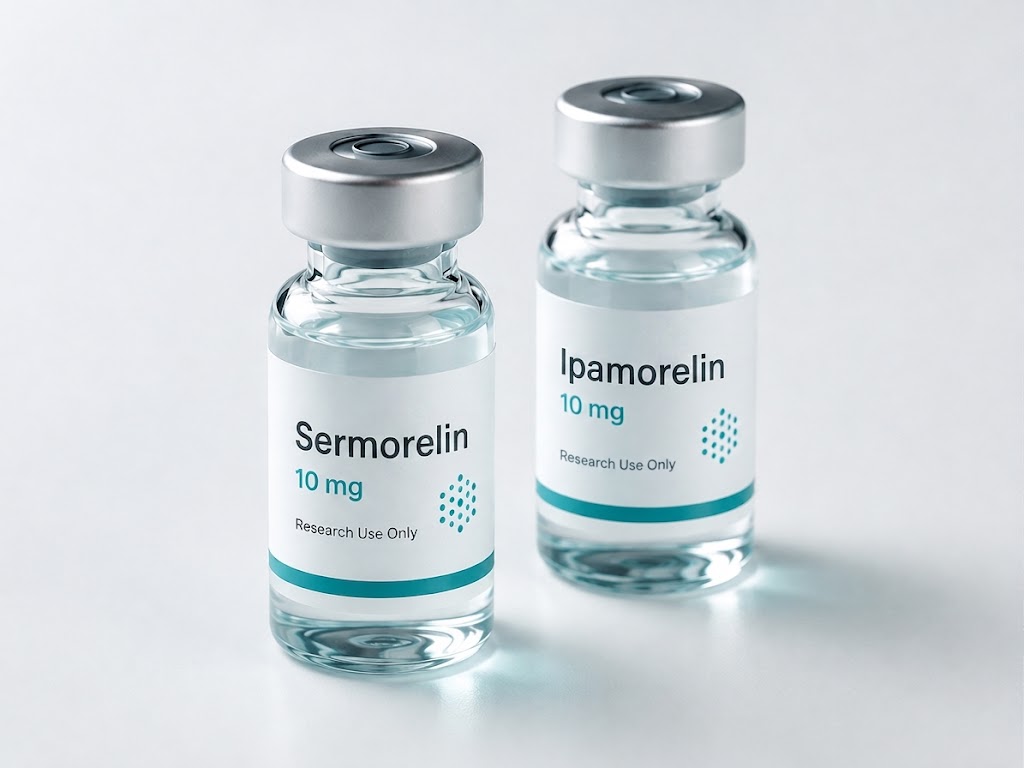
How do they compare, side by side?
How do they compare, side by side?
| Attribute | Sermorelin | Ipamorelin |
|---|---|---|
| Full name | Sermorelin acetate, GRF 1-29, GHRH 1-29 | Ipamorelin, NNC 26-0161 |
| Brand | Geref and Geref Diagnostic, both discontinued | None |
| Length | 29 amino acids | 5 amino acids |
| Origin | The active fragment of human GHRH | Designed, with non-standard residues |
| Receptor | GHRH receptor | Ghrelin receptor, GHS-R1a |
| What it does | Signals the pituitary to produce | Triggers release of what is stored |
| Human PK data | None published [5] | Half-life about 2 hours [6] |
| Best efficacy trial | 110 children, open label, no control group [3] | 114 patients, randomized, placebo controlled [7] |
| That trial's result | 47 of 110 met the growth threshold at 12 months [3] | Missed its primary endpoint at p = 0.15 [7] |
| Approval history | Approved 1990 and 1997, withdrawn 2008 [1] | Never approved |
| Can be compounded | Yes [2] | No, voted against October 2024 [8] |
| Effect on cortisol | Not a reported issue | None, and this is its selling point [9] |
| WADA status | Named outright under S2.2.4 [10] | Named outright under S2.2.4 [10] |
How do two receptors do two jobs in one gland?
Sermorelin
Your hypothalamus produces GHRH, which travels a short distance to the pituitary and tells it to make and release growth hormone. Only the first 29 amino acids of that hormone are needed, and sermorelin is exactly those 29.
Because it works through the normal pathway, the pituitary's feedback loops stay intact. If growth hormone or IGF-1 is already high, the system pushes back, which is the argument for using it rather than injecting growth hormone directly.
The catch is that it depends on the pituitary being able to respond. It does nothing for a deficiency caused by the pituitary itself, only for one caused by insufficient signal reaching it.
Ipamorelin
Growth hormone comes out in bursts, and ghrelin is one of the signals that triggers a burst. Ipamorelin copies that signal at a receptor called GHS-R1a.
Its selling point is selectivity. Older compounds hitting the same receptor also raised cortisol, prolactin and appetite. Raun's 1998 work found ipamorelin left those alone even at doses far above the effective range. [9]
That work was done in rat cells and pigs, and the selectivity has not been tested in people at the doses people actually use.
Why they get stacked: two different receptors, two different mechanisms, one gland. The reasoning is that pushing production and release at the same time produces more than either alone. Nobody has tested that combination in a published human trial.
What are the key differences?
What actually separates them?
- Both act on the pituitary
- Both raise growth hormone
- Both are injected
- Both are named on the WADA list
- Neither is approved for adult use
Sermorelin
Ipamorelin
What has nobody answered?
Which six gaps has nobody answered?
Nobody has measured sermorelin in a person.No human pharmacokinetic study appears in the literature. [5] The duration figures you will see trace back to a rat study from 1988. For a compound that held an approval for eighteen years, that is a strange absence.
The adult evidence is smaller and shakier than it looks.Four studies are usually cited. Corpas 1992 enrolled ten men for fourteen days. [13] Vittone 1997 found no change in body weight, BMI, lean mass or body fat. [15] Khorram 1997 and Vitiello 2006 both used GHRH analogs other than sermorelin. [14][16] None was designed to test what sermorelin is now prescribed for.
The sleep claim has one measurement behind it, pointing the wrong way.Khorram's sixteen-week trial found sleep quality unaffected. [14] Everything else written about sermorelin and sleep is mechanism and anecdote.
Every adult dosing protocol is invented.The figures circulating, around 200 to 300 micrograms at bedtime five nights a week, trace to clinic practice rather than to any trial. The approved dose was 30 micrograms per kilogram daily in children, which for a 30 kilogram child is 900 micrograms. Adults are using a fraction of that per kilogram, and nobody has published a dose finding study in adults.
Nobody has tested ipamorelin for what people take it for.Its one efficacy trial measured recovery after bowel surgery and missed. Body composition, sleep and recovery in healthy adults have never been studied. [7]
And nobody has tested the combination.The two are commonly run together on the reasoning that they work through different receptors. No published human trial has examined that.
What are the side effects, and what are you buying?
Which has a label from its approved years, and which has one trial?
Two different routes into the country, and two different problems with what ends up in the vial.
From the approved years and the trials
Sermorelin's entries come from its time as a marketed drug.
- Injection site reactionsboth
- Facial flushingsermorelin
- Headache and nauseaboth
- Reported as well tolerated in its trial, adverse events comparable to placebo [7]ipamorelin
From sermorelin's prescribing information
These come from when it was a labeled product.
- Untreated hypothyroidism, which affects the growth hormone responselabel
- Epilepsylabel
- Obesity, high blood sugar or raised fatty acids, all of which blunt the responselabel
- Pregnancy and breastfeedingno data
What you are actually buying
Two different routes, two different problems.
- Compounded sermorelin comes from a licensed pharmacy and is not an FDA approved productpharmacy
- Ipamorelin has no legal route, so anything sold is a research chemicalgrey market
- Seized peptides tested 5 to 75 percent pure, plus arsenic and lead [11]analysis
- A US lab reported problems in almost 30 percent of samples, including bacteria [12]testing
*Where this page says nothing is established, it means nobody has studied it. It does not mean a compound is safe.
The distinction in card 3 is worth being clear about. A compounding pharmacy is regulated, inspected and dispenses against a prescription, which is a meaningfully different thing from a vial ordered online. It is still not an approved product, and the FDA does not verify compounded preparations for safety, quality or effectiveness the way it does manufactured drugs. Our guide on reading a certificate of analysis covers what to actually look for.
Are they banned in sport?
Are both named, with no ambiguity?
This reflects the 2026 Prohibited List, in force from 1 January 2026. WADA publishes a new list each September, so check the current version if you are reading this later in the year.
Sermorelin is named among the GHRH analogs, alongside CJC-1293, CJC-1295 and tesamorelin. Ipamorelin is named among the growth hormone secretagogues, alongside MK-677, anamorelin and macimorelin. [10]
Both are prohibited at all times, in and out of competition. Everything in S2 is a non-specified substance, carrying a default four year ban for a first violation.
Having once been an approved medicine makes no difference. Sermorelin is on the list by name.
Are they FDA approved?
Why is this the clearest legal split of any pairing in this library?
Geref Diagnostic approved 28 December 1990 and Geref on 26 September 1997. EMD Serono discontinued production in 2008 and the FDA withdrew the approval effective 18 June 2009. A Federal Register determination published 4 March 2013 stated it was not withdrawn for reasons of safety or effectiveness. [1][2]
That determination is the whole reason it remains available. A substance whose approval was withdrawn for commercial reasons can be compounded under sections 503A and 503B, so a licensed pharmacy may prepare it against a prescription.
Note what that does not mean. It is not an approval. The adult use it is prescribed for was never approved for anyone.
Never approved anywhere. It went into Category 2 of the 503A bulk substances list in September 2023, came off in September 2024 when the nomination was withdrawn, and was then taken to the advisory committee anyway.
On 29 October 2024 the committee reviewed it for growth hormone deficiency and postoperative ileus and voted against adding it to the list. It was one of four substances turned down that day, alongside ibutamoren, kisspeptin-10 and L-theanine. [8]
So two compounds sold beside each other are in entirely different positions. One is dispensed by a pharmacy against a prescription. The other cannot legally be compounded at all.
Questions people ask
Which one should I use?
They act on different receptors and are usually run together rather than chosen between. If you are picking one, the practical difference is that sermorelin has a legal route through a prescriber and ipamorelin does not.
Is sermorelin FDA approved?
Not any more. It was approved in 1990 and 1997 for use in children, and withdrawn in 2008 for commercial reasons. It can still be legally compounded because of that, but a compounded preparation is not an approved product.
Why can I get sermorelin from a doctor but not ipamorelin?
Because sermorelin once held an approval that was withdrawn for business rather than safety reasons, which allows compounding. Ipamorelin never had one, and the FDA's advisory committee voted against allowing it in October 2024.
Is the 74 percent figure for sermorelin accurate?
It is 47 of 56 children who remained in the analysis, and 110 were enrolled. Twenty were removed specifically for failing the efficacy criteria at six months. Against everyone who started, the figure is 47 of 110.
Does sermorelin help you sleep?
The one controlled trial that measured sleep quality found it unaffected over sixteen weeks, and that study used a modified GHRH analog rather than sermorelin itself. Sleep is the most common reason it gets prescribed, and the evidence for it is mechanism and anecdote rather than measurement.
Is the adult research on sermorelin actually on sermorelin?
Partly. Corpas 1992 and Vittone 1997 used GHRH 1-29. The two most cited studies, Khorram 1997 and Vitiello 2006, used other GHRH analogs. Findings from a related molecule are a reasonable starting point and they are not the same as testing the compound in the vial.
How long does sermorelin last?
Nobody has published a human pharmacokinetic study of it. The figures you will see trace to a rat study from 1988. Ipamorelin, by contrast, has a measured human half-life of about 2 hours.
Can you take them together?
People do, on the reasoning that they act on different receptors. No published human trial has tested the combination.
Are they banned in sport?
Yes, both by name, under section S2.2.4 of the 2026 Prohibited List.
What this page is built on
- 01US Food and Drug Administration approval history for GEREF Diagnostic (sermorelin acetate) injection, NDA 19-863, approved 28 December 1990, and GEREF injection, NDA 20-443, approved 26 September 1997. Both held by EMD Serono. Production discontinued 2008, approval withdrawn effective 18 June 2009. Regulatory documents.
- 02Federal Register. Determination that GEREF (sermorelin acetate) injection was not withdrawn from sale for reasons of safety or effectiveness. 4 March 2013. FR Doc 2013-04827. Regulatory document. This determination is what permits compounding under sections 503A and 503B.
- 03Geref prescribing information, clinical studies section. Multicentre, open-label study in prepubertal children with idiopathic growth hormone deficiency. 110 children received 0.03 mg/kg/day subcutaneously. 56 were evaluable at 12 months. 54 were unevaluable: 24 eligibility violations, 10 protocol discontinuations and 20 for failing the efficacy criteria at 6 months. 47 of the 56 evaluable patients gained 2 cm/year or more over baseline height velocity. No control group.
- 04Prakash A, Goa KL. Sermorelin: a review of its use in the diagnosis and treatment of children with idiopathic growth hormone deficiency. BioDrugs. 1999;12(2):139-157. PMID 18031173. Review. Height velocity increases sustained over 12 months. The effect on final adult height was not determined.
- 05Sermorelin pharmacokinetics. No human pharmacokinetic study of sermorelin appears in the published literature. The reported half-life of about 6.2 minutes comes from intravenous administration in rats, Rafferty et al. 1988.
- 06Gobburu JV, Agersø H, Jusko WJ, Ynddal L. Pharmacokinetic-pharmacodynamic modeling of ipamorelin, a growth hormone releasing peptide, in human volunteers. Pharm Res. 1999;16(9):1412-6. PMID 10496658. Human pharmacokinetic study. Half-life about 2 hours, growth hormone peak around 30 to 40 minutes.
- 07Beck DE, Sweeney WB, McCarter MD; Ipamorelin 201 Study Group. Prospective, randomized, controlled, proof-of-concept study of the ghrelin mimetic ipamorelin for the management of postoperative ileus in bowel resection patients. Int J Colorectal Dis. 2014;29(12):1527-34. PMID 25331030. Trial NCT00672074. Human Phase 2, randomized, double blind, placebo controlled. 114 patients. Missed its primary composite endpoint at p = 0.15. Development discontinued.
- 08US Food and Drug Administration. Pharmacy Compounding Advisory Committee meeting, 29 October 2024, reviewing ipamorelin acetate and ipamorelin free base for growth hormone deficiency and postoperative ileus. The committee voted against adding it, alongside ibutamoren mesylate, kisspeptin-10 and L-theanine. Regulatory document.
- 09Raun K, Hansen BS, Johansen NL, Thøgersen H, Madsen K, Ankersen M, Andersen PH. Ipamorelin, the first selective growth hormone secretagogue. Eur J Endocrinol. 1998;139(5):552-61. Animal and laboratory study, rat pituitary cells and swine.
- 10World Anti-Doping Agency. The 2026 Prohibited List, section S2.2.4, naming sermorelin among GHRH analogs and ipamorelin among growth hormone secretagogues. Effective 1 January 2026. Regulatory document. All S2 substances are non-specified.
- 11Janvier S, Cheyns K, Canfyn M, Goscinny S, De Spiegeleer B, Vanhee C, Deconinck E. Impurity profiling of the most frequently encountered falsified polypeptide drugs on the Belgian market. Talanta. 2018;188:795-807. Peer-reviewed analytical study.
- 12NBC Washington. Lab finds problems in 30% of peptide vials tested. December 2024. News report of commercial laboratory testing, not peer reviewed.
- 13Corpas E, Harman SM, Pineyro MA, Roberson R, Blackman MR. Growth hormone (GH)-releasing hormone-(1-29) twice daily reverses the decreased GH and insulin-like growth factor-I levels in old men. J Clin Endocrinol Metab. 1992;75(2):530-535. Human study. 10 men aged 60 to 78, GHRH 1-29 twice daily for 14 days. IGF-1 up about 25 percent.
- 14Khorram O, Laughlin GA, Yen SSC. Endocrine and metabolic effects of long-term administration of [Nle27]growth hormone-releasing hormone-(1-29)-NH2 in age-advanced men and women. J Clin Endocrinol Metab. 1997;82(5):1472-1479. Human study, single blind, placebo controlled. 19 adults aged 55 to 71. Lean body mass up 1.26 kg in men, skin thickness up in both sexes, sleep quality unaffected. The compound was [Nle27]GHRH-(1-29)-NH2, a modified analog, not sermorelin.
- 15Vittone J, Blackman MR, Busby-Whitehead J, et al. Effects of single nightly injections of growth hormone-releasing hormone (GHRH 1-29) in healthy elderly men. Metabolism. 1997;46(1):89-96. PMID 9005976. Human study. No significant change in body weight, BMI, waist to hip ratio, lean body mass or percent total fat.
- 16Vitiello MV, et al. Growth hormone releasing hormone improves the cognition of healthy older adults. Neurobiol Aging. 2006. PMID 16399214. Human study, 89 subjects, six months. A GHRH analog rather than sermorelin specifically.