
HGH vs Sermorelin
HGH works whether or not your pituitary does, and sermorelin only works if it does, which is the medical difference. The legal difference is larger and almost nobody mentions it: distributing HGH for anti-aging or performance is a federal felony carrying up to five years, while sermorelin can be legally compounded on prescription.
- Growth hormone
- One carries a felony statute
- Both once approved

Why is the approved one the one you can go to prison for?
One supplies the hormone and one asks the body to make it. The approved product carries a criminal statute attached to the exact use people want it for, and the withdrawn one can be legally compounded.
| Attribute | HGH | Sermorelin |
|---|---|---|
| Length | 191 amino acids, a protein | 29 amino acids, a peptide |
| What it does | Supplies growth hormone directly | Asks your pituitary to make more |
| FDA status | Approved, for specific conditions | Approved 1990 and 1997, withdrawn 2008 [3] |
| Can be compounded | No | Yes, legally [4] |
| Off-label distribution | A federal felony, up to 5 years [1] | Ordinary prescribing rules |
| Evidence for anti-aging use | Reviewed, and not recommended [11] | Never studied |
| Works if the pituitary has failed | Yes | No |
The felony statute applies to distribution, not to a patient holding a valid prescription. See the regulatory section below.

HGH
Recombinant human growth hormone, 191 amino acids, identical to what your pituitary makes. Sold as somatropin under brand names including Norditropin, Genotropin and Humatrope. The actual hormone, supplied from outside, and it works whether your own pituitary is functioning or not.

Sermorelin
The first 29 amino acids of GHRH, the hormone your hypothalamus uses to tell the pituitary to release growth hormone. Nothing added, nothing swapped. A copy of your body's own instruction, and it only helps if the pituitary can still act on it.
Which is the hormone, and which is the instruction that produces it?
HGH is 191 amino acids, which puts it well past the conventional line and makes it a protein. Sermorelin is 29, and it is the first two thirds of GHRH.
Not a peptide. At 191 residues it is a protein, and it acts downstream of the pituitary entirely.
The first 29 residues, shown solid, carry the whole activity. The remaining 15 are shown muted.
Those 29 alone. The shortest piece of GHRH that still does the whole job.
Six times the size. 191 amino acids against 29. That is the line between a protein and a peptide.
Opposite positions in the chain. GHRH acts on the pituitary. Growth hormone is what the pituitary releases.
Only one works when the pituitary has failed. Supplying the hormone does not depend on the gland at all.
What does the evidence actually show?
The drug that won the market is the one you can be prosecuted for supplying.
Recombinant growth hormone is approved
It replaces the cadaver-derived pituitary extract used previously. That earlier product had transmitted Creutzfeldt-Jakob disease, and the switch to recombinant material ended that risk.
Distribution for unauthorised uses becomes a felony
Amendments to the Food, Drug and Cosmetic Act criminalise distribution of HGH for any use not authorised by the Secretary of Health and Human Services. Up to five years in prison and a 250,000 dollar fine. Congress authorises the DEA to investigate. This is the provision that makes HGH unlike almost every other prescription drug. [1][2]
- anti-aging is not an authorised use
- performance is not an authorised use
Geref Diagnostic approved
On 28 December the FDA approves Geref Diagnostic, for testing whether the pituitary is producing growth hormone. [3]
Geref approved for children
On 26 September the FDA approves Geref for growth failure in children with growth hormone deficiency. The pivotal study was open label with no control group. 110 children received 30 micrograms per kilogram daily, and 47 of the 56 who remained in the analysis met the growth threshold at twelve months. [5]
- open label
- no control group
HGH takes the market
Recombinant HGH takes the pediatric growth hormone deficiency market. It works regardless of pituitary function, it produces predictable output, and it does not depend on the patient having an intact axis. Sermorelin does not compete.
The anti-aging question, answered
Liu and colleagues at Stanford publish a systematic review in the Annals of Internal Medicine covering 18 studies and 220 healthy older adults across 107 patient-years, mean treatment 27 weeks. Fat mass fell 2.1 kilograms and lean mass rose 2.1 kilograms, with no change in total weight and none in bone density. Treated participants were significantly more likely to develop soft tissue swelling, joint pain, carpal tunnel syndrome and gynaecomastia. The authors concluded that growth hormone cannot be recommended as an anti-aging therapy. [11]
- systematic review
- not recommended
And the performance question
The same group publishes a second systematic review, on athletic performance. Growth hormone increased lean body mass and did not improve strength, may have worsened exercise capacity, and produced more swelling and fatigue. The authors concluded that performance claims are not supported by the literature. [12]
Off the market
EMD Serono stops making Geref. The FDA withdraws the approval the following year. [3]
Not withdrawn for safety
A Federal Register determination records that Geref was not withdrawn for reasons of safety or effectiveness. That single sentence is why sermorelin can still be legally compounded. [4]
Long-acting products arrive
Somapacitan is approved for adult deficiency in 2020, and somatrogon reaches approval in several countries for pediatric use, showing non-inferiority to daily growth hormone in a Phase 3 trial. The category continues to develop. [7]
The positions are inverted
HGH is prescribed for named conditions and its off-label distribution is a felony. Sermorelin is compounded and prescribed mostly for uses that were never approved for anyone.
Recombinant HGH displaced sermorelin commercially because it is better at the job. For a child with a damaged pituitary, sermorelin does nothing and HGH works. Then the law diverges from the medicine entirely, and the better drug is the more restricted one, for reasons that have nothing to do with which is safer. [1][4]
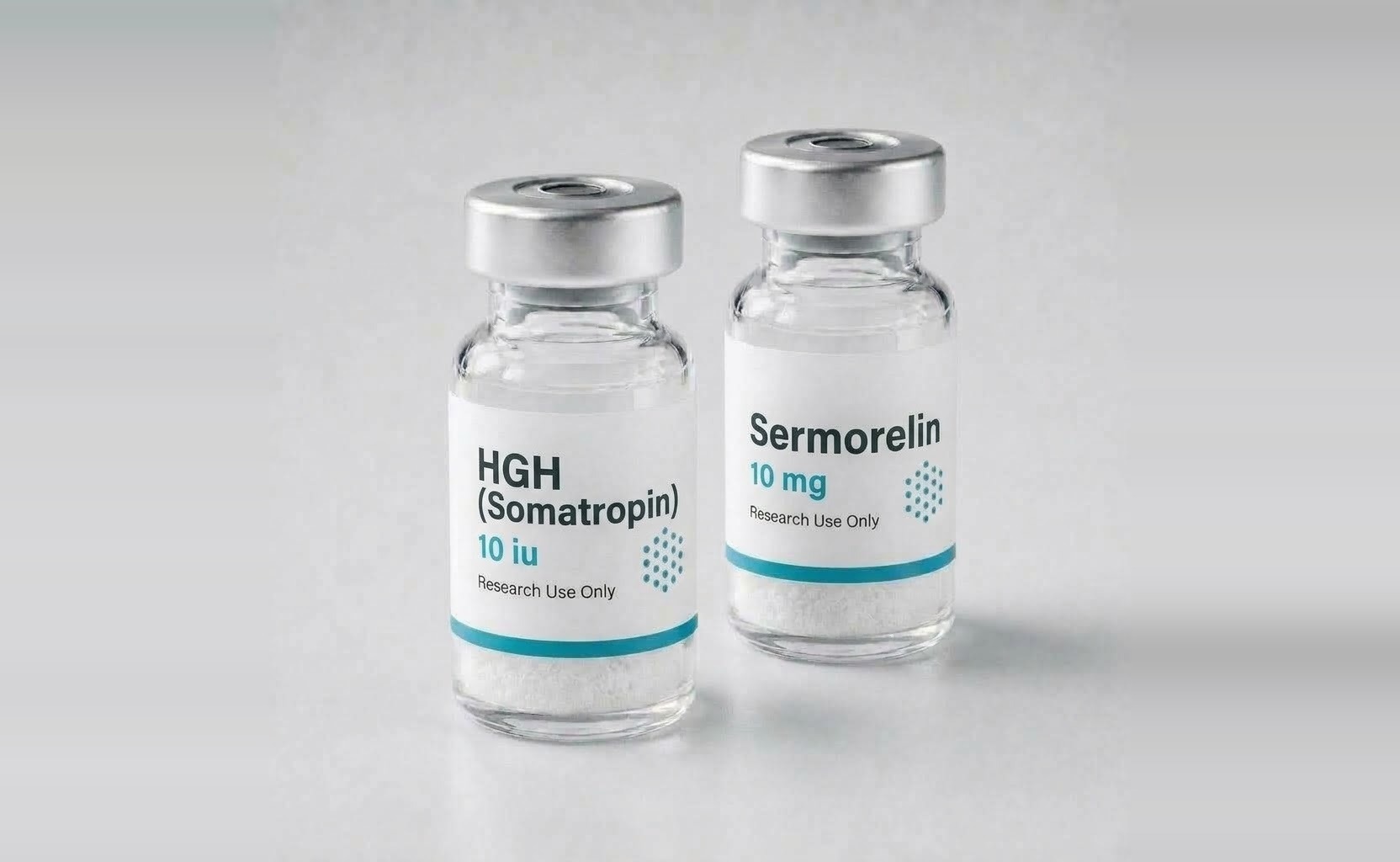
How do they compare, side by side?
Everything that differs.
| Attribute | HGH | Sermorelin |
|---|---|---|
| Also called | Somatropin, Norditropin, Genotropin, Humatrope | Sermorelin acetate, GRF 1-29, Geref |
| Size | 191 amino acids, a protein | 29 amino acids, a peptide |
| Position in the chain | The hormone itself | The signal that triggers it |
| Requires a working pituitary | No | Yes |
| Feedback loop | Bypassed. Suppresses your own production | Intact. Your body can still push back |
| Release pattern | Sustained, non-physiological | Pulsed, closer to natural |
| FDA status | Approved for named conditions | Approved 1990 and 1997, withdrawn 2008 [3] |
| Why it left the market | Still on it | A commercial decision, not safety [4] |
| Can be compounded | No | Yes, because of that determination [4] |
| Off-label distribution | Federal felony, up to 5 years [1] | Ordinary prescribing rules |
| Human PK data | Extensive | None published [6] |
| Cost per month | Roughly 500 to 3,000 dollars | Roughly 100 to 300 dollars compounded |
| WADA status | Named, S2 | Named, S2.2.4 [8] |
How do they sit upstream and downstream of the same gland?
HGH
HGH sits at the bottom of the chain and skips everything above it. It is the hormone, supplied directly. No pituitary needed, no feedback loop consulted, no dependence on an intact axis.
That is why it won. It works in situations where sermorelin cannot, and its output does not vary with how well a patient's own system happens to be functioning.
Supplying the hormone directly also suppresses your own production through the same feedback loop it bypasses. Sustained non-physiological levels produce the recognisable problems at excess doses: fluid retention, carpal tunnel syndrome, glucose intolerance and, at extremes, the features of acromegaly.
Sermorelin
Your hypothalamus produces GHRH, which travels a short distance to the pituitary and tells it to make and release growth hormone. Only the first 29 amino acids are needed, and sermorelin is exactly those 29.
Because it works through the normal pathway, the pituitary's feedback loops stay intact. If growth hormone or IGF-1 is already high, the system pushes back.
Sermorelin's ceiling is what your own pituitary can produce. That is a limitation and it is also a safety feature. It does nothing for a deficiency caused by the pituitary itself.
HGH is not a peptide — so why does the law matter more?
Search "peptides vs HGH" and you get a dozen pages framing these as opposing categories, when neither one is a category at all. A peptide is a chain of amino acids, conventionally under about fifty residues. HGH is 191, which makes it a protein. Sermorelin at 29 is a peptide, and so are semaglutide at 31, tirzepatide at 39, tesamorelin at 44 and BPC-157 at 15.
The word "peptide" in this market describes a purchasing channel instead of a chemical class. It has come to mean an injectable you buy without an approved product behind it, and HGH sits outside that because it has one.
Off-label prescribing is ordinary medicine, and a doctor can prescribe most approved drugs for uses the label does not cover. HGH is an exception written into statute. Distributing it, or possessing it with intent to distribute, for any use not specifically authorised by the Secretary of Health and Human Services is a federal felony. [1][2]
Almost every comparison in this library sets an approved product against something with no legal route. Here the usual pattern is inverted.
What are the key differences?
What separates them.
- Both raise growth hormone
- Both are injected
- Both are named on the WADA list
- Both were once approved for pediatric deficiency
HGH
Sermorelin
What has nobody answered?
Four gaps, and one concerns a drug approved since 1985.
Nobody has measured sermorelin in a person.No published human pharmacokinetic study exists. [6] For a compound that held an approval for eighteen years and is prescribed today through compounding pharmacies, that is a strange absence.
Nobody has compared them head to head in adults.Both were approved for pediatric growth hormone deficiency and the market chose between them commercially. No trial has put them against each other in the adult population where both are now used off-label.
HGH's anti-aging use has been studied, and sermorelin's has not.Liu's reviews looked at growth hormone in healthy older adults and in athletes and concluded against it in both cases. [11][12] No equivalent review exists for sermorelin, because no equivalent body of trials exists to review. One compound has been examined for the use people want and found wanting. The other has not been examined at all. Neither position is an endorsement.
The pulse argument has never been tested against an outcome.Sermorelin's central claim is that pulsed release through an intact feedback loop is better than sustained supply. That is mechanistically reasonable, and no trial has compared the two approaches on anything a patient would notice.
What are the side effects, and what are you buying?
One has a label and a criminal statute. One has neither.
HGH, from decades of labeled use
Dose dependent, and mostly reversible on stopping.
- Fluid retention and swelling, the most common complaintlabel
- Carpal tunnel syndrome, from soft tissue swellinglabel
- Glucose intolerance and raised blood sugarlabel
- At excess doses over time, the features of acromegalylabel
- In healthy older adults, significantly higher rates of all of the above than placebo [11]review
The statute most pages omit
This is not a warning about side effects.
- Distributing HGH for any unauthorised use is a federal felony under 21 USC 333(e) [1]statute
- Up to five years in prison and a fine of up to 250,000 dollars [1]statute
- Anti-aging, performance and body composition are not authorised uses [2]statute
- Congress authorised the DEA to investigate HGH offences [2]enforcement
What you are actually buying
Two very different markets.
- Compounded sermorelin comes from a licensed pharmacy and is not an FDA approved productpharmacy
- HGH sold outside the prescription system is counterfeit-prone and legally hazardousgrey market
- Seized peptides tested 5 to 75 percent pure, plus arsenic and lead [9]analysis
- A US lab reported problems in almost 30 percent of samples, including bacteria [10]testing
*Where this page says nothing is established, it means nobody has studied it. It does not mean a compound is safe.
Card 02 is doing something different from the safety cards on other pages. The statute targets distribution, and possession with intent to distribute. A patient holding a prescription written for an authorised condition is not the target. What the law reaches is the supply side: clinics, sellers and prescribers operating outside the authorised indications. Our guide on reading a certificate of analysis covers what to look for in the vial itself.
Are they banned in sport?
Both are named. This is the most heavily tested class there is. This reflects the 2026 Prohibited List, in force from 1 January 2026. WADA publishes a new list each September, so check the current version if you are reading this later in the year.
Both HGH and sermorelin appear under section S2. Sermorelin is named among the GHRH analogs in S2.2.4, alongside CJC-1293, CJC-1295 and tesamorelin. [8]
Both are prohibited at all times, in and out of competition. Everything in S2 is a non-specified substance, carrying a default four year ban for a first violation.
Growth hormone is among the most actively tested substances in sport, with both direct detection and biomarker methods in routine use. Assuming a GHRH analog is invisible because it is not growth hormone itself is the wrong assumption, since the analogs are named separately for exactly that reason.
Are they FDA approved?
The section that matters most on this page.
Somatropin is approved for a defined list: growth hormone deficiency in children and in adults with documented pituitary disease, Turner syndrome, Noonan syndrome, small for gestational age, chronic renal disease in children, idiopathic short stature, and wasting associated with HIV.
Under 21 USC 333(e), distributing HGH, or possessing it with intent to distribute, for any use other than a disease or recognized medical condition authorised by the Secretary of Health and Human Services is a federal offence carrying up to five years and a 250,000 dollar fine. [1]
HGH is not a controlled substance. It does not appear on the schedules under 21 USC 812. The restriction comes from a separate provision written specifically for it, which is why it is easy to miss. Anti-aging is explicitly not an authorised use, and neither is athletic performance or body composition. [1][2]
Geref was approved in 1990 and 1997 and withdrawn in 2008 when production stopped. A Federal Register determination published in March 2013 recorded that it was not withdrawn for reasons of safety or effectiveness, and that determination is what permits compounding under sections 503A and 503B. [4]
Note what that does and does not mean. Compounded sermorelin is not an FDA approved product, the FDA does not verify compounded preparations for safety or quality, and the adult uses it is prescribed for were never approved for anyone.
The positions are almost the reverse of what people assume. The approved drug carries a criminal statute attached to the use most people want it for. The withdrawn one has a clear legal route through a pharmacy.
Questions people ask
Is HGH illegal?
Not to possess with a valid prescription for an approved condition. Distributing it, or possessing it with intent to distribute, for anti-aging, performance or body composition is a federal felony carrying up to five years and a fine of up to 250,000 dollars under 21 USC 333(e). It is not a controlled substance, and this restriction comes from a separate statute written specifically for growth hormone. [1][2]
Is HGH a peptide?
No. HGH is 191 amino acids, and that makes it a protein. The conventional line sits around fifty residues. Sermorelin at 29 is a peptide, and so are semaglutide, tirzepatide and tesamorelin.
Which one works better?
HGH, for growth hormone deficiency, and it is not close. It works whether or not the pituitary functions, and sermorelin only works if it does. That is why HGH took the market.
Does HGH work for anti-aging?
Not according to the only systematic review of the question. Stanford researchers pooled 18 studies in healthy older adults and found 2.1 kilograms of lean mass gained and 2.1 lost as fat, with no change in bone density and significantly higher rates of swelling, joint pain, carpal tunnel syndrome and gynaecomastia. They concluded that growth hormone cannot be recommended as an anti-aging therapy. [11] The anti-aging industry published a formal response disputing the paper.
Does HGH improve athletic performance?
No. The same group reviewed that question separately and found growth hormone increased lean body mass, did not improve strength, may have worsened exercise capacity, and increased adverse events. Performance claims are not supported by the literature. [12]
Is sermorelin safer than HGH?
No trial has compared them. What is true is that sermorelin's ceiling is lower, because your own pituitary limits how much growth hormone gets released and the feedback loop stays intact. That is a real structural difference, and it is not the same as having been shown safer in a trial.
Why can I get sermorelin from a doctor but not HGH for anti-aging?
Because sermorelin's approval was withdrawn for commercial reasons, recorded in the Federal Register, which permits compounding. HGH has a statute making off-label distribution a felony. [1][4]
How long does sermorelin last?
Nobody has published a human pharmacokinetic study of it. [6] The figures in circulation trace to a rat study from 1988.
What does HGH cost compared to sermorelin?
Brand-name somatropin generally runs from several hundred to a few thousand dollars a month depending on dose and insurance. Compounded sermorelin generally runs a few hundred. Cost is one of the main reasons people consider the substitution.
What are the side effects of HGH?
Fluid retention and swelling, joint pain, carpal tunnel syndrome from soft tissue swelling, glucose intolerance, and at excess doses over time the features of acromegaly. In healthy older adults, a Stanford review found significantly higher rates of all of these than on placebo. [11]
Does sermorelin actually work?
For growth failure in children with growth hormone deficiency, it held an FDA approval for eleven years, so a regulator was satisfied at the time. The pivotal trial was open label with no control group, and 47 of 110 enrolled children met the growth threshold. [5] For the adult anti-aging use it is mostly prescribed for now, no trial has tested it.
Can you take sermorelin and HGH together?
There is no reason to. HGH supplies the hormone directly and bypasses the pituitary, so asking the pituitary to release more of what is already being supplied achieves nothing. HGH also suppresses your own production through feedback, which works against what sermorelin does.
Are they banned in sport?
Yes, both, under section S2 of the 2026 Prohibited List, prohibited at all times. [8]
What this page is built on
- 0121 USC 333(e). Food, Drug and Cosmetic Act, penalties chapter, as amended in 1988 and 1990. Federal statute. Distribution of human growth hormone, or possession with intent to distribute, for any use other than a disease or recognized medical condition authorised by the Secretary of Health and Human Services and prescribed by a physician is a felony carrying up to five years in prison and a fine of up to 250,000 dollars. HGH is not a scheduled controlled substance under 21 USC 812(c).
- 02Perls TT, Reisman NR, Olshansky SJ. Provision or distribution of growth hormone for antiaging: clinical and legal issues. Review. Concludes that the 1988 and 1990 amendments make off-label distribution of growth hormone for aging or age-associated illness illegal in the United States, and notes that Congress authorised the DEA to investigate growth hormone offences in a manner similar to anabolic steroids.
- 03US Food and Drug Administration approval history for GEREF Diagnostic (sermorelin acetate), NDA 19-863, approved 28 December 1990, and GEREF, NDA 20-443, approved 26 September 1997. Both held by EMD Serono. Production discontinued 2008, approval withdrawn 2009. Regulatory documents.
- 04Federal Register. Determination that GEREF (sermorelin acetate) injection was not withdrawn from sale for reasons of safety or effectiveness. 4 March 2013. Regulatory document. This determination is what permits compounding under sections 503A and 503B.
- 05Geref prescribing information, clinical studies section. Multicentre, open-label study in prepubertal children with growth hormone deficiency. 110 children received 30 micrograms per kilogram daily. 47 of the 56 evaluable at twelve months met the growth threshold. No control group.
- 06Sermorelin pharmacokinetics. No human pharmacokinetic study of sermorelin appears in the published literature. The duration figures in circulation trace to intravenous administration in rats, 1988.
- 07Long-acting growth hormone products. Somapacitan approved for adult growth hormone deficiency in 2020; somatrogon approved in several countries for pediatric use after a Phase 3 non-inferiority trial. Regulatory and trial record. US status has changed over time; check the current position.
- 08World Anti-Doping Agency. The 2026 Prohibited List, section S2, naming growth hormone and, under S2.2.4, sermorelin among the GHRH analogs. Effective 1 January 2026. Regulatory document. All S2 substances are non-specified, carrying a default four year ban.
- 09Janvier S, Cheyns K, Canfyn M, et al. Impurity profiling of the most frequently encountered falsified polypeptide drugs on the Belgian market. Talanta. 2018;188:795-807. Peer-reviewed analytical study. Purity between 5 and 75 percent, with arsenic and lead detected.
- 10NBC Washington. Lab finds problems in 30% of peptide vials tested. December 2024. News report of commercial laboratory testing, not peer reviewed.
- 11Liu H, Bravata DM, Olkin I, et al. Systematic review: the safety and efficacy of growth hormone in the healthy elderly. Ann Intern Med. 2007;146(2):104-115. Systematic review. 18 studies, 220 healthy older adults, 107 patient-years, mean 27 weeks. Fat mass down 2.1 kg, lean mass up 2.1 kg, no change in total weight or bone density. Significantly more soft tissue swelling, joint pain, carpal tunnel syndrome and gynaecomastia. Concluded growth hormone cannot be recommended as an anti-aging therapy.
- 12Liu H, Bravata DM, Olkin I, et al. Systematic review: the effects of growth hormone on athletic performance. Ann Intern Med. 2008;148(10):747-758. Systematic review. Growth hormone increased lean body mass, did not improve strength, may have worsened exercise capacity, and increased adverse events. Concluded performance claims are not supported by the literature.