
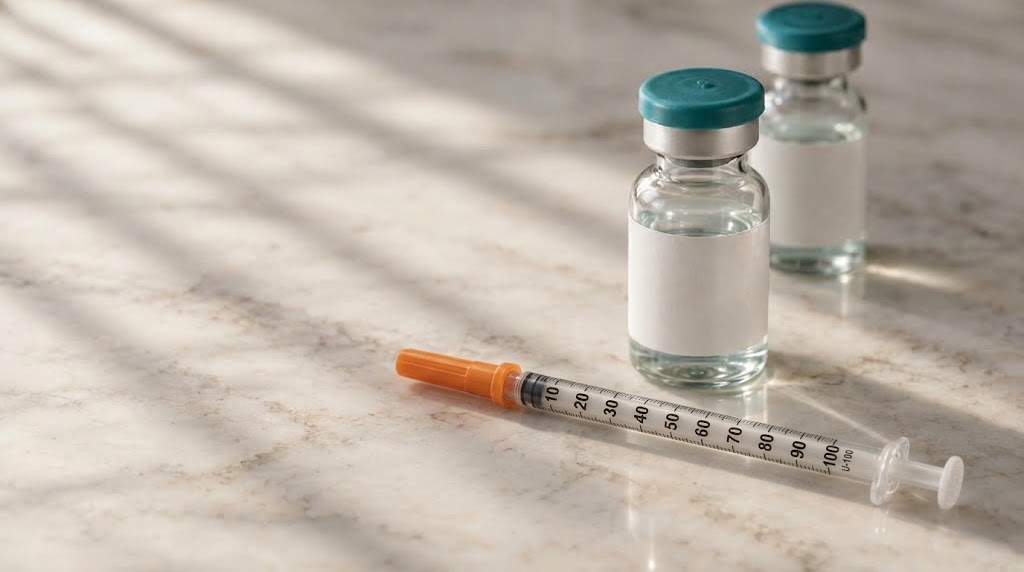
Most of what gets called microdosing is not a microdose. It is the approved starting dose, 0.25 mg of semaglutide (Ozempic, Wegovy) or 2.5 mg of tirzepatide (Mounjaro, Zepbound), taken and held instead of climbed past.
A real microdose means below those figures, often 0.05 to 0.1 mg of semaglutide. No trial has tested that, in anyone, for anything.
The separate question, whether you can come down to a lower dose after losing weight, does have a randomised answer as of May 2026, and the answer is a qualified yes.1
Key numbers, September 2026:
- Peptide Decoding vendor price index, 23 September 2026: semaglutide median $6.83 per mg across 25 sellers, tirzepatide $4.67 per mg across 37. At those prices, four weeks of semaglutide costs about $66 at the label maintenance dose and about $7 at the starting dose.2 How the index is collected
- 0 trials of doses below the approved starting dose for weight management
- 1 randomised trial of stepping down after weight loss: SURMOUNT-MAINTAIN, 378 adults
- 2 different practices share the name: holding a starting dose, and dosing below it
What do people mean by microdosing?
Three different things, and the confusion between them explains most of the arguing.
| What people call microdosing | What it actually is | Tested? |
|---|---|---|
| Holding 0.25 mg semaglutide or 2.5 mg tirzepatide | The approved starting dose, taken indefinitely | Only as a titration step everyone passed through |
| Below 0.25 mg, often 0.05 to 0.1 mg | A microdose, in the pharmacological sense | No, not for weight management at any duration |
| Same dose every ten or fourteen days | An interval change, not a dose change | No |
Holding the starting dose. Staying at 0.25 mg of semaglutide or 2.5 mg of tirzepatide instead of titrating up. This is the most common version and it is not a microdose. It is the first rung of the approved ladder, taken indefinitely.
Dosing below the ladder. Weekly amounts under the approved starting dose, commonly described as 0.05 to 0.1 mg of semaglutide. This is what the word actually means, borrowed from early-phase drug development, where sub-therapeutic doses are given to study how a drug behaves without producing a clinical effect.
Stretching the interval. Same dose, every ten days or every two weeks. Less discussed and a different pharmacological question, since these drugs have week-long half-lives.
When a study, a guideline or a clinician says something about "microdosing", check which of the three they mean. Most disagreements in this area are two people describing different practices.
What are the approved doses?
For semaglutide in weight management, which is Wegovy: 0.25 mg weekly for four weeks, then 0.5, then 1.0, then 1.7, then 2.4 mg, each step held four weeks. For tirzepatide, which is Zepbound for weight and Mounjaro for diabetes: 2.5 mg weekly for four weeks, then 5, and upward in 2.5 mg steps to a maximum of 15.
The starting dose exists for tolerability, not for effect, and both labels say so in their own words.
The Wegovy label states that the 0.25 mg, 0.5 mg and 1 mg weekly dosages are initiation and escalation dosages and are not approved as maintenance dosages for chronic weight management.3 The Zepbound label states that the 2.5 mg dosage is for treatment initiation and is not intended for chronic weight management; the Mounjaro label uses the same phrasing about glycemic control.4
Read that first sentence again, because it covers more than people expect. Not just 0.25 mg. Half a milligram and a full milligram are also not approved maintenance doses, which puts a good deal of what gets called sensible low-dose maintenance outside the label too.
That does not mean nothing happens at low doses. It means the label is not claiming anything happens.
What do the trials say about low doses?
Less than either side of this argument suggests.
The trials that established these drugs used fixed target doses: 2.4 mg weekly for semaglutide, up to 15 mg for tirzepatide. The lower rungs appear in those trials only as titration steps that everyone passed through, not as arms anyone stayed in.
Dose-finding studies from earlier development did test weekly semaglutide down to 0.1 mg, which is genuinely in microdose territory. Those were short trials in type 2 diabetes measuring blood sugar, not weight, and the effects at the bottom of the range were small.
What does not exist anywhere is a trial that took people with obesity, gave some of them a sub-starting dose for a year, and measured what happened. Anyone claiming a specific result for a microdose is extrapolating from a curve, not reporting a finding.
Can you come down to a lower dose after losing weight?
This one has an answer, and it arrived on 12 May 2026.
SURMOUNT-MAINTAIN followed 441 adults with obesity through 60 weeks of open-label tirzepatide at the maximum dose they could tolerate, 10 or 15 mg. Then 378 of them were randomised three ways: continue at that dose, drop to 5 mg, or switch to placebo, for another 52 weeks.1
| At week 112 | Weight change from baseline | Regained half of what they lost |
|---|---|---|
| Continued at 10 or 15 mg | -21.9% | 8% |
| Reduced to 5 mg | -16.6% | 25% |
| Switched to placebo | -9.9% | 67% |
Reducing to 5 mg held about 70% of the loss. Stopping held under half. The trial's own conclusion is that dose reduction may be a worthwhile alternative to discontinuation, with the caveat that individual responses vary.1
The finding has two edges. Five milligrams is a normal rung of the tirzepatide ladder, not a microdose, so this is not evidence for going below the label. And semaglutide has no equivalent trial, so none of it transfers to Ozempic or Wegovy.
Why do people microdose?
Cost, mostly, and the arithmetic is stark in a market where you buy the vial instead of the pen.
In the Peptide Decoding vendor price index for 23 September 2026, the median price of semaglutide is $6.83 per mg across 25 sellers. At that price, four weeks at the 2.4 mg maintenance dose works out to about $66 of powder. The same four weeks at 0.25 mg works out to about $7.2 A 20 mg vial at a median of $99 covers roughly eight weeks at the label dose, or eighty weeks at the starting dose.
Tirzepatide's median in the same index is $4.67 per mg across 37 sellers, and the gap is wider in absolute terms: about $187 for four weeks at 10 mg, against about $47 at 2.5 mg.
See How Much Do Peptides Actually Cost? for the broader price comparison.
Side effects are the second reason, and they are real. Nausea tracks dose in every trial of both drugs. The third is that some people simply want the least medication that does something, which is a reasonable instinct and also an untested one here.
Microdosing versus stopping
For anyone at goal weight deciding what to do next, this is the comparison that matters, and it is the one with data behind it. See also After Significant Weight Loss.
| Staying on a reduced dose | Stopping | |
|---|---|---|
| Evidence | One randomised trial, tirzepatide at 5 mg, 52 weeks | The placebo arm of the same trial |
| Weight at week 112 | -16.6% from baseline | -9.9% |
| Regained half their loss | 25% | 67% |
| What it does not cover | Doses below 5 mg, and semaglutide entirely | Nothing: stopping is well characterised |
So a lower dose beats stopping, on the one drug where it has been tested, at a dose that is still on the label.
Do doctors recommend microdosing?
Not as a routine, and the professional position is on the record. The president of the American Association of Clinical Endocrinology has stated that the association does not support the routine use of microdosing in clinical care and recommends adherence to approved dosing, noting that most reports are anecdotal and that large randomised trials have only evaluated standard regimens.5
The field is not unanimous. A letter in the American Diabetes Association's journal Diabetes Care argued that microdosing could play a valuable role given problems with availability, affordability and tolerability.5 At AACE's own 2026 conference, a clinical pharmacist presented on the do's and don'ts of the practice, treating it as something to be done carefully rather than refused outright.
The most useful framing came from an obesity physician at Cedars-Sinai in May 2026: what people call microdosing is usually titration, which is standard practice, and that is not the same as the microdosing being sold online.6
Obesity medicine guidance does support individualising maintenance to the lowest effective dose in appropriate patients. That is a different statement, and it is where the two positions get conflated. Lowest effective dose means finding the bottom of the approved range for a given person. It does not mean going below the range into territory nobody has studied.
How much weight do you lose on a lower dose?
At 5 mg of tirzepatide, 15% over 72 weeks, and below that nobody has measured. The closest thing to a low-dose arm in a proper trial is SURMOUNT-1, which randomised 2,539 adults with obesity to 5, 10 or 15 mg of tirzepatide or placebo for 72 weeks.7
| Weekly dose | Weight change at 72 weeks |
|---|---|
| 15 mg | -20.9% |
| 10 mg | -19.5% |
| 5 mg | -15.0% |
| Placebo | -3.1% |
The curve flattens at the top: the jump from 10 to 15 mg buys less than a point and a half. And 5 mg, the lowest arm anyone has run for 72 weeks, still produced 15%.
That is the strongest argument available for taking less, and it is an argument for 5 mg rather than for a microdose.
Everyone in SURMOUNT-1 also climbed the ladder to reach their assigned dose over 20 weeks. Nobody in it started at 5 mg and stayed there, which is what holding a starting dose actually involves.
Four claims that keep circulating
Each of these appears on clinic pages and in coverage, and each is wrong or overstated.
"Trials show microdoses work, because people lost weight during titration." Titration weeks are not a low-dose arm. Everyone in those trials was climbing toward a target dose, and weight lost in week three of an escalation says nothing about what a year at that dose would do.
"A STEP subanalysis showed 1 mg worked almost as well as 2.4 mg." That finding is real and it is not about microdosing. One milligram is four times the starting dose and well inside the approved range.
"Obesity guidelines support microdosing." They support individualising maintenance to the lowest effective dose, which means finding the bottom of the approved range for a given person. AACE's stated position is that it does not support routine microdosing in clinical care.5
"SURMOUNT-MAINTAIN proves low doses maintain weight loss." It showed that 5 mg of tirzepatide held about 70% of the loss over a year, against under half for stopping.1 Five milligrams is a normal rung of the ladder. The trial says nothing about anything below it, and nothing about semaglutide.
One more thing worth knowing about that trial: the figures presented at a conference in May differ slightly from the ones published in the journal, so a page quoting -22.4% and -17.0% is using the conference version. The published paper says -21.9% and -16.6%, and those are the numbers on this page.
Is it harder to measure a small dose?
Yes, and this is the practical risk in the whole practice.
A vial holds a fixed amount of powder. Once reconstituted, the dose you want becomes a volume you have to draw, and the smaller the dose the smaller that volume. Go far enough down and you are drawing an amount close to the smallest mark on the syringe.
With a pen rather than a vial, the common method is counting clicks to deliver a partial dose. Novo Nordisk discourages it, because the pens were built to deliver fixed amounts and were never designed to be split.6 The FDA has logged dosing errors with compounded GLP-1s, in both directions, some of them landing people in hospital.6
At that point a slip of one graduation is no longer a rounding error. At a full maintenance dose it might be a few percent; at a tenth of that dose the same slip can be a third of what you meant to take. The error does not shrink with the dose, so its share of the dose grows.
So small doses need more dilution, not less, which is counterintuitive and is where people go wrong. And the volume is best worked out before the vial is opened, not at the point of injection. Our dose calculator does that arithmetic, and the dosage chart records which figures come from a label, a trial or a forum.
Common questions
What is GLP-1 microdosing?
Taking semaglutide or tirzepatide below the lowest approved dose, generally under 0.25 mg or 2.5 mg weekly. In practice most people using the term are holding the approved starting dose, which is titration stopped early.
Is 0.25 mg of semaglutide a microdose?
No. It is the approved starting dose, the first rung of the ladder, intended as a step toward a treatment dose.
Does GLP-1 microdosing work?
Nobody knows. No trial has tested sub-starting doses for weight management. Dose-finding studies tested weekly semaglutide down to 0.1 mg in diabetes, briefly, with small effects. Claims of a specific result at a microdose are extrapolation.
Can I lower my dose after I lose the weight?
On tirzepatide, a randomised trial says dropping to 5 mg held about 70% of the loss over a further year, against under half for stopping. That is a lower dose, not a microdose, and there is no equivalent trial for semaglutide.
How much weight do people lose on a lower dose?
In SURMOUNT-1, the only trial with fixed lower-dose arms run to 72 weeks, tirzepatide produced 15.0% at 5 mg, 19.5% at 10 mg and 20.9% at 15 mg, against 3.1% on placebo. Nothing below 5 mg has been measured.
Is it harder to measure a small dose accurately?
Yes, and that is the practical risk. The smaller the dose, the smaller the volume you draw, and the closer it gets to the smallest mark on the syringe. A one-mark error that would be trivial at a full dose can be a third of a very small one.
Is microdosing GLP-1 safe?
Unknown below the approved starting dose, because nobody has studied it. The known risks of these drugs come from trials at higher doses, and lower doses reduce the rate of nausea without removing it. The separate risk with sub-label dosing is measurement: the smaller the volume, the larger a small error becomes as a share of the dose.
Can you microdose Ozempic or Wegovy?
People do, and there is no trial behind it. Both are semaglutide, and the approved ladder starts at 0.25 mg weekly. Anything below that has not been tested for weight management at any duration.
Does a lower dose mean fewer side effects?
Nausea tracks dose across the trials of both drugs, so lowering it reduces the rate. It does not remove it: nausea appears at the starting doses too.
Is microdosing cheaper?
Considerably, when you buy by the vial. In the Peptide Decoding vendor price index (23 September 2026), four weeks of semaglutide costs about $66 at the maintenance dose and about $7 at the starting dose. Cost is the main reason the practice exists.
Do doctors recommend it?
Not as a routine. The American Association of Clinical Endocrinology does not support routine microdosing. Obesity guidance does support individualising to the lowest effective dose, which means the bottom of the approved range rather than below it.
What about dosing every two weeks instead?
Less studied than either of the other two practices. These drugs have week-long half-lives, so stretching the interval is a different question from lowering the dose, and it has no trial behind it.
Citing this page. Peptide Decoding. GLP-1 Microdosing: What People Mean and What the Label Says. Label wording verified against the prescribing information 25 September 2026; price figures from the Peptide Decoding vendor price index, capture of 23 September 2026. https://peptidedecoding.com/guides/glp-1-microdosing
Sources
- Horn DB, Aronne LJ, Wharton S, Bays HE, le Roux CW, Srinath R, et al. Tirzepatide for maintenance of bodyweight reduction in people with obesity in the USA (SURMOUNT-MAINTAIN): a multicentre, double-blind, randomised, placebo-controlled trial. The Lancet 2026;407(10545):2305-2318. Published online 12 May 2026. doi:10.1016/S0140-6736(26)00656-2. PMID 42119587, NCT06047548. Phase 3b trial, read via the published abstract and the registry record. 441 adults entered a 60-week open-label period on tirzepatide at maximum tolerated dose; 378 were randomised 3:3:2 at week 60 to continue, reduce to 5 mg, or placebo for 52 weeks. At week 112: -21.9%, -16.6% and -9.9% from baseline, with 8%, 25% and 67% regaining at least half their loss. The conference presentation of the same trial reported -22.4%, -17.0% and -10.1%; the published figures are used here.
- Peptide Decoding vendor price index, capture of 23 September 2026. Methodology at /prices#methodology. peptidedecoding.com/prices. Our own data, counting one priced product at one seller as a listing: 6,495 listings across 133 sellers. Semaglutide median $6.83 per mg across 25 sellers, tirzepatide $4.67 across 37, using in-stock single vials with exact prices and sizes in milligrams, multipacks excluded. Four-week figures are the median price per mg multiplied by the label dose, and describe the cost of powder rather than of a prescription.
- Wegovy (semaglutide) prescribing information, Recommended Dosage. novo-pi.com. The approved label. States that the 0.25 mg, 0.5 mg and 1 mg once-weekly dosages are initiation and escalation dosages and are not approved as maintenance dosages for chronic weight management, and sets the escalation schedule of 0.25, 0.5, 1, 1.7 and 2.4 mg at four-week intervals.
- Zepbound and Mounjaro (tirzepatide) prescribing information, Recommended Dosage. The approved labels. Zepbound: the 2.5 mg dosage is for treatment initiation and is not intended for chronic weight management, with maintenance dosages of 5, 10 or 15 mg weekly. Mounjaro carries the same wording with respect to glycemic control. Read via FDA and pharmacy-benefit summaries of the label text rather than the PDF itself; confirm the exact phrasing against the current label.
- Professional positions on microdosing. AACE president Scott Isaacs, quoted in trade coverage: the association does not support the routine use of microdosing GLP-1 receptor agonist medications in clinical care and recommends adherence to FDA-approved dosing, noting that evidence is limited and mostly anecdotal and that large randomised trials have evaluated standard regimens only. The counterpoint is a January 2025 letter in Diabetes Care arguing microdosing could help with availability, affordability and tolerability. A session at AACE's April 2026 conference covered the practice as something to approach carefully rather than refuse.
- Cedars-Sinai. Can microdosing GLP-1s promote health and weight loss?, 26 May 2026. cedars-sinai.org. Academic medical centre explainer quoting obesity physician Amanda Velazquez: what people call microdosing is usually titration, and clinical titration is not the same as the microdosing sold online. Also the source for the manufacturer discouraging click-counting on pens, and for FDA reports of dosing errors with compounded GLP-1s.
- Jastreboff AM, Aronne LJ, Ahmad NN, Wharton S, Connery L, Alves B, et al. Tirzepatide Once Weekly for the Treatment of Obesity (SURMOUNT-1). New England Journal of Medicine 2022;387:205-216. doi:10.1056/NEJMoa2206038. NCT04184622. Phase 3 trial, 2,539 adults randomised 1:1:1:1 to tirzepatide 5, 10 or 15 mg or placebo for 72 weeks including a 20-week escalation. Week 72 weight change: -15.0%, -19.5%, -20.9% and -3.1% on placebo.