
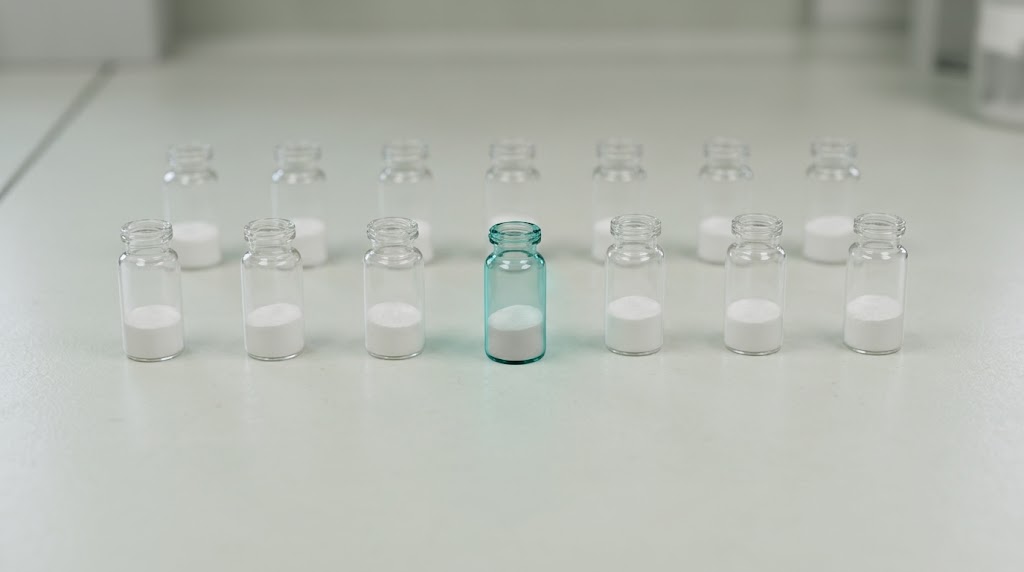
Australia's Therapeutic Goods Administration said on 14 September that it had tested a vial sold as retatrutide after a patient was admitted to hospital with a torn oesophagus from uncontrollable vomiting. The vial contained no retatrutide. It contained semaglutide at roughly eight times the level in approved products.1 The TGA's advice was that any retatrutide obtained outside a clinical trial could be counterfeit and should not be used.
The case follows a run of laboratory results from the same country. In August, a Melbourne laboratory released its 2026 record for retatrutide vials bought through social media and unlabelled listings: 18 tested, one matching its label, about a third stronger than stated, a third weaker, one with no retatrutide at all.2
Those figures describe one channel. The larger record points the other way. Finnrick, which buys from sellers anonymously and sends the vials to partner laboratories, had published 3,858 retatrutide tests from 293 sellers as of 20 September, more than for any other peptide. Of the 200 most recent, 142 passed its purity and fill standard and 54 failed. Sellers with long test records pass about nine times in ten.3
Read together, the two records say the same thing. Retatrutide from a seller with a published test history usually is what it says it is. An unlabelled vial bought through a social-media listing usually is not.
Retatrutide has no approved product anywhere and is made by one company, Eli Lilly, for trials. In June the FDA said selling it to consumers is illegal and it cannot be compounded; in August Lilly sued six US sellers and said it had reported more than 14,000 listings to platforms and payment companies.4 None of that has removed it from sale. Our 23 September price capture found 53 of 132 tracked sellers now listing GLP-1 drugs under codes rather than names, with retatrutide the compound most often coded.
What the case does not say. The TGA's advisory does not name the seller, say where the vial was bought, or say whether it carried a label. It describes the vial as the original product the patient used and says nothing about the channel. Readers have filled that gap online with guesses in both directions; the published record supports neither.
What it changes for a buyer. Three things, none of them new this week but all of them sharper. A seller's blind-test history is public and checkable before ordering. The concentration in a specific vial is not knowable without a test of that vial, whatever the seller's record. And an unmarked vial from a social-media listing is a different purchase from a labelled one from a tracked seller, which is where every published failure so far has come from.
The buying guide covers what the tests found, how careful buyers check a vial, and what online vials cost.
Related: Is it safe to buy retatrutide online? · GLP-3, GLP-3 RT and the other seller codes
Sources
- Therapeutic Goods Administration, TGA tests counterfeit retatrutide product following serious adverse event report, 14 September 2026. https://www.tga.gov.au/safety/safety-monitoring-and-information/safety-alerts/tga-tests-counterfeit-retatrutide-product-following-serious-adverse-event-report ↩
- ABC News (Australia), New testing of black market peptides reveals dangerous dosing levels, 28 August 2026. https://www.abc.net.au/news/2026-08-28/black-market-peptides-dangerous-doses/107059092 ↩
- Finnrick, Retatrutide safety testing results, dataset as of 20 September 2026. https://www.finnrick.com/products/retatrutide ↩
- Eli Lilly and Company, news release, 12 August 2026. https://investor.lilly.com/news-releases/news-release-details/lilly-calls-online-platforms-payment-companies-and-regulators ↩