
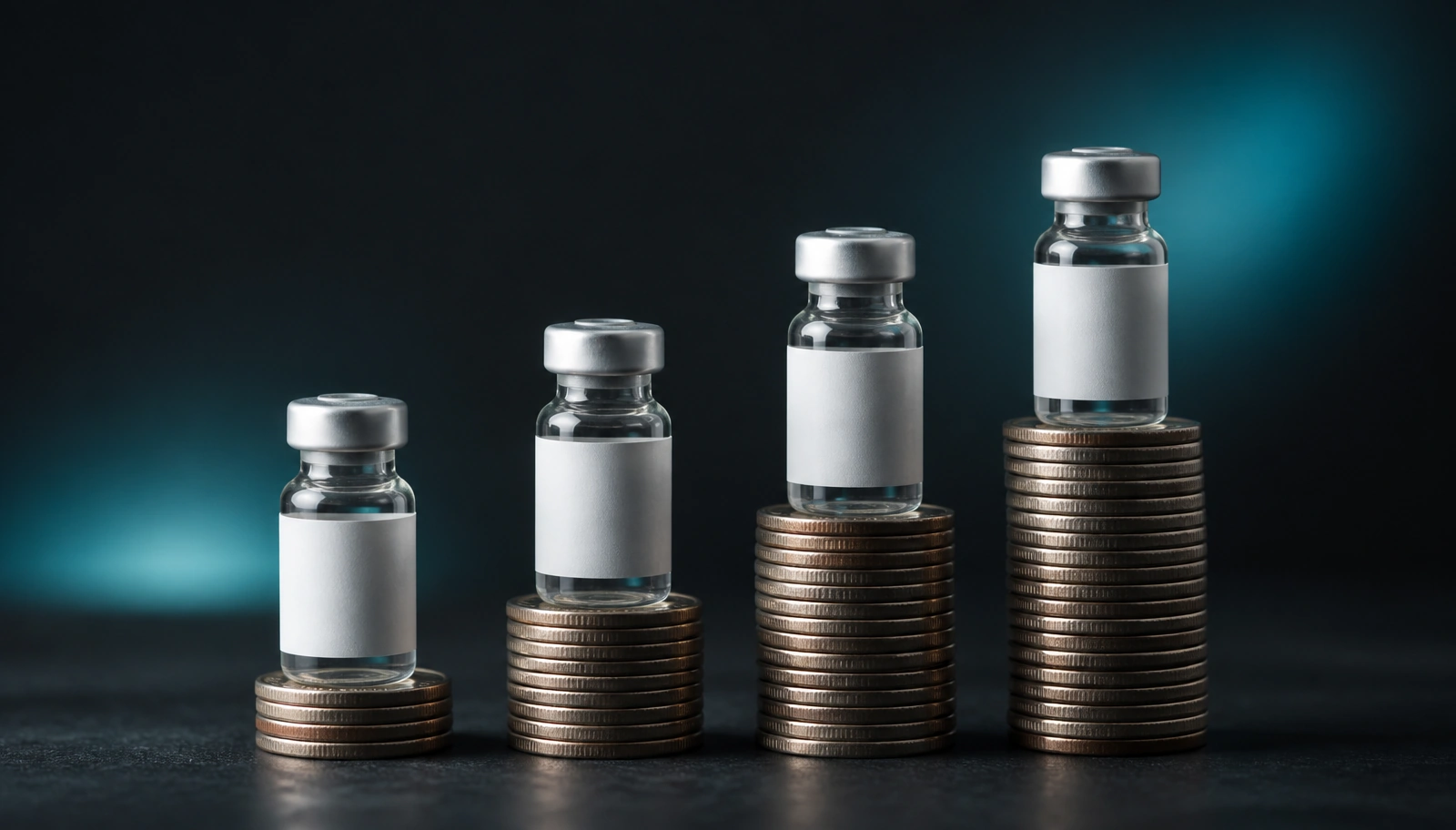
The same peptide can cost about $40 a month as a self-sourced vial, on published estimates, or $800 a month and more through an in-person clinic, on published clinic pricing.2 Neither figure comes from our own price capture. What changes across that range is almost never the peptide.
There are four ways to buy. An FDA-approved drug from the maker, a compounded version through telehealth, the same version through a clinic you visit, or a research-labelled vial bought online.
Each price covers different things. The cheapest covers the vial and nothing else, while the most expensive sometimes covers a legal status the seller has not actually got.
Almost every price you will find online was published by someone selling you something. These numbers were not, and they are dated below so you can check them.
The four routes, and what the money buys
| Route | Monthly, mid-2026 | What is included | Year one, roughly |
|---|---|---|---|
| Approved drug, direct from maker | $199 to $449 | A product tested and manufactured under FDA rules | Medication cost, plus a prescriber |
| Compounded, via telehealth | $150 to $549 | Prescriber, licensed pharmacy, some monitoring. Labs usually extra | $2,000 to $3,100 |
| Compounded, in-person clinic | $300 to $800+ | In-person assessment, bundled labs, continuing prescriber | $3,000 to $5,500 |
| Research-labelled vial | $40 to $150 | The vial | Medication cost, plus supplies |
Prices moved twice in the first half of 2026. Treat every figure as a dated snapshot and check at source.
An FDA-approved drug, bought from the manufacturer
This applies to a small list: semaglutide, tirzepatide, liraglutide, tesamorelin, bremelanotide, insulin and a few others. For the weight-loss drugs, direct manufacturer programs have moved sharply. As of mid-2026, cash prices through the manufacturers' own channels run roughly $299 to $449 a month for Zepbound and around $199 to $349 for Wegovy, with the oral version starting lower.1
The list prices of $1,000 and up still appear in headlines. Very few people pay them once a self-pay program or a savings card is in place.1
Only this route sells a product tested as a finished thing, made under FDA manufacturing rules, in a dose that matches its label because a regulator checked. Confirm current pricing at the source before you count on it, because these numbers changed twice in the first half of 2026.
A compounded preparation through telehealth
Telehealth programs bundle an intake, a prescription, the compounded medication and some monitoring into a monthly fee. Published figures cluster around $199 to $400 a month for peptide programs, and roughly $150 to $549 for compounded GLP-1 programs.2
Labs are usually excluded. Expect $150 to $500 for a baseline panel and $75 to $200 for follow-ups.2
The money buys a prescriber, a licensed pharmacy, and a preparation made under state pharmacy oversight. It does not buy FDA review of that formulation for potency or consistency. A regulated pharmacy and an approved product are two different things.
An in-person clinic
Higher, generally $300 to $800 a month and up, with initial consultations from $150 to $500.2 One cost guide puts the first-year total for a single compound, once consultation and labs are included, at $3,000 to $5,500.3
In-person assessment, bundled labs and a continuing relationship with the prescriber account for the difference. Whether those are worth two to four times the telehealth price depends entirely on how complicated your situation is.
A research-labelled vial bought online
The cheapest by a wide margin, and the reason the category exists. Published estimates put self-sourced monthly costs at $40 to $150 for common compounds.2
A vial is all that price covers. No prescriber, no prescription, no labs, no monitoring, no verified potency, and no recourse if the parcel never arrives. Our guide on what happens when a vendor vanishes covers the last one in detail, and the short version is that the payment method you use at checkout decides whether you have any process at all.
What the first year actually costs
Monthly medication price is the number every page advertises, and the year costs a good deal more than twelve of them.
Add a baseline panel, follow-up labs, consultation fees, and supplies. Syringes, alcohol swabs and bacteriostatic water run about $20 to $30 a month on their own.2 A program advertised at $200 a month, with a $300 intake and $400 of labs across the year, is closer to $3,100 than $2,400.
Insurance does not help. Compounded peptide preparations are not covered in the United States, because insurers treat unapproved preparations as elective.3 The narrow exception is an FDA-approved drug prescribed for its approved indication, which is a different situation from most of what this page covers. HSA and FSA funds are sometimes usable when a licensed provider has prescribed for a documented condition.3
The monthly price has no end date
Every cost page in this category quotes a monthly figure against an endpoint that does not exist.
For the GLP-1 drugs the trial evidence is explicit. In the STEP 1 extension, people who had lost 17.3% of their body weight on semaglutide regained 11.6 percentage points of it in the year after stopping, which is about two-thirds of the loss. The improvements in blood pressure, glycaemic control and lipids drifted back toward baseline along with it. The authors concluded that ongoing treatment is required to maintain the result.6 The tirzepatide withdrawal trial found the same pattern.6
So the honest arithmetic is not $349 a month for six months. It is $349 a month for as long as you want the effect, which is a different purchase and a different number. At mid-2026 cash pricing that is roughly $4,200 a year, indefinitely. Our guide on how long before you know if it is working covers what the trial data can and cannot tell you about that first stretch.
The same logic applies with less evidence behind it to almost everything else on this page. Nothing about a growth hormone secretagogue suggests an effect that outlasts the injections, and for most compounds sold in this market there is no trial to consult either way. A three-month protocol buys a three-month result unless something is published showing otherwise.
Compare annual cost against annual budget instead of comparing monthly prices to each other. And a program sold as a course, a cycle or a protocol with a defined end is making a claim about durability, which it should be asked to support.
The prepay discount and the expiry date
Clinics and vendors both offer three and six-month bundles at a discount, which can work out well for powder sitting sealed in a fridge.
The beyond-use date is what complicates it. A reconstituted vial has a life measured in weeks, and the 28-day figure people quote is really a limit on punctures and contamination, not a property of the molecule. Our guides on storage and on vial punctures cover where that number comes from.
Buying six months of a compound at a discount is fine if you are buying six sealed vials. It is a different transaction if the discount applies to a quantity larger than you can use before it turns, because then the discount is calculated on volume you will throw away. Work out how many vials you will actually finish, then apply the discount to that number and see whether it still beats buying as you go.
Blends cost more than the sum of their parts
A blend is a pricing decision as much as a formulation one, and the ratio inside the vial was picked by a manufacturer, not by you.
GLOW is roughly 50 mg of GHK-Cu in a 70 mg vial, with the remainder split between BPC-157 and TB-500. KLOW is the same idea in an 80 mg vial with KPV added. Someone buying either for tendon repair is paying for a vial that is mostly the copper peptide, and the per-milligram cost of the compound they came for is far higher than the sticker suggests.
Run the arithmetic on the component you actually want. Divide the vial price by the milligrams of that one compound, not by the label total, then compare it against buying that compound on its own. The blend sometimes still wins on convenience, and it rarely wins on price.
Why the published numbers disagree by four times
Look up the monthly cost of BPC-157 and you will find $80 to $150, $150 to $350, and $150 to $400, all published in 2026, all stated as though settled.23
Compounding pharmacies set their own rates with no reference price, so some of that variation is real. The rest is who is publishing. Every page carrying these figures is a clinic, a telehealth platform or an affiliate earning a commission on the click. A page that sells the mid-priced option has a reason to describe the cheap option as risky and the expensive one as excessive.
Until three independent figures agree, any price in this category is a quote from someone with a stake in it.
The premium some clinics are charging for a legal status that does not exist
The pricing question turns into a legal one here.
Several clinic pages published in 2026 state that BPC-157 and a group of similar compounds returned to compoundable status, and price their programs accordingly. They are describing a real sequence of events and drawing the wrong conclusion from it.
Three separate events have been compressed into one. Compounds were removed from a restricted category in April 2026, which lifted one restriction without authorising anything. An FDA advisory committee then voted in July 2026 to recommend six peptides for the 503A bulks list, against the written advice of the agency's own scientists.4 That vote was advisory. Formal addition requires FDA rulemaking, meaning a proposed rule, a public comment period and a final rule, and no timeline for that has been announced.4
Until it happens, those compounds are not lawfully compoundable. A clinic charging a supervised-care premium for a compound its pharmacy cannot lawfully compound is selling you a legitimacy it does not have. Our coverage of the July vote and our guide to peptide legality both go further into where the line actually sits.
Which compounds have a lawful route at all
Price comparison assumes a choice between routes. For most compounds sold in this market, there is no choice, because only one route exists.
A handful are FDA-approved drugs, available on prescription for their approved indications and, at a prescriber's judgment, off-label. Semaglutide, tirzepatide, tesamorelin and bremelanotide sit here.
Sermorelin sits in its own position. It was approved once as Geref and withdrawn for commercial reasons, and that prior approval gives compounding pharmacies stronger standing than for compounds never approved at all.5 It is also among the cheapest legal options, which is why it appears in almost every telehealth bundle.
Everything else, which is most of the compounds people are searching for, has no lawful prescription route today. A clinic can still quote you a monthly price for one of them, and you will be charged it.
What the cheap tier actually costs
The $40 vial is genuinely $40. What it leaves out is verification, monitoring and recourse.
Verification. Nobody checked the contents. Independent analyses of gray-market vials have found products under their stated strength and carrying impurities, and a certificate of analysis is only as good as the lot number on it. Our COA guide covers how far that document goes.
Monitoring. No baseline labs, no follow-up, and nobody watching for the effects that show up in bloodwork instead of in the mirror.
Recourse. If the vial is wrong, the order never ships, or the vendor disappears, you have whatever your payment method gives you and nothing else.
None of that makes the expensive route automatically correct. It makes the price difference explicable, which is different from making it justified.
The subscription is the product
Most telehealth peptide programs are auto-renewing subscriptions, and the monthly price is the enrollment price, not the exit price.
Three things to establish before the first payment, because all three are easier to check now than to argue about later. Whether there is a minimum commitment. How much notice cancellation requires, and whether it must go through a portal, an email or a phone call. And what happens to any medication already dispensed or already paid for.
One structural point worth understanding. Stopping the subscription and stopping the medication are usually the same event, since the prescription and the supply both run through the platform. That makes cancellation a clinical decision as well as a billing one, and it is the reason a program with a long notice period is more expensive than its monthly price implies.
How to compare two prices honestly
Monthly price does not compare across routes. Vial sizes, concentrations and dosing all differ, so the same monthly figure can buy very different amounts of drug. Cost per milligram survives those differences. What vials actually sell for is covered in our dated market guide. Our guide to working out cost per dose has the arithmetic, along with how to calculate a reorder date so the monthly figure means something.
Two adjustments matter when you run it. Count the waste, because a vial that expires before you finish it costs what you paid, not what you used. And count the whole year, since intake fees and baseline labs land once and distort any single month you look at.
Where these figures stop being useful
Current prices, beyond the moment it was written. This category moved twice in five months during 2026, and any figure here is a dated snapshot instead of a quote.
What a specific clinic will charge you, since almost none publish prices before an intake call.
Whether a given route is right for you. A person managing several medications and a person with a healthy baseline panel are buying different things at the same sticker price.
Common questions
Why is the same peptide $40 online and $300 at a clinic?
The clinic price includes a prescriber, a licensed compounding pharmacy, and some monitoring. The online price includes a vial. Whether the difference is worth $260 a month depends on whether you would use the parts you are paying for.
Does insurance cover peptide therapy?
Not for compounded preparations, which insurers treat as elective.3 An FDA-approved drug prescribed for its approved indication is a different case and is often covered, subject to prior authorisation.
Are compounded GLP-1s cheaper than the brand now?
Less reliably than they were. Manufacturer cash programs moved to roughly $199 to $449 a month during 2026, which narrowed a gap that used to be large.1 Check current numbers before assuming.
What is the cheapest legal peptide?
Sermorelin is generally the cheapest compound with a genuine prescription route, partly because of its prior approval status.5 Cheapest and most appropriate are separate questions.
Do I have to stay on it forever?
For the GLP-1 weight-loss drugs the trial evidence points that way, since two-thirds of the lost weight came back within a year of stopping in the STEP 1 extension.6 For most other compounds no withdrawal data exists at all, which is a different answer from a reassuring one.
Is a six-month prepay deal worth it?
Only for sealed vials you will actually get through. A reconstituted vial has a beyond-use date measured in weeks, so a discount on more than you can finish is a discount on waste.
Is a more expensive vial a better vial?
Price and purity are independent. A high price tells you about the seller's positioning, not about what is in the vial, and the only thing that speaks to contents is testing.
The clinic says it is FDA-registered. Does that mean the peptide is approved?
No. Facility registration is not product approval, and a compounding pharmacy being licensed says nothing about whether a particular compound may lawfully be compounded there.
How much should I budget for the first year?
Sources
- Manufacturer direct-pay pricing for GLP-1 drugs, mid-2026. Trade and major press, read via search results. CNBC reported that from 1 December 2025 cash-paying patients could obtain Zepbound vials through LillyDirect at $299 to $449 a month depending on dose, reduced from $349 to $499. Novo Nordisk reduced Wegovy and Ozempic cash pricing from $499 to $349 for existing self-pay patients, with lower introductory pricing for starting doses and separate pricing for the oral version approved in January 2026. Independent price trackers published in July 2026 place the practical cash range at roughly $299 to $449 for Zepbound and $199 to $349 for Wegovy and Ozempic, against list prices of roughly $1,000 to $1,640. Individual manufacturer program pages were not fetched at source, and every tracker consulted warns that these figures changed repeatedly during the first half of 2026. Verify at lilly.com and novocare.com before publication and add both links.
- Published cost ranges for telehealth peptide programs, in-person clinics, self-sourced vials, laboratory panels and injection supplies, 2026. Commercial sources, read via search results, and all of them have a financial interest in the numbers they publish. Telehealth peptide programs are variously given as $199 to $400 and $200 to $500 a month; compounded GLP-1 programs $150 to $549; in-person clinics $300 to $800 and above; initial consultations $50 to $500; baseline laboratory panels $150 to $500 with follow-ups $75 to $200; injection supplies $20 to $30 a month; self-sourced research-grade compounds $40 to $150 a month. The figures for BPC-157 specifically range from $80 to $150 up to $150 to $400 across three sources published within four months of each other. The guide reports the spread instead of picking a number, because no independent reference price exists.
- Clinic and comparison-site cost guides published in 2026 covering first-year totals, insurance coverage and HSA eligibility. Commercial sources, read via search results. First-year totals for sermorelin including consultation and labs given as $3,000 to $5,500; first-year totals for a typical protocol elsewhere given as $2,000 to $2,800. Compounded peptide therapy is consistently described across these sources as not covered by United States health insurance, with HSA and FSA funds sometimes usable where a licensed provider has prescribed for a documented condition. Several of these same pages assert that BPC-157 and similar compounds have returned to compoundable status, which is the error the guide addresses directly.
- Legal and trade coverage of the FDA Pharmacy Compounding Advisory Committee meeting, 23 and 24 July 2026. Law firm alerts and trade press, read via search results, corroborated across four independent sources including Polsinelli, Mintz, Health Affairs Forefront and AJMC. The committee voted narrowly to recommend six of seven peptides, being BPC-157, KPV, TB-500, MOTS-c, semax and epitalon, for addition to the 503A bulks list, and declined to recommend emideltide. The vote is advisory and does not change legal status. Formal revision of the 503A bulks list requires FDA rulemaking, with no announced timeline. FDA staff had recommended against all seven in writing. Our own news coverage of this meeting carries the fuller account.
- Sermorelin regulatory standing. Commercial and reference sources, read via search results, corroborated across three that agree on the substance. Sermorelin was FDA-approved as Geref and later withdrawn from the market by its manufacturer for commercial reasons rather than safety, and that prior approval is generally described as giving compounding pharmacies stronger standing than for compounds never approved. The site's own legality guide states that sermorelin remained in Category 1 when nineteen other compounds moved to Category 2, which is the more precise formulation and should be used in preference to anything in these sources.
- Wilding JPH, Batterham RL, Davies M, et al. Weight regain and cardiometabolic effects after withdrawal of semaglutide: The STEP 1 trial extension. Diabetes, Obesity and Metabolism 2022;24(8):1553-1564. Peer-reviewed trial extension, abstract read at source. Extension analyses included 327 participants. Mean weight loss from week 0 to week 68 was 17.3% with semaglutide against 2.0% with placebo. Following withdrawal, the semaglutide arm regained 11.6 percentage points of lost weight by week 120, giving a net loss of 5.6% from baseline. Cardiometabolic improvements seen at week 68 reverted toward baseline for most variables. The authors conclude that ongoing treatment is required to maintain improvements in weight and health. The comparable tirzepatide finding comes from SURMOUNT-4 (Aronne LJ, Sattar N, Horn DB, et al., JAMA 2024), where participants switched to placebo after a 36-week run-in regained 14% of body weight while those continuing tirzepatide lost a further 5.5%; that citation was captured from two independent secondary sources and its abstract was not read at source.