
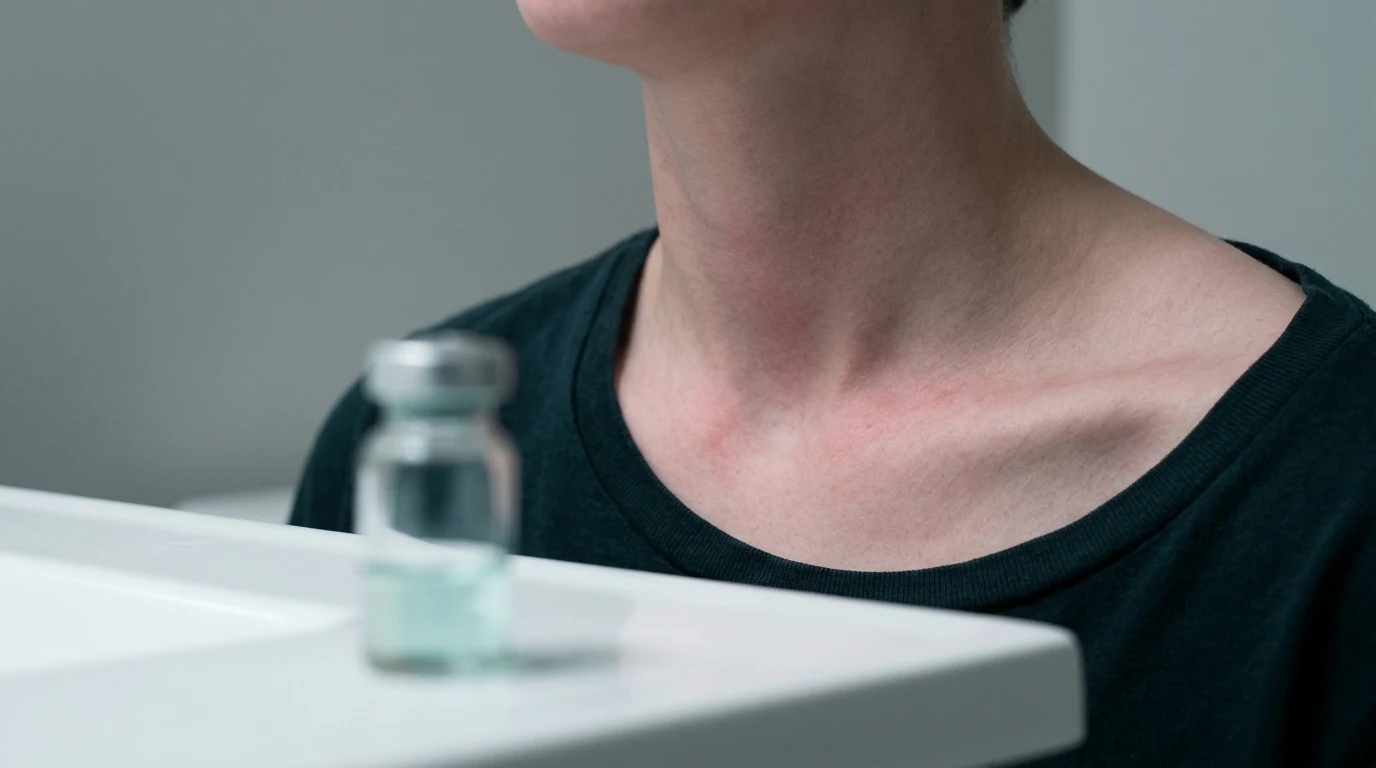
A hot, red face or a head rush a minute after a shot is on record for several peptides.12 In two 2006 trials of CJC-1295, about 30% of people on the drug had flushing, warmth or a brief drop in blood pressure.1 On the label for PT-141, 20.3% of women flushed. On placebo, 0.3% did.2 The sermorelin label lists it too.3
A flush on its own is usually not an allergy.4 It turns into an emergency when it comes with trouble breathing, a swollen face or throat, hives that spread, fainting, or bad cramps and vomiting.4 Doctors treat that mix as anaphylaxis, and it can start within minutes.4
Is flushing after a peptide injection an allergic reaction?
Flushing alone is not enough to count as an allergic emergency under the World Allergy Organization's criteria.4 The organization lists flushing as one of the skin signs of anaphylaxis, along with generalized hives, itching and swollen lips, tongue or uvula.4 Its criteria call anaphylaxis highly likely when those skin signs arrive suddenly "and at least one of the following" joins them: breathing trouble, low blood pressure or fainting, or severe stomach symptoms.4 A flush with none of those does not meet the criteria.4
The labels file the same symptom in different places. Tesamorelin's label puts flushing inside its hypersensitivity warning, next to itching, redness, hives and rash, and reports hypersensitivity reactions in 4% of trial patients.5 It tells patients with a suspected reaction to stop the drug and get prompt medical attention.5 The PT-141 label treats flushing as an ordinary side effect and says none of the flushing events were serious.2 The sermorelin label sits in between. It says "no generalized allergic reactions" had been reported, and it still warns that "local or systemic allergic reactions may occur."3
A third route has nothing to do with allergy. Some peptides push mast cells in the skin to release histamine directly, as our guide to itchy injection sites explains.6 That tends to raise an itchy welt at the site with a flush around it. It stays local.6
The three differ in where they show, what comes with them and how fast they arrive.
| Flushing on its own | Histamine welt | Anaphylaxis | |
|---|---|---|---|
| Where it shows | The face, in the sermorelin and GHRH records37 | At the injection site6 | Skin anywhere, plus another body system4 |
| What comes with it | Warmth, sometimes brief dizziness1 | Itching6 | Breathing trouble, low blood pressure or fainting, or severe stomach symptoms4 |
| How fast | "Soon after" the dose7 | Minutes to hours6 | Minutes to several hours4 |
| What happens next | PT-141 label: none serious. Tesamorelin label: stop and get seen25 | Usually fades within hours to a day6 | Epinephrine is the first-line treatment4 |
Which signs after an injection need emergency care?
Emergency care is needed when a flush or head rush comes with any of these signs, according to the World Allergy Organization's criteria.4 They can begin within minutes or as late as several hours after exposure.4
- Trouble breathing, wheezing, or a high-pitched sound on breathing in4
- Swelling of the lips, tongue or throat4
- Hives or itching spreading across the body4
- Fainting or collapse4
- Severe cramping stomach pain or repeated vomiting4
In the US, that means calling 911. Slower trouble at the site itself, such as spreading redness and heat over the following days, has its own warning signs in our guide to when an injection site reaction means stop.
Low blood pressure or breathing trouble counts on its own, even with no skin signs, after exposure to a known or likely allergen.4 For adults, low blood pressure in these criteria means a systolic reading under 90 mmHg or a fall of more than 30% from the person's usual reading.4 The organization's first-line treatment is epinephrine injected into the outer thigh muscle.4 The sermorelin and tesamorelin labels both tell patients to get prompt medical attention for a suspected allergic reaction.35
Which peptides have flushing on record?
Six compounds have flushing, or something close to it, written into a label or a trial report. Natural GHRH is on the list because sermorelin is a shortened copy of it.3
| Compound | Where it is recorded | What the record says |
|---|---|---|
| CJC-1295 | Two trials published in 2006 | Flushing, warmth or a brief blood pressure drop in about 30%, with flushing rising from 40% in the lowest dose group to 100% in the highest1 |
| Sermorelin | FDA label, revised 2001 | Flushing in under 1% with injections under the skin, and "flushing of the face" listed for diagnostic IV use3 |
| Natural GHRH, the hormone sermorelin is taken from | 1996 study in 8 healthy men | "Transient facial flushing soon after" an IV dose7 |
| Tesamorelin | FDA label, revised 2025 | Flushing listed as a sign of hypersensitivity, seen in 4%5 |
| PT-141 (bremelanotide) | FDA label | Flushing in 20.3%, and in 0.3% on placebo2 |
| Macimorelin | FDA label, revised 2026 | "Feeling hot" in 2 of 154 people (1.3%), taken by mouth8 |
Five of the six act on the growth hormone system, the family our growth hormone peptides guide sorts out. CJC-1295, sermorelin and tesamorelin all copy natural GHRH, the hormone that tells the pituitary to release growth hormone. Macimorelin works through the ghrelin receptor instead. PT-141 is the only one outside the family.
Why does CJC-1295 cause so much flushing?
CJC-1295 has the highest flushing rate of any compound in this guide. Its trials do not say why. Both 2006 trials tested CJC-1295 with DAC, the long-acting version, and our comparison of the two versions lists their full set of side effects.1 The version sold without DAC, also called Modified GRF 1-29, has no published human trial of its own, so its flushing rate is unknown.1
In the DAC trials, flushing, warmth or a brief drop in blood pressure affected about 30% of people on the drug.1 Flushing climbed with the dose, from 40% of the lowest dose group to 100% of the highest.1 Two people had brief dizziness and low blood pressure after their first injection at 30 micrograms per kilogram.1
How long does flushing last after a peptide injection?
How long a peptide flush lasts is mostly not written down. None of the four labels in the table gives a duration for flushing.2358 The closest figures come from other measurements:
- The 1996 GHRH study called the flushing "transient" and said it came "soon after" the injection. The same sentence ends with "which subsided within 3-5 min," and that phrase may cover the flushing or only another complaint in the sentence.7
- Sermorelin peaks in the blood 5 to 20 minutes after an injection under the skin and has a half-life of 11 to 12 minutes.3 By our arithmetic, about 3% of the peak level remains an hour later.
- In the CJC-1295 trials, the blood pressure drops were described as brief.1
- With NAD+ infusions, the side effects stopped when the infusion finished.9
PT-141 is the one label that times a related effect. Its small rise in blood pressure peaks 2 to 4 hours after a dose and usually settles within 12 hours.2
Does sermorelin cause more flushing by IV than under the skin?
Sermorelin seems to cause more flushing by IV than under the skin. Its label lists "flushing of the face" among reactions seen when the drug was given by IV for diagnosis, while flushing came in under 1% when it was injected under the skin for treatment.3 An IV dose reaches the blood all at once. Under the skin, sermorelin takes 5 to 20 minutes to peak, and only about 6% of the dose reaches the bloodstream compared with IV.3 The 1996 GHRH study that recorded facial flushing gave its doses as an IV bolus over 30 seconds.7
No study here tested one dose both ways, so the link to speed is a pattern across separate studies. NAD+ fits it too. In the 2026 clinic review, side effects led people on NAD+ to slow their infusions, and the effects ended when the infusion did.9
Why would a head rush happen right after an injection?
A head rush right after an injection has two documented explanations. Neither is an allergy. The first is the drug lowering blood pressure. In the 2006 CJC-1295 trials, flushing and warmth were grouped with brief drops in blood pressure, and two people had dizziness with low blood pressure after a first injection.1
The second is the shot itself. The CDC says fainting after a vaccination seems to come from the process of getting the injection and not from the vaccine.10 It advises having people sit or lie down for the shot and watching them for 15 minutes afterward.10 That finding comes from vaccine research.
Low blood pressure and fainting are also anaphylaxis signs.4 A head rush that arrives with a spreading rash, swelling or trouble breathing is the emergency pattern.
How common is flushing on PT-141?
Flushing on PT-141 is common. Vyleesi is the approved brand of bremelanotide, the same molecule sold online as PT-141. In the trials behind the Vyleesi label, 20.3% of women flushed after a dose, compared with 0.3% on placebo.2 None of those flushing events was serious. Fewer than 1% were severe.2
Nausea was twice as common, at 40.0%. Headache came in at 11.3%.2 PT-141 also pushes blood pressure up, by up to 6 mmHg systolic and 3 mmHg diastolic, while the heart rate falls by up to 5 beats a minute.2 The label rules it out for people with uncontrolled high blood pressure or known heart disease.2
Which flushing claims have no record behind them?
Several common beliefs about peptide flushing have no label or trial behind them. Each one is a gap in the record.
- None of the labels or trials cited here gives a flushing rate for ipamorelin, GHRP-2, GHRP-6 or hexarelin. A 1994 hexarelin dose study in 12 men said only that the drug "was well tolerated in all subjects."11
- Nothing in these sources ties a flush to a stronger effect or a better result.
- No record links a flush to a contaminated or mislabeled vial, in either direction.
- No label gives a duration for flushing.
- Both clinical reports on NAD+ side effects used IV infusions, so NAD+ under the skin is undocumented.912
Does NAD+ cause flushing?
Flushing from NAD+ is not documented in the two clinical reports on NAD+ infusions. NAD+ has no FDA label to give an official rate, and neither report tested NAD+ injected under the skin.
A 2024 randomized pilot found that NAD+ given by IV caused more and worse side effects during the infusion than an IV form of nicotinamide riboside.12 Its abstract does not name them, and the study has not been peer reviewed.12
In a 2026 review of records at one clinic, all six people given NAD+ by IV reported "moderate to severe abdominal cramping, diarrhea, nausea, vomiting," along with a faster heart rate and chest pressure during the infusion.9 Flushing is not among the effects it recorded. All of them "ceased immediately upon infusion completion."9
Common questions
Is it normal to flush after a CJC-1295 injection?
Flushing after a CJC-1295 injection is common in its trials. In the 2006 trials, flushing, warmth or a brief drop in blood pressure affected about 30% of people on the drug, and the rate rose with the dose.1
Is facial flushing after sermorelin normal?
Facial flushing after sermorelin is listed on its FDA label, at under 1% with injections under the skin. The label also lists "flushing of the face" when sermorelin is given by IV for diagnosis.3
Is flushing after an injection an allergic reaction?
Flushing alone does not meet the World Allergy Organization's criteria for anaphylaxis. Those criteria need skin signs plus breathing trouble, low blood pressure or fainting, or severe stomach symptoms.4
When is flushing after an injection an emergency?
Flushing after an injection is an emergency, by the World Allergy Organization's criteria, when it comes with trouble breathing, swelling of the lips, tongue or throat, hives spreading across the body, fainting, or severe cramping and vomiting.4 The organization's first-line treatment is epinephrine into the thigh muscle.4
How long does peptide flushing last?
Peptide flushing has no duration on the Vyleesi, Egrifta WR, sermorelin or Macrilen labels. A 1996 GHRH study called it "transient" and "soon after" the injection, and sermorelin's half-life is 11 to 12 minutes.73
Why do I get a head rush after injecting?
A head rush after injecting has two documented causes in the CJC-1295 trials and CDC guidance. The trials recorded brief drops in blood pressure, and the CDC links fainting after shots to the injection process itself.110
Does PT-141 cause flushing?
PT-141 causes flushing in about one in five women, according to the Vyleesi label: 20.3%, against 0.3% on placebo.2 None of those events was serious.2 Our guide to what PT-141 does for desire covers what the drug is for.
Does NAD+ cause flushing?
NAD+ flushing is not recorded in the 2024 and 2026 clinical reports on NAD+ infusions. A 2026 clinic review recorded cramping, nausea, vomiting and chest pressure during IV infusions instead.9
Does tesamorelin cause flushing?
Tesamorelin's label, for the brand Egrifta WR, lists flushing as a sign of a hypersensitivity reaction. Those reactions occurred in 4% of trial patients.5 The label tells patients with a suspected reaction to stop the drug and get prompt medical attention.5
Does ipamorelin cause flushing?
Ipamorelin has no published flushing rate in the sources cited here, unlike CJC-1295 and sermorelin. It also has no FDA label.
Can flushing happen hours after an injection?
Allergic reactions can begin anywhere from minutes to several hours after exposure, according to the World Allergy Organization.4 The flushing in the 1996 GHRH study came "soon after" the injection.7
Is flushing a sign the peptide is working?
No label or trial in this guide, including the 2006 CJC-1295 trials, links flushing to a stronger effect. Flushing rose with the dose in the CJC-1295 trials, but no source here compares flushing with results.1
Does a higher dose cause more flushing?
A higher dose brought more flushing in the 2006 CJC-1295 trials, where it rose from 40% in the lowest dose group to 100% in the highest.1 The other labels in this guide do not break flushing down by dose.
Can a peptide injection cause hives?
Hives after a peptide injection appear on the sermorelin and tesamorelin labels and in the CJC-1295 trials. Sermorelin's label lists hives at under 1%, tesamorelin's lists them among hypersensitivity signs, and a temporary hive-like rash at the injection site affected nearly 30% in the CJC-1295 trials.351
Is macimorelin's "feeling hot" the same as flushing?
Sources
- Peptide Decoding. CJC-1295 with DAC vs without DAC. peptidedecoding.com.Read at source on our own page. That page reports the adverse events from Teichman SL et al., Prolonged stimulation of growth hormone (GH) and insulin-like growth factor I secretion by CJC-1295, a long-acting analog of GH-releasing hormone, in healthy adults, Journal of Clinical Endocrinology and Metabolism 2006;91(3):799-805, DOI 10.1210/jc.2005-1536. The paper's full text could not be opened for this guide, and its abstract reports only that no serious adverse reactions occurred. ↩ ↩ ↩ ↩ ↩ ↩ ↩ ↩ ↩ ↩ ↩ ↩ ↩ ↩ ↩ ↩
- VYLEESI (bremelanotide injection) prescribing information. FDALabel, version effective January 10, 2025. nctr-crs.fda.gov.
- Sermorelin acetate prescribing information. FDA revision October 2, 2001. rxlist.com.Read via a reproduction: RxList's copy of the label. It carries the FDA revision date but no manufacturer name. Source of the adverse reaction lists, the allergy statements and the pharmacokinetics. RxList's copy gives the dose in two different units in two places; this guide uses no dose figure from it. ↩ ↩ ↩ ↩ ↩ ↩ ↩ ↩ ↩ ↩ ↩ ↩ ↩
- World Allergy Organization. Anaphylaxis: Diagnosis and Treatment. Poster, 2021, summarizing Cardona V, Ansotegui IJ, Ebisawa M, et al., World Allergy Organization Anaphylaxis Guidance 2020, World Allergy Organization Journal 2020;13(10):100472. worldallergy.org.
- Reichardt B, Schrader M, Mojto J, Mehltretter G, Müller OA, Schopohl J. The decrease in growth hormone (GH) response after repeated stimulation with GH-releasing hormone is partly caused by an elevation of somatostatin tonus. Journal of Clinical Endocrinology and Metabolism. 1996;81(5):1994-1998. epub.ub.uni-muenchen.de.
- Reyna K, Heinzen G, Patel N, Ritter M, Siojo A, Legere H, Pojednic R. Intravenous infusion of nicotinamide adenine dinucleotide (NAD+) versus nicotinamide riboside (NR): a retrospective tolerability pilot study in a real-world setting. Frontiers in Aging. 2026;7. DOI: 10.3389/fragi.2026.1652582. frontiersin.org.
- Imbimbo BP, Mant T, Edwards M, et al. Growth hormone-releasing activity of hexarelin in humans: a dose-response study. European Journal of Clinical Pharmacology. 1994;46:421-425. link.springer.com.Read at source: the abstract on the publisher's page. Twelve healthy men. ↩
- Hawkins J, Idoine R, Kwon J, et al. Randomized, placebo-controlled, pilot clinical study evaluating acute Niagen+ IV and NAD+ IV in healthy adults. medRxiv, posted June 10, 2024. DOI: 10.1101/2024.06.06.24308565. medrxiv.org.
Citing this page. Peptide Decoding. Is Flushing After a Peptide Injection Normal? Which Peptides Do It. Figures from the Vyleesi, Egrifta WR, sermorelin and Macrilen labels, the 2006 CJC-1295 trials and the World Allergy Organization's anaphylaxis criteria. Reviewed November 27, 2026. https://peptidedecoding.com/guides/flushing-after-peptide-injection