
Gonadorelin (GnRH)_Dosage, benefits & legal status
Also known as GnRH, LHRH, Factrel, Gonadorelin
A shot that keeps your own testosterone and fertility hormones going.
Common vial size is what vendors typically sell, not a recommendation. Enter your own vial in the calculator.
What is Gonadorelin (GnRH)?
Plain language first. The technical label stays, but it never stands alone.Overview
It prompts your own hormone production, often used alongside testosterone therapy to keep the testicles active. Because it clears fast, it needs frequent dosing.
Gonadorelin is synthetic GnRH, the hormone your brain uses to tell the pituitary to make testosterone and fertility hormones.
What it's used for
A shot that tells the body to make its own testosterone and fertility hormones, often used alongside testosterone therapy to keep the testicles working.
How does Gonadorelin (GnRH) work?
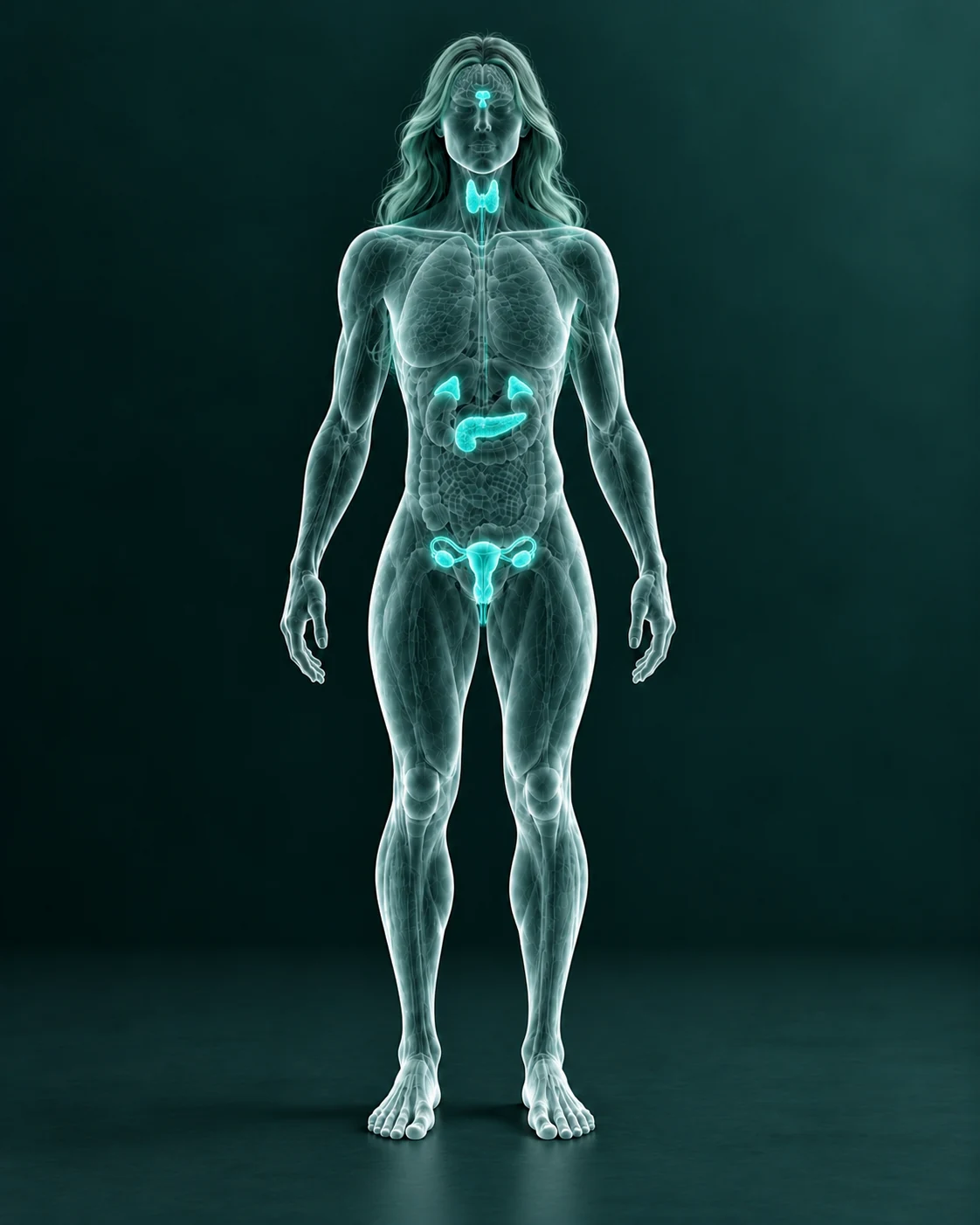
What it does in the body, and where.Gonadorelin is GnRH itself, identical to what your brain releases. How you give it determines whether it switches the system on or shuts it off.
- 01It prompts the pituitary to release LH and FSHWhich in turn drive testosterone and sperm, or the ovarian cycle.
- 02Pulsed dosing stimulates, continuous dosing suppressesThe pituitary desensitises to a constant signal. This is not a side effect but the basis of an entire drug class used to shut hormone production down deliberately.
- 03Timing therefore matters more than doseWhich is why it is given as frequent small injections rather than a steady level.
- 04It clears in minutesA very short half-life, which is what makes pulsed dosing practical.
What else is it used for?
Each use below carries its own evidence level. Approved means regulators have cleared it for that purpose. Investigational means it is in trials. Early research means it is being studied and is not established.
- Testing whether the pituitary gland is working, which was its approved diagnostic useClinical use
- Keeping the testicles working during testosterone therapy, which is the main reason it is used nowClinical use
The published record
Papers and trials about Gonadorelin (GnRH)
Searched: Gonadorelin, Factrel.
Left out: GnRH (too short to disambiguate without context); LHRH (too short to disambiguate without context).
220 papers tagged human · 89 not reviews or lab · 28 clinical trial publications
1,164 registered trials · 24 with posted results
Furthest stage reached: Approved in the US, no longer sold, Factrel, discontinued
Compare this against the whole library →
Category 1, component of an FDA-approved drugRegulatorsCounted from Europe PMC indexing, not read by a person; a human tag can land on reviews, commentary or lab papers; clinical trial publications is the narrower count. 349 papers and 100 trials indexed in detail.
At a glance
Four things to know about Gonadorelin (GnRH)
Evidence
Clinical use
Category
Sexual and hormonal
Common vial
2 mg
Half-life
2 to 10 minutes
How much, and do you cycle it?
The range, and whether you take breaks.0.1 up to 0.2 mg per dose (start low, increase slowly), 2-3x per week or more. Pulsed, not continuous. How often you give it decides whether it switches the system on or off Human study
This is the clearest cycling story in the whole set. Given in pulses roughly every one to two hours it stimulates the axis; given continuously it shuts the axis down. That is not a side effect, it is the mechanism, and it is what drugs like leuprolide exploit to suppress testosterone deliberately. Continuous dosing does the opposite of what most people taking it want.
Source: Belchetz et al., pulsatile vs continuous GnRH (Science 1978)
How long does it stay in the body?
The half-life, and where the figure comes from.2 to 10 minutesHuman study
Sources disagree. Human pharmacokinetic work behind the Factrel application gives 2 to 10 minutes, while other references give 10 to 40 minutes. The short half-life is the whole point of the molecule: pulsed dosing stimulates the pituitary and continuous dosing shuts it down.
Not yet traced to a primary source.
You can compare this against the whole library to see where it sits.
How do I dose and price it?
Enter your vial and your dose. Pick a mix. We show the draw and the cost.The vial holds a fixed amount of drug. Adding more water does not make more drug, it just spreads it thinner, so you draw a bigger number on the syringe for the same dose.
Choose your mix
Measuring the water1 mL = one full 100-unit syringe.
Gonadorelin (GnRH) starts at $17.00 across 23 vendors, typically $6.55 – $20.00 per mg.
27 listings, last read Oct 24, 2026. Shipping and card fees are not included.
How do you store it?
Before mixing, and after.Dry powder in the freezer or fridge. Once mixed, fridge, and use within about a month.
Unmixed lyophilized Gonadorelin (GnRH) keeps for a long time cold. Once you add water the clock starts: most reconstituted vials hold up for roughly 28 to 30 days at fridge temperature. Keep it out of light, and do not freeze it after mixing.
What are the side effects and cautions?
Known cautions and warnings for this compound.Solubility, computed: 30% charged residues, 30% hydrophobic. Water usually sufficient.
A first-pass rule from peptide manufacturers' guidance. It does not account for disulfide bridges, salt form or how the powder was dried, and it predicts what should be easy rather than what will happen in your vial.
Who should avoid it
- Known allergy to gonadorelin
- Any condition where raising sex hormones would be unwise
- Pregnancy or breastfeeding
Stop and get help
- Swelling, trouble breathing, or hives, since repeated use has caused severe allergic reactions
Common effects
- Headache and light-headedness
- Nausea
- Injection-site reactions
- Generally mild after a single dose
Where this page says nothing is established, that means nobody has studied it, not that a compound is safe.
Is Gonadorelin (GnRH) approved?
And where the numbers on this page come from.Not approved, but legal to obtain. Gonadorelin (GnRH) has no FDA approval, and it can be prescribed or prepared by a compounding pharmacy in the United States.
- Approval statusClinical use
- RouteUnder the skin (subcutaneous)
- Checked22 July 2026
- DoseFrom product labeling and clinical guidelines.
- Vial sizeFrom what vendors typically list; not a recommendation.
- SourcesNone traced yet.
What has happened recently
We have not yet written a full regulatory note for this compound. The status above is current as of the date shown.
What regulators say
From official documentsProhibited at all times, in and out of competition. S2.2.1 Testosterone-stimulating peptides in males: gonadotrophin-releasing hormone (GnRH, gonadorelin). Non-Specified.
Checked 12 September 2026WADA: The 2026 Prohibited List (in force 1 January 2026)Category 1, component of an FDA-approved drug
Listed as Gonadorelin Acetate
Checked 11 September 2026FDA: Bulk Drug Substances Nominated for Use in Compounding Under Section 503B (interim categories 1, 2, 3), updated March 21, 2025
Enforcement naming this compound
Vendor product named as an unapproved new drug (Wholesale Peptide, June 2026)
Research-use-only labelling did not change the finding This is a finding about one seller's vial, not about the compound or any approved product containing it.
Read the letter
You can compare this against the whole library, or read how to check a seller.
What else is like Gonadorelin (GnRH)?
Others in Sexual and hormonal, side by side.If you're weighing Gonadorelin (GnRH), it's worth reading Enclomiphene, HMG (Menotropin), and Triptorelin in the same class.
A shot that keeps your own testosterone and fertility hormones going.
- Dose
- 0.1 up to 0.2 mg per dose (start low, increase slowly)
- How often
- 2-3x per week or more
Half of the fertility drug Clomid, sold on its own for testosterone.
- Dose
- 12.5 up to 25 mg per day
- How often
- Daily
A fertility hormone shot that drives sperm or egg production.
- Dose
- 75 up to 150 IU per dose (start low, increase slowly)
- How often
- Several per week
An FDA-approved hormone drug for prostate cancer, sold by research vendors for something else entirely.
- Dose
- Set by an FDA label
- How often
- Monthly to six-monthly depot
Guides for this compound
- How to Reconstitute a Peptide
Mix peptide powder with bacteriostatic water, step by step.
- How to Read an Insulin Syringe
Read the units, convert to millilitres, and draw the exact dose.
- mcg vs mg: The Peptide Dosing Mistake to Avoid
Your vial says mg and your protocol says mcg. Here is the conversion and how to check it.
Sources
No primary source has been traced for this compound yet. Treat everything on this page as unverified until one is. How we grade evidence
Beyond these, 449 records are indexed. Browse the records