
Amylin (amlintide)_Dosage, benefits & legal status
Also known as amlintide, IAPP, islet amyloid polypeptide, human amylin, AC-001
The beta-cell hormone that pramlintide, cagrilintide and every other amylin drug was built to copy. It cannot be a drug itself: residues 25 to 29 turn it into islet amyloid, and raising it about 100-fold in people did nothing measurable.
Common vial size is what vendors typically sell, not a recommendation. Enter your own vial in the calculator.
What is Amylin (amlintide)?
Plain language first. The technical label stays, but it never stands alone.Overview
Amylin is the hormone that pramlintide, cagrilintide, petrelintide, eloralintide, AZD6234, PF-08653945, ASC36, amycretin and CagriSema were all built to copy, so it explains what that whole class of weight and diabetes drugs is aiming at. It is not a drug itself, and the clearest reason is a negative result: in 7 people, a 6-hour infusion that raised blood levels to about 100 times fasting changed neither glucose nor insulin, and the glucose infusion rate was 13% lower but not significantly so (p=0.17). Its own sequence is the other reason, because residues 25 to 29 make it clump into the amyloid found in the pancreas in type 2 diabetes, and pramlintide swaps three of them for proline to stop that. Nobody takes it as a treatment: it is sold only by laboratory reagent catalogs, at roughly $795 per milligram.
Amylin, or islet amyloid polypeptide, is a 37-residue beta-cell hormone from the IAPP gene, with a disulfide between cysteines 2 and 7 and an amidated C-terminal tyrosine; the synthetic peptide carries the INN amlintide. It signals through the calcitonin receptor paired with a receptor activity-modifying protein, giving the AMY1, AMY2 and AMY3 complexes, and acts mainly at the area postrema to slow gastric emptying, hold back postprandial glucagon and shorten meals. Residues 25 to 29 also make it the amyloid deposited in islets in type 2 diabetes, the reason every amylin drug, starting with pramlintide, is a redesigned sequence rather than the hormone itself.
What it's used for
Nothing. It has never been approved or developed as a treatment, and the only two published human studies, from 1994 and 1998, measured its kinetics and its effect on glucose handling. Laboratory reagent catalogs sell it for research at roughly $795 a milligram, while the research-peptide sellers that stock cagrilintide at 5 and 10 mg a vial do not carry it.
How does Amylin (amlintide) work?
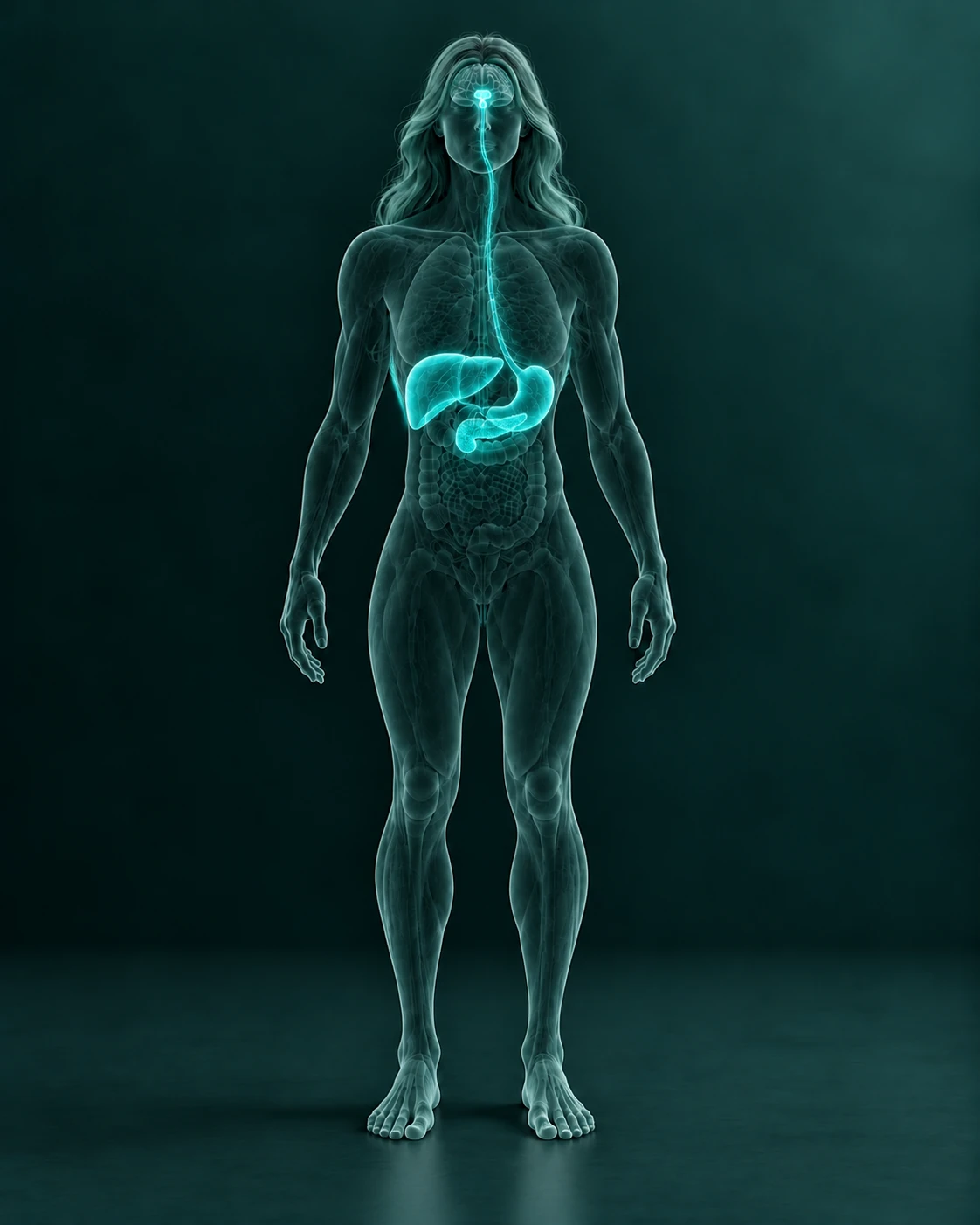
What it does in the body, and where.Amylin is the second hormone a beta cell releases when a meal arrives, and it works through a calcitonin receptor fitted with a helper protein.
- 01Released with insulinBeta cells store amylin in the same granules as insulin and release the two together after food. In cultured newborn rat pancreas the amount secreted was 0.76 to 0.95% of insulin on a molar basis, the source of the familiar 1-to-100 figure. In people, swallowing glucose raised plasma amylin from 2.03 to 3.78 pmol/L while insulin rose from 48.3 to 265 pmol/L, the two tracking each other at r=0.74.
- 02One receptor, built from two partsThe target is the calcitonin receptor joined to a receptor activity-modifying protein: RAMP1 gives AMY1, RAMP2 gives AMY2, RAMP3 gives AMY3. Adding RAMP1 or RAMP3 to transfected human calcitonin receptors raised specific amylin binding by 262% and 338%, and unlabeled amylin half-blocked that binding at 3.1 and 4.0 nanomolar. The site that matters for appetite is the area postrema, a brainstem patch outside the blood-brain barrier.
- 03What the signal doesThrough that brainstem relay the signal slows stomach emptying, holds back glucagon after a meal and ends meals sooner, flattening the glucose curve. In rodents a single peripheral dose cuts food intake for about 2 hours, mostly by shrinking the meal. Raising blood amylin about 100-fold for 6 hours in 7 people changed neither glucose nor insulin, so the effect is not a simple function of how much hormone is in the blood.
What else is it used for?
Each group carries its own evidence level.Approved means regulators have cleared it for that purpose. Investigational means it is in trials. Early research means it is being studied and is not established.
What happened when people were given it
peer-reviewed-human- Human trialA 6-hour infusion in 7 subjects reached 2,006 ± 327 pmol/L against 20 ± 9 on placebo and left insulin and glucose unchanged; the glucose infusion rate was 13% lower, p=0.17. The authors concluded amylin is not a circulating hormone that controls glucose metabolism in people.
- Human trial9 healthy men given 50 mcg into a vein under somatostatin: mean residence time 27.7 ± 2.1 minutes against 14.1 for insulin and 16.4 for C-peptide, clearance 6.2 ± 0.2 mL/kg/min, volume of distribution 173 ± 16 mL/kg. The paper reports no half-life.
- RegulatoryThose two studies, from 1994 and 1998, are the whole published human record. Both predate mandatory trial registration, and no registry entry for amylin or amlintide was found.
Why the sequence cannot be a drug
Research only- Lab studySynthetic decapeptides covering residues 20 to 29 from human and cat amylin, the two species that get islet amyloid, formed amyloid-like fibrils in a tube; the matching peptides from three rodent species did not. Positions 25 to 29, Ala-Ile-Leu-Ser-Ser, are the strongly amyloidogenic core, and swapping a proline for the serine at 28 nearly abolishes fibril formation.
- Lab studyLeft alone, the mature hormone is largely unstructured and strongly tends to aggregate; pairing with itself may be the first step, insulin blocks both that pairing and fibril growth, and insulin-degrading enzyme breaks the fibrils down.
- lab-analysisPramlintide is the human chain with prolines at 25, 28 and 29, exactly the positions that study pinpointed. It is not rat amylin: rat amylin differs from human at six positions (18, 23, 25, 26, 28 and 29), pramlintide at three. Every analog on this site trades sequence fidelity for solubility, stability or duration in the same way.
Islet amyloid in the pancreas
Research only- Human observationIn an autopsy study of Pima Indians, islet amyloid was present in 20 of 26 people with diabetes (77%) against 1 of 14 without (7%); 12 of the 26 had amyloid in more than 10% of islets, while the one affected non-diabetic subject had 4% of islets involved.
- ReviewDeposits are most common in type 2 diabetes and are seen in only a few other mammals, such as monkeys and cats. The aggregated protein is toxic to beta cells and is thought to contribute to beta-cell loss, though no causal role in human disease has been proven and no therapy targets it.
- Animal studyWild-type rats and mice do not form these deposits, because their own IAPP carries prolines in the same region. That is why islet amyloid work uses human-IAPP transgenic rodents, and why a rodent study of an amylin drug says nothing about aggregation risk in people.
The receptor it acts through
Research only- Lab studyAdding RAMP1 to transfected human calcitonin receptors raised specific amylin binding by 262 ± 48% and RAMP3 by 338 ± 57%, against 73 ± 26% for RAMP2; unlabeled amylin half-blocked that binding at 3.1 ± 0.5 nM with RAMP1 and 4.0 ± 0.8 nM with RAMP3, with calcitonin 45-fold and 126-fold weaker.
- Animal studyRAMP1 knockout mice show altered fat use and storage, RAMP3 is linked to glucose handling and food intake, and RAMP1 plus RAMP3 double knockouts gain more weight on a high-fat diet, suggesting the two overlap.
- No dataWhich complex carries the appetite effect is not settled: AMY2 has no assigned role, and amylin receptors have mostly been studied in the brain rather than in peripheral tissue.
How it compares with amyloid beta
Research only- lab-analysisDifferent gene and different precursor: amyloid beta is cut from the 770-residue APP protein (UniProt P05067), while amylin comes from the 89-residue IAPP preproprotein. Aligning mature amylin against the 42-residue amyloid beta gives a longest identical stretch of four residues, VGSN. That is background level, so the two are unrelated in sequence.
- ReviewWhat they share is physical, not sequential: both are intrinsically disordered peptides that assemble into cross-beta amyloid fibrils, both deposit outside cells in a tissue, and both are associated with the loss of the cell that makes them.
- No dataA research literature on cross-seeding between the two does exist, but its findings could not be confirmed from a primary source, so any claim that islet amyloid seeds brain amyloid, or the reverse, is unconfirmed.
Amylin's half-life is widely quoted as about 13 minutes. That figure could not be traced to any peer-reviewed human measurement; it appears in patent prose from an industry amylin-analog program. The measured human number is a mean residence time of 27.7 ± 2.1 minutes, and the only published kinetics paper reports no half-life at all. The 1-to-100 amylin-to-insulin ratio is usually presented as a fact about human blood: it comes from newborn rat pancreas cultures, where secretion was 0.76 to 0.95% of insulin on a molar basis, and the same kinetics paper argues the circulating ratio misstates the relationship because amylin clears much more slowly than insulin. Fasting blood levels are reported as 5 to 10 pmol/L in a recent review and as 2.03 ± 0.22 pmol/L in the 1990 human measurement; the assays and eras differ, so no single precise fasting figure holds. About 90% of people with type 2 diabetes are often said to have islet amyloid; the primary autopsy study gives 77%, 20 of 26, against 7%, 1 of 14, in non-diabetic controls. Pramlintide is often called rat amylin: it is the human chain with prolines at 25, 28 and 29, while rat amylin differs from human at six positions. The amyloid-forming region is quoted as residues 20 to 29, true but loose, since the strongly amyloidogenic core is 25 to 29 and a single proline for serine at 28 nearly abolishes fibrils. Amylin is also reported as chemically unrelated to amyloid beta, right about sequence and precursor, with a longest identical stretch of four residues, but misleading if read as no connection, because both assemble into cross-beta fibrils. Two things trip up buyers. Catalogs list amidated and non-amidated 'amylin (1-37) human' as separate products, and the non-amidated free acid is not the native hormone. At least one catalog page describes the peptide as isolated from the amyloid-rich pancreases of diabetic patients. That describes the 1987 discovery, not what is in the vial. Finally, UniProt records a MALDI mass of 3936 Da on the IAPP entry without stating which part of the precursor was measured; the computed mass of the mature peptide, matching the figure printed on reagent catalogs, is 3903.3 Da.
The published record
Papers and trials about Amylin (amlintide)
361 papers tagged human · 274 not reviews or lab · 5 clinical trial publications
7 registered trials · 1 with posted results
Furthest stage reached: Phase 4 as registered, results posted
Counted from Europe PMC indexing, not read by a person; a human tag can land on reviews, commentary or lab papers; clinical trial publications is the narrower count. 499 papers and 7 trials indexed in detail.
At a glance
Four things to know about Amylin (amlintide)
Evidence
Category
Weight loss and metabolic
Common vial
Varies
Half-life
Not established
How much, and do you cycle it?
The range, and whether you take breaks.50 mcg into a vein (1998 kinetics study), once. Not a schedule: one single dose and one 6-hour infusion, in two studies Human study
Nobody takes amylin, so no schedule exists. The 1998 study gave one injection and the 1994 study a single 6-hour infusion; no repeated-dose human study has been published.
How long does it stay in the body?
The half-life, and where the figure comes from.Not establishedNo figure
No peer-reviewed human half-life exists. The one published kinetics study fitted three exponentials to blood levels after 50 mcg into a vein in 9 healthy men and reported a mean residence time of 27.7 ± 2.1 minutes, a total body clearance of 6.2 ± 0.2 mL/kg/min and a volume of distribution of 173 ± 16 mL/kg, with no half-life. The same paper compares that with published values of 14.1 minutes for insulin and 16.4 minutes for C-peptide, so amylin's mean residence time is about twice insulin's. The 13-minute half-life repeated in secondary sources traces to patent prose, not to a measurement in people.
Source: Clodi M et al., American Journal of Physiology Endocrinology and Metabolism 1998;274:E903-E908
You can compare this against the whole library to see where it sits.
How is it given?
Dosing context and source notes.Given in hospital from a prepared product, so there is nothing to mix.
Reported dose: 50 mcg per dose. Clodi M et al., American Journal of Physiology Endocrinology and Metabolism 1998;274:E903-E908
No treatment dose exists, because nobody is treated with amylin. The figure here is the research dose from the only published single-dose study: 50 mcg of synthetic human amylin into a vein in 9 healthy men, given during a somatostatin infusion at 0.06 mcg/kg/min so that their own release was switched off and only the injected peptide was measured. The other human study infused amylin for 6 hours in 7 subjects, reaching about 2,000 pmol/L against about 20 pmol/L on placebo, roughly 100 times fasting; its abstract does not state the dose or infusion rate, so that amount cannot be quoted. Both studies were published in the 1990s, no repeated-dose human data exist, and nothing is sold for dosing: reagent catalogs ship 1 mg of lyophilized trifluoroacetate salt for about $795, labeled for research use only. With no treatment dose, the calculator starts with an empty dose field.
How do you store it?
Before mixing, and after.Given in a hospital or trial clinic, so the pharmacy stores it.
Amylin (amlintide) goes into a vein and is prepared by hospital, clinic or trial pharmacy staff, following the product label or the trial protocol. Some products like this are ready-made solutions and others are powders mixed just before use, often with hours rather than weeks of shelf life once prepared. It is not a medicine people store at home.
What are the side effects and cautions?
Known cautions and warnings for this compound.Solubility, computed: 11% charged residues, 38% hydrophobic. Acid may help.
A first-pass rule from peptide manufacturers' guidance. It does not account for disulfide bridges, salt form or how the powder was dried, and it predicts what should be easy rather than what will happen in your vial.
Who should avoid it
- Not studied as a treatment for anything: the two human studies measured kinetics and glucose handling, not benefit
- Not studied in pregnancy, breastfeeding or children: no human data exist
- Not studied beyond a single 50 mcg dose and one 6-hour infusion: there is no repeated-dose human experience
- Not studied by any route other than into a vein
- Not studied in people with diabetes or obesity, or in kidney or liver disease: the redesigned analogs were tested instead
Stop and get help
- Any reaction during a research infusion: the two published studies report no adverse events, so there is no safety database to judge one against
- Signs of low blood sugar if it were ever combined with insulin: the one approved drug in this family carries a boxed warning for severe hypoglycemia used with insulin
Common effects
- No adverse events are reported in either human study: 9 healthy men given 50 mcg into a vein, and 7 subjects given a 6-hour infusion
- During that 6-hour infusion, blood levels about 100 times fasting left insulin (25 ± 8 against 32 ± 16 pmol/L) and glucose (5.3 ± 0.1 against 5.1 ± 0.1 mmol/L) unchanged
- Glucose infusion rate during the clamp was 13% lower on amylin, not a significant difference (p=0.17)
- Side-effect data are absent rather than negative: two small physiology studies, no adverse-reaction tables, no modern trial
Where this page says nothing is established, that means nobody has studied it, not that a compound is safe.
Is Amylin (amlintide) approved?
And where the numbers on this page come from.No. Amylin (amlintide) is not approved for any use, anywhere. It is sold labeled for laboratory research only, and there is no legal route to buy it for human use.
- Approval statusResearch only
- RouteInto a vein (in studies)
- Checked21 October 2026
- DoseFrom published human studies. Not approved by a regulator for this dose.
- Vial sizeFrom what vendors typically list; not a recommendation.
- SourcesUniProt P10997 (IAPP_HUMAN)FDA GSRS substance record, amlintide (UNII U3U3114NE1)Clodi M et al., American Journal of Physiology Endocrinology and Metabolism 1998;274:E903-E908Wilding JPH et al., Diabetologia 1994;37:166-169Westermark P et al., Proceedings of the National Academy of Sciences 1990;87:5036-5040Clark A et al., Diabetologia 1990;33:285-289Westermark P, Andersson A, Westermark GT, Physiological Reviews 2011;91:795-826Boyle CN, Zheng Y, Lutz TA, Journal of Clinical Medicine 2022;11:2207Muff R et al., Endocrinology 1999;140:2924-2927Butler PC et al., Diabetes 1990;39:752-756Kahn SE et al., Diabetes 1990;39:634-638Symlin (pramlintide acetate) prescribing information, DailyMedDrugs@FDA, NDA 021332 (Symlin)Intarcia Therapeutics amylin-analog patent IL282079B2
What has happened recently
Amylin has never been approved by any regulator, anywhere, in any form: no US, EU or other marketing application has been filed, and no orphan, fast track or breakthrough designation has been found. The synthetic peptide does carry an INN and a USAN, amlintide (INN code 7447, USAN code GG-78), plus an FDA substance identifier (UNII U3U3114NE1) and a CAS number (122384-88-7), because it was characterized and named, not because anyone developed it. Developer codes AC-001 and AC001 sit on the same FDA substance record; the record does not name an originator, so the usual attribution to Amylin Pharmaceuticals is an inference rather than a documented fact. Both published human dosing studies, from 1994 and 1998, predate mandatory trial registration, and no ClinicalTrials.gov record for amylin or amlintide was found, though the registry could not be queried directly. One drug in the family is approved: Symlin (pramlintide acetate), NDA 021332, first approved on March 16, 2005 and now held by AstraZeneca AB, with all three listed Symlin products shown as discontinued on Drugs@FDA when checked on October 22, 2026. Cagrilintide, petrelintide, eloralintide, AZD6234, PF-08653945, ASC36, amycretin and CagriSema are all investigational.
You can compare this against the whole library, or read how to check a seller.
What else is like Amylin (amlintide)?
Others in Weight loss and metabolic, side by side.If you're weighing Amylin (amlintide), it's worth reading Semaglutide, Tirzepatide, and Retatrutide in the same class.
The beta-cell hormone that pramlintide, cagrilintide and every other amylin drug was built to copy. It cannot be a drug itself: residues 25 to 29 turn it into islet amyloid, and raising it about 100-fold in people did nothing measurable.
- Dose
- 50 mcg into a vein (1998 kinetics study)
- How often
- Once
The drug in Ozempic and Wegovy: a weekly shot that curbs hunger for steady weight loss.
- Dose
- 0.25 up to 2.4 mg per week (start low, increase slowly)
- How often
- Weekly
The drug in Mounjaro and Zepbound: a weekly shot for major weight loss and blood sugar.
- Dose
- 2.5 up to 15 mg per week (start low, increase slowly)
- How often
- Weekly
An experimental weekly shot with some of the biggest weight-loss numbers yet in trials.
- Dose
- 1 up to 12 mg per dose (start low, increase slowly)
- How often
- Weekly
Guides for this compound
- How to Reconstitute a Peptide
Mix peptide powder with bacteriostatic water, step by step.
- How to Read an Insulin Syringe
Read the units, convert to millilitres, and draw the exact dose.
- mcg vs mg: The Peptide Dosing Mistake to Avoid
Your vial says mg and your protocol says mcg. Here is the conversion and how to check it.
- How to Read a Peptide COA
What the purity number does and does not tell you, and how to spot an edited report.
- How to Vet a Peptide Vendor
Independent COAs, HPLC purity, and the red flags that mean walk away.
Sources
- UniProt P10997 (IAPP_HUMAN)(2026)Gene IAPP; 89-residue preproprotein with the mature 37-mer at residues 34 to 70; disulfide at precursor residues 35 to 40 (mature Cys2 to Cys7); tyrosine amide at residue 70; S20G variant (rs1800203); the mature peptide is largely unstructured alone and strongly tends to form fibrillar aggregates, with insulin inhibiting both homodimerization and fibril formation.
- FDA GSRS substance record, amlintide (UNII U3U3114NE1)(2026)Complete 37-residue sequence with the disulfide written 1_2->1_7; INN amlintide (code 7447) and USAN (GG-78); CAS 122384-88-7; alternate names AMYLIN HUMAN and ISLET AMYLOID POLYPEPTIDE (HUMAN); developer codes AC-001 and AC001.
- Clodi M et al., American Journal of Physiology Endocrinology and Metabolism 1998;274:E903-E908(1998)9 healthy men, 50 mcg synthetic human amylin into a vein under somatostatin: volume of distribution 173 ± 16 mL/kg, mean residence time 27.7 ± 2.1 minutes, total clearance 6.2 ± 0.2 mL/kg/min, against 14.1 minutes for insulin and 16.4 for C-peptide. No half-life reported.
- Wilding JPH et al., Diabetologia 1994;37:166-169(1994)7 subjects, each studied twice with a 6-hour amylin or placebo infusion: plasma amylin 2,006 ± 327 pmol/L against 20 ± 9, and 1,636 ± 422 against 24 ± 6 during a euglycemic hyperinsulinemic clamp; no change in insulin or glucose; glucose infusion rate 13% lower, p=0.17.
- Westermark P et al., Proceedings of the National Academy of Sciences 1990;87:5036-5040(1990)Residues 20 to 29 drive fibril formation; synthetic 20-29 decapeptides from human and cat formed amyloid-like fibrils while three rodent species did not; positions 25 to 29 (Ala-Ile-Leu-Ser-Ser) are strongly amyloidogenic, and a proline for serine at 28 nearly abolishes fibril formation.
- Clark A et al., Diabetologia 1990;33:285-289(1990)Autopsy study in Pima Indians: islet amyloid in 20 of 26 diabetic subjects (77%) against 1 of 14 non-diabetic subjects (7%); 12 of 26 diabetic subjects (46%) had amyloid in more than 10% of islets, while the single affected non-diabetic subject had 4% of islets involved.
- Westermark P, Andersson A, Westermark GT, Physiological Reviews 2011;91:795-826(2011)Islet amyloid deposits are most common in type 2 diabetes and occur in only a few other mammals, such as monkeys and cats; the aggregated protein is toxic to beta cells and is thought to be critically important for beta-cell loss in type 2 diabetes, and also forms in islets transplanted into people with type 1 diabetes. Full text was not retrievable.
- Boyle CN, Zheng Y, Lutz TA, Journal of Clinical Medicine 2022;11:2207(2022)AMY1, AMY2 and AMY3 are the calcitonin receptor with RAMP1, RAMP2 and RAMP3; fasting plasma amylin 5 to 10 pmol/L with a postprandial peak near 20 pmol/L; the area postrema mediates the anorectic effect, relayed through the nucleus of the solitary tract, lateral parabrachial nucleus and central amygdala; rodent IAPP prolines prevent beta-sheet formation; amylin does not suppress glucagon during hypoglycemia.
- Muff R et al., Endocrinology 1999;140:2924-2927(1999)Transfecting the human calcitonin receptor isotype 2 with RAMP1 raised specific amylin binding 262 ± 48% and with RAMP3 338 ± 57%, against only 73 ± 26% with RAMP2; unlabeled rat amylin, the ligand that study used, gave IC50 values of 3.1 ± 0.5 nM with RAMP1 and 4.0 ± 0.8 nM with RAMP3.
- Butler PC et al., Diabetes 1990;39:752-756(1990)In lean non-diabetic subjects, swallowing glucose raised plasma amylin from 2.03 ± 0.22 to 3.78 ± 0.39 pmol/L while insulin rose from 48.3 ± 3.1 to 265 ± 44 pmol/L (r=0.74, p<0.001); fasting amylin did not differ between people with type 2 diabetes and weight-matched controls.
- Kahn SE et al., Diabetes 1990;39:634-638(1990)Co-secretion of islet amyloid polypeptide with insulin in neonatal rat pancreatic monolayer culture: the molar proportion secreted was 0.95 ± 0.08%, 0.84 ± 0.15% and 0.76 ± 0.05% across three secretagogue conditions, the origin of the 1-to-100 ratio.
- Symlin (pramlintide acetate) prescribing information, DailyMed(2019)Pramlintide is a 37-amino-acid analog differing from human amylin at positions 25, 28 and 29, C171H267N51O53S2, 3949.4 Da; amylin is co-secreted with insulin by beta cells in response to food intake, slows gastric emptying, and pramlintide reduces the postprandial rise in plasma glucagon; boxed warning for severe hypoglycemia with insulin.
- Drugs@FDA, NDA 021332 (Symlin)(2026)Original approval March 16, 2005, AstraZeneca AB; marketing status for all three listed Symlin products is Discontinued, checked October 22, 2026.
- Intarcia Therapeutics amylin-analog patent IL282079B2(2018)Industry source of the often-repeated claim that native amylin's half-life is about 13 minutes, and of the framing that a short serum half-life plus aggregation makes the native hormone unsuitable as a therapeutic agent.
Beyond these, 506 records are indexed. Browse the records