
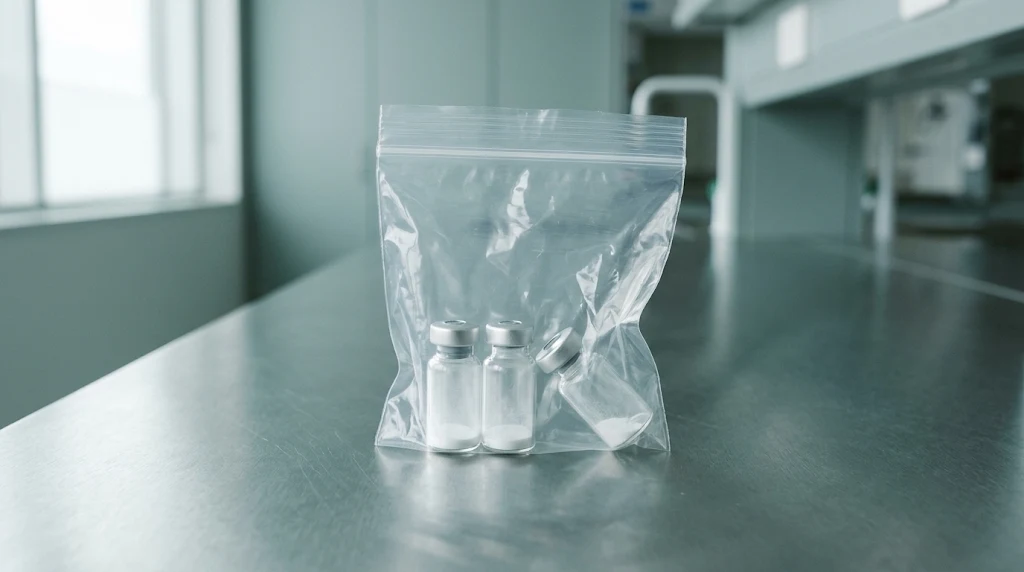
Health Canada found three species of bacteria in injectable peptides it seized and tested, according to public advisory RA-82930, issued on November 6, 2026.1 They are Acinetobacter seifertii, Acinetobacter nosocomialis and Cutibacterium acnes.1 Officials seized more than 11,400 vials from a Shanghai-based supplier and two Canadian online stores. The products listed include retatrutide, tirzepatide, MOTS-c and tesamorelin.1
What the advisory leaves out matters to anyone holding a vial. It does not say which products carried the bacteria, how many vials were tested, or which lots were affected. It reports no illness.1 Global News covered the advisory that evening without naming the organisms.2 This page is current as of November 9, 2026, and the advisory showed no update since it was published.
What bacteria did Health Canada find in peptides?
Health Canada named Acinetobacter seifertii, Acinetobacter nosocomialis and Cutibacterium acnes, the skin bacterium formerly called Propionibacterium acnes, and its wording ("including") leaves room for others.1 Two of the three are hospital-infection organisms. The third lives on almost everyone's skin.
| Bacterium | What it is | Where it normally lives | What it can do in people | Gram type |
|---|---|---|---|---|
| Acinetobacter seifertii | Member of the A. baumannii group | Hospital patients and settings | Severe bloodstream infection, including shock34 | Negative4 |
| Acinetobacter nosocomialis | Member of the A. baumannii group | Hospital patients and settings, mostly intensive care | Bloodstream infection5 | Negative4 |
| Cutibacterium acnes | Common skin bacterium, slow-growing | Human skin | Usually nothing; opportunistic infection after surgery and around implants6 | Positive6 |
The two Acinetobacter species are close relatives that routine clinical lab tests cannot tell apart by appearance.35 Gram type matters for a practical reason. Gram-negative bacteria such as Acinetobacter carry an outer membrane that sheds endotoxin, a fever-causing toxin that lingers after the bacteria die.47 Gram-positive bacteria such as C. acnes have no such membrane, and that shapes which test would catch each one.
The published infection data on the Acinetobacter species comes from hospital patients who were already very ill, often in intensive care.35 It does not predict what happens to a healthy person who injects a contaminated vial, only what these organisms can do once they reach the blood.
Which peptides were contaminated?
Unknown. Health Canada lists six products as examples of what it seized and does not say which of them tested positive.1
| What the November 6 advisory says | What it does not say | |
|---|---|---|
| Products | hCG, MOTS-c, NAD+, retatrutide, tesamorelin, tirzepatide, as examples | Which ones contained bacteria |
| Testing | Bacteria found; three species named | How many vials or products were tested, or how many failed |
| Lots | Photos captioned "NJ-500mg vials" and "TR-60mg vials" | Any lot or batch numbers |
| Harm | Contaminated injections can cause serious infection, hospitalization and, in severe cases, sepsis | Any reported illness from these products |
| Seizure | More than 11,400 vials, taken under court-issued entry warrants; both store websites now inactive | How many came from each source |
Every entry in the left column comes from the advisory.1 Two of the six products are not peptides: hCG is a glycoprotein hormone and NAD+ is a coenzyme, and the advisory's title mentions "non-peptide drugs" for that reason.1
Earlier Health Canada peptide warnings stopped at the possibility. Its August 1, 2025 seizure advisory and its April 9, 2026 warning about peptides bought online both said such products could contain microbes.89 Neither reported testing a seized product. The November advisory is the first of the three to report what a laboratory found.
What does a skin bacterium in a sealed vial suggest?
It suggests the product was handled outside sterile conditions at some point, though Health Canada does not say where.1 People are a major source of contamination in the clean rooms where injectable drugs are filled.10 A 2020 industry case study found C. acnes in abundance there and noted that routine culture-based monitoring often misses it.10 A skin organism in a vial fits a person contaminating product during filling, and it also fits contamination during repackaging or storage. Nothing public says where the two Acinetobacter species came from.
Would a COA, an endotoxin test or a sterility test catch these bacteria?
A standard certificate of analysis would catch none of them. An endotoxin test would likely flag the two Acinetobacter species, and only a sterility test looks for all three.
| Test | What it measures | Acinetobacter species | C. acnes |
|---|---|---|---|
| Standard COA (identity and HPLC purity) | Whether the labeled molecule is present and what share of the powder it makes up | Not detected | Not detected |
| Endotoxin test (LAL) | Toxin from the outer membrane of gram-negative bacteria, alive or dead | Likely flagged, since both are gram-negative | Not detected, since it is gram-positive |
| Sterility test | Whether live organisms grow in culture over days | Detected if alive | Detected if alive, but slow; culture can take up to 14 days |
A certificate of analysis, or COA, is the lab report a seller posts for a batch. HPLC, the method behind the purity figure, separates a powder into its parts and measures the labeled molecule; it says nothing about bacteria or endotoxin.11 LAL, short for Limulus amebocyte lysate, is the standard endotoxin assay.7 The C. acnes culture time comes from a testing manufacturer's reference material.6 Our guide on how to vet a peptide vendor explains why most certificates leave sterility and endotoxin out.
Both tests are available to buyers. Finnrick, a testing service that buys vials blind and publishes results, lists endotoxin and sterility among the tests labs can run beyond its identity, purity and potency bundle.12 Finnrick reported 140 endotoxin tests through January 2026. About 63% found no endotoxin, about 29% found a trace too small to measure, and nearly 8% found a measurable amount.7 Finnrick's retatrutide pass standard covers purity and fill only, as our guide on buying retatrutide online explains.
US pharmacies compounding peptides under the HHS interim policy face a stricter bar. Every bulk ingredient needs a certificate covering bacterial endotoxins and microbial counts, as our report on what HHS allowed sets out.13
What should someone holding one of these vials do?
Health Canada's advice is "Do not buy or use these products."1 Anyone who has used them and feels unwell, or develops a fever or pain and swelling at the injection site, should get medical attention right away.1 Unused product can go to a pharmacy or a local hazardous waste program for disposal.1 Our guide on when an injection site reaction means stop and get seen covers the signs that separate infection from an ordinary reaction.
The action is Canadian. Health Canada asked the supplier to stop selling into Canada and is working with the Canada Border Services Agency to stop shipments.1 Searches on November 9, 2026 found no FDA statement on the same supplier.
For anyone buying elsewhere, the most useful documents are a per-lot certificate with the lot printed on the vial and an endotoxin result for that same lot. Choosing a seller on our vendors page with no open regulatory action, and testing the first vial from a new source, cover what paperwork cannot.
What happens next?
Health Canada says seizures, testing and disruption of distribution will continue.1 A follow-up naming products, lots or illnesses would change what readers can act on. In the United States, comments on the HHS interim compounding policy close around November 13, 2026.13
Common questions
What bacteria did Health Canada find in seized peptides?
Acinetobacter seifertii, Acinetobacter nosocomialis and Cutibacterium acnes (formerly Propionibacterium acnes), according to Health Canada's November 6, 2026 advisory. The advisory says these are among the bacteria found, so there may be others.
Was retatrutide or tirzepatide contaminated?
Unknown. Both are on Health Canada's list of seized products, alongside hCG, MOTS-c, NAD+ and tesamorelin, but the advisory does not say which products tested positive.
How many peptide vials did Health Canada seize?
More than 11,400, from one Shanghai-based supplier and two Canadian online stores combined.
Has anyone gotten sick from these peptides?
None reported. The advisory says contaminated injections can cause serious infection and sepsis but records no illness linked to these products.
Are Acinetobacter bacteria dangerous?
They can be. Acinetobacter seifertii and Acinetobacter nosocomialis cause serious bloodstream infections, mostly in hospital patients who are already very ill.
Is Cutibacterium acnes dangerous?
Usually not. It lives on nearly everyone's skin and causes infection mainly after surgery or around implants. Finding it inside a sealed vial suggests a handling problem.
Would a COA show bacteria in a peptide vial?
No. A standard certificate of analysis checks identity and purity. Bacteria and endotoxin need separate tests.
Would an endotoxin test catch these bacteria?
Partly. An endotoxin test would likely flag the two gram-negative Acinetobacter species and would miss gram-positive Cutibacterium acnes. A sterility test looks for live organisms of both kinds.
Can I have my own peptide vial tested for bacteria?
Yes. Independent labs run endotoxin and sterility tests on peptide vials, and testing services such as Finnrick list both.
What should I do if I used one of the seized products?
Stop using it. Health Canada says to get medical attention right away if you feel unwell or develop a fever, or pain and swelling at the injection site.
Does the Health Canada advisory affect peptides sold in the US?
Not directly. The action covers Canada, and no FDA statement on the same supplier was found as of November 9, 2026.
Did Health Canada publish lot numbers?
No. The advisory's photo captions mention "NJ-500mg" and "TR-60mg" vials, with no lot or batch numbers.
Has Health Canada tested seized peptides before?
Not in its earlier peptide advisories reviewed here. The August 2025 and April 2026 advisories warned that products might contain microbes without reporting test results.
Sources
- Health Canada. "Health Canada warns about contaminated unauthorized injectable peptides and non-peptide drugs." Public advisory RA-82930, Recalls and safety alerts, published and last updated November 6, 2026. recalls-rappels.canada.ca.Tier: read at source, through a text fetch that limits quotation length. Regulator's own document. States that Health Canada seized and tested unauthorized injectable peptides and found bacteria including Acinetobacter seifertii, Acinetobacter nosocomialis and Propionibacterium (Cutibacterium) acnes; more than 11,400 vials seized from the supplier and two online retailers under court-issued entry warrants; both retailer websites no longer active. Lists hCG, MOTS-C, NAD+, retatrutide, tesamorelin and tirzepatide as examples. Photo captions reference NJ-500mg and TR-60mg vials. Describes infection, hospitalization and sepsis as risks of injecting contaminated products, and does not report any illness. Gives no count of products tested or positive, no product-level results and no lot numbers. Asks the supplier to stop selling into Canada and describes work with the Canada Border Services Agency. The supplier and retailers are named in the advisory and not on this page, under this site's rule on seller names. ↩ ↩ ↩ ↩ ↩ ↩ ↩ ↩ ↩ ↩ ↩ ↩ ↩ ↩
- Morgan R. "Health Canada warns of bacteria found in unauthorized peptides sold online." Global News, November 6, 2026, 6:29 pm. globalnews.ca.Tier: read at source. Reports the seizure of more than 11,400 vials, the six products and lab testing finding three bacteria that could harm humans, without naming the bacteria. Reports no illnesses and does not link the advisory. ↩
- "Clinical and molecular characterization of Acinetobacter seifertii in Taiwan." 2020. PubMed 33128052. pubmed.gov.Tier: abstract read at source; authors and journal were not shown on the page fetched, and the copyright line suggests the Journal of Antimicrobial Chemotherapy; this page does not confirm that. Retrospective study of 80 adults with A. seifertii bloodstream infection at four medical centers over eight years. Describes A. seifertii as a new member of the A. baumannii group. 28-day mortality 18.8%, in-hospital mortality 30.0%; high APACHE II score and immunosuppressant therapy independently associated with 28-day death; 16.3% of isolates carbapenem-resistant. ↩ ↩ ↩
- Koizumi Y, Sakanashi D, Ohno T, et al. "The clinical characteristics of Acinetobacter bacteremia differ among genomospecies: A hospital-based retrospective comparative analysis of genotypically identified strains." Journal of Microbiology, Immunology and Infection. 2019;52(6):966-972. doaj.org.Tier: read via a reproduction, the DOAJ record of the article. Describes the genus Acinetobacter as an "aerobic, gram-negative coccobacillus." 35 bacteremia cases at one 900-bed Japanese hospital: 14 A. baumannii, 12 A. nosocomialis, 6 A. ursingii, 3 A. seifertii. All three A. seifertii cases developed shock, against 43% for A. baumannii. Seven-day mortality 25% for A. nosocomialis and 7% for A. baumannii, a difference that was not statistically significant. ↩ ↩ ↩ ↩
- Yang YS, Lee YT, Tsai WC, et al. "Comparison between bacteremia caused by carbapenem resistant Acinetobacter baumannii and Acinetobacter nosocomialis." BMC Infectious Diseases. 2013;13:311. link.springer.com.Tier: read at source. Nine-year retrospective study of 71 patients with carbapenem-resistant A. baumannii and 64 with carbapenem-resistant A. nosocomialis bacteremia. 14-day mortality 40.8% against 14.1%. 84.4% of A. nosocomialis cases were acquired in intensive care. Groups A. baumannii, A. nosocomialis and A. pittii as a group that clinical labs cannot distinguish by phenotype. These are drug-resistant isolates in hospital patients; nothing in the Health Canada advisory says the vial isolates were resistant. ↩ ↩ ↩
- bioMérieux. Cutibacterium acnes reference page, pharma microorganisms scientific library. Undated; page title not confirmed, described here from its content. biomerieux.com.Tier: read at source. A reference page from a microbiology testing manufacturer, not a peer-reviewed source. States C. acnes is found on the skin of virtually every human, prefers anaerobic growth, is among the slowest-growing usual test organisms, and may need prolonged aerobic and anaerobic culture for 14 days to detect. Describes it as generally non-pathogenic but opportunistic, linked to postoperative, implant and device infections. ↩ ↩ ↩
- Mazoyer R. Blog post on endotoxin testing for peptides. Finnrick, February 6, 2026; exact title not confirmed. finnrick.com.Tier: read at source; written by the testing service's chief executive. Defines endotoxins as fragments of the outer membrane of gram-negative bacteria and notes a peptide can be free of living bacteria and still contain endotoxin. Reports 140 endotoxin tests through January 2026: about 63% none detected, about 29% below the limit of quantification, nearly 8% quantifiable. Uses a 40 EU per vial threshold and calls the threshold arbitrary. Describes endotoxin testing as a paid add-on to the standard protocol, while the same site's footer lists endotoxins in standard testing; this page treats the testing-page description in note 12 as current and could not resolve the difference. ↩ ↩ ↩
- Health Canada. Public advisory RA-77807, Recalls and safety alerts, published and last updated August 1, 2025.Tier: read at source. Concerns unauthorized injectable peptides seized from one online seller, listing more than 40 products including BPC-157, tirzepatide and retatrutide. Reports no test results and no confirmed contamination. The advisory's title and web address carry the seller's name, so neither is reproduced here. ↩
- Health Canada. Public advisory RA-81874, Recalls and safety alerts, published and last updated April 9, 2026. recalls-rappels.canada.ca.Tier: read at source. A general warning about peptides bought online. Lists contaminant types such products may contain, including microbes, and reports no testing of any seized product. ↩
- Parenteral Drug Association. Case study on Cutibacterium acnes in cleanroom monitoring for parenteral manufacturing. PDA Journal of Pharmaceutical Science and Technology, accepted January 17, 2020. journal.pda.org.Tier: partly read at source; the title and authors were not shown on the page fetched. States that personnel are a major source of microbial risk in cleanrooms, that metagenomic analysis found a greater abundance of Cutibacterium acnes, and that traditional culture-based monitoring fails to consistently recover it. ↩ ↩
- Peptide Decoding. "How to Vet a Peptide Vendor." peptidedecoding.com.Tier: this site's own guide, read at source November 9, 2026. States that sterility and endotoxin are separate laboratory analyses that standard peptide certificates do not include. ↩
- Finnrick. Testing, vendor support page. finnrick.com.Tier: read at source November 9, 2026. Lists identity, purity and potency as the standard testing bundle, and endotoxins, heavy metals, residual solvents and sterility as further test types that depend on lab choice. Gives no sterility method or incubation period. ↩
- Peptide Decoding. "Can You Get BPC-157 From a Compounding Pharmacy Now? What HHS Allowed." October 29, 2026. peptidedecoding.com.Tier: read via a reproduction, this site's own report on the HHS policy and its Appendix B testing table, read November 9, 2026. Reports that the testing standard requires bacterial endotoxins by LAL under USP <85> and microbial enumeration under USP <1111>. The November 13, 2026 comment deadline is calculated from the two-week period after the October 30 Federal Register publication, not stated as a date in the notice. ↩ ↩
Citing this page. Peptide Decoding. Health Canada Named Three Bacteria in Seized Peptides. It Did Not Name the Vials. Findings from Health Canada public advisory RA-82930, November 6, 2026, with earlier advisories RA-77807 (August 1, 2025) and RA-81874 (April 9, 2026); organism background from published hospital studies and a manufacturer reference; endotoxin figures from Finnrick, February 6, 2026. Reviewed November 9, 2026. https://peptidedecoding.com/news/health-canada-contaminated-peptides