
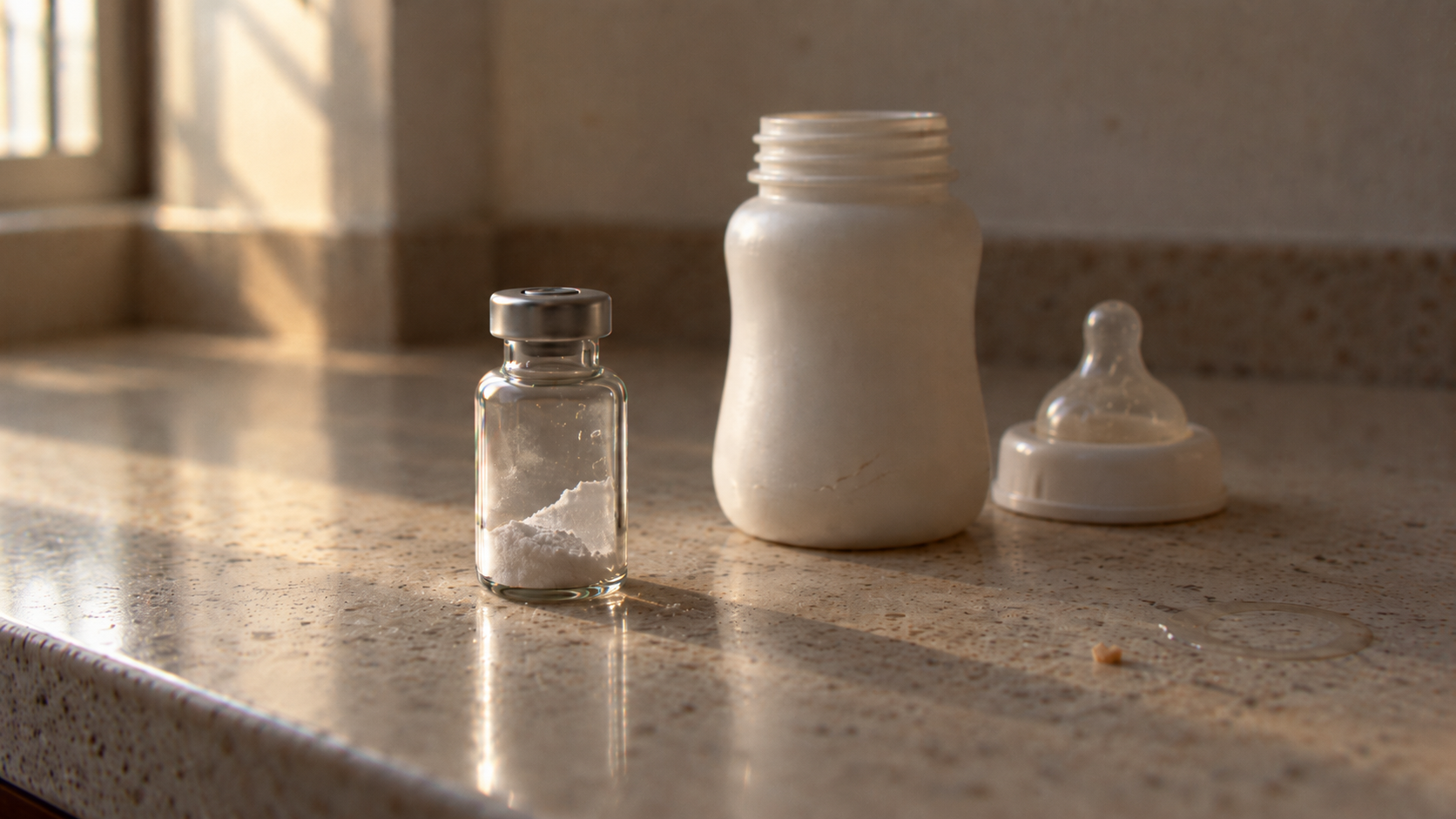
Two GLP-1 drugs have been measured in human breast milk, and neither showed up in a meaningful amount. Semaglutide was undetectable in all 24 milk samples from eight women taking it.1 Tirzepatide was undetectable in 164 of 171 samples from eleven women, and the traces in the other seven added up to less than 0.02% of the dose.2 The Wegovy label still says there are no human milk data. The current Zepbound label now reports the single-dose milk study, but says infant effects and milk production have not been studied.
For everything sold in a research vial, nothing has been measured at all. No milk levels, no infant follow-up, no entry in the NIH's lactation database.
What has not been studied for any of them is the part most postpartum readers are asking about: what appetite suppression does to milk supply.
Updated 27 September 2026.
| Measured in human milk? | What the label says | What LactMed says123 | |
|---|---|---|---|
| Semaglutide, injected | Yes, undetectable in 8 women | No human data; present in rat milk4 | Not detectable; infants had no adverse effects |
| Semaglutide, oral tablets | No | No human data | Avoid; the absorption enhancer may enter milk |
| Tirzepatide | Yes, undetectable in 164 of 171 samples | Single-dose milk study reported; no infant or milk-production data5 | Usually undetectable; not a reason to stop breastfeeding; caution with newborns |
| Liraglutide | No | No human data | Likely very low; caution |
| Retatrutide | No | No label; trials exclude breastfeeding | No entry |
| BPC-157, TB-500, GHK-Cu, ipamorelin, CJC-1295 and other research-vial compounds | No | No label | No entry |
LactMed entries were read on 27 September 2026; the database revises entries as studies appear, and the links in the sources go to the current versions.
Does semaglutide pass into breast milk?
One study. Eight nursing mothers taking injected semaglutide at 0.25 to 1 mg a week (many resume at the low end of the ladder after a birth; the microdosing guide covers what those doses mean) gave breast milk samples at 0, 12 and 24 hours after a dose. None of the 24 samples contained measurable semaglutide; the detection limit was 1.7 micrograms per litre. The authors worked out what the infant's dose would have been if every sample had contained semaglutide right at that limit: an average of 1.12% of the mother's dose.1 Lactation pharmacologists treat 10% as the level where concern starts.
The infants were 4 to 23 months old, mixed fed with formula, and were breastfed for 3 to 9 weeks while their mothers took the drug. Their mothers reported normal growth and development.1 No newborns, no exclusively breastfed babies, and no measurement of milk volume or composition. The NIH's lactation database revised its entry in December 2024 to say that injected semaglutide was not detectable in milk and that the infants had no adverse effects.3
The oral tablet is a different case. Rybelsus contains an absorption enhancer, salcaprozate sodium, and LactMed's position is that the enhancer may enter milk and accumulate in the infant, so only the injected form should be used while breastfeeding.3
Compounded versions were not in either study. Both measured the branded injection. Compounded semaglutide is often mixed with an additive, most commonly vitamin B12, and sublingual or oral compounded drops rely on absorption enhancers of their own. None of those additives has been measured in milk, so the peptide findings carry over and the rest of the vial is a blank. The compounded semaglutide guide covers what those products contain.
Is tirzepatide safe while breastfeeding? What was measured
There are two sets of data, both from Lilly. Eleven lactating women received a single 5 mg injection and gave milk samples over 28 days. Tirzepatide was undetectable in 164 of the 171 samples; the amount in the other seven, added together, came to less than 0.02% of the dose, with the last measurable trace five days after the injection. Separately, five women on 2.5 to 5 mg weekly gave samples on their dosing day; a few came in below the detection limit and none reached the quantification limit.2
LactMed's summary is the most direct language any official source has used about a GLP-1 and breastfeeding: tirzepatide is usually undetectable in milk at doses up to 5 mg, absorption by the infant is unlikely, and if a mother requires it, that is not a reason to discontinue breastfeeding. It adds two cautions. The single-dose study does not capture the build-up that happens with weekly dosing, so levels during regular use are probably higher than the study shows. And the caution applies especially with a newborn or preterm infant.2
The current Zepbound label includes the manufacturer's single-dose milk study. It says there are no data on effects in the breastfed infant or on milk production.5
Why are GLP-1 drugs unlikely to reach a nursing baby?
Semaglutide is a 31-residue peptide with a molecular weight of about 4,100; tirzepatide is larger. Molecules that size cross into milk poorly, and both are more than 99% bound to proteins in the mother's blood, which keeps them there. A baby who did swallow some would absorb almost none: injected semaglutide is 0.4% to 1% orally available in adults, because the gut digests it like any other protein.3 That is why a peptide that lasts a week in the mother's bloodstream is expected to be a non-event in the baby's, and why the measured results came out the way they did.
The same reasoning applies to every peptide in the library. None of it has been tested for any of them. The perimenopause guide is another place in this series where trials left a population out. Readers navigating life after a weight-loss course can also see what comes after significant weight loss, and the separate fertility and pregnancy guide covers the stages before breastfeeding.
What has not been studied in breastfeeding?
Milk supply. Neither study measured how much milk the women produced or what was in it. LactMed lists "effects on lactation and breastmilk" as having no published information for semaglutide, tirzepatide or liraglutide.123 It is the question most people bring to this page, and nobody has looked.
Calories. The CDC's figure is that a breastfeeding mother needs roughly 330 to 400 more calories a day than she did before pregnancy.6 A drug whose main effect is eating less pulls against that. Whether it reduces supply, changes milk composition, or does neither is not known, because no study has weighed the babies or measured the milk.
Newborns and exclusively breastfed infants. The semaglutide infants were 4 months and older and all took formula too. The tirzepatide women received one dose. Nobody has measured milk in the first weeks after birth, when the infant is smallest and the gut is most permeable, and LactMed's caution is specifically about that period.2
Long-term outcomes. The semaglutide infants were followed for 3 to 9 weeks and their development was reported by their mothers, not measured. There is no study of children exposed through milk beyond that.
Retatrutide and everything in a research vial. Retatrutide's trials exclude women who are breastfeeding, so no data exist from that direction either. For BPC-157, TB-500, GHK-Cu, the growth-hormone peptides and the rest of the library, there is no milk measurement, no infant follow-up, no LactMed entry, and no label to consult. The evidence table shows how many of these compounds have any human trial at all; breastfeeding data would be a subset of that, and for most of them the parent number is zero.
What do the Wegovy and Zepbound labels say about breastfeeding?
The Wegovy label states there are no data on semaglutide in human milk, on the breastfed infant, or on milk production, and that semaglutide was present in the milk of lactating rats.4 The current Zepbound label includes the single-dose tirzepatide milk study and says infant effects and milk production have not been studied.5 The Wegovy label also tells women planning pregnancy to stop the drug at least two months before, on account of its half-life. And tirzepatide reduces the absorption of oral contraceptives, which matters to anyone starting the pill after a birth. The fertility and pregnancy guide covers both.
A label can only cite the studies the manufacturer submitted for approval. The Texas Tech semaglutide study was independent and came after approval. The Lilly tirzepatide study is now described in the current Zepbound label. LactMed also discusses what those measurements mean for breastfeeding, while noting the limits of both studies. Anyone deciding with a clinician can read both documents.
Common questions
Can I take semaglutide while breastfeeding?
The only study that measured it found none in the milk of eight women, and their infants had no reported problems. The label says no human data. Milk supply has not been studied. That is what is known; the decision is one to make with the person prescribing it.
Does Ozempic or Wegovy pass into breast milk?
In the one published study, no: undetectable in all 24 samples at a limit of 1.7 micrograms per litre.
Is tirzepatide (Zepbound, Mounjaro) safe while breastfeeding?
LactMed's summary is that it is usually undetectable in milk at doses up to 5 mg and that needing it is not a reason to stop breastfeeding, with caution for newborns and preterm infants. The current label reports the single-dose milk study but has no infant-effects or milk-production data. Supply has not been studied.
Does semaglutide reduce milk supply?
Nobody has measured it. Neither milk study looked at volume or composition. The known effect of the drug is a large drop in calorie intake, and a breastfeeding mother needs several hundred extra calories a day, so the question is a reasonable one with no data behind it.
Can I take Rybelsus (oral semaglutide) while breastfeeding?
LactMed says no: the tablet's absorption enhancer may enter milk and accumulate in the infant, and only the injected form should be used.
Is BPC-157 safe while breastfeeding?
No one has measured it. There is no milk study, no infant data and no LactMed entry for BPC-157 or any other research-vial peptide.
Do I need to pump and dump after a dose?
Nothing in the studies supports it. Semaglutide was undetectable in milk at 0, 12 and 24 hours after a dose, and tirzepatide was undetectable in almost every sample across 28 days. Both drugs stay in the mother's blood for weeks, so timing a feed around an injection would change nothing even if levels in milk were measurable.
How long after stopping semaglutide is it out of my milk?
It was not found in milk while women were taking it, so there is no clearance figure to give. In the mother's blood, semaglutide is present for about five weeks after the last dose. The Zepbound label reports a tirzepatide elimination half-life of approximately five to six days but does not give a milk-clearance interval.
Sources
- Diab H, Fuquay T, Datta P, Bickel U, Thompson J, Krutsch K. Subcutaneous semaglutide during breastfeeding: infant safety regarding drug transfer into human milk. Nutrients 2024;16(17):2886. https://pmc.ncbi.nlm.nih.gov/articles/PMC11397063/
- Drugs and Lactation Database (LactMed), National Institute of Child Health and Human Development. Tirzepatide. Summary of use during lactation and drug levels. https://www.ncbi.nlm.nih.gov/books/NBK581488/
- Drugs and Lactation Database (LactMed). Semaglutide, revised 15 December 2024; and Liraglutide. https://www.ncbi.nlm.nih.gov/books/NBK500980/ and https://www.ncbi.nlm.nih.gov/books/NBK500977/
- Wegovy (semaglutide) injection, FDA-approved prescribing information, section 8.2 Lactation. https://www.accessdata.fda.gov/drugsatfda_docs/label/2025/215256s024lbl.pdf
- Zepbound (tirzepatide) injection, prescribing information, section 8.2 Lactation, DailyMed. Current label, including the single-dose milk study. https://dailymed.nlm.nih.gov/dailymed/drugInfo.cfm?setid=487cd7e7-434c-4925-99fa-aa80b1cc776b
- Centers for Disease Control and Prevention, Maternal Diet and Breastfeeding: additional calorie needs during lactation. https://www.cdc.gov/breastfeeding-special-circumstances/hcp/diet-micronutrients/maternal-diet.html