
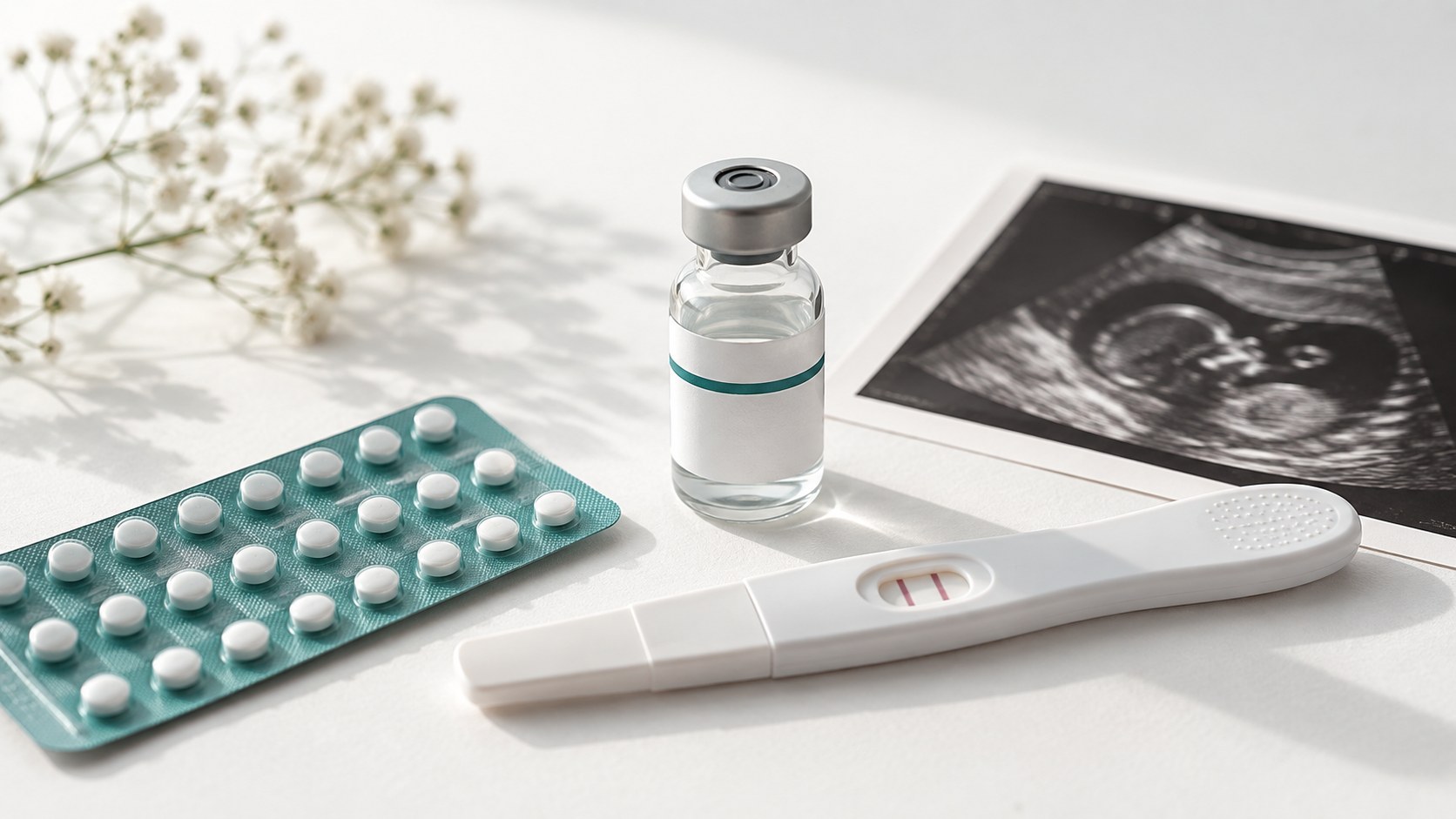
Tirzepatide can stop the pill working properly. If you take both, add a barrier method now. Four weeks after you start, and four weeks after every dose increase. The label says so itself.
Semaglutide does not carry that warning. The two drugs get discussed as one, and here they diverge.
Both can restore fertility. Weight loss restarts ovulation in people who were not ovulating, which is what sits behind the unplanned pregnancies people keep reading about.
So two things move at once. The contraception weakens. The fertility returns. Neither label mentions the other.
Neither drug belongs in pregnancy, or in the months before trying. For every research peptide, nobody has studied any of it in pregnancy at all, and the person exposed cannot consent.
Does Mounjaro affect birth control?
Tirzepatide slows how quickly the stomach empties, and oral contraceptives are absorbed through the stomach and small intestine. In the label's own drug interaction study, peak levels of contraceptive hormones fell by 55 to 66%, with total exposure down by around 20 to 23%.
The label's instruction is unambiguous. Switch to a non-oral method, or add a barrier method, for four weeks after starting tirzepatide and for four weeks after every dose escalation.
Dose increases reset the clock. Each step up changes gastric emptying again, so a titration schedule creates a new four-week window every time it moves. Somebody who added condoms at the start and stopped after a month has been unprotected through several escalations.
Methods that do not go through the stomach are unaffected. The coil, the implant, the injection and the patch all bypass the mechanism entirely.
Semaglutide is different. Its label reports no clinically significant pharmacokinetic difference for ethinyl estradiol or levonorgestrel, and it carries no matching four-week instruction. It does warn that delayed gastric emptying can affect oral medicines generally, which is a weaker and broader statement.
That same mechanism matters before surgery or sedation, when the anesthetic team needs to know what you take.
That distinction matters because the two drugs are constantly discussed as one thing. Our comparison of the three covers where else they diverge.
Why people get pregnant unexpectedly on GLP-1 drugs
This half produced the headlines.
The tirzepatide label states that the drug may restore fertility. Weight loss and improved insulin sensitivity can restart ovulation in people who were not ovulating. That matters most in polycystic ovary syndrome, where not ovulating is the common cause of infertility.
This is not a quirk of the drug. Weight loss restoring ovulation in anovulatory infertility is well established, which is why weight management sits in fertility guidance ahead of most interventions. What is new is the number of people losing weight quickly, not the biology.
So somebody who has spent years assuming they could not conceive easily may find that assumption no longer holds. The same drug also weakens the contraception they were relying on.
Neither half of that is hidden. Both sit on labels, and they are never printed alongside each other.
Peptides, PCOS and fertility
Polycystic ovary syndrome is the most common cause of anovulatory infertility. It also travels with insulin resistance and weight, which makes it the diagnosis most affected by everything above. For the other changes people report, see what GLP-1 drugs may do to periods.
Restored ovulation is most likely here. Weight loss and improved insulin sensitivity address the mechanism directly, which is why weight management appears in fertility guidance for PCOS long before any drug does. Somebody who has spent years with unpredictable or absent cycles may start ovulating without noticing that anything has changed.
Cycle-control prescriptions are common in this group. The combined pill is frequently prescribed for cycle regulation and not for contraception, and somebody taking it for that reason may not think of it as birth control at all. On tirzepatide, it is affected the same way regardless of why it was prescribed.
And metformin is often already in the picture, which is worth mentioning to whoever manages it, since two drugs acting on the same problem is worth a conversation.
None of that is a reason to avoid these drugs. For a lot of people with PCOS they address the underlying problem better than anything else available. It is a reason to decide about contraception deliberately, instead of by default.
Can you take GLP-1 drugs while pregnant?
The regulatory position is consistent across agencies. GLP-1 receptor agonists should not be taken during pregnancy, just before trying to conceive, or while breastfeeding, because there is not enough safety data to know whether they cause harm.
The animal data is the reason for caution, not a source of reassurance. Studies in animals showed reduced fetal growth and structural abnormalities at exposures relevant to human dosing.
No adequate human data exists, and none will for some time, because nobody runs randomized trials of new drugs in pregnancy. What exists instead is registry data collected from people who conceived while taking them, which accumulates slowly and is the reason those registries ask you to enroll.
How long after stopping before trying to conceive?
The label instruction depends on the molecule, and both semaglutide products give the same interval.
The Wegovy and Ozempic labels instruct discontinuation at least two months before a planned pregnancy. Neither the Zepbound nor the Mounjaro label specifies a preconception interval.
For semaglutide, two months is a manufacturer instruction, not a four-to-six-week clearance estimate. For tirzepatide, the absence of a label interval does not establish a shorter safe wait.
Neither interval has been established by a trial comparing waiting times. Discuss the plan with your prescriber before stopping, including what replaces the drug. See what the labels actually specify, and the new PCOS study.
What to do if you get pregnant while taking one
Stop the drug and contact your obstetric provider. Every source agrees, and it is the label instruction.
Have two things in mind before that call. Exposure in very early pregnancy is common, because people conceive before they know, and it is not the same as having taken something knowingly through organogenesis. And there are pregnancy-safe alternatives for the underlying condition, insulin being the standard one for diabetes, which is a question for the same appointment.
Ask about a pregnancy exposure registry. Enrolling is how the human data eventually exists, and it costs you nothing.
And if you are reading this having already conceived on one of these drugs, the useful thing to know is that you are not unusual and you have not done something reckless. People conceive before they know, which is why the registries exist and why they have people in them. Exposure in the first weeks, before a positive test, is a different situation from continuing a drug knowingly through the period when organs form. Your obstetric provider will have had this conversation before.
Are peptides safe in pregnancy?
No research peptide has been studied in pregnancy. Not BPC-157, not TB-500, not the growth hormone secretagogues, not any of it.
That absence sits differently from the ones elsewhere on this site. Our guide on why most peptides have no human evidence covers how a compound ends up untested. Here the untested population is somebody other than the person choosing, and no consent reaches them.
Anybody pregnant, trying, or who might become pregnant sits outside every safety framework that exists for these compounds. None of those frameworks contemplated pregnancy at all.
And a vendor claiming a compound is safe in pregnancy is not merely unsupported in the usual way, since there is no source they could be citing.
Three questions with no answer
Male fertility
Men ask two different questions here, and only one has an answer.
For the growth hormone compounds, nobody has looked. Growth hormone and IGF-1 have roles in reproductive function, and no trial has examined what a secretagogue does to sperm parameters. Our guide to the growth hormone peptides covers what has been studied, and this is not among it.
The question men more often mean is about testosterone, and there the answer is established. Exogenous testosterone suppresses the signal that drives sperm production, and it does so reliably enough that it has been studied as a male contraceptive. Compounds including hCG and kisspeptin are used specifically to preserve or restore fertility in that situation, which is a different subject entirely and one to raise with a prescriber.
If you are trying to conceive and taking anything at all, that belongs on the list you give a fertility clinic.
Breastfeeding
Small human milk studies now exist for injected semaglutide and tirzepatide. For what was measured, what remains unknown about milk supply, and why research vials are a different case, read peptides and breastfeeding.
Whether a past course matters
Somebody who took something last year and is now trying to conceive is asking a reasonable question that nobody can answer from evidence. Clearance is the only thing anyone can reason from, which produces an estimate and not an answer.
Where this stops being useful
Whether a specific drug is safe for you, which is a clinical question and one where a prescriber has information a website does not.
The right washout for your situation, which depends on the drug, the dose, your kidney function and what replaces it.
Anything about research peptides in pregnancy, because there is nothing to be useful about.
Readers coming at this from the other end of the transition may want peptides in perimenopause instead, and for the youngest end of it, GLP-1 drugs in adolescence is the separate question.
After birth, what has been measured in breast milk is a different question from pregnancy exposure.
Common questions
Does Ozempic affect birth control?
Semaglutide's label reports no clinically significant effect on the absorption of the hormones in combined oral contraceptives, and it carries no specific contraception instruction. Tirzepatide does, and the two are frequently confused.
Does Mounjaro or Zepbound affect birth control?
Yes, and it is label-mandated, not theoretical. Tirzepatide reduces absorption of oral contraceptive hormones, with peak levels falling by 55 to 66% in the label's interaction study. Use a non-oral method or add a barrier method for four weeks after starting and four weeks after every dose increase.
Why do people get pregnant unexpectedly on these drugs?
Two mechanisms together. Weight loss can restore ovulation in people who were not ovulating, and tirzepatide can reduce oral contraceptive effectiveness. The label states the drug may restore fertility.
How long should I wait after stopping before trying to conceive?
The Wegovy and Ozempic labels specify at least two months before a planned pregnancy. Neither tirzepatide label specifies a preconception interval, which does not establish a shorter safe wait. Discuss timing and replacement treatment with your prescriber before stopping.
I got pregnant while taking it. What now?
Stop and contact your obstetric provider, which is the label instruction. Early exposure is common and there are pregnancy-safe alternatives for the underlying condition. Ask about enrolling in an exposure registry.
Can I take BPC-157 while pregnant?
Nobody has studied it, or any other research peptide, in pregnancy. There is no source anyone could cite for a safety claim either way.
I have PCOS. Does this apply to me more?
Considerably. PCOS is the most common cause of anovulatory infertility and the group where restored ovulation is most likely. The combined pill is also often prescribed there for cycle control instead of contraception, which does not change how tirzepatide affects it.
I already got pregnant on it. Have I harmed the baby?
Exposure before a positive test is common and is a different situation from continuing knowingly. Stop the drug, contact your obstetric provider, and ask about an exposure registry. This is a conversation they will have had before.
Do peptides affect male fertility?
Nobody has looked. Growth hormone and IGF-1 have roles in reproductive function, and no trial has examined what a secretagogue does to sperm parameters.
Is it safe while breastfeeding?
Small human milk studies found little or no injected semaglutide and tirzepatide, but milk supply and infant outcomes remain inadequately studied. Research-vial peptides have no lactation studies. See what was measured and discuss your situation with your prescriber.
Sources
FDA prescribing information for tirzepatide (Mounjaro and Zepbound), Eli Lilly. Regulatory. States that tirzepatide may reduce the efficacy of oral hormonal contraceptives due to delayed gastric emptying, and instructs patients on an oral hormonal contraceptive to switch to a non-oral method, or add a barrier method, for four weeks after initiation and for four weeks after each dose escalation. Also records that the drug may restore fertility, and that it should be discontinued when pregnancy is recognized.
FDA prescribing information for semaglutide (Wegovy and Ozempic), Novo Nordisk. Regulatory. Reports no clinically significant pharmacokinetic differences for ethinyl estradiol or levonorgestrel when co-administered with semaglutide, and carries no equivalent contraception instruction. It does warn that delayed gastric emptying may affect the absorption of oral medicines generally.
MHRA guidance on GLP-1 receptor agonists, contraception and pregnancy, published 5 June 2025. States that GLP-1 receptor agonists should not be taken during pregnancy, just before trying to become pregnant, or while breastfeeding, and sets out the tirzepatide contraception advice above.
Wegovy prescribing information and Ozempic prescribing information, section 8.3. Both instruct discontinuation at least two months before a planned pregnancy, citing semaglutide's long half-life. Neither Zepbound nor Mounjaro specifies a preconception interval.