
Scheduled for February 2027. Published 18 August 2026.
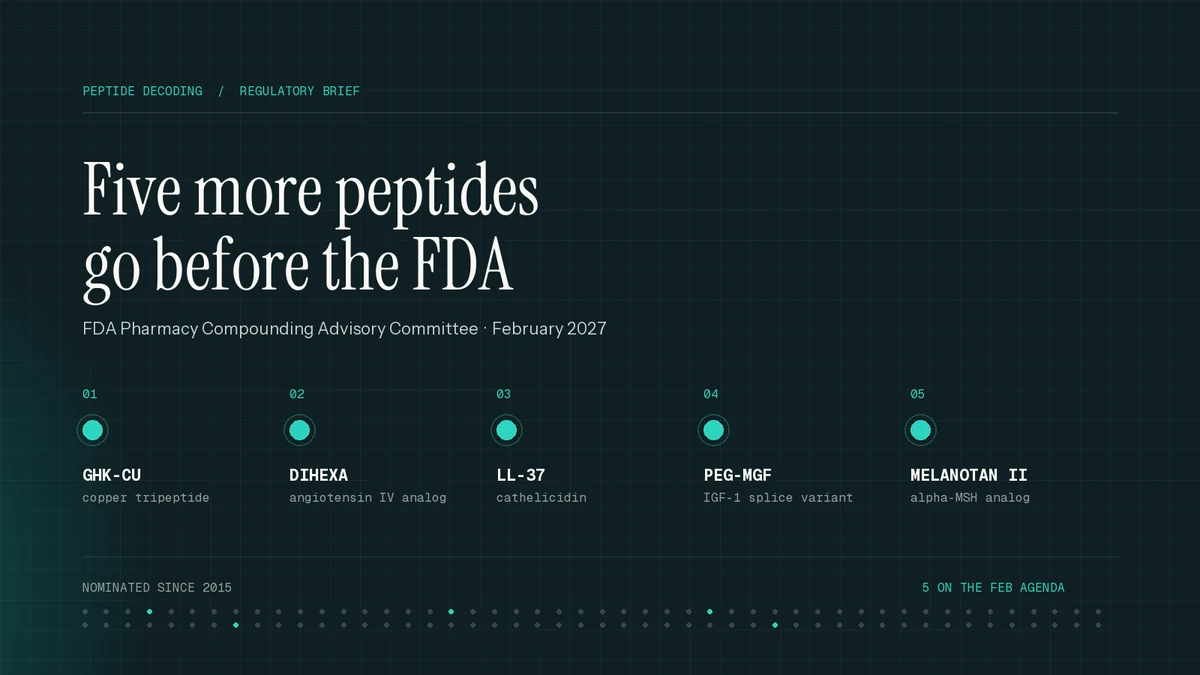
The panel that backed six peptides in July will look at five more by the end of February. They are GHK-Cu, Dihexa, LL-37, PEG-MGF and Melanotan II.
The meeting has no date yet and has not been formally announced. Not one of the five has a finished human trial behind the injected form. Three have real safety problems on record. And the same panel, with different people on it, said no to every peptide it saw in 2024.
The rest of this page covers each one, and why this group is a harder case than July's.
The state of the docket
The FDA announced this meeting on 15 April 2026, at the same time it announced July's.1
A Federal Register notice did go out at the time, announcing both meetings at once.25 What has not followed is everything that turns a plan into a meeting.
No date, four months on. No public comment docket, where July's opened as FDA-2025-N-6895 and ran until 22 July.26 No briefing documents from the FDA's own scientists. And no published list of the conditions each peptide was nominated for.1
That last gap matters more than it sounds. In July every peptide was put forward for one narrow condition, and the FDA published the list: BPC-157 for ulcerative colitis, MOTS-c for obesity and osteoporosis, Semax for stroke damage, emideltide for opioid withdrawal and insomnia.2 Nobody knows the equivalent for these five yet. Anything you read describing what they are up for is describing what sellers promote them for, not what the panel will actually weigh.
The FDA's own scientists publish their verdict about two working days before the meeting. In July they recommended against all seven.3
GHK-Cu, and the split nobody explained
The most consequential thing in the February slate has already happened.
GHK-Cu is not going before the panel as one substance. It has been split according to how you take it, and the two halves are now in opposite positions.
The FDA's own records lay out the sequence. On 22 April 2026 GHK-Cu came off Category 1 entirely, because whoever had put it forward withdrew. On 5 May one of them wrote back to say they had meant to withdraw only the injectable version and wanted to keep the rest. The FDA agreed: GHK-Cu, except for injectable routes, goes back into Category 1.4
Category 1 means still being looked at, and pharmacies have generally been allowed to use those substances while the FDA works through them.
So the cream version went back into Category 1 without any panel review at all, on the strength of one clarification letter. The injectable version is what goes before the panel in February.
The evidence justifies that split better than the process does. Applied to skin, GHK-Cu has real controlled human trials behind it, including placebo-controlled work on sun-damaged skin, and it is a permitted cosmetic ingredient under the name copper tripeptide-1. Injected, it has no published human trial for anything.5
The FDA's stated worry about the injectable form is that it may trigger an immune reaction, because the peptide can clump together and carry impurities, and because there is so little human data.6 The other obvious point, which the agency documents do not lead with, is that injecting a copper compound is a different thing from rubbing one on your face. Anyone whose body cannot handle copper properly is ruled out entirely.
No other compound in the February five has a route split.
The problem with Dihexa is the paperwork
Dihexa's situation is unusual, and it has nothing to do with the compound.
It was built at Washington State University by Joseph Harding and John Wright, and patented in 2013. The claim that made it famous came from a university announcement in 2012. Dihexa, it said, was ten million times more powerful than BDNF, the body's own signal for building new connections between brain cells. Harding's own words were that the molecule turned out to be insanely active.7
Two of the papers underpinning that work no longer stand.
In April 2025, the Journal of Pharmacology and Experimental Therapeutics retracted the 2012 paper that first framed Dihexa's mechanism, and the 2014 paper that established how it was supposed to work.8 The second notice is unusually blunt. Following an investigation by Washington State University, it says, figures in the article and data in a subsequent correction were found to contain falsified or fabricated data, and two named authors were found solely responsible.9
Both papers had carried a formal notice of concern since September 2021, when the journal flagged four papers from the same laboratory at once.10
The fallout went well beyond the journal. One of the named authors, who had become chief executive of the biotech company built on this research, resigned in October 2021, and the university later revoked her doctorate. The company paid roughly $10 million in February 2023 to settle securities fraud claims, and about $4 million in January 2025 to settle allegations that it failed to report the misconduct to federal agencies.11
The story is not entirely one-sided, and both exceptions favor Dihexa.
The paper that produced the famous BDNF comparison is a third one, from 2013. It carries a notice of concern and has not been retracted.12 So the headline number is flagged rather than withdrawn.
And an independent group in China published a study in 2021 reporting cognitive improvement with Dihexa in a mouse model of Alzheimer's disease, working through a different signaling pathway.13 Replication from outside the original laboratory was the thing missing from this record, and now some exists.
One fact survives all of it. Dihexa itself has never been in a human trial. Not once, by any route.6
Its closest relative did reach people, and failed. Fosgonimeton, built by the same company from the same idea, went into a large Alzheimer's trial with around 554 participants. In September 2024 it missed its main goal, moving the score by 0.08 with a p-value of 0.70, which is about as close to nothing as a trial result gets. Athira cut roughly 70% of its staff and shelved the program that November.14
One more thing. The growth signal Dihexa is built to amplify, involving a protein called hepatocyte growth factor, is a known driver of several cancers. Turning it up on purpose, in a compound with no human safety data at all, is a question the panel will have to face.15
Dihexa may not even be a peptide. It is a molecule built to imitate one, which raises exactly the identification problems the FDA cited over and over in July.
Melanotan II has the clearest harm record of any peptide in the program
Most compounds in this space are unproven. Melanotan II is documented.
It is a lab-made copy of a hormone that controls skin pigment, built at the University of Arizona in the 1980s to produce a tan without sunlight. Small early human studies confirmed it works for that, and for erections. No modern safety trial was ever finished, it has no approval anywhere in the world, and the UK, Australian, Irish, Canadian and European regulators have all warned against it.17
The published record of harm is specific rather than theoretical. One case follows a 39-year-old man whose blood levels of a muscle-breakdown marker rose tenfold in twelve hours, from 1,760 to 17,773, after a single 6 mg injection. His kidney and heart readings were disturbed too, and he spent three days in intensive care.18 Other published cases include melanoma growing out of existing moles, a painful erection lasting long enough to need surgery, a blocked artery in the kidney, and a serious brain condition.6
Do not confuse it with Melanotan I. That compound is approved, under the name Scenesse, for a rare light-sensitivity disorder. They are different molecules with different regulatory positions.
LL-37 and PEG-MGF
The two with the least to say about them.
LL-37 is a germ-killing peptide your own body makes, the only one of its kind in humans, and there is real interest in it as an infection fighter. The human evidence is limited and comes from creams, aimed at wound healing.
The reason to look twice is that in psoriasis the immune system attacks LL-37 directly, and it has also been tied to lupus, where LL-37 sticks to the body's own DNA and sets off an inflammatory response. The lupus link is less settled. Both are unusual things to find in a molecule put forward for broad use.
The FDA's own reasoning for restricting it flagged immune reactions, evidence that it encourages tumor growth in some tissues, and effects on male fertility in animal studies.6
PEG-MGF is a modified piece of a growth signal your muscles release after hard exercise, with a chemical coat added to make it last. The FDA's assessment is blunt: no human exposure data identified.6 The most-cited lab result was not reproduced when an outside laboratory tried. The natural version clears the body in minutes, which is the whole reason for the coating.
PEG-MGF is banned in tested sport at all times under WADA category S2. Melanotan II falls under S0, the category for anything with no approval anywhere. GHK-Cu, LL-37 and Dihexa are not named on the list. Not named is not the same as allowed, because S0 sweeps up unapproved substances generally.
The thing that makes February hard to predict
Any forecast about this meeting should be read against one fact.
In 2024, this committee rejected every peptide it looked at.
On 29 October 2024, it considered ipamorelin, ibutamoren and kisspeptin-10 and voted against all three. On 4 December it did the same for CJC-1295, AOD-9604 and thymosin alpha-1.16 The margins were reported as lopsided rather than narrow, with several compounds going down close to unanimously.
Twenty months later the same panel, under the same law, applying the same four-part test, recommended six of seven.
The evidence did not change. The membership did. Eight temporary voting members were appointed on 29 June 2026, weeks before the July meeting, and STAT reported that a majority of them are involved with businesses that promote or prescribe peptides.19 Later analysis went further, reporting that the supporting votes came from members with peptide-business ties and identifying one member as the son of a member of Congress who had pushed HHS to convene the panel. That second claim rests on secondary reporting and we have not checked it against the committee's own disclosures.
Whether the same people sit in February is not yet public. It is more likely to decide the outcome than anything about the five compounds themselves.
What a favorable vote is actually worth
Even if all five are recommended, the record says wait.
The list this feeds contains six substances, written into federal regulation at 21 CFR 216.23(a). Five of the six are topical: cantharidin, diphenylcyclopropenone, N-acetyl-D-glucosamine, squaric acid dibutyl ester and thymol iodide. The sixth is a laboratory dye called Brilliant Blue G.2015
A proposed rule published in September 2019 would have added five more substances. It was never finalised.2116
Glutathione cleared this same committee in June 2022, by 8 to 5 with one abstention, against the FDA's own staff. It is not on the list. Methylcobalamin followed the same path in 2021, with the same outcome.22
Roughly ten substances have completed the process out of hundreds nominated since 2015.23
There is also a complication for any shortcut. In January 2025 the FDA effectively closed the Category 1 route for substances put forward from 7 January onward, which narrows the options for tolerating these compounds while the rules are written.24
What to watch
These would move it materially.
The Federal Register notice. It will carry the date, the file number, the comment deadline, and the list of conditions each peptide was put forward for. Until it appears, February is a plan rather than an event.
The FDA briefing documents. The agency has already created a 2027 materials page, currently empty.27 Materials appear no later than two working days before the meeting, and they are where the agency's own scientists say what they think. In July they said no to everything.
Any FDA action on the July six. A draft rule would be the strongest signal available about how the agency means to treat this whole program. None has appeared.
The committee roster. Given 2024 against 2026, this predicts the outcome better than the evidence does.
What has changed for you today
Nothing.
Topical GHK-Cu sits in Category 1, which is not the same as approved and not the same as listed. The other four are in the same position they were in April. No pharmacy has gained authority to make any of them, and nothing about February changes that in advance.
Sources
1. FDA. Meeting of the Pharmacy Compounding Advisory Committee. Regulatory. Page content current as of 15 April 2026. Confirms the five substances and states that meeting time and location will be scheduled in the coming months, with a Federal Register notice and public comment docket to follow. 2. FDA. Meeting of the Pharmacy Compounding Advisory Committee, 23-24 July 2026. Regulatory. Publishes the specific use evaluated for each of the seven July peptides. 3. FDA. Briefing document, Pharmacy Compounding Advisory Committee, July 2026. Regulatory. Applies the four-part test at 21 CFR 216.23(c). FDA reviewers recommended against all seven. 4. FDA. Certain bulk drug substances for use in compounding that may present significant safety risks. Regulatory. Documents the 22 April 2026 removal, the 5 May nominator clarification, and the return of GHK-Cu except for injectable routes to Category 1. 5. Peptide Decoding. GHK-Cu: three products, three different sets of evidence. Cross-reference to the site's GHK-Cu guide, which reviews the controlled topical human trials and documents, by direct PubMed and ClinicalTrials.gov search, that no published human randomised trial has evaluated injectable GHK-Cu for skin, hair or wound outcomes. Copper tripeptide-1 is a permitted cosmetic ingredient. 6. Same as reference 4. FDA Category 2 safety rationales. LL-37: immunogenicity, protumorigenic in some tissues, effects on male reproduction in nonclinical work. Dihexa acetate: no human exposure data identified by any route. Injectable GHK-Cu: immunogenicity from aggregation and impurities, limited human data. PEG-MGF: no human exposure data identified, immunogenicity. Melanotan II: published case reports of melanoma, posterior reversible encephalopathy syndrome, sympathomimetic toxidrome and priapism. 7. Washington State University Insider, 11 October 2012, and McCoy AT et al., Journal of Pharmacology and Experimental Therapeutics, 2013, PMID 23055539. University announcement and primary paper. Source of the seven-orders-of-magnitude and ten-million-times comparisons to BDNF, and of Harding's quote. US Patent 8,598,118 B2. 8. Kawas LH, McCoy AT, Yamamoto BJ, Wright JW, Harding JW. Development of angiotensin IV analogs as hepatocyte growth factor/Met modifiers. J Pharmacol Exp Ther 2012;340(3):539-548, PMID 22129598. Retraction notice, J Pharmacol Exp Ther 2025 Apr;392(4):103566, DOI 10.1016/j.jpet.2025.103566, PMID 40312092. The 2012 paper was retracted in April 2025 after a Washington State University investigation found falsified and fabricated data; see reference 9 for the notice language. 9. Benoist CC, Kawas LH, Zhu M, et al. The procognitive and synaptogenic effects of angiotensin IV-derived peptides are dependent on activation of the hepatocyte growth factor/c-Met system. J Pharmacol Exp Ther 2014;351(2):390-402, PMID 25187433. Retraction notice, J Pharmacol Exp Ther 2025 Apr;392(4):103567, DOI 10.1016/j.jpet.2025.103567, PMID 40312093. The notice states the article was retracted at the request of the Editor, that following a Washington State University investigation figures 1B and 2A/C and data in the subsequent erratum submission were found to contain falsified and/or fabricated data, and that two named authors were found solely responsible. 10. Four papers by Athira CEO earn expressions of concern, Retraction Watch, 24 September 2021. Reports the four simultaneous expressions of concern issued by the journal for papers from the Harding and Wright laboratories published between 2011 and 2014. 11. Reporting on the Athira Pharma settlements and the revocation of the doctorate. Resignation as chief executive in October 2021; doctorate revoked by Washington State University; approximately $10 million settlement of securities fraud class action in February 2023; approximately $4 million False Claims Act settlement in January 2025 over failure to report the misconduct to federal agencies. Secondary reporting; the settlement filings themselves were not read at source. 12. McCoy AT et al. Evaluation of metabolically stabilized angiotensin IV analogs as procognitive/antidementia agents. J Pharmacol Exp Ther 2013, PMID 23055539. Carries an expression of concern from 2021 and has not been retracted. This is the paper the BDNF potency comparison comes from. 13. Sun X et al. Dihexa in an APP/PS1 mouse model of Alzheimer's disease. Brain Sciences 2021, PMID 34827486. Independent group, outside the original laboratory. Reports cognitive improvement via a different signalling pathway. 14. Athira Pharma. LIFT-AD Phase 2/3 topline results, 3 September 2024, and corporate update, 8 November 2024. Trial NCT04488419, approximately 554 enrolled. Change of 0.08 on the Global Statistical Test, P=0.70. Roughly 70% staff reduction and the fosgonimeton programme paused. 15. Published literature on the hepatocyte growth factor and c-Met pathway. Established oncogenic driver in multiple tumour types, and the pathway Dihexa is designed to amplify. 16. FDA PCAC meeting records, 29 October 2024 and 4 December 2024. Ipamorelin, ibutamoren and kisspeptin-10 rejected in October; CJC-1295, AOD-9604 and thymosin alpha-1 in December. Specific margins are reported inconsistently across secondary sources and are not stated here; the FDA meeting minutes are the authoritative record. 17. UK Medicines and Healthcare products Regulatory Agency, public warning against Melanotan, 2009, and Australian Therapeutic Goods Administration safety advisory on Melanotan-II. Regulator statements. Both warn against the unapproved tanning injection; the Australian, Irish, Canadian and European regulators have issued warnings since. Origin at the University of Arizona in the 1980s and the early human findings with dose-limiting nausea are documented in the clinical literature; the compound is approved nowhere. 18. Nelson et al. Clinical Toxicology (Philadelphia), 2012;50(10):1169-73. Case report. 39-year-old man, single 6 mg injection. Creatine kinase 1,760 units per litre on admission rising to 17,773 at twelve hours, creatinine 2.25 mg/dL, troponin 0.23 ng/mL, three days in intensive care. 19. STAT News, 29 June 2026, reporting eight new panellists appointed to the Pharmacy Compounding Advisory Committee and that a majority are involved with businesses that promote or prescribe peptides. Further analysis in Health Affairs Forefront, 2026, with reporting from the Washington Post and the Associated Press. The STAT characterisation of a majority is the attested claim. The stronger claim, that supporting votes came from members with peptide-business ties, and the identification of one member as the son of Rep. Diana Harshbarger, rest on secondary reporting not verified against committee disclosures. 20. eCFR. 21 CFR 216.23. The codified list. Six substances: Brilliant Blue G, cantharidin, diphenylcyclopropenone, N-acetyl-D-glucosamine, squaric acid dibutyl ester and thymol iodide. 21. FDA proposed rule, 5 September 2019, 84 FR 46688, docket FDA-2018-N-4845, RIN 0910-AH81. Proposed adding five substances and declining twenty-six. Never finalised. Secondary sourcing for the docket and RIN numbers. 22. Alliance for Pharmacy Compounding. PCAC recommends glutathione for bulks list, June 2022. 8 to 5 with one abstention, against FDA staff, on 8 June 2022. Methylcobalamin reviewed 9 June 2021, same pattern. 23. LumaLex Law and FDA Law Blog analyses, 2026. Roughly ten substances have completed the process out of hundreds nominated since 2015. Secondary sourcing. 24. FDA interim policy on compounding with bulk drug substances, January 2025. Effectively ends the Category 1 enforcement-discretion pathway for substances nominated on or after 7 January 2025. Secondary sourcing via legal analyses. 25. Federal Register notice announcing the Pharmacy Compounding Advisory Committee meetings of 23-24 July 2026 and before the end of February 2027, published April 2026. Regulatory. Announces both meetings. Cited via legal analyses; the notice itself was not read at source. 26. FDA considers adding a dozen peptides to its bulk drug compounding list, Regulatory Affairs Professionals Society, April 2026. Trade reporting. Confirms the July docket FDA-2025-N-6895, open until 22 July 2026, and that no public docket had been made available for the February meeting. 27. FDA. 2027 meeting materials, Pharmacy Compounding Advisory Committee. Regulatory. Page created, no materials posted as of 18 August 2026.