
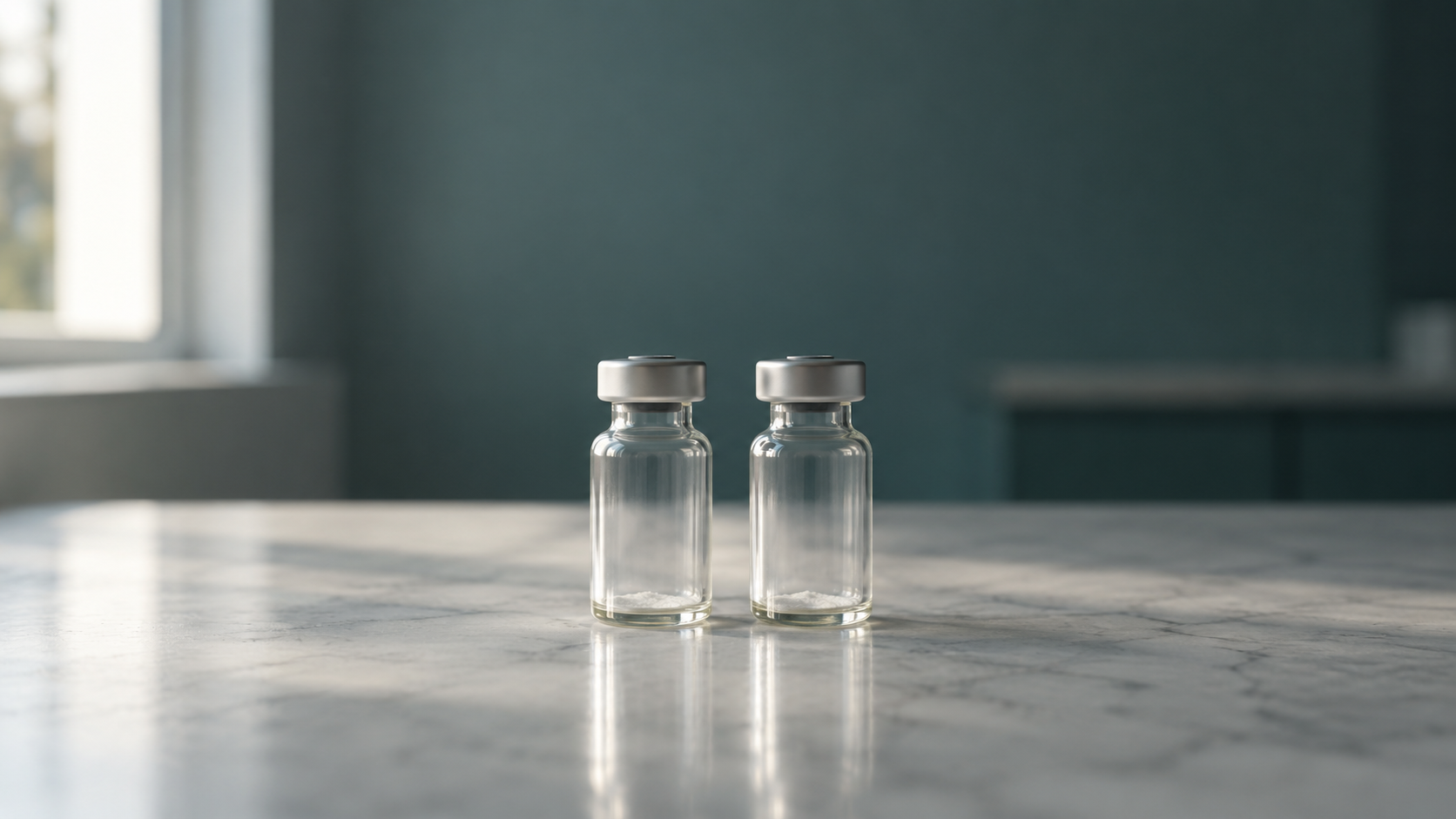
Almost certainly not, and the vial is not empty.
Ten milligrams of lyophilised peptide, which just means freeze-dried, is about the size of a few grains of salt, spread across the bottom of a vial built to hold two millilitres of liquid. A thin film, a scattering of flakes, or nothing you can see at the angle you are holding it: all normal.
The uncomfortable part is the other half of the answer. Looking at a vial tells you nothing about what is in it, in either direction. A full-looking cake is not evidence of a good vial, and an empty-looking one is not evidence of a bad one.
So the question worth asking is not what it looks like. It is what the seller will show you.
What the vial sizes look like across the market:1
- 10 mg is the most common vial size, in 2,057 listings
- 5 mg is next, in 1,005
- Sizes run from 1 mg to 10,000 mg
- 48 compounds are sold across a fivefold or wider size range, so one seller ships near-identical vials with very different labels
Why 10 mg looks like almost nothing
Weigh it out and the surprise goes away.
A milligram is a thousandth of a gram. Ten milligrams is a hundredth of a gram, which is roughly a tenth of what you would get in a pinch of salt. Put that in a glass vial two or three centimetres tall and it occupies a sliver of the bottom.
Freeze-drying makes it look like even less. Lyophilisation removes water under vacuum from a frozen solution, and what remains holds the shape of what was there before: an airy, porous structure that can collapse into a film, flake off the glass, or end up as a smear you only see when you tilt the vial against the light.
Most of what people describe as an empty vial is a cake that has detached and is sitting somewhere they have not looked, including on the underside of the stopper.
Why 10 mg and 60 mg look the same
Because the number on the label is mass, and what you see is volume, and those two come apart completely at this scale.
A 60 mg vial holds six times the mass of a 10 mg vial. Six times almost nothing is still almost nothing, against the empty space in the vial. At a glance across a bench, both look like a glass tube with a trace of white in the bottom.
Two other things flatten the difference further. The cake's size depends on how much liquid was frozen, not how much compound was in it, so a vial filled with 1 mL of a dilute solution and one filled with 1 mL of a concentrated solution produce similarly sized cakes. And some products include a bulking agent, mannitol or a sugar, specifically to make a visible cake. Two vials with the same peptide mass can look very different if one has a bulking agent and the other does not.
In our September capture, vial sizes run from 1 mg to 10,000 mg across the compounds we track, with 10 mg the single most common size by a wide margin.1 Forty-eight compounds are sold across a size range of five times or more, which means the same seller is shipping visually similar vials with very different labels.
The vacuum test, and what it does not prove
The one physical check available before you commit the vial, and it is worth knowing its limits.
Many lyophilised vials are sealed under partial vacuum, because the freeze-drying cycle ends with the chamber evacuated and the stoppers seated inside it. When you push a needle through the stopper on one of those, air moves in rather than out, and if you have added no liquid yet, you can feel the plunger want to draw.
What a vacuum tells you: the seal has held since manufacture. That is genuinely useful and it is the only thing about the glass that is.
What it does not tell you: anything about the contents. A correctly sealed vial of nothing holds a vacuum exactly as well as a correctly sealed vial of peptide.
And the absence of a vacuum is weaker evidence than people think. Not every product is vacuum-sealed, some are backfilled with nitrogen, and a vial can lose vacuum in transit through a stopper that was marginally seated without anything else being wrong. Treat no vacuum as a reason to look harder, not as proof of anything.
The reconstitution test
The most informative thing you can do, and you have to commit the vial to do it.
Add your diluent slowly down the side of the glass and watch the bottom. Powder that is present does something visible: the cake lifts, clouds briefly, and clears. A film adhering to the glass detaches and goes into solution over a few seconds to a few minutes.
An actually empty vial does none of that. The liquid goes in and looks like liquid immediately, with no moment of turbidity at all.
That moment is worth watching for, because it is the only direct observation available to you at home. It still does not establish identity, mass or purity. It distinguishes something from nothing, which is the question most people are actually asking when they say the vial looks empty.
Two practical notes. Do it against a dark background, where a brief cloud is far easier to see than against a white wall. And if you are going to dispute anything, photograph the vial before this step, because afterwards the evidence is gone.
What you are actually looking at
Five things people describe, and what each one means.
| What you see | What it is | Does it mean anything is wrong? |
|---|---|---|
| A thin white film on the glass | The cake, dried flat against the surface | No |
| Loose flakes or a cracked disc | A cake that broke up in transit | No |
| A small intact puck at the bottom | A cake that survived the journey | No |
| Powder on the underside of the stopper | The cake detached and landed there | No |
| Nothing visible at any angle | Usually a very thin film, occasionally a genuinely empty vial | Only the reconstitution test will tell you |
| Yellow or brown colouring | Degradation or contamination | Yes, stop |
| Liquid where powder should be | Melted or moisture has got in | Yes, stop |
The first five are variations on normal and tell you nothing about the contents. The last two are the only appearances that are evidence of a problem.
Can you tell quality by looking at the vial?
No. Two short lists, and the second one is longer.
What it can tell you. Whether something is physically present. Whether the vial is cracked or the seal is lifted. Whether the contents have turned brown or yellow, which is a real signal. Whether there is liquid in a vial that should contain powder, which means it has partly melted or absorbed moisture.
What it cannot tell you. The mass. The identity. The purity. Whether it is the compound on the label or a cheaper one. Whether it contains anything active at all.
That second list is the whole problem. The visual check people perform on arrival is answering a question the vial cannot answer.
How do you know what is really in the vial?
Not from the vial. Every real answer is indirect.
A certificate of analysis for your lot. Not a generic one on the website, a document naming the batch you received. Our COA guide covers what to look for and what makes one worthless.
Third-party testing. Some buyers send samples to a lab. It costs more than most vials and it is the only direct answer available.
Consistency with what you expected. A vial that reconstitutes clear, at the volume you planned, with no particles, is behaving normally. That is weak evidence, and it is better than appearance.
What happens over weeks. Effect or absence of effect over a reasonable period is slow, confounded and unreliable, and it is still more informative than looking at the glass.
Why advice on this contradicts itself
Ask in a forum and you will get two confident answers.
One says an empty-looking vial is a scam and you should dispute the charge. The other says it is always normal and to stop worrying.
Both are describing something real. Vials do arrive underfilled or with nothing in them, and the overwhelming majority of empty-looking vials are correctly filled. The difference between the two cases is not visible, which is why both camps can argue from experience and neither can settle it by eye.
What the first camp is right about is that it happens. What the second camp is right about is that the appearance is not how you would know.
When should you contact the seller?
In a handful of situations the look of the vial is evidence of something.
The vial is visibly damaged, cracked or has a lifted or missing seal. The contents are brown, yellow or discoloured. There is liquid where powder should be. The stopper is depressed or the vial has no vacuum when punctured, on a product that should be under vacuum. The label is missing, wrong or does not match what you ordered.
Those are concrete and documentable. Photograph them before opening anything, because a seller's first question will be what it looked like on arrival, and a photograph taken after you have handled it is worth much less.
An empty-looking vial with an intact seal and a white or colourless trace is none of these, and a dispute on that basis will not go well.
Common questions
Is it normal for a peptide vial to look empty?
Yes. Ten milligrams of freeze-dried powder is roughly a tenth of a pinch of salt and can form a thin film, flake off the glass, or stick to the underside of the stopper. In our data the most common vial size is 10 mg, so most vials people receive look like this.
Why do 10 mg and 60 mg vials look the same?
Because you are looking at volume and the label states mass. Six times a very small mass is still a very small volume in the same glass vial. Cake size also depends on how much liquid was freeze-dried and whether a bulking agent was used, neither of which tracks the peptide mass.
Can I tell how much is in the vial by looking?
No. Appearance establishes that something is present and nothing else: not mass, not identity, not purity.
My powder is stuck to the rubber stopper. Is that a problem?
Common and not in itself a problem. The cake detaches in transit and lands wherever it lands. It dissolves the same way once the diluent is in.
What if I can see nothing at all?
Tilt the vial against a dark background and look at the base and the stopper. If you still see nothing, the fastest test is to reconstitute and watch: powder that is present behaves differently from an empty vial when liquid goes in.
Does a vacuum mean the vial is genuine?
It means the seal has held since manufacture, which is worth knowing and is the only thing the glass can tell you. An empty vial sealed correctly holds a vacuum just as well. Absence of a vacuum is also weak evidence, since not every product is vacuum-sealed and a stopper can lose it in transit.
How can I tell if there is anything in the vial at all?
Reconstitute it against a dark background and watch the first few seconds. Powder clouds briefly and clears; an empty vial just looks like liquid going in. That distinguishes something from nothing, and nothing more.
My vial looks empty. Did the seller scam me?
Almost certainly not, and the appearance is not how you would know either way. Ten milligrams of lyophilised powder can be invisible at the wrong angle. Underfilled vials do exist, and they look the same as correctly filled ones, which is why the answer has to come from a certificate of analysis for your lot rather than from the glass.
How do I know if my peptide is fake?
Not by looking at it. Appearance establishes that something is present and nothing else. The only direct answer is a certificate of analysis naming your lot, or sending a sample to a lab yourself.
Should I weigh the vial?
A kitchen scale cannot resolve 10 mg, and weighing a sealed vial measures the glass and the stopper too, which vary by more than the contents weigh. It does not work.
When should I contact the seller?
When the seal is lifted or missing, the glass is damaged, the contents are discoloured, there is liquid where powder should be, or the label is wrong. Photograph it before doing anything else.
Does a bigger cake mean better quality?
No. A larger cake often means a bulking agent or a larger fill volume. It says nothing about how much active compound is present.
Sources
- Peptide Decoding vendor price capture, 29 September 2026. peptidedecoding.com/prices. Our own data, counting one priced product at one seller as a listing: 7,534 listings across 151 sellers. Vial sizes stated in milligrams run from 1 mg to 10,000 mg; 10 mg is the most common single size, appearing in 2,057 listings, followed by 5 mg in 1,005. Forty-eight compounds are listed across a size range of five times or more between their smallest and largest vial.
Citing this page. Peptide Decoding. My Peptide Vial Looks Empty. Is That Normal? Vial size data from the 29 September 2026 capture. https://peptidedecoding.com/guides/vial-looks-empty