
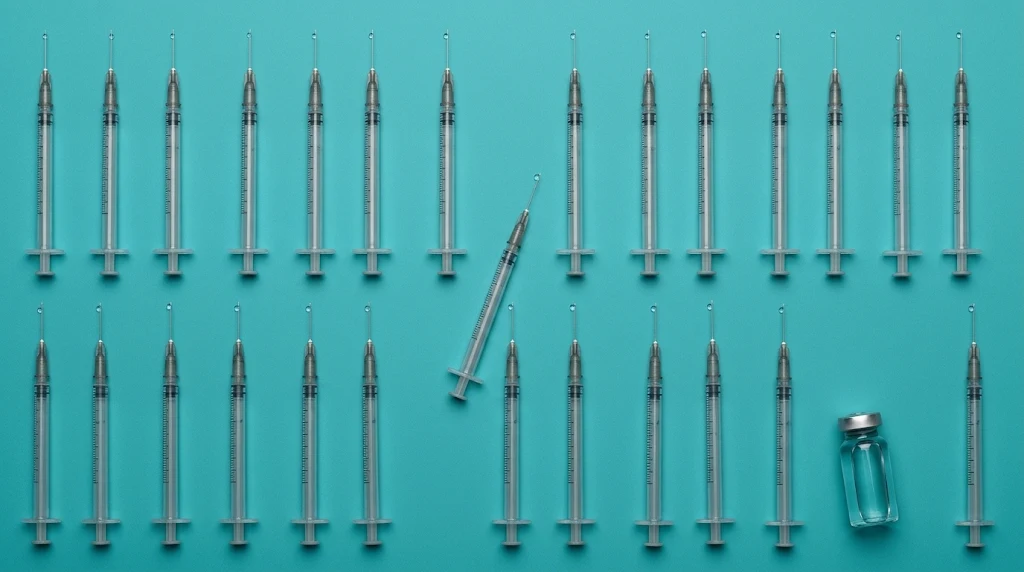
A standard insulin syringe holds back about 1.3 microliters of liquid after the plunger bottoms out, the volume known as syringe dead space.1 On a U-100 barrel that is roughly an eighth of one unit mark, between two lines you could not tell apart by eye. Syringes with a detachable needle measured five to thirteen times worse in the same experiment, between 7.5 and 17.8 microliters.1 Those 2015 figures were checked November 10, 2026, and the gap comes down to one design feature. The syringe most peptide users already own is the low-loss option, and the setups people assemble for a wider drawing needle keep a real share of the draw. Every cost-per-dose figure, this site's included, counts the milligrams on the label and not the milligrams that arrive.
What is dead space, and where does it sit?
Dead space is the residual volume remaining inside the syringe and the needle once the plunger has been depressed as far as it travels. Pfizer's extraction guidance for its COVID-19 vaccine uses that definition and treats the measurement as operational, establishing 0.035 mL as the maximum for a syringe and needle combination expected to deliver six doses from a single vial.2 A 2023 analysis of vaccine wastage quantified it gravimetrically. Fill the syringe to its highest graduation, empty it, then weigh whatever remains and read grams as milliliters.3
Physically the residual occupies three separate spaces. There is the conical interior of the hub where a detachable needle seats, the gap between the end of plunger travel and the entrance to the needle, and the lumen running the length of the needle itself. Bonding the needle directly onto the barrel almost eliminates the first of those three. That single manufacturing difference accounts for most of the variation in the measurements below.
How much does an insulin syringe hold back?
The 1.3 microliter measurement comes from a 2015 virology study that filled syringes with dye, emptied them, and quantified whatever remained.1 Residual volume was incidental to the investigation. Its authors were determining how long hepatitis C stays infectious inside a used syringe, and the volume of trapped liquid is the mechanism that answers that question, so the measurement is a byproduct of research with no commercial interest in its outcome.
That paper also reports the established figure for fixed-needle syringes from earlier literature as 5 microliters or below.1 Its own measurement finished comfortably underneath that.
Insulin syringe vs detachable needle: how big is the difference?
Each row below pairs one configuration from that study with its residual volume, read against two draw sizes on a U-100 barrel. Nothing in the table is a dose. Every percentage is one volume divided by another.
| Setup | Residual (mcL, microliters) | Share of a 10-unit draw | Share of a 4-unit draw |
|---|---|---|---|
| 1 mL insulin, needle bonded to barrel, 27G | 1.3 | 1.3% | 3.2% |
| 1 mL tuberculin, detachable 25G | 7.5 | 7.5% | 18.8% |
| 1 mL tuberculin, detachable 27G | 7.7 | 7.7% | 19.2% |
| 2 mL barrel, reduced-dead-space 25G needle | 8.7 | 8.7% | 21.7% |
| 2 mL barrel, detachable 25G | 17.0 | 17.0% | 42.5% |
Barrel capacity matters independently of the needle, since every 2 mL configuration performed worse than every 1 mL configuration. Syringes marketed specifically as low dead space are the odder result. One of them, fitted with an ordinary needle, measured between 13.9 and 17.8 microliters depending on which needle was attached. That is worse than a plain 1 mL tuberculin syringe.1
A low-dead-space barrel carrying a conventional needle is not a low-dead-space configuration. Liquid accumulates in the hub and the lumen. A low-dead-space claim means little without naming the needle it was measured with.
Why does another study report much larger volumes?
A 2023 analysis of vaccine waste weighed the same property. It came out far higher. Its lowest pairing, a 1 mL syringe with a 1 inch 22G needle, held 0.0433 mL, about 43 microliters. Its worst, a 3 mL syringe with a 1 inch 21G needle, held 0.1228 mL.3 Across nominally comparable 1 mL detachable setups that runs roughly five times the 2015 dye figures, so the two sets disagree and both belong here.
Method accounts for most of the gap. Dye measurement in 2015 recorded what stayed after the plunger was fully depressed.1 Weighing in 2023 filled each syringe to its top graduation, expelled the contents to mimic administration, and recorded the difference, with no statement in its methods about whether the plunger went all the way down. That figure can therefore include liquid a complete push would have cleared.3 Needle bore differs as well, since 1 inch 21 and 22 gauge needles carry far more lumen volume than the 27 to 31 gauge needles bonded to insulin syringes.
For this page the 2023 figures are the weaker pair, because what matters here is what remains after a full push, and that is what the dye method measured. Those numbers describe something else, the loss a vaccination program takes across a whole vial.
What does dead space do to cost per dose?
Proportionally, small draws suffer most. Residual volume is fixed, so the smaller the quantity inside the barrel, the larger the fraction abandoned there. A 10-unit draw through a bonded-needle insulin syringe surrenders 1.3 percent. That same syringe loses 3.2 percent of a 4-unit draw. Figures accurate as of November 10, 2026.
For the syringe most people already use, that sits below the other discrepancies in the chain. Net peptide content occupies a position further up the same calculation and disturbs it considerably harder, because a purity percentage on a certificate compares peptide against peptide and establishes nothing about how much of the vial is peptide. Our guide on what 99% purity actually means examines that gap. A vial whose net content falls beneath its label has already displaced the concentration before any syringe touches it.
The arithmetic turns on the draw-and-swap habit. Someone drawing through a wider detachable needle and then exchanging it for something finer to inject is operating with the larger residual figure twice over, and on a small draw that represents a fifth to two fifths of the barrel staying behind. The cost per dose tool and the cost per dose guide both calculate from the labeled vial size, as every such calculation does. Dead space is one leak in that assumption. It is also the only one you can settle by picking up the syringe and checking whether the needle comes off.
Where else does peptide go missing?
Peptide goes missing in four places, ordered roughly by how substantially each one moves the number:
- Net peptide content beneath the labeled milligrams, displacing concentration for every dose in the vial
- Liquid nobody can withdraw, because a needle cannot reach the final portion of it at the base of a tilted vial
- Whatever is expelled while clearing air from the barrel before injecting
- The residual volume measured above, abandoned inside the syringe afterward
Only the last of those four carries a measured figure here. The other three are mechanical certainties with no number attached.
What has not been measured?
Every figure on this page was generated with water or with dye, never with a reconstituted peptide solution. Surface adsorption, the tendency of peptides to adhere to plastic, would operate on top of the volumes above. A search through PLOS, PMC and Europe PMC returned no measurement of adsorption for a reconstituted peptide drawn into a disposable insulin syringe. That is an absence across three indexes, not evidence that nobody has investigated it.
The 2015 study additionally carries a correction notice published in the same journal in December 2015, and repeated attempts to retrieve that notice failed.1 Residual figures reproduced here were confirmed identically against two independent copies of the original article, so they arrive with that verification and that gap both recorded.
Lot-to-lot variation in hub geometry across the insulin syringes actually sold remains unmeasured. The 1.3 microliter figure represents one model from one manufacturer in one experiment.
So the practical check is brief. Establish whether the needle separates from the syringe, because that single feature distinguishes the 1.3 microliter column from the 17 microliter one. Anyone drawing through one needle and injecting through another is governed by the larger figure. The concentration entering any calculator should be the concentration the vial actually contains, a question about net peptide content and testing, not about the syringe.
Common questions
Am I wasting peptide every time I inject?
On a bonded-needle insulin syringe you lose about 1.3 microliters per injection, or 1.3 percent of a 10-unit draw. Through a detachable needle that share runs several times higher. The larger waste on most vials sits in net peptide content, not in the syringe.
Should I rinse the syringe to recover what is left?
Residual volume sits below the smallest graduation on the barrel, so measuring what came back, or what the rinse did to the concentration, becomes impossible. Introducing water into a used syringe also surrenders sterility. The quantity at stake on an insulin syringe is approximately an eighth of a unit.
Does pulling the plunger back and pushing again clear the dead space?
Retracting the plunger draws air into the barrel, and expelling that air displaces some liquid from the lumen. The hub does not empty. Every published measurement was recorded after the plunger had been fully depressed, so 1.3 microliters is what remains following a normal complete push.
Is a bigger syringe always worse?
Within the measured set, yes. Every 2 mL configuration retained more than every 1 mL configuration, from 8.7 microliters at best to 17.8 at worst. Barrel diameter and hub volume both increase alongside the capacity of the syringe.
Does dead space explain a vial running out early?
Dead space alone does not explain it. At 1.3 microliters per injection, accumulated loss across a vial's worth of draws stays small beside net peptide content beneath the label, or a draw volume calculated from a concentration the vial never contained. Our guide on why two calculators disagree addresses the second possibility.
Are syringes marketed as low dead space worth looking for?
The description characterizes the barrel, while the measurements show the needle determining the outcome. One low-dead-space barrel in that study, fitted with a conventional needle, measured worse than a plain tuberculin syringe. A bonded-needle insulin syringe already occupies the low end without any such claim printed on the package.
Sources
Sources
- Binka M, Paintsil E, Patel A, Lindenbach BD, Heimer R. Survival of Hepatitis C Virus in Syringes Is Dependent on the Design of the Syringe-Needle and Dead Space Volume. PLoS One. 2015;10(11):e0139737. DOI 10.1371/journal.pone.0139737. PMID 26536599. https://journals.plos.org/plosone/article?id=10.1371%2Fjournal.pone.0139737 - residual volumes for all syringe and needle pairings, and the 5 microliter literature figure for fixed-needle syringes. A correction notice was published at PLoS One 2015;10(12):e0146088 and could not be read in this session. read via a reproduction ↩1 ↩2 ↩3 ↩4 ↩5 ↩6 ↩7
- Information about Low Dead-Volume Syringes and/or Needles for Pfizer-BioNTech COVID-19 Vaccine. Pfizer Canada ULC, document PP-CVV-CAN-0030-EN, copyright 2021. https://www2.gnb.ca/content/dam/gnb/Departments/eco-bce/Promo/covid-19/ldv-info-pfizer-biontech-vaccine.pdf - the definition of dead volume and the 0.035 mL ceiling for a six-dose extraction. read via a reproduction ↩1
- Pessoa-Gonçalves YM, de Jesus MA, Desidério CS, Minchio IC, Louzada MJ, Shimano AC, Oliveira CJF. Understanding the Relationship between Vaccine Supply Dead Space and Wasted COVID-19 Vaccine Doses. Rev Soc Bras Med Trop. 2023;56:e0353-2023. DOI 10.1590/0037-8682-0353-2023. PMID 37792841. https://pmc.ncbi.nlm.nih.gov/articles/PMC10550090/ - the gravimetric method for measuring dead space, Table 1 for the per-syringe and per-needle volumes, and the Results for the 0.0433 mL and 0.1228 mL combination figures. read via a reproduction ↩1 ↩2 ↩3