
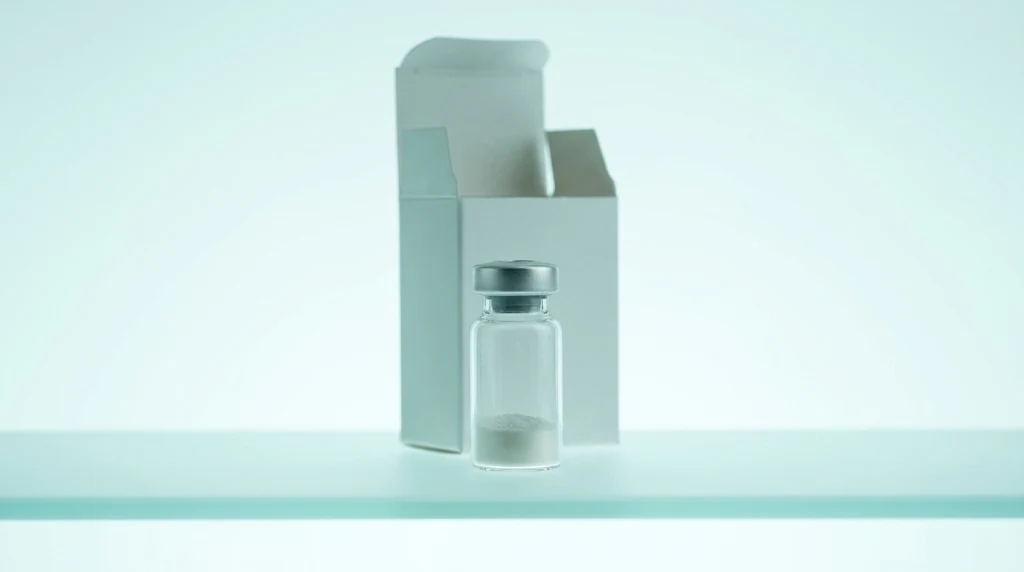
Tesamorelin is an FDA-approved peptide that ships the way gray-market peptides ship, as a dry powder in a small glass vial. Its label tells you to keep that vial inside its original box to protect it from light.1 The same label holds the powder at controlled room temperature instead of in a refrigerator, and gives the mixed solution seven days.1 A photostability test treats 1.2 million lux hours as the meaningful dose, and reaching it takes weeks of continuous light.2 A light instruction on an approved label describes a vial and its carton, tested as a pair. It does not describe the molecule inside. Semaglutide carries two different light instructions on one label, depending on which container it arrives in.3
Which approved peptide labels say anything about light?
Four of them address light. They do not all say the same thing.
Tesamorelin's label is the one to read first, because its container matches what most readers hold. It is supplied as a white to off-white lyophilized powder in a single-patient-use vial. The label stores it at 20 to 25 degrees Celsius, permits excursions from 15 to 30 degrees, keeps it in its original box to protect it from light, and prohibits freezing.1 Its reconstituted solution remains at that same temperature and is discarded seven days after mixing.1
Tirzepatide is the plainest of the four, because both of its approved presentations carry an identical instruction to store the product in its original carton to protect it from light.45
Semaglutide splits. Its pens are kept in the original carton until administration, after which the instruction becomes protection from excessive heat and sunlight.3 The single-dose prefilled syringes are given a different sentence altogether, requiring protection from light and retention in the original carton until administration.3 One molecule, from one manufacturer, in a single label document, carries two separate instructions.
"Store EGRIFTA WR 11.6 mg vial at room temperature at 20°C to 25°C (68°F to 77°F) in the original box to protect from light; excursions permitted to 15°C to 30°C (59°F to 86°F)"1
"Store reconstituted EGRIFTA WR at room temperature at 20°C to 25°C (68°F to 77°F). Discard unused solution of EGRIFTA WR 7 days after mixing. Do not freeze."1
For the semaglutide pens:
"OZEMPIC must be kept in the original carton until time of administration."3
"Keep the pen cap on when not in use. OZEMPIC should be protected from excessive heat and sunlight."3
For the single-dose prefilled syringes:
"Protect OZEMPIC from light. OZEMPIC must be kept in the original carton until time of administration."3
"Store ZEPBOUND in the original carton to protect from light."4
All four labels were read on November 11, 2026. The tesamorelin label is revised 3/2025, the semaglutide label 5/2026, and the tirzepatide labels 4/2026.1345
Why does one drug get two different light instructions?
Because the sentence is the output of a packaging determination, not a verdict on the peptide.
Photostability testing of a new drug product follows the ICH Q1B guideline, and that guideline prescribes an escalating sequence. The product is evaluated fully exposed, then within its immediate pack, then within its marketing pack, meaning the immediate container together with secondary packaging such as a carton. Testing terminates at whichever stage demonstrates that the product is adequately protected.2 Where the immediate container is already impenetrable to illumination, an aluminum tube or can, only the directly exposed product is normally evaluated.2
So a label sentence answers a single question: what had to be wrapped around this product before it passed. A pen barrel with a cap, held in a hand for a few seconds a week, passed on different terms than a thin-walled syringe. The molecule never changed.
That distinction does not transfer. A clear glass vial sold for research use has no carton behind it and no photostability determination in front of it, so no label sentence is available to inherit. Reading tirzepatide's carton instruction across to an unboxed vial overstates what was demonstrated. Semaglutide's heat-and-sunlight wording, applied to that same vial, understates it. Neither sentence was written about that container.
How much light is light, in a photostability test?
Q1B sets the confirmatory exposure as a minimum total dose. The specification is at least 1.2 million lux hours of overall illumination, plus at least 200 watt hours per square meter of near-ultraviolet energy in the 320 to 400 nanometer band.2 A dose is not a duration. Dividing 1.2 million lux hours by a room's illuminance returns the hours needed to accumulate it: 1,200 hours at 1,000 lux, or roughly 50 days, and 2,400 hours at 500 lux. Nobody has published the illuminance of your kitchen or your closet, so what those figures establish is the scale of the exposure and not a date to work to. The accumulated dose a regulator treats as meaningful requires weeks of continuous illumination, not the two minutes a vial spends on the counter warming up.
Near-ultraviolet energy is the second half of that specification, and it is the half a window alters. Ordinary window glass eliminates most UVB while transmitting a considerable proportion of UVA, and the transmitted band sits inside the range Q1B identifies. A vial on a sunlit windowsill accumulates dose on both axes simultaneously.
Powder or solution: which one is actually at risk?
Powder is the stable form. Tesamorelin's label is the one document that puts a number on each.
- Dry powder. Controlled room temperature, 20 to 25 degrees Celsius, in its original box, not frozen. No day count at all until the expiration date on the vial.1
- Reconstituted solution. Same temperature range, in use, discarded seven days after mixing.1
That seven-day figure deserves attention, because community practice for a reconstituted gray-market vial is conventionally 28 days, and our guide on the 28-day question covers where that number originates. The approved powder-in-a-vial product allows its own mixed solution a quarter of that interval. The dry state is where peptide stability resides, and water starts every clock, illumination included.
Which residues does light attack?
Photodegradation is not uniform across peptides. It concentrates on a short list of residues: methionine, cysteine, tryptophan and tyrosine.
An analytical note published in 2026 by Waters measured the effect directly, on model peptides rather than on anything sold in a vial. Two enolase peptides containing methionine, tryptophan and tyrosine underwent oxidation while traversing the illumination of a photodiode array detector during an ordinary chromatography run. Interposing an optical filter between the lamp and the flow cell restored the native signal and reduced the oxidized peaks by 84 and 86 percent.6 The note records that its filtered and unfiltered measurements came from separately prepared samples collected at different times, so the percentages themselves are soft.6 What holds is the direction. Seconds of the wrong light, on susceptible residues, produced a measurable change.
Now read that against the labels. Semaglutide's molecular formula is C187H291N45O59, and tirzepatide's is C225H348N48O68.35 Neither contains sulfur. The absence of sulfur eliminates both methionine and cysteine, so two of the four susceptible residues are structurally absent from the two compounds people buy most. Tesamorelin's formula does carry sulfur, C221H366N72O67S for the acetate salt, and its label confirms a tyrosine at the N-terminal position where the hexenoyl group attaches.1
The limitation of that reading matters as much as the reading. A molecular formula excludes sulfur-containing residues and establishes nothing else. Tryptophan and tyrosine remain invisible in a formula, and none of these labels prints a complete amino acid sequence. Those two residues cannot be settled from label text at all.
What has not been measured?
The absence claim on this page is the weakest thing on it, so it comes with the list of places it was checked. Q1B governs new drug substances and products, so a photostability conclusion is a registration deliverable.2 I searched for a published photostability result on a research-use peptide vial in the four approved labels above, in the Q1B guideline's own scope, and across the FDA documents this site tracks on its compound status page. None of those three carries one, and three places is not an exhaustive search.
Three further questions have no public answer:
- Whether the amber glass some vials arrive in attenuates enough near-UV to matter for a specific peptide.
- Whether a sequence-level prediction holds up for compounds whose labels print no sequence.
- Whether photodegradation products of these peptides do anything in a person, as opposed to simply reducing how much intact peptide is left.
What does careful handling look like?
Keep the vial in whatever box it arrived in, and keep that box closed. The habit reproduces the only intervention these approved labels actually require.
Treat the dry powder as the durable state and the reconstituted vial as the one running a clock, with the shorter of your two candidate numbers winning. Keep both away from direct sun. Windowsills are the worst spot, because the near-ultraviolet component of the exposure is highest there. Position a refrigerated vial away from the cooling element, since freezing is prohibited on every label here.1345 For any compound carrying an approved label, consult that label's own storage section before accepting a generalization from a storage guide, this one included.
Common questions
Does a clear glass vial need to be kept in the dark?
Clear glass contributes no light protection, and no approved label asks a transparent container to protect its contents unaided. Every light instruction above is satisfied by a carton surrounding the container.1345 Keeping the vial boxed reproduces that arrangement at no cost.
Is amber glass enough?
Amber glass attenuates part of the spectrum, and no published determination establishes how much protection it confers on a specific research-use peptide. Q1B evaluates a product inside its actual container and stops once adequate protection is demonstrated, so the answer for any particular vial is empirical and unpublished.2
Does a refrigerator count as dark?
A closed refrigerator is dark, and the interior lamp operates only while the door stands open. Temperature is the instruction to verify first, since tesamorelin's powder is stored at controlled room temperature and not refrigerated.1 Our guide on storing peptides before and after mixing covers temperature.
Can I leave a vial on the counter while it warms up?
The exposure dose Q1B treats as meaningful accumulates over weeks of continuous illumination, so a few minutes of ambient indoor light is not the variable to worry about.2 Direct sunlight is different. It loads the visible and near-ultraviolet axes simultaneously, at a far higher rate.
Does light matter for the powder or only after mixing?
Both, and the label instructions are directed at the powder. Tesamorelin's box requirement applies to the unreconstituted vial.1 Reconstitution introduces separate problems, the day count among them, and our guide on a cloudy vial covers what a visible change does and does not establish.
Related reading
- How to Store Peptides: Before and After Mixing
- Do I Have to Throw My Vial Out at 28 Days?
- Can You Freeze Peptides?
- My Peptides Arrived Warm. Are They Ruined?
- My Peptide Went Cloudy. Is It Ruined?
- Traveling With Peptides
- How to Read a Peptide COA
Sources
- Waters application note, optical filtering strategies for PDA detection with mass spectrometry verification, 2026. https://www.waters.com/nextgen/ie/en/library/application-notes/2026/shielding-peptides-from-light-optical-filtering-strategies-for-pda-detection-coupled-with-mass-spectrometry-verification.html read via a reproduction ↩ ↩