
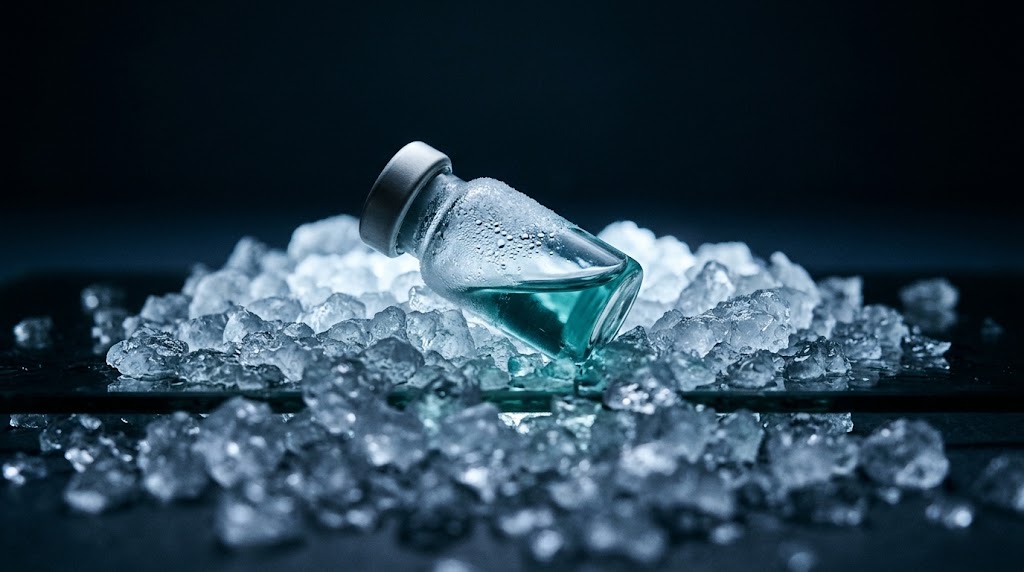
No approved peptide drug label tells you to freeze anything. Two that I read for this page say the opposite in plain words. Both are lyophilized peptide powders, the same physical form a research vial arrives in. That surprises people, because the freezer feels like the safest place in the house for something expensive and fragile.
The instinct is reasonable. Cold slows chemistry, and these are delicate molecules. What the instinct misses is that freezing is not simply more cold. Water expands, concentrates whatever it leaves behind, and forms surfaces that were not there before. Those three things are what the stability literature worries about.
Can you freeze a peptide vial?
Freezing a sealed vial of dry peptide powder and freezing a vial you have already mixed are two different questions with two different answers. Dry powder tolerates cold well, having already survived a freeze during manufacture. A reconstituted vial is mostly water, and water is where the trouble starts.
Neither of the two approved lyophilized peptide labels I read instructs freezing in either state. Both say room temperature for the sealed powder.12 One says to refrigerate after mixing and discard at 60 days.2 The other says to use the mixed solution immediately and discard what is left.1
Freezing the powder is probably unnecessary. Freezing a mixed vial carries a mechanism of harm that has been measured in proteins. No document written by a manufacturer who answered to a regulator recommends either one.
What do the labels on real peptide drugs actually say?
Glucagon is a 29 amino acid peptide supplied as a lyophilized powder, the same physical form as a research vial, so its label is a close parallel. Its storage instruction reads "[see USP Controlled Room Temperature] prior to reconstitution" followed by "Do not freeze."1 For the mixed product the instruction is "Use reconstituted glucagon solution immediately. Discard any unused portion."1
Chorionic gonadotropin is also supplied as a lyophilized powder. Its label says "Store at room temperature 20°C to 25°C (68°F to 77°F) [see USP Controlled Room Temperature]" and then "Do not freeze and do not shake."2 After mixing, "the reconstituted vial may be refrigerated between 2℃ to 8℃ (36℉ to 46℉) and must be discarded after 60 days," with the dosage section adding "REFRIGERATE AFTER RECONSTITUTION."2
Read side by side, those two labels agree on the direction. Both specify room temperature for the sealed powder, refrigeration at most after mixing, and no freezing at either stage.
Why does a lyophilized powder label say room temperature instead of freezer?
Room temperature works for a lyophilized powder because the water is gone. Chemical degradation in peptides mostly needs water to proceed, so pulling the water out removes the pathway rather than slowing it down. A molecule with nothing to react with does not need to be kept cold to stay still.
Freezer storage buys very little on top of that, and it introduces handling problems the room-temperature instruction avoids. A vial moved in and out of a freezer collects condensation on the glass and eventually inside it. The vial then holds exactly the water the manufacturing process spent money removing. Both labels land on room temperature with freezing ruled out, and the reasoning above is why that is not an oversight.12
A freezer is not actively dangerous for sealed dry powder, only unneeded. Handling a sealed sterile vial more than you have to carries its own small costs.
Is freezing the powder the same as freeze-drying it?
Freeze-drying and freezing are related processes separated by one decisive difference: whether the water leaves. Freeze-drying freezes the solution and then pulls the ice off as vapor under vacuum, so the peptide ends up dry. Putting a finished vial in a freezer does neither of those things to the powder, since there is no meaningful water left to freeze.
That difference explains why a powder has already been through a freeze and came out intact. Manufacturers add excipients, often a sugar such as sucrose or trehalose, specifically to protect the molecule through that step. Those excipients were designed for one controlled freeze under known conditions, not for repeated trips through a domestic freezer.
For a mixed vial the comparison breaks down completely. A mixed vial has the water back in it. A mixed vial in a freezer is the first half of lyophilization with none of the engineering and none of the vacuum.
What does freezing do to a peptide in solution?
Aggregation is the damage mechanism, and freezing appears on the standard list of stresses that cause it. A 2023 review of therapeutic peptide stability in aqueous formulations states that "stress conditions, such as freezing, heating, or agitation, may induce aggregation."3 Aggregates form when molecules that should stay separate stick together, through covalent or non-covalent bonds, and the process does not reverse on warming.
A 2024 review of lyoprotectants reports the freeze-thaw case directly, noting that "Irreversible aggregation upon freeze–thaw cycles was observed on lyophilized Rituximab antibody."4 Rituximab is a monoclonal antibody and not a peptide, a distinction that limits how far the finding carries. The word doing the work is irreversible.
Thawing a vial returns it to liquid. The molecules do not return to the state they were in before, and nothing visible in the vial distinguishes the two outcomes.
What is cryoconcentration, and why does it matter in a small vial?
Cryoconcentration is what happens to everything that is not water while the water turns to ice. A 2020 study of freeze-thaw in protein solutions found that "Not only protein is highly enriched during freezing but also salts of the buffer system."5 The same work described "traces of liquid water between the ice crystals with high concentrations of salt."5 Those pockets reach concentrations the formulation was never designed for.
Consequences followed in that study. High salt in those pockets "may result in product damage and activity loss during freezing."5 Soluble clumping "was enhanced by concentrating the protein and increasing salt concentration."5 Inside the ice, a formulation briefly becomes a much harsher solution than anybody designed.
Where the vial sat in the device mattered too. The authors reported that "the side regions of the freezing device show the highest concentrations of product after the freeze-thaw circle."5 Damage is uneven, and a single sample can miss it.
How much of the freeze-thaw research is on peptides at all?
Most of it is not. Of the three papers cited here, one reviews therapeutic peptides in aqueous solution and names freezing in a list of stresses without testing freeze-thaw.3 The freeze-thaw findings come from work on a monoclonal antibody and on protein solutions at manufacturing scale.45
Size is the reason to hesitate before carrying those findings across. An antibody is a large folded protein with structure to lose, and much aggregation damage is a story about unfolding. A 10 or 30 amino acid peptide has far less structure to disturb, so a mechanism that wrecks an antibody may do considerably less to a short chain. Nobody has published the comparison in a form that settles it.
Pointing that out cuts both ways. The protein literature probably overstates the risk to a short peptide, and it is still the only measured evidence anyone has. Treating it as proof of harm goes too far. Treating a short peptide as immune goes too far in the other direction.
Would a purity test even show freeze-thaw damage?
Probably not, and the 2020 study says so about its own method. The authors recorded a 28% reduction in total protein that "might be the result of insoluble aggregate formation."5 They then noted that size exclusion chromatography "is not capable of detecting the high particle size of insoluble aggregates."5 Material had left the measurement without failing it.
Carry that into the documents people actually receive. A certificate of analysis reports what the vial contained when the lab tested it, before shipping and before anything in your kitchen happened to it. A purity figure describes the soluble material presented to the instrument.
Insoluble aggregate can therefore sit in a vial while the paperwork still reads clean, and the paperwork is not wrong. It answered a different question at a different time.
What does the bacteriostatic water label say about storing a mixed vial?
Bacteriostatic water carries its own instruction, and it is more restrictive than most people expect. The label states "Do not store reconstituted solutions of drugs for injection unless otherwise directed by the manufacturer of the solute."6 Storage of a mixed vial is conditional on the drug's maker saying storage is acceptable.
That matters for research-labeled powder, because no manufacturer direction exists. Nobody has filed a stability program, nobody has set an in-use period, and the diluent's label defers to a document that was never written. Our guide on the 28 day figure covers where that number comes from and what it is measuring.
The same label gives the preservative concentration, "0.9% (9 mg/mL) or 1.1% (11 mg/mL) of benzyl alcohol added as a bacteriostatic preservative."6 Storage of the water itself is "20 to 25°C (68 to 77°F)."6 Nothing on it mentions freezing in either direction.
Does one freeze-thaw cycle matter, or is it the repeats?
Repeats are where the 2020 study put the emphasis, reporting that "longer freezing duration and several freezing cycles may enhance agglomeration severely."5 Both duration and cycle count appear in that sentence, pointing at cumulative exposure and not a single threshold event.
Practical reading of that is limited, because the study measured a protein at manufacturing scale and not a peptide in a 2 mL vial. Severely is the authors' word for their system. How much of it transfers to a short chain in a small glass vial has not been published.
One pattern does hold across the papers cited here. Nothing in them describes a freeze-thaw cycle as neutral, and the damage they describe accumulates instead of resetting. A vial that went through a power cut and came back sits in a different position from one cycled every week for a month. Our fridge power loss guide covers the temperature excursion case.
What happens if my vial froze by accident?
Two labels in this drug class answer that directly, and the answer is to stop using it. The tirzepatide labels state "Do not freeze MOUNJARO. Do not use MOUNJARO if frozen." and "Do not freeze ZEPBOUND. Do not use ZEPBOUND if frozen."7 That is an instruction and not an inference.
The two lyophilized peptide labels read for this page are quieter. Both say not to freeze, and neither adds a sentence about a product that was frozen anyway.12 A discard instruction does exist in this class, on the liquid pen labels, and it does not appear on either powder label.
Dry powder sealed in its vial has the strongest case for being unaffected. A mixed vial that froze and thawed has a measured mechanism of harm behind the concern and no way to check from the outside, because the Glucagon label's clear-solution test will pass a vial holding insoluble aggregate.15 Cloudiness, clumping and color change are what that test looks for.
Our guide to a fridge that lost power covers the accidental excursion in detail, including what each GLP-1 label allows and for how long. This page is about the freezer as a deliberate choice.
Does freezing stop bacterial growth in a mixed vial?
Cold suspends bacterial growth without undoing what already grew or sterilizing anything. Cold stops division. Organisms already present survive freezing well, and they resume when the vial warms. A freeze pauses the biology without resetting it.
Benzyl alcohol is what addresses the contamination side, at the concentrations the diluent label states.6 A preservative limits growth after each needle entry, the risk that the in-use clock on a multi-dose vial is really tracking.
Combining the two ideas gives the answer people are usually looking for. A freezer does not extend an in-use period, because the period counts contamination opportunities and not elapsed chemistry. Cold does not remove the contamination that entry events introduce.
Why do storage instructions disagree so much?
Documents written for different purposes produce different instructions, and the disagreement is mostly about who had to prove something. An approved label carries storage conditions that a manufacturer tested and a regulator accepted, tied to one formulation in one container with one stability program behind it.
Storage figures that circulate outside those documents have no such program attached. I have not cited any of them on this page. Every figure that is here carries a label section or a journal reference. A number with no document behind it cannot be checked, and repeating it would launder it into something that looks sourced.
What that leaves is a narrow set of claims and a wide set of unknowns. The narrow set is what two approved peptide labels and three peer-reviewed papers actually say. Everything beyond that, including the right answer for a specific research peptide in a specific buffer, has not been published.
What has not been measured?
Peptide-specific freeze-thaw data has never been measured. That gap accounts for most of the uncertainty on this page. No study cited here froze and thawed a short synthetic peptide in a reconstituted vial, measured what came out, and reported it.345 Every freeze-thaw figure on this page comes from a protein or an antibody.
Potency after freezing is also unmeasured for these compounds. For anyone deciding what to do, potency matters more than aggregate counts. Knowing the mechanism is not the same as knowing the outcome. Whether aggregation translates into less working material in a given peptide at a given concentration needs its own experiment.
Container and volume are the third unknown. That work was done at pilot scale in a freezing device, where position in the vessel changed the result.5 A 2 mL glass vial freezing in a domestic freezer is a different geometry cooling at a different rate. Nothing published says how the findings scale down.
What would settle it?
One experiment would settle most of it. Nobody has run it because no party has an interest in the answer. The design would take a common research peptide, reconstitute it and split it. One arm would go through a set number of freeze-thaw cycles. Both arms would then be measured for soluble purity and insoluble particle counts.
Potency would need to be in that design too, by an assay that reports activity and not only chromatographic purity. The 2020 study's warning about size exclusion chromatography missing insoluble aggregate is the reason.5 A purity-only readout can report a clean result while material has left the solution entirely.
Until that exists, the strongest statement available is the one these documents support. Two approved lyophilized peptide labels say room temperature and not the freezer. The freeze-thaw damage literature is real and is about larger molecules. Every confident answer on this subject comes from the gap between those two facts.
Common questions
Can you freeze peptides?
No approved peptide drug label instructs freezing, including the Glucagon and chorionic gonadotropin labels read for this page. Both specify room temperature for sealed powder, and both direct refrigeration or immediate use after mixing.12
Should I store lyophilized peptide powder in the freezer?
Room temperature of 20°C to 25°C (68°F to 77°F) is what the Glucagon and chorionic gonadotropin labels specify for sealed powder.12 Dry powder has little water left to drive degradation, so freezer storage adds handling and condensation risk without a documented benefit.
Is freezing worse for mixed peptides than for powder?
A mixed vial is mostly water, and a 2023 review of therapeutic peptides in aqueous solution lists freezing among the stresses that induce aggregation. Lyophilized powder has almost none left, and irreversible aggregation on freeze-thaw cycles has been reported for a lyophilized antibody.34
What is cryoconcentration?
Cryoconcentration is the concentrating of everything that is not water as ice forms, measured directly in a 2020 freeze-thaw study. That study found protein and buffer salts both "highly enriched during freezing," with liquid pockets between ice crystals holding "high concentrations of salt."5
Does freezing a vial extend how long it lasts?
Cold does not extend an in-use period, because the 28 day and 60 day clocks on multi-dose vials count contamination opportunities from needle entries instead of elapsed chemistry. A freezer suspends bacterial growth without removing organisms already introduced or sterilizing the contents.
My peptide vial froze by accident. Is it ruined?
The Mounjaro and Zepbound labels say "Do not use MOUNJARO if frozen" and "Do not use ZEPBOUND if frozen," so for those products the instruction is to stop.7 The two lyophilized peptide labels read here say not to freeze without addressing a vial that already did, and sealed dry powder has the strongest case for being unaffected.12
Can I tell by looking whether freezing damaged my peptide?
Cloudiness, clumping and color change are the documented visual signs, and the Glucagon label's instruction is to use the product only if the solution is clear.1 Clear liquid does not rule out insoluble aggregate. One study noted that its own chromatography could not detect it.5
Would a COA show freeze-thaw damage?
A certificate of analysis reports what a lab measured before shipping, and one 2020 study recorded a 28% drop in total protein that its own method could not see. That study noted that size exclusion chromatography "is not capable of detecting the high particle size of insoluble aggregates."5
Is one freeze-thaw cycle as bad as several?
Cycle count and duration both appeared in a 2020 study's finding that "longer freezing duration and several freezing cycles may enhance agglomeration severely," which points at cumulative exposure.5 That study measured a protein at manufacturing scale, not a peptide in a small vial.
Has anyone tested freeze-thaw on actual research peptides?
Not in these sources, since all three peer-reviewed papers behind this page studied protein solutions or the monoclonal antibody Rituximab. None of them and none froze and thawed a short synthetic peptide in a reconstituted vial and reported the result.345
Does bacteriostatic water change whether I can freeze a mixed vial?
The Hospira bacteriostatic water label says "Do not store reconstituted solutions of drugs for injection unless otherwise directed by the manufacturer of the solute."6 For research-labeled powder no manufacturer direction exists, so the condition that would permit storage is unmet.
Why do peptides get freeze-dried if freezing is a problem?
Lyophilization removes the water instead of leaving it as ice, and a 2024 review covers the protectants added to carry a molecule through that step.4 A finished vial sent back through a domestic freezer gets the freezing without the vacuum, the engineering or the protection those excipients were designed around.
Is a peptide more robust to freezing than an antibody?
Probably, though nobody has published the comparison, and the freeze-thaw findings here come from protein solutions and from Rituximab. Much aggregation damage involves large folded proteins unfolding. A short peptide has far less structure to disturb, so the findings cited here likely overstate the risk to a short chain.45
Does the freezer affect peptides still sealed in their original packaging?
Sources
- Glucagon for Injection (glucagon injection, powder, lyophilized, for solution), US prescribing information, Fresenius Kabi USA, LLC, sections 16.2 Recommended Storage, 2.3, and the Patient Information and Instructions for Use. Read at source via DailyMed. Quoted for the room temperature storage instruction, "Do not freeze.", the instruction to use reconstituted solution immediately and discard any unused portion, and the inspection instruction. Glucagon is a 29 amino acid peptide supplied as a lyophilized powder. ↩1 ↩2 ↩3 ↩4 ↩5 ↩6 ↩7 ↩8 ↩9 ↩10 ↩11 ↩12 ↩13
- Chorionic Gonadotropin for Injection, 10,000 USP units, US prescribing information, Fresenius Kabi USA, LLC, How Supplied and Dosage and Administration. Read at source via DailyMed. Quoted for "Store at room temperature 20°C to 25°C (68°F to 77°F) [see USP Controlled Room Temperature].", "Do not freeze and do not shake.", the statement that the reconstituted vial may be refrigerated between 2℃ to 8℃ (36℉ to 46℉) and must be discarded after 60 days, and "REFRIGERATE AFTER RECONSTITUTION." ↩1 ↩2 ↩3 ↩4 ↩5 ↩6 ↩7 ↩8 ↩9 ↩10 ↩11
- Nugrahadi PP, Hinrichs WLJ, Frijlink HW, Schöneich C, Avanti C. Designing Formulation Strategies for Enhanced Stability of Therapeutic Peptides in Aqueous Solutions: A Review. Pharmaceutics 2023;15:935. DOI 10.3390/pharmaceutics15030935. Read at source. Quoted for the statement that stress conditions such as freezing, heating or agitation may induce aggregation. This review names freezing among aggregation stresses and does not itself test freeze-thaw cycling. ↩1 ↩2 ↩3 ↩4 ↩5
- Karunnanithy V, Abdul Rahman NHB, Abdullah NAH, Fauzi MB, Lokanathan Y, Ng Min Hwei A, Maarof M. Effectiveness of Lyoprotectants in Protein Stabilization During Lyophilization. Pharmaceutics 2024;16(10):1346. DOI 10.3390/pharmaceutics16101346. Read at source. Quoted for the report of irreversible aggregation upon freeze-thaw cycles in lyophilized Rituximab, a monoclonal antibody and not a peptide, and for the freeze-concentrated phase description. ↩1 ↩2 ↩3 ↩4 ↩5 ↩6 ↩7
- Spadiut O, Gundinger T, Pittermann B, Slouka C. Optimization of Methodologies to Study Freeze/Thaw Processes in Drug Substance Bottles. Pharmaceutics 2020;12(4):382. DOI 10.3390/pharmaceutics12040382. Read at source. Quoted for cryoconcentration of protein and buffer salts, the liquid pockets of high salt concentration between ice crystals, product damage and activity loss during freezing, enhanced soluble agglomeration with concentration and salt, the highest product concentrations in the side regions after a freeze-thaw cycle, the effect of longer freezing duration and several cycles, the 28% reduction in total protein attributed to possible insoluble aggregate formation, and the statement that size exclusion chromatography cannot detect the high particle size of insoluble aggregates. This study measured a protein at pilot and manufacturing scale, not a peptide in a vial. ↩1 ↩2 ↩3 ↩4 ↩5 ↩6 ↩7 ↩8 ↩9 ↩10 ↩11 ↩12 ↩13 ↩14 ↩15 ↩16 ↩17 ↩18 ↩19
- Bacteriostatic Water for Injection, US prescribing information, Hospira, Inc., Description, Precautions and storage statements. Read at source via DailyMed. Quoted for "Do not store reconstituted solutions of drugs for injection unless otherwise directed by the manufacturer of the solute.", the benzyl alcohol concentration statement, and "Store at 20 to 25°C (68 to 77°F). [See USP Controlled Room Temperature.]" The label contains no reference to freezing. ↩1 ↩2 ↩3 ↩4 ↩5
- Mounjaro (tirzepatide) and Zepbound (tirzepatide) injection, US prescribing information, How Supplied/Storage and Handling. Verified at source by exact-phrase query against the openFDA drug label API field storage_and_handling (
https://api.fda.gov/drug/label.json). The query returned exactly one record for each of the full sentences "Do not freeze MOUNJARO. Do not use MOUNJARO if frozen." and "Do not freeze ZEPBOUND. Do not use ZEPBOUND if frozen." The surrounding section could not be read in full, because the fetch window does not reach section 16 on either record, so only these two sentences are quoted and nothing else about those labels is claimed here. Both are liquid pen and vial products, not lyophilized powders. ↩1 ↩2