
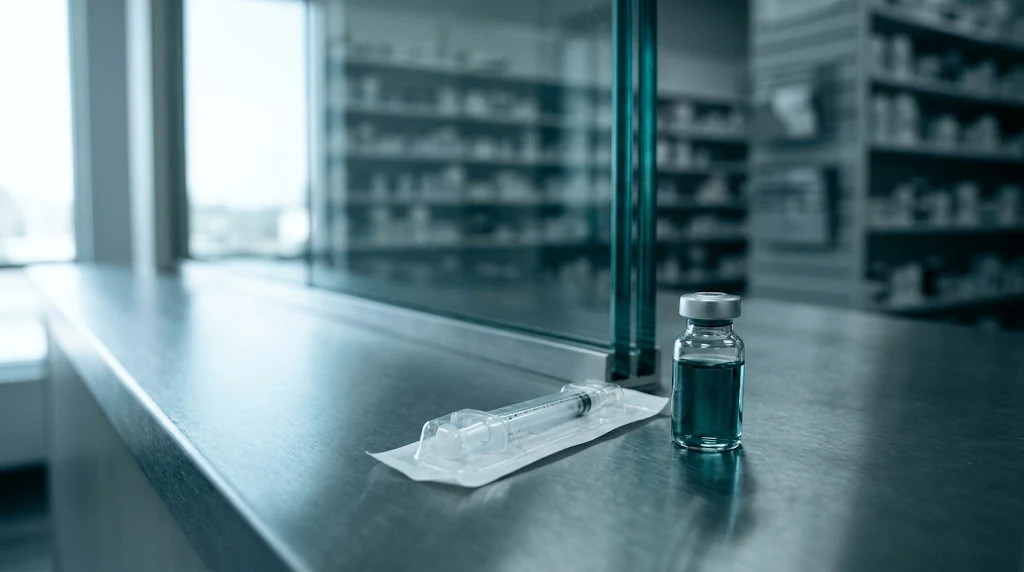
No federal rule puts a prescription between you and insulin syringes. The FDA cleared the best-known one for over-the-counter sale in March 2022, under the same regulation and the same product code as syringes that are cleared prescription only.12 Whether a pharmacy hands one over is determined by your state. The four states read at their own sources for this page run from no restriction at all to a cap of ten. One connection goes unmentioned everywhere else. The design feature that lets a syringe sell over the counter is a needle bonded permanently into the barrel. That same bond decides how much of your draw never leaves it.
Does the FDA require a prescription for a syringe?
No, and the agency's own paperwork shows it going both ways. Becton Dickinson's 0.3 mL insulin syringe was cleared on March 9, 2022 under 21 CFR 880.5860, the piston syringe regulation, as a Class II device with product code FMF. Its clearance summary records the device as over the counter, matching the predicate it was measured against.1
A device filed as Disposable Syringe with Needle was cleared six weeks earlier, on January 24, 2022. It sits under the same regulation and the same product code, with the hypodermic needle regulation added alongside. Its summary records it as prescription only.2
Two devices shared a regulation and a class, were cleared six weeks apart, and landed on opposite answers. Classification is not what decides it.
Why is one syringe over the counter and a near-identical one prescription only?
The filings differ in what each device claims to do. Neither document gives a reason for the prescription line, so what follows is what the two records show rather than an explanation either one offers.
| Insulin syringe, K212499 | Syringe with needle, K211482 | |
|---|---|---|
| Regulation | 21 CFR 880.5860 | 21 CFR 880.5860 and 880.5570 |
| Device class | II | II |
| Cleared | March 9, 2022 | January 24, 2022 |
| Intended use as filed | Subcutaneous injection of U-100 insulins | Injecting fluids into or withdrawing them from the body |
| Needle | Bonded into the barrel with adhesive | Luer slip or luer lock, detachable |
| Barrel sizes | 0.3 mL | 1 mL through 50 mL |
| Needle gauges | 29G, 30G, 31G | 18G through 30G |
| Type of use | Over the counter | Prescription only |
Figures from the two clearance summaries, read November 19, 2026.12
One device does a single named job that a person performs on themselves, at one small size, through a needle that cannot be swapped. The other is a general instrument offered in eight barrel sizes for putting anything in or taking anything out. Those are different products in all but the regulation they share.
What does a cleared insulin syringe actually guarantee?
A clearance guarantees sterility to a stated level. It says nothing at all about what you put inside.
The insulin syringe summary records gamma sterilization by cobalt 60 at a minimum dose of 20 kGy, a sterility assurance level of 10⁻⁶, and an endotoxin result meeting its limit by Limulus amebocyte lysate assay. The product is recorded as non-pyrogenic. The device was tested against ISO 8537 for insulin syringes and ISO 9626 for needle tubing, with a five-year shelf life.1 The other device records the same 10⁻⁶ sterility assurance level by ethylene oxide, with a three-year shelf life.2
Read that next to a research-labeled vial and the asymmetry is easy to miss. Regulatory scrutiny fell on the syringe, not its contents. It carries a clearance number, a sterility level somebody had to demonstrate, and a named standard. The vial carries whatever the seller tested for, normally identity and purity and not sterility. Our guides on reading a certificate of analysis and testing a vial yourself cover what those documents reach.
How do state rules differ on buying syringes?
State rules differ more than people expect. Four of them, read at source, show the spread.
| State | Prescription needed | Age | Quantity | Conditions on the sale |
|---|---|---|---|---|
| California | No | 18 or older | No limit on sale or possession | Stored behind the counter; a disposal option and counseling at the time of sale |
| New York | No, through a registered provider | 18 or older | 10 or fewer | No advertising of nonprescription sale; safety insert with every transaction |
| North Carolina | No | None stated | No limit | No identification required |
| Minnesota | No | None stated | No limit in the current text | Not openly available to customers; pharmacy certifies a disposal activity |
State sources read November 19, 2026.3456
California also records that an adult may possess needles and syringes for personal use, with no ceiling on what one person can buy or hold.3 New York's program is the tightest of the four, and it runs through providers who register with the state health department. The ten-syringe limit and the safety insert both come from that registration.4
Why do the state-by-state charts disagree with the states themselves?
Because the charts lag the statutes. Two of these four states have moved underneath them.
Delaware appears on chart after chart as a state requiring a prescription. Its current section says a licensed pharmacist, intern or pharmacy student may provide hypodermic syringes or needles, including pen needles, without a prescription to anyone who has reached 18, and must check identification for age. An act of the 151st General Assembly struck the earlier condition limiting this to people self-administering prescription medications. It also repealed the felony paragraph that once governed giving a syringe away.7
Minnesota appears on those same charts with a ten-syringe cap. Its 2026 statute, as published by the state's Revisor, sets no number at all. A pharmacy or pharmacist may sell unused needles and syringes without a prescription, provided the stock is kept where customers cannot reach it and the pharmacy certifies that it takes part in an activity supporting proper disposal. Minnesota last amended that retail subdivision in 2023.6
Both of the stale descriptions were still circulating on the first page of search results on November 19, 2026. Neither chart carrying them is cited here, because both are commercial pages and one of them sells syringes.
Can a pharmacist refuse to sell you syringes?
Yes. That discretion survives in every state above. North Carolina's guidance for pharmacists states the position plainly: a pharmacist may decline to sell to someone they suspect will use the syringes for drugs. The same document urges them to sell anyway. Refusing, it argues, pushes people toward reusing and sharing.5 That guidance also records no identification requirement, no minimum age and no quantity limit in North Carolina law.5
California and Minnesota both require the stock to sit where customers cannot reach it, and New York requires the same.346 The sale still goes through a person in each of them.
How much peptide does a detachable needle cost you?
A detachable needle strands five to thirteen times what the bonded kind keeps.
The 2015 dye study behind the standard figures measured 1.3 microliters left in a 1 mL U-100 insulin syringe with a fixed 27 gauge half-inch needle. Across every detachable-needle setup it tested, residual volume ran from 7.5 microliters to 17.8. Its floor was a 1 mL tuberculin syringe with a 25 gauge needle, its ceiling a 2 mL barrel with a 23 gauge inch-and-a-quarter needle. That same paper gives the earlier published figure for fixed-needle syringes as 5 microliters or below.8 Those measurements were checked November 19, 2026.
On a 10-unit draw from a U-100 barrel, 1.3 microliters is 1.3 percent of what you drew. At 17.8 microliters, the stranded fraction exceeds a sixth of that draw. Our guide on syringe dead space runs that through cost per dose and sets out why small draws suffer worst.
Checking whether the needle comes off answers the legal question and the waste question at once.
What is still unsettled here?
Three gaps are worth stating.
- Every residual figure above was produced with dye and with plasma, never with a reconstituted peptide. Peptides adsorb to plastic, so that effect would sit on top of the volumes measured, and it has not been quantified for this setup.8
- A correction notice to that dye study followed on December 23, 2015. The notice was not read for this page, so the figures here are reported as the article itself publishes them.8
- Four states were read at their own sources. The other forty-six were not, and the compilations covering all fifty disagree with each other and, in two cases checked here, with the states. A chart is a starting point for finding your own state's statute, not a substitute for it.
What a careful buyer does with all of this is short. Check the needle: if it separates, you are on the high-residual end. Buy from a counter where the product carries a clearance and a sterility level, not an unlabeled bag. Look up your own state's pharmacy board or statute instead of a fifty-state table. Run the calculator on the concentration the vial actually holds, since the syringe is the smallest leak in that chain.
Common questions
Do I need a prescription to buy insulin syringes?
Federal rules do not require one. The FDA has cleared insulin syringes for over-the-counter sale, and whether a pharmacy will sell you one is set by state law. Of the four states read at source for this page, none required a prescription, and conditions ranged from none to a limit of ten per transaction with an age check.
Does FDA clearance mean a syringe is safe to use with peptides?
It means the device was shown sterile to a stated level and non-pyrogenic, and tested against named standards. Clearance covers the instrument and says nothing about the contents. The insulin syringe filing names one intended use: subcutaneous injection of U-100 insulins.
Will a pharmacy ask what the syringes are for?
It can. A pharmacist may decline a sale anywhere, and some states require an age check or identification. North Carolina's guidance to its pharmacists records no identification requirement and recommends selling regardless of stated purpose.
Are the syringes bundled with an order the same as pharmacy ones?
The bundled ones are not reliably the same, and the difference is visible from the outside. A syringe whose needle unscrews is a detachable-needle setup. The measurements put those at five to thirteen times the residual volume of a bonded insulin syringe. Barrel size matters on its own too, since every 2 mL configuration in that study held back more than every 1 mL one.
Does a bigger barrel really waste more?
Within the set that was measured, a larger barrel did strand more. The 2 mL configurations retained more than the 1 mL configurations regardless of which needle was fitted, because hub volume and barrel diameter both rise with capacity.
Is a state-by-state syringe chart reliable?
Treat it as a pointer. Two of the four states checked here were described incorrectly by charts still online in November 2026, in both cases because the statute changed and the chart did not. Your state's pharmacy board or its published statutes settle it.
Keep reading
- How Much Peptide Is Left in the Syringe After You Inject?
- How to Read an Insulin Syringe
- Sharps and Vial Disposal: What to Do With Both
- Bacteriostatic Water vs Sterile Water
- Are Peptides Legal? What "Research Use Only" Actually Means
- How to Reconstitute a Peptide
Sources
- K212499, BD Insulin Syringe (0.3mL), 510(k) summary and clearance letter, US Food and Drug Administration, letter dated March 9, 2022. https://www.accessdata.fda.gov/cdrh_docs/pdf21/K212499.pdf - regulation 21 CFR 880.5860, Class II, product code FMF, predicate K190054; the over-the-counter designation; needle bonded to the barrel nozzle with adhesive; gamma sterilization at a minimum 20 kGy, sterility assurance level 10⁻⁶, LAL endotoxin result and non-pyrogenic finding; ISO 8537 and ISO 9626; five-year shelf life. read via a reproduction ↩1 ↩2 ↩3 ↩4
- K211482, Disposable Syringe with Needle, 510(k) summary and clearance letter, US Food and Drug Administration, letter dated January 24, 2022. https://www.accessdata.fda.gov/cdrh_docs/pdf21/K211482.pdf - regulations 21 CFR 880.5860 and 880.5570, Class II, product codes FMF and FMI, predicate K163161; the prescription-only designation; luer slip and luer lock connectors; barrel sizes 1 mL to 50 mL and gauges 18G to 30G; ethylene oxide sterilization to 10⁻⁶; three-year shelf life. read via a reproduction ↩1 ↩2 ↩3 ↩4
- Nonprescription Sale of Syringes in Pharmacies, California Department of Public Health, Office of AIDS. https://www.cdph.ca.gov/Programs/CID/DOA/Pages/OA_prev_npss.aspx - sale by licensed pharmacists to adults 18 and older without a prescription; no limit on the number sold, purchased or possessed; behind-the-counter storage; the counseling and disposal requirements, citing Business and Professions Code sections 4145.5 and 4146. read via a reproduction ↩1 ↩2 ↩3
- Program Requirements and Guidelines to Sell or Furnish Hypodermic Needles and Syringes without a Prescription, Expanded Syringe Access Program, New York State Department of Health. https://www.health.ny.gov/diseases/aids/providers/prevention/harm_reduction/needles_syringes/esap/provreq.htm - eligible providers and registration; quantities of 10 or fewer to persons 18 or older; the advertising prohibition; storage away from customers; the safety insert with every transaction; no third-party reimbursement. read via a reproduction ↩1 ↩2 ↩3
- Pharmacy Sales of Syringes without a Prescription, North Carolina Department of Health and Human Services, Division of Public Health, dated October 2022, hosted by the North Carolina Board of Pharmacy. https://www.ncbop.org/downloads/FAQsNonPrescriptionSyringeSalesNC.pdf - sale to anyone without a prescription; no identification requirement; no minimum age; no quantity limit; a pharmacist's discretion to decline, and the guidance against doing so. read via a reproduction ↩1 ↩2 ↩3
- Minnesota Statutes § 151.40, Possession and Sale of Hypodermic Syringes and Needles, 2026 edition, Office of the Revisor of Statutes. https://www.revisor.mn.gov/statutes/cite/151.40 - subdivision 1 and its exceptions; subdivision 2 permitting sale by a registered pharmacy or licensed pharmacist without a prescription, with no quantity figure, the storage condition and the disposal certification; history showing the subdivision amended in 2023. read via a reproduction ↩1 ↩2 ↩3
- 16 Del. C. § 4762, Hypodermic syringe or needle, consolidated current text, State of Delaware. https://delcode.delaware.gov/title16/c047/sc04/index.html - subsection (a) permitting a licensed pharmacist, intern or pharmacy student to provide syringes and needles without a prescription to persons 18 or older with an identification check, and carrying no condition about self-administering prescription medications. The amendment that produced this text is House Bill 157 of the 151st General Assembly, read separately at https://legis.delaware.gov/json/BillDetail/GenerateHtmlDocument?legislationId=58598&legislationTypeId=1&docTypeId=2&legislationName=HB157 for the struck self-administration condition and the repeal of the class G felony paragraph. read via a reproduction ↩1
- Binka M, Paintsil E, Patel A, Lindenbach BD, Heimer R. Survival of Hepatitis C Virus in Syringes Is Dependent on the Design of the Syringe-Needle and Dead Space Volume. PLOS ONE 2015;10(11):e0139737. DOI 10.1371/journal.pone.0139737. https://journals.plos.org/plosone/article?id=10.1371%2Fjournal.pone.0139737 - residual volume of 1.3 microliters in the 1 mL insulin syringe with a fixed 27 gauge half-inch needle; the 7.5 to 17.8 microliter range across detachable-needle configurations; the 5 microliters or below literature figure for fixed-needle syringes; brilliant yellow dye as the measurement method. A correction notice appears at PLOS ONE 2015;10(12):e0146088 and was not read for this page. read via a reproduction ↩1 ↩2 ↩3