
RADA16 (PuraStat)_Dosage, benefits & legal status
Also known as RADA16-I, RAD16-I, Ac-(RADA)4-NH2, PuraStat-GI, PuraStat-OM, PuraStat-RM, PuraBond, PuraSinus, PuraDerm Gel, PuraMatrix, TDM-621, TDM-511
A self-assembling peptide that turns into a clear gel the moment it meets blood. Cleared in the US as a medical device, first as a wound gel in 2015 and as the bleeding gel in 2021, never approved as a drug.
Common vial size is what vendors typically sell, not a recommendation. Enter your own vial in the calculator.
What is RADA16 (PuraStat)?
Plain language first. The technical label stays, but it never stands alone.Overview
When doctors remove growths from the gut lining through an endoscope, or treat sudden bleeding in the stomach or bowel, oozing from small vessels can be hard to stop with heat or clips alone. In a 111-patient study of acute gut bleeding, the gel stopped the bleeding in 94% when used first and in 75% when used after another method, though 16% bled again within 30 days. It is a cleared medical device placed by a doctor in the hospital, not an approved drug, and there is no evidence for injecting it as a healing peptide.
RADA16 is a synthetic 16-residue ionic-complementary peptide, Ac-(RADA)4-NH2, that self-assembles into a beta-sheet nanofiber hydrogel when its acidic 2.5% solution meets blood or tissue fluid at body pH. It has no receptor target: the gel physically seals capillary and small-vessel oozing and serves as a temporary scaffold, unlike BPC-157 and TB-500, both studied as signals that act on cells. Every US product is a 510(k)-cleared device from 3-D Matrix, an MIT spinout built on Shuguang Zhang's self-assembling peptides, and it has no INN and no drug approval.
What it's used for
A ready-made gel that endoscopists and surgeons lay on oozing blood vessels to stop bleeding, mainly after removing growths from the gut. Related versions are cleared in the US for sinus packing, wounds, mouth sores and rectal mucositis.
How does RADA16 (PuraStat) work?
What it does in the body, and where.RADA16 does not act on a receptor: it is a building block that turns from liquid to gel when it meets blood.
- 01A charged liquidIn the syringe the peptide sits in an acidic solution of about pH 2. Each chain alternates positive arginine and negative aspartic acid on one face with water-avoiding alanine on the other, and it already forms thin beta-sheet fibers carrying a net positive charge, so it flows like a thick liquid.
- 02Gelling on contactBlood and tissue fluid at body pH cancel the charge. The fibers then pack face to face and link up into a transparent hydrogel within seconds (15 to 20 seconds in a 2021 review by company scientists), a nanofiber mesh with pores of about 50 to 200 nm by the maker's figures. It plugs oozing capillaries and small vessels and does not swell.
- 03Breaking downThe 2.5% gel is 97.5% water. Enzymes break it down to arginine, alanine and aspartic acid over about 30 days, according to the maker, whose own studies found no build-up in specific organs. Meanwhile the mesh resembles the scaffold that normally surrounds cells.
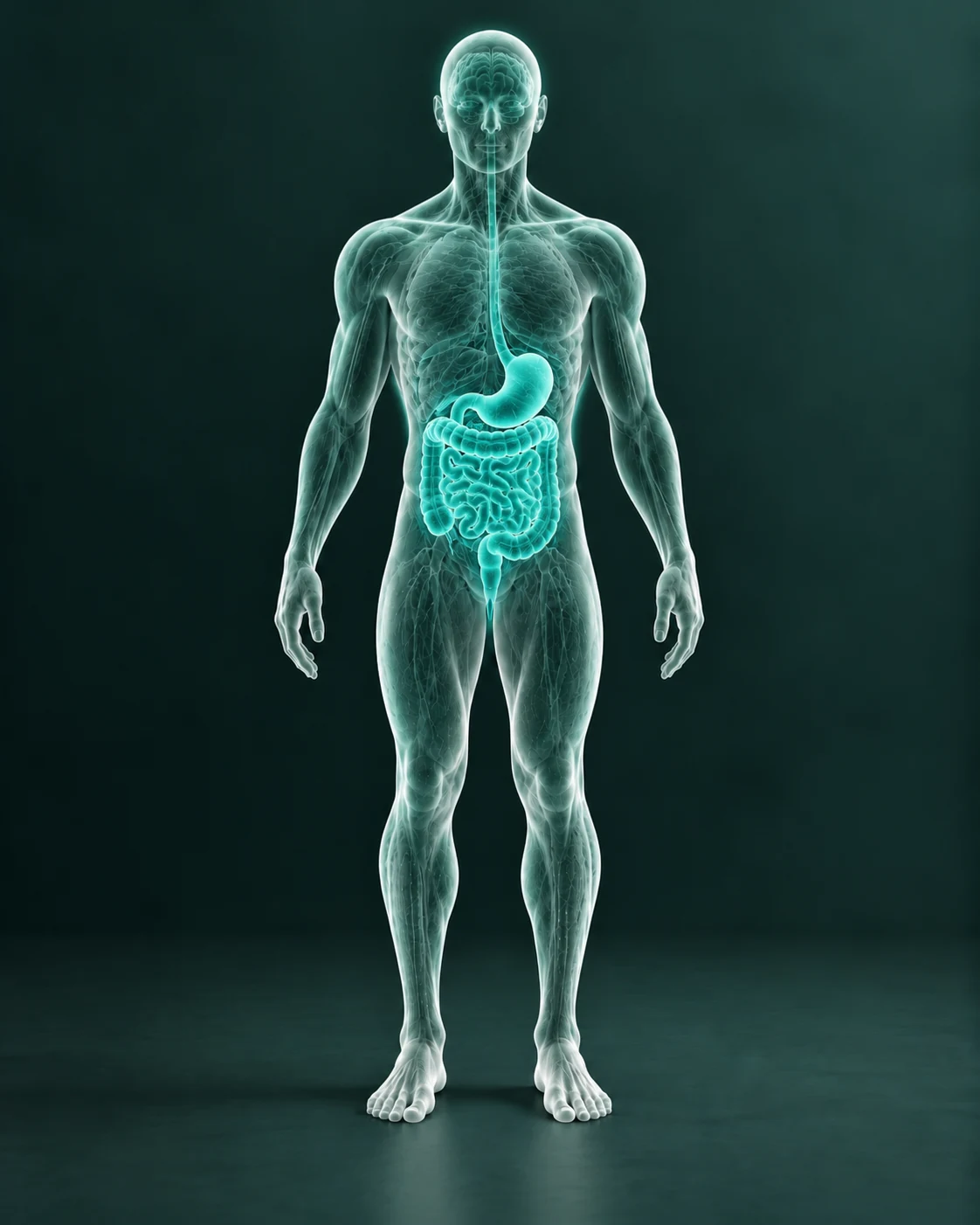
What else is it used for?
Each group carries its own evidence level.Approved means regulators have cleared it for that purpose. Investigational means it is in trials. Early research means it is being studied and is not established.
Acute GI bleeding (111 patients)
Clinical use- Human observation78 upper and 33 lower non-variceal bleeds: initial hemostasis 94% (74 of 79) as first treatment and 75% (24 of 32) after another method.
- Human observationNo rebleeding at days 3 and 7 in 91% and 87% of first-treatment cases; 30-day rebleeding 16% (18 of 111), and 5 (4.5%) needed surgery.
- Human observationNo device-related adverse events or technical failures were reported.
- No dataThe study had no comparison group; the FDA relied on it to add GI bleeding to the clearance in 2023.
During endoscopic resection (randomized, 101 patients)
Clinical use- Human trialWith the gel available, heat was used to control bleeding during the procedure in 49.3% against 99.6% with diathermy alone (P<0.001).
- Human trialNo difference in time to hemostasis, procedure length or delayed bleeding; complete healing at 4 weeks was 48.8% against 25.0% (P=0.02).
- No dataA single-center trial, and the main outcome measured how often heat was needed rather than bleeding itself.
Rescue after failed methods (77 patients)
Clinical use- Human observationUsed after at least two other methods had failed: hemostasis in 90.9%, rebleeding in 8 patients (10.4%), no device-related adverse events.
Pooled GI evidence (2023 review)
Clinical use- ReviewA systematic review abstract of 3 randomized trials and 14 observational studies: initial hemostasis 87.7%, mean rebleeding 4.7% (0 to 16.2% across studies) and delayed bleeding 5.02%.
- No dataNo head-to-head randomized trial against Hemospray or other topical agents has been published.
Surgical bleeding outside the gut
Clinical use- Human observationCardiovascular surgery, 25 patients: immediate hemostasis at 88% of sites (29 of 33).
- Human observationHeart pump (LVAD) surgery, 15 patients: hemostasis at 93% of sites (27 of 29); in a separate 50-patient cardiac surgery series, RADA16 alone worked in 84% of applications.
- No dataThese are small uncontrolled series gathered in a review written by 3-D Matrix staff, not trials against other hemostats.
PuraStat is often called FDA-approved; it is 510(k)-cleared as a Class II or unclassified device, and no PMA, De Novo or drug approval exists (the De Novo behind its GI regulation, DEN170015, belongs to Cook's Hemospray). The February 28, 2023, clearance (K222481) is often quoted as the FDA's clearance of PuraStat, but it was neither the first RADA16 clearance (PuraDerm Gel, K143058, February 13, 2015) nor the first GI one (K210098, June 25, 2021); it added primary non-variceal GI bleeding and the Forrest 1a exclusion, and there are 13 clearances through August 3, 2026. The 111-patient study appears as both 2021 and 2022 because it was published online in 2021 and in Surgical Endoscopy in 2022. The rescue hemostasis rate in de Nucci et al. is 90.9% in the paper, against 90.1% in a company brochure and 90% in a review. The randomized trial's complete healing at 4 weeks was 48.8% against 25.0%; the brochure's '75% vs 54%' counts healing or scarring. Fiber width is given as 10 to 20 nm by the maker and about 6 nm in a 2021 review by company scientists, and the 2.5% gel is 97.5% water, not the 'over 99%' that applies to dilute research gels. The maker's 2021 filing calls the April 2019 PuraSinus decision a marketing approval; it was a 510(k) clearance. Research powders sold as RAD16-I are not the sterile 2.5% device gel.
The published record
Papers and trials about RADA16 (PuraStat)
182 papers tagged human · 107 not reviews or lab · 6 clinical trial publications
25 registered trials · 3 with posted results
Furthest stage reached: Approved outside the US, European Union, Japan, Australia, Canada, Brazil, Mexico, Indonesia, Thailand, Colombia
Counted from Europe PMC indexing, not read by a person; a human tag can land on reviews, commentary or lab papers; clinical trial publications is the narrower count. 409 papers and 25 trials indexed in detail.

At a glance
Four things to know about RADA16 (PuraStat)
Evidence
Clinical use
Category
Healing and recovery
Common vial
Varies
Half-life
Not established
How much, and do you cycle it?
The range, and whether you take breaks.Enough gel to cover the bleeding area, from 1, 3 or 5 mL syringes of 2.5% gel (FDA 510(k) summary), during the procedure, reapplied until bleeding stops. Not cycled; applied during a procedure FDA label
The gel is laid on once during an endoscopy or operation and reapplied on the spot if bleeding continues. For rectal mucositis it was repeated over several sessions (median 3, range 2 to 7); no on and off schedule applies.
Not establishedNo figure
It is a gel placed on a surface, not a drug that circulates, so it has no blood half-life. The maker says enzymes break the gel down into arginine, alanine and aspartic acid over about 30 days, and its filings cite its own studies showing no build-up in specific organs and excretion in about 30 days. No independent human study of what happens to it was found.
Source: 3-D Matrix PuraStat product page (broken down over about 30 days); no human pharmacokinetic study
You can compare this against the whole library to see where it sits.
How is it given?
Dosing context and source notes.Given in hospital from a prepared product, so there is nothing to mix.
There is no dose in the drug sense. The device is a sterile 2.5% RADA16 gel in water for injection, supplied in prefilled syringes holding 1, 3 or 5 mL. It is applied onto the bleeding or wounded surface, through a nozzle held close to the bleeding point or a commercially available endoscopic catheter attached by an adapter, in whatever amount covers the area. The maker's instructions say to remove as much blood as possible first, leave the gel undisturbed while it sets and repeat the application if needed; excess gel can be left in place. In a 21-patient radiation proctitis series (FDA summary K213552) the median was 5 mL per session (range 3 to 5 mL) over a median of 3 treatments. It is not injected, and it is not the 1% research gel or a freeze-dried research powder, so the calculator does not draw a dose.
How do you store it?
Before mixing, and after.Follow the storage on the product label.
RADA16 (PuraStat) is supplied as a finished product, so its label sets the storage. Pens, prefilled syringes, implants, tablets and ready-made solutions are used as supplied. Kits that include a powder are mixed just before the dose and usually used straight away, not kept for weeks. Many injectable products go in the fridge and must not be frozen, while others are kept at room temperature, so check the pack or ask the pharmacist.
What are the side effects and cautions?
Known cautions and warnings for this compound.Solubility, computed: 62% charged residues, 50% hydrophobic. Water usually sufficient.
A first-pass rule from peptide manufacturers' guidance. It does not account for disulfide bridges, salt form or how the powder was dried, and it predicts what should be easy rather than what will happen in your vial.
Who should avoid it
- Spurting arterial bleeding (Forrest 1a): the US labeling states it is not indicated
- Bleeding from varices: the US GI bleeding clearance covers non-variceal bleeding only
- Bleeding after endoscopic resection that is more than mild or moderate: the clearance covers mild and moderate bleeding
- Injection or swallowing: every clearance is for a gel laid on a bleeding or wounded surface, and there is no evidence for injected or oral use
Stop and get help
- Vomiting blood, black or bloody stools, or feeling faint in the days after an endoscopy where it was used: bleeding returned within 30 days in 16% of the 111-patient series, and 5 needed surgery
Common effects
- No device-related adverse events in 223 patients across three GI endoscopy studies (FDA summary K210098)
- Rebleeding within 30 days in 16% (18 of 111) of acute GI bleeds, and 5 (4.5%) needed surgery
- In rescue use after at least two failed methods, rebleeding in 10.4% (8 of 77), with no device-related adverse events
- In a randomized trial during endoscopic resection, delayed bleeding did not differ from diathermy alone; after sinus surgery, in a 19-patient retrospective series, none bled again and 3 (16%) formed adhesions
Where this page says nothing is established, that means nobody has studied it, not that a compound is safe.
Is RADA16 (PuraStat) approved?
And where the numbers on this page come from.Yes, as a medical device. RADA16 (PuraStat) is cleared by the FDA as a medical device, not approved as a drug, and doctors apply it during procedures. It is also registered in the European Union, Japan, Australia, Canada, Brazil, Mexico, Indonesia, Thailand, and Colombia.
- Approval statusClinical use
- RouteOn the bleeding or wound surface, as a gel (often through an endoscope)
- Checked19 October 2026
- Approved outside the USEuropean Union, Japan, Australia, Canada, Brazil, Mexico, Indonesia, Thailand, Colombia: CE-marked in Europe since January 2014, with a post-procedure bleeding-prevention indication added in October 2018. Japan approved PuraStat as an absorbable local hemostatic material for GI endoscopy on July 16, 2020. Also registered in Indonesia (April 2015), Colombia (2015), Brazil (November 2015), Australia (January 2016, with bleeding prevention added in September 2019), Thailand (January 2016), Mexico (February 2016) and Canada (January 2019). In the US it is cleared as a device, not approved as a drug.This does not change the United States position above.
- DoseFrom the drug label. The manufacturer tested this range and a regulator reviewed it.
- Vial sizeFrom what vendors typically list; not a recommendation.
- SourcesFDA 510(k) summary K222481, PuraStatFDA 510(k) summary K210098, PuraStat-GIopenFDA 510(k) listing, applicant 3-D MatrixFDA 510(k) summary K213552, PuraStat-RMFDA 510(k) summary K210211, PuraStat-OMFDA 510(k) summary K193085, PuraDERM GelPuraSinus 510(k) summary K183015 (third-party mirror)Three-D Matrix, annual securities filing for fiscal 2021 (EDINET mirror)Sankar S et al., Frontiers in Bioengineering and Biotechnology 2021;9:679525Branchi F et al., Surgical Endoscopy 2022;36:2954-2961Subramaniam S et al., Endoscopy 2021;53:27-35de Nucci G et al., Endoscopy 2020;52:773-779MeSH Supplementary Concept RADA16-I (C546681)3-D Matrix, PuraStat product page
What has happened recently
Every US product is a 510(k)-cleared medical device from 3-D Matrix; none has gone through a PMA, De Novo or new drug application, and RADA16 has no INN. The first clearance was PuraDerm Gel, a wound dressing (K143058, February 13, 2015), followed by PuraSinus for sinus packing (K183015, April 12, 2019), PuraDERM Gel again (K193085, May 11, 2020), the first GI clearance, PuraStat-GI, for bleeding during and after endoscopic resection (K210098, June 25, 2021, Class II under 21 CFR 878.4456 with Cook's Hemospray as the predicate), PuraStat-OM for oral wounds (K210211, October 8, 2021) and PuraStat-RM for rectal mucositis (K213552, April 1, 2022). K222481 (February 28, 2023) added primary non-variceal GI bleeding and the Forrest 1a exclusion. Six later clearances, from October 22, 2024, to August 3, 2026, cover updated versions of PuraStat, PuraStat GI and PuraStat-RM, including new sterilization methods and packaging changes, for 13 in all. In Europe PuraStat has been CE-marked since January 2014, with a bleeding-prevention indication added in October 2018 and FUJIFILM Europe its exclusive distributor for endoscopy under a June 2019 agreement. Japan approved it for GI endoscopy on July 16, 2020, after an earlier application filed in May 2011 was withdrawn on March 13, 2015. The technology comes from Shuguang Zhang's work at MIT, licensed exclusively to 3-D Matrix in April 2003.
You can compare this against the whole library, or read how to check a seller.
What else is like RADA16 (PuraStat)?
Others in Healing and recovery, side by side.If you're weighing RADA16 (PuraStat), it's worth reading BPC-157, TB-500 / Thymosin Beta-4, and PDA (Pentadeca Arginate) in the same class.
A self-assembling peptide that turns into a clear gel the moment it meets blood. Cleared in the US as a medical device, first as a wound gel in 2015 and as the bleeding gel in 2021, never approved as a drug.
- Dose
- Enough gel to cover the bleeding area, from 1, 3 or 5 mL syringes of 2.5% gel (FDA 510(k) summary)
- How often
- During the procedure, reapplied until bleeding stops
A popular healing peptide for injuries, gut, and joint or tendon pain.
- Dose
- 0.25 up to 0.5 mg per dose (start low, increase slowly)
- How often
- 1-2x daily
A recovery peptide for healing muscle and tendon, often paired with BPC-157.
- Dose
- 2 up to 2.5 mg per injection (start low, increase slowly)
- How often
- Twice a week
A newer, more stable cousin of BPC-157 for faster healing.
- Dose
- 0.25 up to 0.5 mg per day (start low, increase slowly)
- How often
- 1-2x daily
Guides for this compound
- How to Reconstitute a Peptide
Mix peptide powder with bacteriostatic water, step by step.
- How to Read an Insulin Syringe
Read the units, convert to millilitres, and draw the exact dose.
- mcg vs mg: The Peptide Dosing Mistake to Avoid
Your vial says mg and your protocol says mcg. Here is the conversion and how to check it.
Sources
- FDA 510(k) summary K222481, PuraStat(2023)Cleared February 28, 2023; added primary non-variceal GI bleeding and states it is not indicated for arterial Forrest 1a bleeding; 2.5% gel in 1, 3 or 5 mL syringes; supported by the 111-patient Branchi study.
- FDA 510(k) summary K210098, PuraStat-GI(2021)First GI clearance, June 25, 2021, with Hemospray (DEN170015) as predicate; chemical name acetyl-[arginyl-alanyl-aspartyl-alanyl]4-amide tetrahydrochloride; no device-related adverse events in 223 patients.
- openFDA 510(k) listing, applicant 3-D Matrix(2026)13 clearances from February 13, 2015, to August 3, 2026, with product codes; the listing covers 510(k)s only.
- FDA 510(k) summary K213552, PuraStat-RM(2022)Cleared April 1, 2022, for rectal mucositis such as radiation proctitis; 21 patients, median 5 mL and 3 treatments; 14 of 16 seen in clinic had marked improvement in bleeding.
- FDA 510(k) summary K210211, PuraStat-OM(2021)Cleared October 8, 2021, as an oral barrier that manages pain from wounds, mouth sores, ulcers, extraction sites and mucositis.
- FDA 510(k) summary K193085, PuraDERM Gel(2020)Cleared May 11, 2020, for hydration and management of partial and full thickness wounds, including pressure sores, leg and diabetic ulcers and laser resurfacing burns.
- PuraSinus 510(k) summary K183015 (third-party mirror)(2019)Cleared April 12, 2019, as a gel stent after nasal or sinus surgery; 19 patients with no device-related adverse events, no rebleeding and adhesions in 3.
- Three-D Matrix, annual securities filing for fiscal 2021 (EDINET mirror)(2021)Japan approval July 16, 2020; CE marking January 2014; registrations in other countries; company history and the exclusive MIT license from April 2003.
- Sankar S et al., Frontiers in Bioengineering and Biotechnology 2021;9:679525(2021)How RADA16 self-assembles; PuraStat and PuraBond described as CE-marked Class III devices; human surgical studies listed.
- Branchi F et al., Surgical Endoscopy 2022;36:2954-2961(2022)111 acute non-variceal GI bleeds at 15 German centers: initial hemostasis 94% as first treatment and 75% as later treatment; 16% rebleeding at 30 days.
- Subramaniam S et al., Endoscopy 2021;53:27-35(2021)Randomized trial, 101 patients having ESD: heat used for bleeding in 49.3% against 99.6% (P<0.001); complete healing at 4 weeks 48.8% against 25.0% (P=0.02).
- de Nucci G et al., Endoscopy 2020;52:773-779(2020)77 rescue cases after at least two failed methods: hemostasis 90.9%, rebleeding 10.4%, no device-related adverse events.
- MeSH Supplementary Concept RADA16-I (C546681)(2010)Entry terms Ac-RADARADARADARADACONH2 and PuraMatrix; no registry number listed.
- 3-D Matrix, PuraStat product page(2026)European indications; application steps; fibers of about 10 to 20 nm and pores of 50 to 200 nm; broken down over about 30 days.
Beyond these, 434 records are indexed. Browse the records