
Adipotide_Dosage, benefits & legal status
Also known as FTPP, prohibitin-targeting peptide, Adipotide FTPP
An experimental fat-loss peptide considered dangerous, with no safe human use.
Common vial size is what vendors typically sell, not a recommendation. Enter your own vial in the calculator.
What is Adipotide?
Plain language first. The technical label stays, but it never stands alone.Overview
It starves fat of its blood supply. That caused dramatic fat loss in animals, but it also damaged their kidneys. It is considered dangerous, with essentially no safe human use.
Adipotide is an experimental peptide that homes to the blood vessels feeding fat tissue and triggers them to die.
What it's used for
An experimental fat-loss peptide that cuts off the blood supply to fat tissue, with dramatic fat loss in animals.
How does Adipotide work?
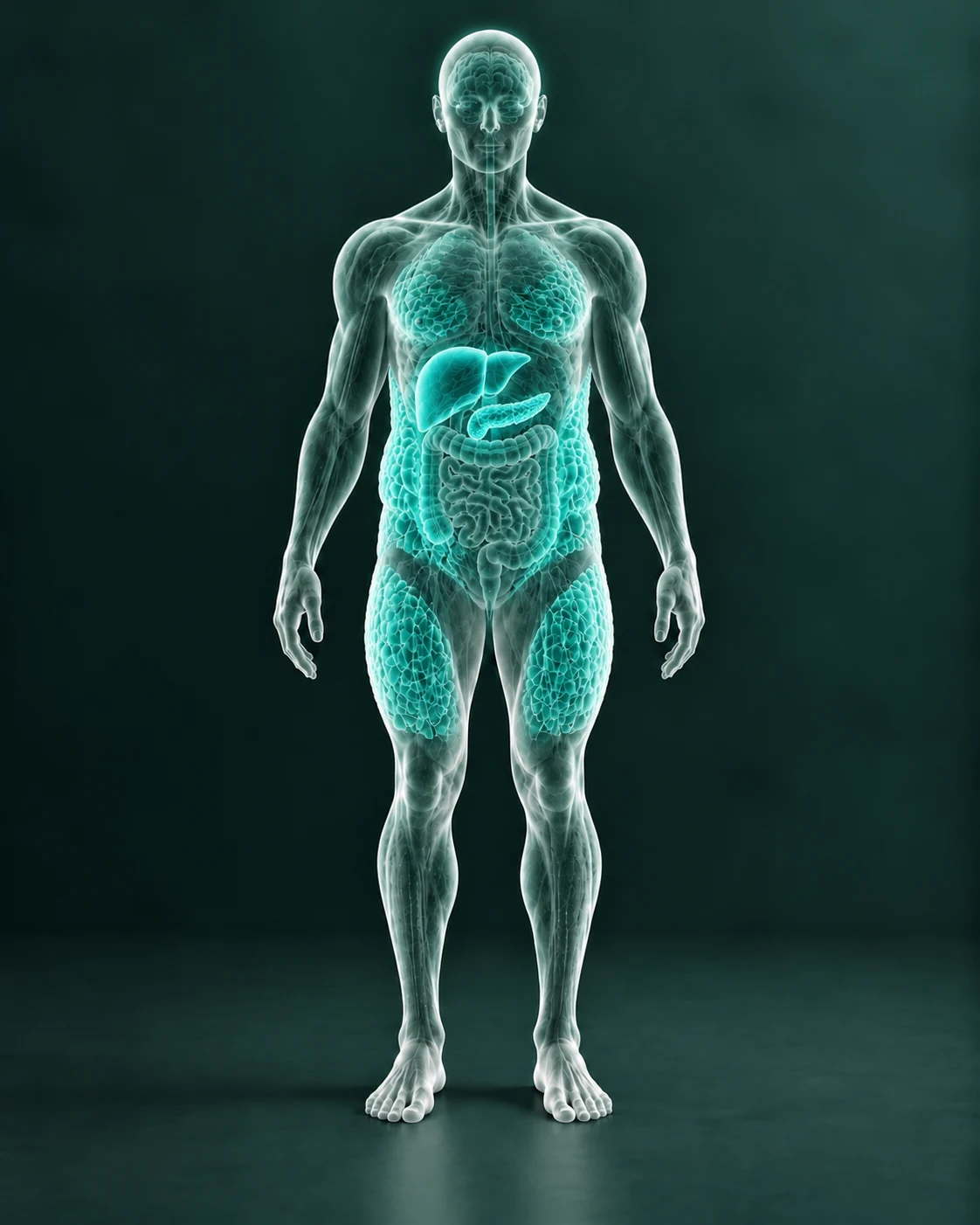
What it does in the body, and where.Adipotide does not affect metabolism at all. It kills the blood supply that fat tissue depends on, and that difference is the whole story.
- 01It homes to blood vessels feeding fat tissueOne half of the molecule finds a marker found on those vessels specifically.
- 02The other half triggers those vessels to dieA pro-apoptotic sequence that destroys the cell it has been delivered into.
- 03Fat tissue is starved of blood supplyObese monkeys lost substantial weight rapidly, which is why it drew attention.
- 04Kidneys were damaged in the same studiesThe kidney has a dense vascular bed and was affected too. The phase 1 human trial was terminated.
- 05It is here for reference, not as an optionA compound designed to kill blood vessels, which did damage kidneys, and which no human trial has shown to work.
What else is it used for?
Each use below carries its own evidence level. Approved means regulators have cleared it for that purpose. Investigational means it is in trials. Early research means it is being studied and is not established.
- Rapid fat loss by cutting off the blood supply to fat tissueResearch only
- It caused kidney damage in animal studies and never reached meaningful human use, so nothing here is establishedResearch only
The published record
Papers and trials about Adipotide
Searched: Adipotide.
Left out: FTPP (too short to disambiguate without context).
2 papers tagged human · 2 not reviews or lab · 0 clinical trial publications
Furthest stage reached: No clinical trial on record
Counted from Europe PMC indexing, not read by a person; a human tag can land on reviews, commentary or lab papers; clinical trial publications is the narrower count.
At a glance
Four things to know about Adipotide
Evidence
Category
Weight loss and metabolic
Common vial
5 mg
Half-life
Nothing published
How much, and do you cycle it?
The range, and whether you take breaks.0.03 mg/kg per day, daily for 28 days in the trial. No schedule exists No range
Never given to people under any published protocol. The 28-day primate study found dose-dependent kidney damage, and development did not continue past a 2012 announcement of first human dosing. There is no cycle because there is no established use.
Nothing publishedNo figure
Nothing published. The mouse and monkey work reported weight change rather than how fast the compound cleared.
You can compare this against the whole library to see where it sits.
How is it given?
Dosing context and source notes.The only human trial listed a starting dose of 0.03 mg per kg under the skin, once a day for 28 days, in men with metastatic prostate cancer and obesity. Body-weight dose. The calculator has no body-weight input, so it cannot produce a draw for this compound.
Adipotide starts at $25.99 across 27 vendors, typically $7.50 – $16.50 per mg.
33 listings, last read Oct 24, 2026. Shipping and card fees are not included.
How do you store it?
Before mixing, and after.Dry powder in the freezer or fridge. Once mixed, fridge, and use within about a month.
Unmixed lyophilized Adipotide keeps for a long time cold. Once you add water the clock starts: most reconstituted vials hold up for roughly 28 to 30 days at fridge temperature. Keep it out of light, and do not freeze it after mixing.
What are the side effects and cautions?
Known cautions and warnings for this compound.Solubility, computed: 48% charged residues, 44% hydrophobic. Water usually sufficient.
A first-pass rule from peptide manufacturers' guidance. It does not account for disulfide bridges, salt form or how the powder was dried, and it predicts what should be easy rather than what will happen in your vial.
Who should avoid it
- Any kidney problem, since kidney damage was the main finding in animal studies
- There is no established safe human use at all
Stop and get help
- Reduced urination, swelling, or unusual fatigue, which can signal kidney trouble
- Signs of dehydration
- Signs of an allergic reaction such as face or throat swelling, hives, or trouble breathing
Common effects
- Kidney strain is the primary documented risk
- Dehydration
- No reliable human safety data exists
Where this page says nothing is established, that means nobody has studied it, not that a compound is safe.
Is Adipotide approved?
And where the numbers on this page come from.No. Adipotide is not approved for any use, anywhere. It is sold labeled for laboratory research only, and there is no legal route to buy it for human use.
- Approval statusResearch only
- RouteUnder the skin (subcutaneous)
- Checked22 September 2026
- DoseFrom published clinical trials. Not approved by a regulator for this dose.
- Vial sizeFrom what vendors typically list; not a recommendation.
- SourcesNone traced yet.
What has happened recently
Never progressed to meaningful human use. In primate studies it caused kidney damage, which is the finding that ended interest in it. There is no established safe human dose.
You can compare this against the whole library, or read how to check a seller.
If you're weighing Adipotide, it's worth reading BAM15, AICAR, and Humanin in the same class.
An experimental fat-loss peptide considered dangerous, with no safe human use.
- Dose
- 0.03 mg/kg per day
- How often
- Daily for 28 days in the trial
A fat-loss compound built to do what DNP does without killing people.
- Dose
- Research only
- How often
- Varies
An AMPK activator sold as exercise in a vial, at doses nobody could realistically use.
- Dose
- 42 mg/kg per dose
- How often
- Single infusion in the trial
A natural longevity peptide studied for cell protection and aging.
- Dose
- Research only
- How often
- As studied
Guides for this compound
- How to Reconstitute a Peptide
Mix peptide powder with bacteriostatic water, step by step.
- How to Read an Insulin Syringe
Read the units, convert to millilitres, and draw the exact dose.
- mcg vs mg: The Peptide Dosing Mistake to Avoid
Your vial says mg and your protocol says mcg. Here is the conversion and how to check it.
- How to Read a Peptide COA
What the purity number does and does not tell you, and how to spot an edited report.
- How to Vet a Peptide Vendor
Independent COAs, HPLC purity, and the red flags that mean walk away.
Sources
No primary source has been traced for this compound yet. Treat everything on this page as unverified until one is. How we grade evidence
Beyond these, 3 records are indexed. Browse the records