
Usually not, and the last section covers the cases where you should. It is a known effect of all three drugs, it is on two approved labels, and the average rise is small.
The Wegovy label reports mean increases of 1 to 4 beats per minute against placebo. It is the only label in this class with a dedicated heart rate section in its warnings.1
Averages hide the spread, and the label gives that too. In the adult weight trials, 41% of people on Wegovy had a maximum rise of 10 to 19 bpm at some visit, against 34% on placebo, and 26% had a rise of 20 bpm or more, against 16%.1 So large single readings happen on placebo as well. The drug moves the odds; it does not create something new.
Retatrutide's rise is dose-dependent, peaked at 24 weeks in its phase 2 trial, and declined after that.2
What the label asks of a clinician is worth knowing: monitor at regular intervals, and discontinue if the increase in resting heart rate is sustained.1 Sustained is the word doing the work, not high on one morning.
What is a normal resting heart rate?
Between 60 and 100 beats per minute for most adults. Most pages on this subject assume you know that, including this one until now.
A resting heart rate between 60 and 100 beats per minute is the conventional normal range for adults. Fit people often sit below 60, which is not a problem. Above 100 at rest has a name, tachycardia, and is the threshold at which a clinician starts asking why.
Two things make that range less useful than it looks.
Your own baseline matters more than the population range. Someone whose resting rate has always been 52 and is now 68 has changed by more than someone who went from 72 to 80, even though the second number is higher. The drug labels measure change from baseline for exactly this reason.
A wrist device and a clinic measure different things. If your watch has eighteen months of history, that history is your baseline and it is better than any range in a textbook.
So the question is not whether your number is high. It is how far it has moved from where it used to sit, and whether it has stayed there.
How much do these drugs raise your heart rate?
By 1 to 4 beats per minute on average. Three of these four labels give a figure and only one treats it as a warning.
| Drug | Mean rise | What placebo did | Where it appears |
|---|---|---|---|
| Wegovy (semaglutide) | 1 to 4 bpm vs placebo | not stated separately | Warnings and Precautions, section 5.91 |
| Ozempic (semaglutide) | 2 to 3 bpm | fell 0.3 bpm | Adverse reactions3 |
| Mounjaro (tirzepatide) | 2 to 4 bpm | rose 1 bpm | Adverse reactions4 |
| Zepbound (tirzepatide) | 1 to 3 bpm | no average rise reported | Adverse reactions5 |
The Wegovy label is the strict one. It instructs clinicians to monitor heart rate, tells patients to report palpitations or a racing heartbeat at rest, and says to discontinue on a sustained increase.1 The tirzepatide labels state in terms that the clinical relevance of heart rate increases is uncertain.4
The Mounjaro label adds one detail the others do not. Episodes of sinus tachycardia were reported, accompanied by an increase from baseline of 15 beats per minute or more.4 That is the label acknowledging that some people's rise is not small.
One figure in the Wegovy label needs separating out. In a trial in patients aged 12 and over with a normal baseline heart rate, 54% of those on the drug had a maximum rise of 20 bpm or more, against 39% on placebo.1 That is an adolescent population and does not transfer to adults, but it shows how common large single readings are in anyone.
What retatrutide's trial found
A dose-dependent rise that peaked and then partly reversed, which is the most useful thing in this whole guide.
The phase 2 trial reports that heart rate increased in a dose-dependent manner up to 24 weeks and declined thereafter, with the decline continuing at 36 and 48 weeks.2
The paper's own characterisation of the size matters, because it contradicts what circulates online. The authors write that the increases were similar to those reported for GLP-1 receptor agonists.2 A figure of 5 to 10 bpm for retatrutide appears on a number of sites, which would be several times the labelled rise for semaglutide and tirzepatide. We could not find that figure in the published paper. The underlying numbers sit in supplementary tables we could not read, so we are not saying it is wrong, only that the paper describes the increases as comparable to the approved drugs, not larger.
TRIUMPH-1, the published phase 3 trial, is a gap. We checked the paper and the accompanying announcement and could not find heart rate reported in either. If it is in the supplement, we have not seen it. For a trial of 2,339 people over 80 weeks, that would be the best data available on whether the peak-and-decline pattern holds at scale.
Does it settle down?
In retatrutide's phase 2 trial, yes, partly. Elsewhere the picture is thinner.
That trial is the only one of the three with a published shape over time: up to a peak at 24 weeks, then down at 36 and 48 weeks, at a stable dose.2
For semaglutide and tirzepatide the labels give an average across a trial rather than a curve. What is established for the older drug liraglutide is that the increase disappears when treatment stops, which is a different claim from it settling while you continue.
So the honest answer: there is published evidence of partial reversal over time for retatrutide, and for the approved drugs the question of whether an individual's rise fades has not been answered in the labels.
If it raises heart rate, is it bad for your heart?
Not on the evidence so far. Higher heart rate and fewer cardiac events were measured in the same drugs, and both findings are real.
SELECT followed more than 17,000 people with obesity and established cardiovascular disease, without diabetes, and found semaglutide reduced major adverse cardiovascular events by 20% against placebo. That is the basis of the cardiovascular indication on the Wegovy label.
Two things follow, and the second is the one to hold on to.
A small rise in resting heart rate has not, in these trials, translated into more cardiac events. Over several years in a high-risk population, the drug reduced them.
And that is a statement about averages across thousands of people, not a reassurance about any individual reading. A trial finding that a drug lowers event rates overall does not mean a resting heart rate of 105 in one person needs no attention.
For tirzepatide, a cardiovascular outcome trial has reported, but it compared tirzepatide against another drug in this class rather than against placebo, which makes it a different kind of evidence. We have not verified its figures from the primary publication and are not quoting them here.
Why do GLP-1 drugs raise heart rate?
Three proposed mechanisms. None is established.
Direct action on the heart and the nerves that control it. Receptors for these hormones are present in cardiac tissue and in the parts of the nervous system that set heart rate. The retatrutide paper notes that glucagon and GLP-1 can exert positive chronotropic effects on the heart, which is the proposed route for the extra effect of a glucagon agonist.2
Reduced vagal tone. The parasympathetic braking signal on the heart may be dampened, which raises the resting rate without the heart working harder.
A knock-on from everything else the drug does. Eating much less, losing fluid, and the gut effects all change the circulatory picture.
All three are proposals. The Wegovy label itself does not state a mechanism, and the uncertainty is why the tirzepatide labels describe the clinical relevance as uncertain.
Is my Apple Watch or Fitbit reading accurate?
Accurate enough, and measuring something different from a clinic. This is the practical half, and it explains most of what people see.
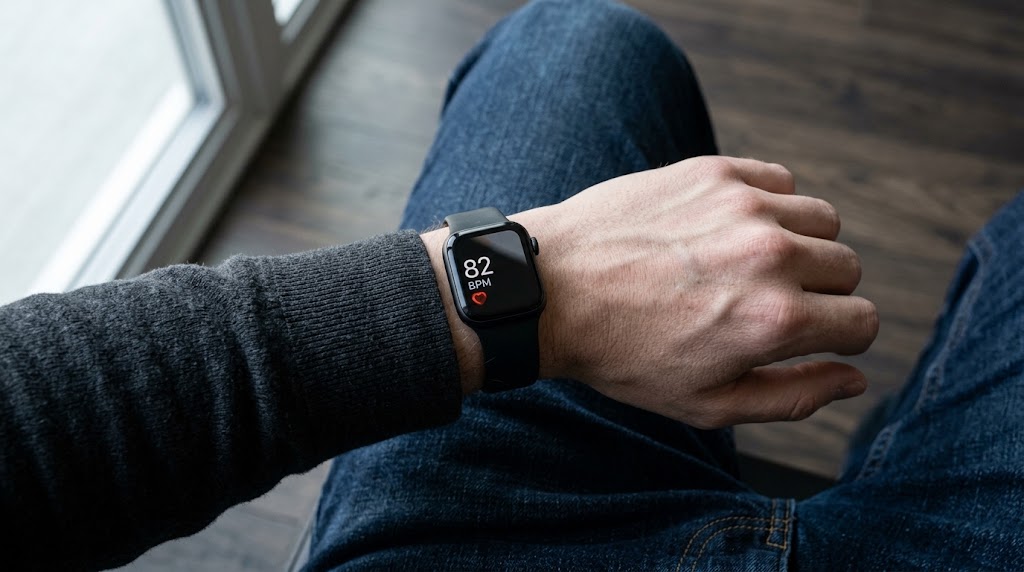
A watch does not measure the same thing a clinic does. An Apple Watch, Fitbit, Garmin, Oura ring or Whoop strap estimates heart rate optically and derives a resting figure from your lowest sustained period, usually during sleep. That is a different measurement from a seated reading at a doctor's visit, and the two do not have to agree.
Everyone's resting heart rate moves day to day. Swings of several beats are normal in anyone, driven by sleep, alcohol, illness, stress, room temperature and how recently you ate.
Several things that push it up are more likely on these drugs. Dehydration is the big one, and eating much less means drinking much less, which our dehydration guide follows in detail. A recent illness, poor sleep during the first weeks of nausea, and alcohol on an emptier stomach all do the same.
Compare like with like. A single morning reading tells you very little. A weekly average over a month tells you something, and it is the figure your watch is best at producing.
Weight loss usually lowers resting heart rate
So a rise during weight loss is worth noticing.
Losing a significant amount of weight generally reduces resting heart rate over time. So someone on one of these drugs has two forces working in opposite directions: the drug pushing the rate up, and the weight loss pulling it down.
What that means in practice. A rise early on, before much weight has gone, is the most expected pattern. A rate that drifts down after several months of weight loss is also expected, and is not evidence the drug stopped working.
What it does not mean is that any rise is therefore fine. The two effects are independent, and a rise large enough to notice should still be raised. The next section covers when.
Does it go up again at each dose increase?
In the trials that tested more than one dose, yes.
Retatrutide's rise was dose-dependent in phase 2.2 For tirzepatide, a meta-analysis of its trial programme found the 15 mg dose raised heart rate significantly more than 10 mg, and 10 mg more than 5 mg, with the pooled increase against control at 1.82 bpm.6
That matters for how you read your own numbers. A step up a fortnight after a dose increase fits the pattern, and so does a plateau once you stay at a dose. A climb that continues while nothing else changed does not, and is the version worth raising.
It is also the reason the retatrutide pattern is interesting: the rise peaked at 24 weeks and then fell while people stayed on the drug.2 Up at each step, then down over time, is a more complicated shape than most coverage describes.
What else could be raising it?
Three things that are common, treatable, and worth ruling out.
An underactive or overactive thyroid. Thyroid problems change resting heart rate and are common enough to test for rather than guess at.
Anaemia. Eating much less for months is a plausible route to low iron, and a low haemoglobin makes the heart beat faster to carry the same oxygen. Also a blood test.
Blood pressure medication. These drugs lower blood pressure, and someone whose dose of a blood pressure or rate-controlling medicine was set before they lost weight may be on the wrong amount now. That is a prescriber conversation and it cuts both ways.
Dehydration, illness, alcohol and poor sleep, which the section above covers and which account for most short-lived rises.
Our bloodwork guide covers what is worth testing and when, and the thyroid and haemoglobin tests are both ordinary ones.
When to be seen
Some of this needs a clinician rather than a forum.
Palpitations, or a sensation of the heart racing or pounding while you are at rest. The Wegovy label specifically instructs patients to report this.1
Chest discomfort or pain. Breathlessness that is new or out of proportion to what you are doing. Fainting, or feeling close to it.
A resting heart rate that stays substantially above your own baseline across weeks rather than days, or one that sits above 100 at rest when it did not before. The label's instruction on a sustained increase is to discontinue, which is a prescriber's decision rather than yours alone.
And bring numbers. A month of daily readings from your watch, with the dates you changed dose, is more useful to a clinician than a description, and it is the one thing a wearable is genuinely good for here.
Common questions
Does semaglutide raise your resting heart rate?
Yes, by 1 to 4 beats per minute on average against placebo in the Wegovy weight trials. The label carries a dedicated heart rate section in its warnings and tells clinicians to monitor it.
How much does tirzepatide raise heart rate?
The Mounjaro label reports a mean increase of 2 to 4 bpm against a 1 bpm rise on placebo, and the Zepbound label 1 to 3 bpm. Both state that the clinical relevance of the increase is uncertain, and the Mounjaro label also records episodes of sinus tachycardia with a rise of 15 bpm or more.
Does retatrutide raise heart rate more than the others?
Its phase 2 paper describes the increases as similar to those reported for GLP-1 receptor agonists, and the rise was dose-dependent, peaked at 24 weeks and declined afterwards. Larger figures circulate online that we could not find in the published paper.
My watch shows a 10 beat rise. Is that normal?
Larger single readings are common, including on placebo. In the Wegovy adult trials, 41% of people on the drug had a maximum rise of 10 to 19 bpm at some visit, against 34% on placebo. A weekly average over a month is far more informative than any single reading.
Will it go back down?
In retatrutide's phase 2 trial the rise peaked at 24 weeks and declined at 36 and 48 weeks at a stable dose. For semaglutide and tirzepatide the labels give an average rather than a curve, so the question of whether an individual's rise fades is not answered there.
If these drugs raise heart rate, why do they protect the heart?
Both findings come from the same programmes. SELECT found semaglutide reduced major adverse cardiovascular events by 20% in more than 17,000 people with obesity and cardiovascular disease. A small average rise in resting heart rate did not translate into more cardiac events across that population, which is a statement about averages and not about any individual reading.
What is a normal resting heart rate?
Conventionally 60 to 100 beats per minute for adults, with fit people often below 60 and above 100 at rest called tachycardia. Your own baseline matters more than the range, which is why the drug labels measure change from baseline rather than absolute numbers.
Does it go up again every time I increase the dose?
In the trials that tested several doses, the rise tracked the dose. A meta-analysis of the tirzepatide programme found 15 mg raised heart rate more than 10 mg and 10 mg more than 5 mg. A step up after a dose increase fits that pattern; a continuing climb while nothing else changed does not.
Could it be something other than the drug?
Yes, and two are worth a blood test: thyroid problems and anaemia, the second being plausible after months of eating much less. Blood pressure medication set before you lost weight is the third, and that is a prescriber conversation.
Should I stop taking it?
That is a prescriber's decision. The Wegovy label's instruction is to discontinue if a patient has a sustained increase in resting heart rate, and sustained means across weeks rather than one high morning.
Is my Apple Watch accurate enough to worry about?
Wrist devices estimate heart rate optically and derive a resting figure from your lowest sustained period, usually overnight, which is not the same measurement as a seated clinic reading. They are good at trends and less good at any single number, so a weekly average over a month is what to look at.
What should I bring to the appointment?
A month of daily readings from your watch with the dates you changed dose, plus any symptoms and when they happened. That is more useful than a description and it is what a wearable is actually good for.
Sources
- Wegovy (semaglutide) prescribing information, section 5.9 Heart Rate Increase, and Adverse Reactions. accessdata.fda.gov. The approved label. Mean increases in resting heart rate of 1 to 4 beats per minute were observed in adult patients compared with placebo in clinical trials for weight reduction. More adults treated with the drug than placebo had maximum changes from baseline of 10 to 19 bpm (41% versus 34%) and of 20 bpm or more (26% versus 16%). In a trial in patients aged 12 and older with normal baseline heart rate, more patients on the drug than placebo had maximum changes of 20 bpm or more (54% versus 39%). The label instructs clinicians to monitor heart rate at regular intervals, instruct patients to report palpitations or feelings of a racing heartbeat at rest, and discontinue if a patient experiences a sustained increase in resting heart rate.
- Jastreboff AM, Kaplan LM, Frías JP, et al. Triple-Hormone-Receptor Agonist Retatrutide for Obesity: A Phase 2 Trial. New England Journal of Medicine 2023;389:514-526. doi:10.1056/NEJMoa2301972. Phase 2 trial, 338 adults, 48 weeks. The paper states that dose-dependent increases in heart rate peaked at 24 weeks and declined thereafter, with the decline continuing at 36 and 48 weeks, and that the increases were similar to those reported for GLP-1 receptor agonists. It also notes that glucagon and GLP-1 can exert positive chronotropic and inotropic effects on the heart. The numeric heart rate data sits in supplementary tables S6 and S8, which we were not able to read.
- Ozempic (semaglutide) prescribing information, Adverse Reactions, Increases in Heart Rate. accessdata.fda.gov. The approved label, read directly. In placebo-controlled trials, Ozempic 0.5 mg and 1 mg resulted in a mean increase in heart rate of 2 to 3 beats per minute, against a mean decrease of 0.3 beats per minute in placebo-treated patients.
- Mounjaro (tirzepatide) prescribing information, Adverse Reactions, Heart Rate Increase. accessdata.fda.gov. The approved label, read directly. In the pool of placebo-controlled trials, treatment of adults resulted in a mean increase in heart rate of 2 to 4 beats per minute, compared with a mean increase of 1 beat per minute in placebo-treated patients. Episodes of sinus tachycardia, associated with a concomitant increase from baseline in heart rate of 15 beats per minute or more, were also reported. The label states that the clinical relevance of heart rate increases is uncertain.
- Zepbound (tirzepatide) prescribing information, Adverse Reactions. pi.lilly.com. Mean heart rate increase reported as 1 to 3 beats per minute against no average rise on placebo. This figure was read through a secondary source citing DailyMed rather than from the label document directly, unlike the other three in the table, and should be confirmed before reuse.
- Impact of tirzepatide on heart rate among patients with type 2 diabetes: a systematic review and pairwise and network meta-analysis. Diabetes, Obesity and Metabolism. Meta-analysis of the tirzepatide trial programme. Baseline heart rate across trials ranged from 65.2 to 75.7 bpm. Pooled increase against control was 1.82 bpm (95% CI 0.75 to 2.89). Network analysis found tirzepatide 15 mg raised heart rate significantly more than 10 mg (mean difference 1.44), than 5 mg (2.53), than GLP-1 receptor agonists (3.46) and than placebo (2.96), indicating a dose-response effect. Read via the published abstract.
Citing this page. Peptide Decoding. My Resting Heart Rate Keeps Climbing on a GLP-1. Should I Worry? Is It the GLP-1? Label figures as cited. https://peptidedecoding.com/guides/glp1-resting-heart-rate