
Ghrelin (lenomorelin)_Dosage, benefits & legal status
Also known as lenomorelin, acyl ghrelin, acylated ghrelin, octanoyl ghrelin, GTP-200
The hormone behind every ghrelin-receptor card on this site, made in the stomach and switched on by an eight-carbon fatty chain. Infused in small trials after stomach surgery and in wasting conditions, it was never approved.
Common vial size is what vendors typically sell, not a recommendation. Enter your own vial in the calculator.
What is Ghrelin (lenomorelin)?
Plain language first. The technical label stays, but it never stands alone.Overview
Ghrelin is the hunger hormone the stomach releases when it is empty, and every ghrelin-receptor drug on this site, from ipamorelin to anamorelin, mimics it at the same receptor, though several, such as GHRP-6 and MK-677, were made before ghrelin itself was found. Infused into a vein, it raised buffet intake by 28% in 9 healthy volunteers, and after surgery to remove the stomach, 10 days of twice-daily infusions cut weight loss to 1.4% against 3.7% on placebo in a 21-patient trial. In cancer the results were mixed, the trials had 5 to 42 people each, and it was never approved; it is sold only as a laboratory reagent, not by research-peptide sellers.
Ghrelin (INN lenomorelin) is a 28-residue peptide hormone made in the stomach, carrying an eight-carbon octanoyl ester on serine 3 that the enzyme GOAT (gene MBOAT4) adds and that its receptor requires. Acyl ghrelin activates the growth hormone secretagogue receptor (GHS-R1a), releasing growth hormone from the pituitary and driving hunger signaling in the hypothalamus; ipamorelin, GHRP-2, GHRP-6, hexarelin, MK-677, anamorelin, macimorelin and relamorelin all act at this same receptor. Kojima and colleagues in Kenji Kangawa's group described it in Nature in December 1999, and it reached small randomized phase 2 trials given into a vein but was never filed for approval.
What it's used for
Nothing outside research. It is sold only as a laboratory reagent, not by research-peptide sellers, and was given into a vein, or in a few studies under the skin, in small studies of appetite, of weight after stomach surgery, and of wasting in cancer, COPD, kidney failure and anorexia nervosa.
How does Ghrelin (lenomorelin) work?
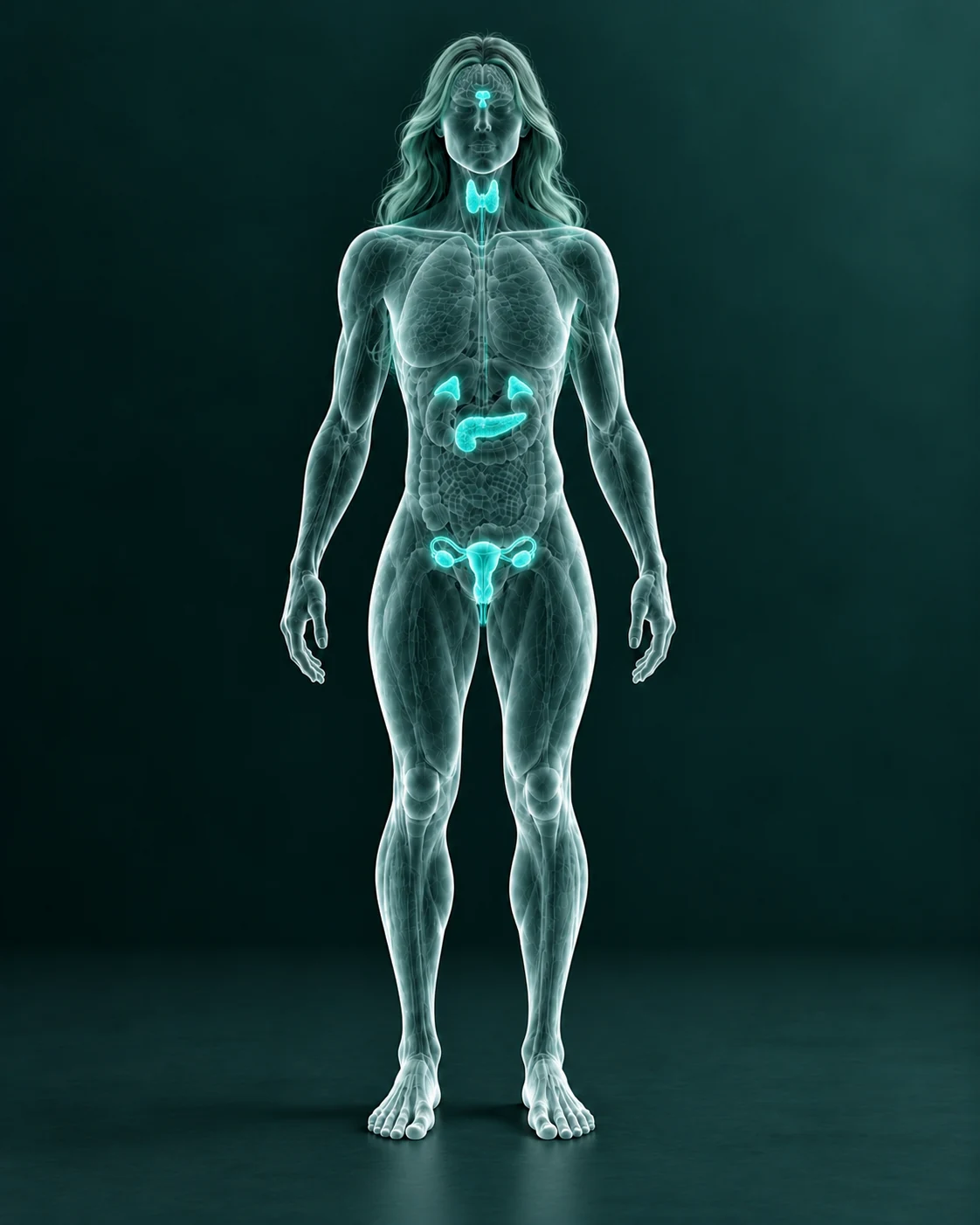
What it does in the body, and where.Ghrelin is the stomach's signal that it is time to eat, and it works only after an enzyme fits it with a fatty chain.
- 01Made and switched onHormone cells in the stomach make a 117-residue precursor and cut out the 28-residue hormone. The enzyme GOAT then attaches an eight-carbon octanoyl chain to serine 3; without that chain ghrelin cannot activate its receptor. Blood levels rise during fasting and fall after eating.
- 02One receptor, two jobsAcyl ghrelin switches on the growth hormone secretagogue receptor (GHS-R1a). In the pituitary this releases growth hormone; in the hypothalamus it drives hunger. It also speeds stomach movement and holds back insulin release. Ipamorelin, GHRP-2, GHRP-6, hexarelin, MK-677, anamorelin, macimorelin and relamorelin all copy ghrelin at this same receptor.
- 03Switched off in minutesEnzymes in the blood strip the fatty chain, so acyl ghrelin lasts 9 to 13 minutes and leaves desacyl ghrelin behind; desacyl ghrelin makes up most of the ghrelin in blood and does not act at this receptor. LEAP2, a peptide from the liver, is the body's own blocker of the same receptor.
What else is it used for?
Each group carries its own evidence level.Approved means regulators have cleared it for that purpose. Investigational means it is in trials. Early research means it is being studied and is not established.
Appetite in healthy people
Early research- Human trial9 healthy volunteers, randomized double-blind crossover: 5.0 pmol/kg/min into a vein raised free-choice buffet intake by a mean of 28 ± 3.9% against saline (P<0.001), and intake rose in every participant.
- Human trialAppetite scores rose during the infusion, and stomach emptying did not change.
After total gastrectomy (phase 2)
Early research- Human trial21 patients randomized (11 ghrelin, 10 placebo) to 3 mcg/kg into a vein twice daily for 10 days from the start of eating: food intake 13.8 against 10.4 kcal/kg a day (P=0.030) and appetite score 5.7 against 3.9 cm (P=0.032).
- Human trialBody weight change -1.4% against -3.7% (P=0.044). Lean mass and basal metabolic rate fell significantly only on placebo; fat mass fell in both groups.
- No dataOne patient on ghrelin was withdrawn for severe sweating during infusion, so 20 completed.
Cancer cachexia
Early research- Human trial21 adults with advanced cancer, randomized double-blind double crossover, 2 mcg/kg (10 patients) or 8 mcg/kg (11) over 60 minutes before lunch: nutritional intake and eating-related symptoms did not differ from placebo.
- Human trialThe primary safety goal was met, with no grade 3 or 4 toxicity, no tumor stimulation seen and IGF-1 unchanged; 81% preferred ghrelin at day 8 and 63% at the end.
Wasting in COPD
tested-and-failed- Human trial33 patients, 2 mcg/kg into a vein twice daily for 3 weeks with pulmonary rehabilitation in both groups: walking distance rose 40 m at week 3 and 47 m at week 7 within the ghrelin group, against 35 m and 18 m on placebo, and the difference was not significant.
- Human trialThe symptom score of the St George's Respiratory Questionnaire was better than on placebo (P=0.026), though the total score, the other co-primary endpoint, was not (P=0.072); maximal expiratory pressure also improved (P=0.015). Treatment was well tolerated, though adverse events were reported by 67% on ghrelin and 33% on placebo, a difference that was not significant.
Related but separate: desacyl ghrelin and livoletide
tested-and-failed- human-earlyDesacyl ghrelin is the same 28 residues without the fatty chain and does not activate the ghrelin receptor; in people it is the larger share of ghrelin in blood, and during an infusion of acyl ghrelin it settled at about twice the acyl level (Tong 2013).
- Human trialLivoletide (AZP-531), an unacylated ghrelin analog, is a ring of 8 residues (962 Da), not desacyl ghrelin. In the ZEPHYR phase 2b in Prader-Willi syndrome (158 patients, 12 weeks), hyperphagia scores fell 4.7 at 60 mcg/kg (P=0.13) and 3.8 at 120 mcg/kg (P=0.45) against 2.8 on placebo, missing the primary endpoint.
- RegulatoryMillendo then ended the livoletide Prader-Willi program, including the extension study and the planned phase 3 (April 6, 2020).
Its half-life is often quoted as about 45 minutes; that figure comes from synthetic acyl ghrelin breaking down in a tube of plasma (Blatnik and Soderstrom, 2011), and in the body acyl ghrelin lasts 9 to 13 minutes. The 27 to 31 minutes measured for total ghrelin is also reported as the half-life of active ghrelin, but total ghrelin is mostly desacyl ghrelin. Ghrelin is often said to have no INN; it is lenomorelin. Its human evidence is often described as physiology research only, when it went through randomized, placebo-controlled phase 2 trials after gastrectomy and in COPD and a company program (GTP-200), though it was never approved and nothing is in development. Calling it the hunger hormone suggests that giving it makes people eat, but results in cancer were mixed: a single infusion raised intake 31% in 7 patients (Neary 2004), while intake did not differ from placebo in a 21-patient safety trial with two infusions each (Strasser 2008). The 40 m gain in walking distance in the COPD trial was a change within the ghrelin group; placebo patients gained 35 m, and the difference was not significant. 'Serine 3' and 'serine 26' are the same residue, numbered in the mature hormone and in its 117-residue precursor. Livoletide is sometimes called unacylated ghrelin; it is a ring of 8 residues (962 Da) derived from it, not the 28-residue hormone. NCT01505764, titled 'The Role of Ghrelin in Cancer Cachexia', tested anamorelin tablets, not ghrelin, and was terminated after enrolling 10 people.
The published record
Papers and trials about Ghrelin (lenomorelin)
317 papers tagged human · 186 not reviews or lab · 119 clinical trial publications
240 registered trials · 9 with posted results
Furthest stage reached: Phase 4 as registered or later, completed, no results posted
Counted from Europe PMC indexing, not read by a person; a human tag can land on reviews, commentary or lab papers; clinical trial publications is the narrower count. 437 papers and 100 trials indexed in detail.

At a glance
Four things to know about Ghrelin (lenomorelin)
Evidence
Investigational
Category
Growth hormone
Common vial
Varies
Half-life
9 to 13 minutes (acyl ghrelin)
How much, and do you cycle it?
The range, and whether you take breaks.2 to 3 mcg/kg per infusion (phase 2 trials), twice daily for 10 days to 3 weeks (most trials); once daily for 8 weeks in one. Short courses in trials, mostly 10 days to 3 weeks in the hospital Trial dose
The repeated-dose trials gave it into a vein twice daily for 10 days after gastrectomy, 14 days in anorexia nervosa and 3 weeks in COPD. The longest controlled course was 8 weeks of once-daily injections under the skin in 31 people with cancer weight loss (Lundholm 2010); no trial tested breaks or repeat courses.
How long does it stay in the body?
The half-life, and where the figure comes from.9 to 13 minutes (acyl ghrelin)Human study
Measured after 1 or 5 mcg/kg into a vein in 12 healthy young men, with 6 more given placebo. Total ghrelin, mostly desacyl ghrelin, has a half-life of 27 to 31 minutes. Enzyme activity in plasma strips the fatty chain, turning acyl ghrelin into desacyl ghrelin; the reverse does not happen in the circulation. Blood levels rose in proportion to dose across 1 to 5 mcg/kg/h, with half-life and clearance unchanged (Tong 2013). The 45-minute figure sometimes quoted is a test-tube measurement in plasma, not a half-life in the body.
Source: Akamizu T et al., European Journal of Endocrinology 2004;150:447-455
You can compare this against the whole library to see where it sits.
How is it given?
Dosing context and source notes.Given in hospital from a prepared product, so there is nothing to mix.
Trial range: 2 up to 8 mcg/kg per dose. Strasser F et al., British Journal of Cancer 2008;98:300-308 (registry record ISRCTN26185223)
Most human studies gave ghrelin into a vein; one 31-patient cancer trial gave 13 mcg/kg (against 0.7 mcg/kg) under the skin once daily for 8 weeks (Lundholm 2010), and small dialysis trials also used injections under the skin. Single doses of 1 and 5 mcg/kg were tested in healthy men, and 2 or 8 mcg/kg over 60 minutes before lunch in cancer cachexia. The repeated courses were twice daily: 3 mcg/kg for 10 days after total gastrectomy, starting when patients began eating again; 3 mcg/kg for 14 days during a hospital stay in anorexia nervosa; and 2 mcg/kg for 3 weeks in the hospital, with pulmonary rehabilitation, in COPD. The appetite study in healthy volunteers used a continuous infusion of 5.0 pmol/kg/min, a different unit that cannot be compared directly with mcg/kg. There is no product, no form for use by mouth, and no kidney or liver dose data; ghrelin is sold only as a laboratory reagent, as powder in 1 and 5 mg vials. With no treatment dose, the calculator starts with an empty dose field.
How do you store it?
Before mixing, and after.Given in a hospital or trial clinic, so the pharmacy stores it.
Ghrelin (lenomorelin) goes into a vein and is prepared by hospital, clinic or trial pharmacy staff, following the product label or the trial protocol. Some products like this are ready-made solutions and others are powders mixed just before use, often with hours rather than weeks of shelf life once prepared. It is not a medicine people store at home.
What are the side effects and cautions?
Known cautions and warnings for this compound.Solubility, computed: 39% charged residues, 32% hydrophobic. Water usually sufficient.
A first-pass rule from peptide manufacturers' guidance. It does not account for disulfide bridges, salt form or how the powder was dried, and it predicts what should be easy rather than what will happen in your vial.
Who should avoid it
- Not studied in pregnancy or breastfeeding: no human data exist
- Not studied for long periods: the controlled repeated-dose trials gave courses of 1 to 8 weeks
- Not studied long term in cancer: it raises growth hormone, and the controlled cancer trials lasted from a single infusion to 8 weeks
- Not studied by mouth, and little studied under the skin: most human studies gave it into a vein, and only a few small trials used injections under the skin
- Not studied in kidney or liver disease: no dose data exist
Stop and get help
- Severe sweating during an infusion: one trial patient was withdrawn for it
Common effects
- Adverse events no different from placebo, and short-lived, in 18 healthy men given 1 or 5 mcg/kg or placebo; no grade 3 or 4 toxicity in 21 people with advanced cancer
- A large growth hormone surge: peak rises of about 25 ng/mL at 2 mcg/kg and 42 ng/mL at 8 mcg/kg in people with cancer, with IGF-1 unchanged, and peaks near 124 and 153 ng/mL after 1 and 5 mcg/kg in healthy men
- Slight changes in blood glucose and insulin in healthy men
- Severe sweating during infusion in 1 of 11 patients given ghrelin after gastrectomy, who was withdrawn; no serious adverse events in 5 female patients with anorexia nervosa
Where this page says nothing is established, that means nobody has studied it, not that a compound is safe.
Is Ghrelin (lenomorelin) approved?
And where the numbers on this page come from.No. Ghrelin (lenomorelin) was never approved, and no development has been reported in recent years. There is no legal route to obtain it as a medicine.
- Approval statusInvestigational
- RouteInto a vein (in most studies)
- Checked21 October 2026
- DoseFrom published clinical trials. Not approved by a regulator for this dose.
- Vial sizeFrom what vendors typically list; not a recommendation.
- SourcesKojima M et al., Nature 1999;402:656-660Wren AM et al., Journal of Clinical Endocrinology and Metabolism 2001;86:5992Akamizu T et al., European Journal of Endocrinology 2004;150:447-455Strasser F et al., British Journal of Cancer 2008;98:300-308 (registry record ISRCTN26185223)Adachi S et al., Gastroenterology 2010;138:1312-1320Miki K et al., PLoS ONE 2012;7:e35708FDA GSRS substance record, lenomorelin (UNII UXG268Q86R)UniProt Q9UBU3, appetite-regulating hormoneYang J et al., Cell 2008;132:387-396Drug Discovery News, DOR BioPharma letter of intent to acquire Gastrotech PharmaBioSpace, DOR BioPharma allows Gastrotech Pharma purchase plan to expire (2006)Millendo Therapeutics, ZEPHYR topline results (Business Wire, April 6, 2020)FDA GSRS substance record, livoletide (UNII 9VHD7J6363)Lundholm K et al., Cancer 2010Neary NM et al., Journal of Clinical Endocrinology and Metabolism 2004
What has happened recently
Never approved by any regulator for any use, and no company has filed for approval. Kojima and colleagues in Kenji Kangawa's group described it in Nature on December 9, 1999. The one company program was GTP-200 from Gastrotech Pharma of Copenhagen, synthetic wild-type ghrelin for cancer cachexia and for patients after gastrectomy. Patient treatment in a phase 1/2 cancer cachexia trial of GTP-200 was completed in September 2005, the same month the Gastrotech-funded Swiss phase 1/2 cancer cachexia trial of ghrelin given into a vein (ISRCTN26185223) ended, so these are likely the same study. DOR BioPharma signed a binding letter of intent to buy Gastrotech for $9 million in stock plus up to $30 million in milestones, but it expired on January 15, 2006, without renewal, and no later company development of GTP-200 has been found, though academic trials continued, including 8 weeks of daily injections under the skin in 31 people with cancer weight loss (Lundholm 2010). The Japanese trials after gastrectomy and esophagectomy, during chemotherapy for esophageal cancer, and in COPD and anorexia nervosa were investigator-led, using synthetic human ghrelin from Kangawa's group at the National Cerebral and Cardiovascular Center. No phase 3 trial has been run, and no orphan, fast track or breakthrough designation has been found. Two drugs acting at its receptor are approved: anamorelin in Japan for cancer cachexia and macimorelin in the US as a growth hormone test.
You can compare this against the whole library, or read how to check a seller.
What else is like Ghrelin (lenomorelin)?
Others in Growth hormone peptides, side by side.If you're weighing Ghrelin (lenomorelin), it's worth reading GHRP-1, GHRP-3, and GHRP-4 in the same class.
The hormone behind every ghrelin-receptor card on this site, made in the stomach and switched on by an eight-carbon fatty chain. Infused in small trials after stomach surgery and in wasting conditions, it was never approved.
- Dose
- 2 to 3 mcg/kg per infusion (phase 2 trials)
- How often
- Twice daily for 10 days to 3 weeks (most trials); once daily for 8 weeks in one
The seven-amino-acid member of the family, studied early and then left behind.
- Dose
- Research only
- How often
- Not established
Named on the WADA banned list, and almost undocumented anywhere else.
- Dose
- Research only
- How often
- Not established
Four amino acids, sold to labs, and never studied in people.
- Dose
- Research only
- How often
- Not established
Guides for this compound
- How to Reconstitute a Peptide
Mix peptide powder with bacteriostatic water, step by step.
- How to Read an Insulin Syringe
Read the units, convert to millilitres, and draw the exact dose.
- mcg vs mg: The Peptide Dosing Mistake to Avoid
Your vial says mg and your protocol says mcg. Here is the conversion and how to check it.
- How to Read a Peptide COA
What the purity number does and does not tell you, and how to spot an edited report.
- How to Vet a Peptide Vendor
Independent COAs, HPLC purity, and the red flags that mean walk away.
Sources
- Kojima M et al., Nature 1999;402:656-660(1999)Discovery of ghrelin as a growth-hormone-releasing acylated peptide from the stomach, published December 9, 1999, by Kenji Kangawa's group.
- Wren AM et al., Journal of Clinical Endocrinology and Metabolism 2001;86:5992(2001)9 healthy volunteers, randomized double-blind crossover: 5.0 pmol/kg/min into a vein raised buffet intake by 28 ± 3.9% (P<0.001); stomach emptying unchanged.
- Akamizu T et al., European Journal of Endocrinology 2004;150:447-455(2004)18 healthy young men given 1 or 5 mcg/kg into a vein or placebo: acyl ghrelin half-life 9 to 13 minutes, total ghrelin 27 to 31 minutes; adverse events no different from placebo.
- Strasser F et al., British Journal of Cancer 2008;98:300-308 (registry record ISRCTN26185223)(2008)21 adults with advanced cancer, 2 or 8 mcg/kg in a double crossover: intake and eating symptoms no different from placebo; no grade 3 or 4 toxicity. Sponsor Kantonsspital St. Gallen, with Gastrotech among the funders; completed September 2005.
- Adachi S et al., Gastroenterology 2010;138:1312-1320(2010)21 patients after total gastrectomy, 3 mcg/kg twice daily for 10 days: intake 13.8 against 10.4 kcal/kg a day (P=0.030); weight change -1.4% against -3.7% (P=0.044).
- Miki K et al., PLoS ONE 2012;7:e35708(2012)33 patients with COPD wasting, 2 mcg/kg twice daily for 3 weeks: neither co-primary endpoint, walking distance or the total questionnaire score (P=0.072), differed significantly from placebo; breathing-symptom subscore better (P=0.026). Registered as UMIN C000000061.
- FDA GSRS substance record, lenomorelin (UNII UXG268Q86R)(2026)INN lenomorelin; 28-residue human sequence with one modification; substance class protein, type hormone.
- UniProt Q9UBU3, appetite-regulating hormone(2026)117-residue precursor; ghrelin-28 at residues 24 to 51; O-octanoyl or O-decanoyl serine essential for activity; obestatin cut from residues 76 to 98.
- Yang J et al., Cell 2008;132:387-396(2008)Identification of GOAT, the acyltransferase that octanoylates ghrelin.
- Drug Discovery News, DOR BioPharma letter of intent to acquire Gastrotech Pharma(2005)GTP-200 was Gastrotech's wild-type ghrelin, in phase 2 for cancer cachexia and patients after gastrectomy.
- BioSpace, DOR BioPharma allows Gastrotech Pharma purchase plan to expire (2006)(2006)The letter of intent expired on January 15, 2006, and was not renewed.
- Millendo Therapeutics, ZEPHYR topline results (Business Wire, April 6, 2020)(2020)Livoletide in 158 patients with Prader-Willi syndrome: hyperphagia score -4.7 (P=0.13) and -3.8 (P=0.45) against -2.8 on placebo; primary endpoint missed and program ended.
- FDA GSRS substance record, livoletide (UNII 9VHD7J6363)(2026)A cyclic octapeptide, C40H63N15O13, MW 962.02; a separate substance from desacyl ghrelin (UNII XEW3CUX2ZE).
- Lundholm K et al., Cancer 2010(2010)31 people with cancer weight loss: 13 mcg/kg against 0.7 mcg/kg under the skin once daily for 8 weeks, the longest controlled course.
- Neary NM et al., Journal of Clinical Endocrinology and Metabolism 2004(2004)A single infusion raised food intake 31% in 7 people with cancer and poor appetite.
Beyond these, 537 records are indexed. Browse the records