
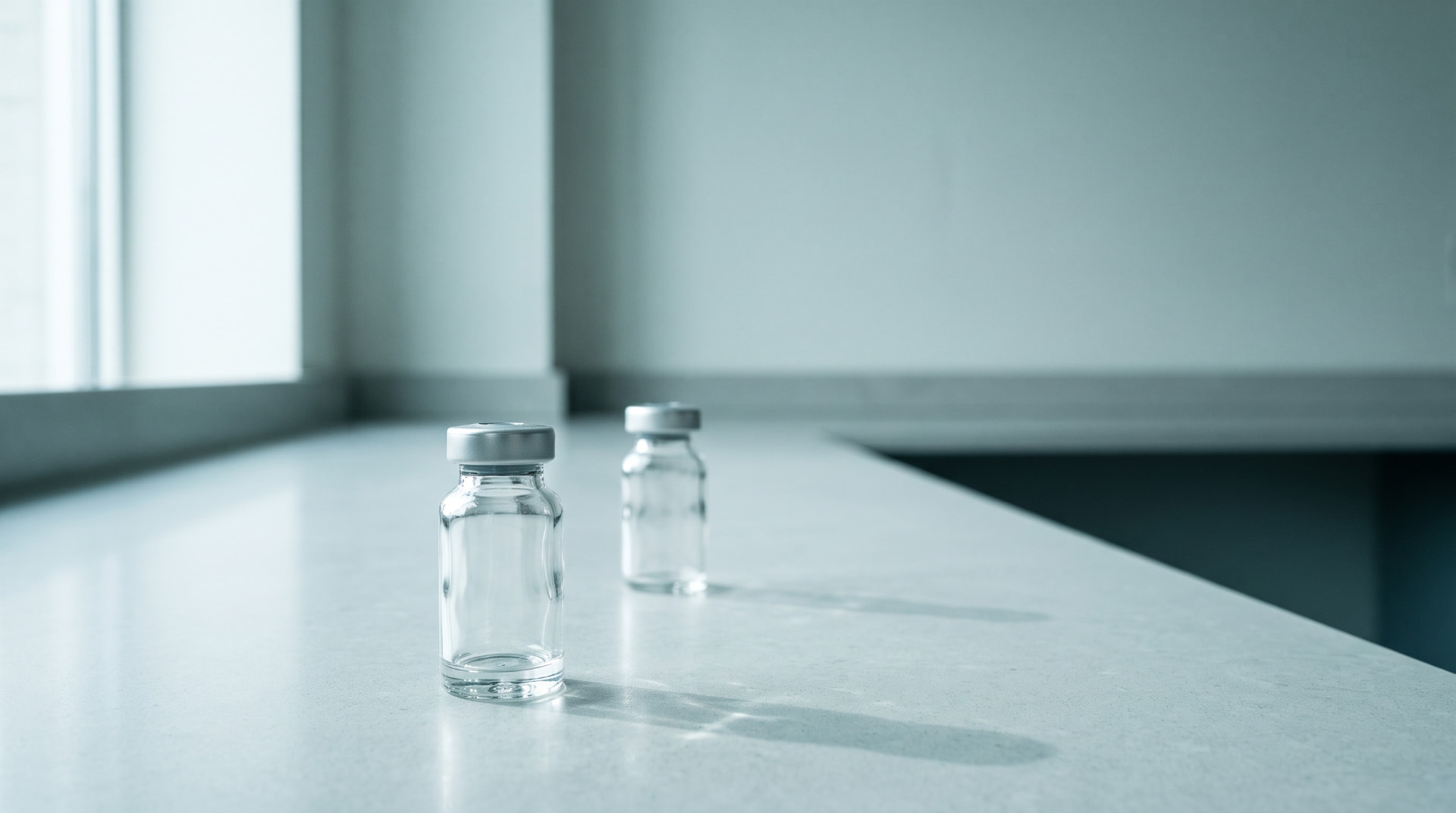
Almost every injectable peptide vial is Type I borosilicate, the grade USP credits with high hydrolytic and thermal shock resistance.1 That is the good news and it is also the end of what you can verify, because no research vial tells you its glass type and no certificate of analysis reports it. One documented failure mode exists for this glass, called delamination, and FDA has recorded no adverse events attributed to it in roughly a decade of surveillance.2 Most of the conditions that cause it do not describe a peptide vial. One of them does. The check that catches it is the same visual inspection you already do after mixing.
What kind of glass is a peptide vial made of?
Type I borosilicate is the near-certain answer, though you are taking it on trust. USP's chapter on glass containers sorts glass by how well it resists water attack. Type I is borosilicate glass, called neutral glass in the chapter, and it contains significant amounts of boric oxide, aluminum oxide and alkali or alkaline earth oxides. That composition gives it high hydrolytic resistance and high thermal shock resistance.1 Type III is soda-lime-silica, built mainly on sodium and calcium oxide, with only moderate hydrolytic resistance.1 Type II starts as Type III soda-lime-silica and gets a suitable treatment of its inner surface.1
Pharmaceutical vial makers work in Type I as a default. Schott, one of the larger suppliers, describes its vials as made of Type I borosilicate glass offering high chemical resistance, and says they comply with USP, the European Pharmacopoeia and ISO 8362.3 No research vial label repeats any of that.
Why does hydrolytic resistance matter for a peptide?
Hydrolytic resistance describes how much of the container ends up in the contents. Water attacks glass slowly, pulling ions out of the surface, and a glass with moderate resistance gives up more of itself than one with high resistance. For a dry powder sitting in a sealed vial, that process barely starts. Dry powder gives water nothing to work with. For a reconstituted solution sitting against the same glass for weeks, it has time to matter.
The practical consequence is that the glass type and the state of your vial interact. A powder vial and a mixed vial are the same container doing two different jobs. Temperature and time split the same way in our guide to storing peptides before and after mixing.
Borosilicate vs soda-lime glass: what actually differs?
Three grades sit in the chapter, built on two materials, and one row carries the decision. USP's Description section defines all three, and the public portion stops before the test methods, so the blanks below are blanks in the source itself.1
| Type I | Type II | Type III | |
|---|---|---|---|
| Material | Borosilicate, called neutral glass | Soda-lime-silica, inner surface treated | Soda-lime-silica |
| Main oxides | Boric oxide, aluminum oxide, alkali or alkaline earth oxides | Same base as Type III | Mainly sodium oxide and calcium oxide |
| Hydrolytic resistance | High | Raised by the surface treatment; the level is not in the public text | Moderate |
| Thermal shock resistance | High | Not stated in the public text | Not stated in the public text |
| On a research vial's label | Nothing | Nothing | Nothing |
Hydrolytic resistance is the row that decided this. High against moderate is the entire reason injectable products are packaged in borosilicate, because the glass that gives up less of itself keeps the solution closer to what was filled. Boric oxide and aluminum oxide are what buy that resistance, and soda-lime-silica built on sodium and calcium oxide does not reach it without help.
The bottom row is the one to sit with. All three grades are clear, all three take a crimp cap, and all three feel the same in your hand. Nothing distinguishes them visually at the scale a vial is made. So the comparison above is useful for knowing what Type I is worth, and useless for confirming you have it.
What is glass delamination?
Delamination is the glass surface shedding thin flakes into the solution, and those flakes are what FDA calls lamellae. FDA describes the problem as the formation of glass fragments in injectable drugs stored in small-volume glass vials, and it issued an advisory to manufacturers in 2011 after several drug recalls in 2010 and 2011 traced to it.2
The flakes come off the surface while the glass body stays intact. The inner face separates in layers, so the name describes lamination coming apart. Delamination needs time and the right chemistry. Nothing about the vial looks broken.
Which delamination risk factors actually apply to a research vial?
FDA names four conditions, saying there are others besides, and those four split cleanly into ones that describe a peptide vial and ones that do not.2
| Factor FDA names | Applies to a research peptide vial? |
|---|---|
| Vials made by the tubing process at higher heat | Likely yes, since small vials are typically tubing-formed |
| Length of time the solution contacts the glass | Yes for a mixed vial, up to the full in-use window |
| Terminal sterilization of the filled product | No, since these are filled as dry powder |
| Drug solution formulated at high pH | No, since bacteriostatic water is near neutral |
That table carries most of the answer to whether this should worry you, and it points two ways at once. Contact time applies to you. That clock runs for as long as you keep a mixed vial.
The pH factor is the one that misses, and pH is doing most of the work in the documented cases, since FDA ties chemical durability to pH alongside processing and storage temperatures and contact time.2 Schott makes the same point from the supply side, offering a coated vial specifically for drugs in the acidic to neutral pH range. A peptide in bacteriostatic water sits in that range.3
A mixed peptide vial therefore carries one of the four named conditions, and it is missing the one that drove the recalls.
Has anyone actually been harmed by glass lamellae?
No case of harm appears in FDA's records. The agency states plainly that there were "no known adverse events reported or directly attributed to the problem."2 It also says lamellae "pose potential risks, particularly when drugs are administered intravenously."2
That route qualifier carries weight for this audience. Subcutaneous injection is not intravenous injection. FDA weighted the concern toward the latter. In 2025 it went further: having reviewed surveillance data from fiscal year 2008 through fiscal year 2017 and found no new or increasing safety signals, it decided it "will not update the 2011 advisory at this time."2 The page carrying that decision was current as of January 7, 2025.
A real mechanism with real recalls behind it, and no documented patient harm, is an unusual combination, and it is the honest shape of this one.
Can you see lamellae in a vial?
Sometimes they are visible to the eye. Visual inspection is also the only detection a buyer has. Lamellae are particulate matter, so the check for them is the check approved labels already instruct for any reconstituted product. Orencia, a lyophilized protein reconstituted in a glass vial, tells users to inspect the solution and says "Do not use if opaque particles, discoloration, or other foreign particles are present."4
Flakes are thin and can be nearly transparent. A negative inspection does not prove a clean vial. The thing to spot is a fleck adrift in the solution. Cloudiness is a different question from discrete floating particles, and our guide to a cloudy vial works through what its timing distinguishes.
Does the peptide stick to the glass?
How much peptide binds to the glass depends almost entirely on concentration. Kristensen, Henriksen and Andresen measured three cationic peptides against borosilicate glass and polypropylene and found that "90% or more of the peptides might be lost from solution" through rapid adsorption to the walls of the sample containers.5 At one micromolar, only 10 to 20 percent was recovered from borosilicate glass vials or polypropylene tubes.5
Those are laboratory concentrations. The same paper explains why they do not transfer. The authors observed that container walls became increasingly saturated as peptide concentration rose, so recovery improves with concentration, and they prepared their own stock solutions at a concentration of at least a hundred micromolar.5 A reconstituted peptide vial sits in the milligram-per-milliliter range, far above that, where the walls saturate almost immediately and the fraction bound is small.
Adsorption is therefore real and mostly irrelevant at the concentrations people actually inject. At the dilute end it becomes relevant again, and that matters if you are working with a very low-concentration mix.
Do coatings on the glass change any of this?
Coated and treated vials exist for exactly these problems. Whether yours is one of them is unknowable. Schott's range includes a vial whose improved inner surface is described as fully controlling delamination and minimizing leachables, and another with an inner coating that reduces glass leachables, offered for drugs at acidic to neutral pH.3
Nothing on a vial announces which of these it is. A coated vial and a plain Type I vial look identical, and a research vial's label carries none of the container specification that an approved product's insert would. A pharmaceutical buyer reads that specification straight off the insert. You are working without one.
Does the stopper matter as much as the glass?
The closure gets less attention and does comparable work. Everything the solution touches can contribute something to it, and approved labels sometimes specify the hardware for that reason. Orencia's reconstitution instructions say to "Prepare ORENCIA using only the silicone-free disposable syringe" and specify an 18- to 21-gauge needle to pair with it.4 Silicone is a material-contact concern serious enough that a manufacturer ships a particular syringe to avoid it.
Gray-market reconstitution uses whatever syringe is on hand. No instruction accompanies the vial. The stopper's mechanical limits are a separate matter and how many times you can puncture a vial covers those, including coring.
What does a certificate of analysis say about the container?
A certificate reports nothing at all about the container, and that absence is easy to miss because the container is not even on the list of things people know a certificate omits. Our guide to reading a peptide COA has a section setting out what a certificate does not cover. The list names sterility and bacterial endotoxin, fill accuracy, handling in transit, grade claims, copper molar occupancy in copper peptides, and the link between the report and the vial in your hand.6 The glass appears nowhere in it.
The report covers assay results on a substance. Two assays do that work, HPLC purity and mass spectrometry, and both describe what was in the tube the lab received.6 Neither says a word about what that substance was shipped in. Across the 180 compounds with prices in our November 22, 2026 sweep, spanning 14,136 listings from 239 stores, every injectable one arrives in a glass vial whose type is specified nowhere a buyer can read.7
Does amber glass change the picture?
Amber glass changes the light answer. That question has its own page. The tint blocks part of the spectrum. The light protection question is worked through in our guide to peptides and light, including what no published study has measured about amber glass and a specific research peptide.
For chemistry, amber and clear are both normally Type I borosilicate with the amber coloring added, so the hydrolytic resistance discussion above does not change when the glass is tinted. Schott's amber framing is about light transmission alone.3
What is still unknown here?
Nobody has published testing of the glass that research peptide vials are actually made of. I found no study, no survey and no regulator document examining the container of a gray-market peptide vial for glass type, delamination or leachables. I looked at FDA's delamination findings page, USP chapter 660, a major vial supplier's technical pages, PLOS ONE for the adsorption literature, and our own certificate and price data. The gap is unsurprising, since testing an unregulated container is nobody's job, and it means the Type I assumption at the top of this page is an assumption.
One source limit is worth stating. USP chapter 660 is public only as far as its Description section, where the glass type definitions sit, and the testing methods and acceptance criteria are behind a subscription.1 The chapter's own official date is not stated on the public portion either. Everything above about how glass types are classified comes from that Description text, and nothing here characterizes the test methods.
What does a careful buyer check?
Inspect the mixed solution, because that is the one check in this whole article that you can actually perform. Hold the vial against a dark background and then a light one. Look for anything drifting that is not a bubble. Treat discoloration or visible particles the way an approved label does, as a reason not to use it.4 Doing that at every draw rather than only at mixing is what catches a problem that develops over the in-use window.
Beyond that, the useful steps are the ordinary ones. Keep the vial in its carton. A carton handles light without relying on the glass. Note the date at first puncture and keep the mixed window short, since contact time is the one delamination factor that applies to you.
Ask a seller what the vial is if you want to know, and treat a non-answer as information. Keep the per-lot certificate with the lot number on the vial, test the first vial of a lot yourself, and run the calculator on the tested concentration. Our guide to getting a peptide tested sets out what each assay costs and returns.
Common questions
What kind of glass are peptide vials made of?
Peptide vials are almost certainly Type I borosilicate, the glass USP describes as neutral, containing significant boric oxide, aluminum oxide and alkali or alkaline earth oxides, with high hydrolytic resistance and high thermal shock resistance. Pharmaceutical vial suppliers use Type I as standard. No research vial states its glass type on the label, so treat it as an expectation you cannot confirm.
What is the difference between Type I, Type II and Type III glass?
The three grades describe hydrolytic resistance, meaning how much of the glass surface water can pull out over time. Borosilicate is Type I and resists that attack best. Soda-lime-silica is Type III and resists it only moderately. Type II is soda-lime-silica whose inner surface has been given a suitable treatment.
What is glass delamination?
Delamination is the inner surface of the glass shedding thin flakes, called lamellae, into the solution. FDA issued an advisory to manufacturers in 2011 after several drug recalls in 2010 and 2011 traced to it. Flaking happens at the surface, so the glass body stays intact and nothing about the vial looks damaged.
Should I be worried about glass particles in my peptide vial?
FDA records no known adverse events reported or directly attributed to lamellae, and it flagged the potential risk particularly for drugs given intravenously. Of the four conditions its advisory names, a mixed peptide vial carries one, contact time, and is missing high pH, the factor behind the documented cases.
Can I see glass lamellae if they are there?
Lamellae are sometimes visible to the eye. They are particulate matter, so the check is a visual inspection against a dark and then a light background. Flakes can be thin and close to transparent, so a clean-looking vial can still hold them. Visible particles or discoloration are a reason to stop, and that is what approved labels instruct for any reconstituted product.
Does my peptide stick to the glass vial?
Peptide does bind to glass, far less than the most-quoted figure suggests. The study reporting that 90 percent or more can be lost worked at one micromolar. The same authors found recovery rises with concentration as the walls saturate, and they kept their own stocks at a concentration of at least a hundred micromolar. Your vial is orders of magnitude more concentrated than that, so the bound fraction is small.
Does the certificate of analysis cover the vial?
A certificate does not cover the container. It reports assay results on the substance, typically HPLC purity and mass confirmation, and says nothing about what that substance was shipped in. The container is not even among the omissions people usually know about, a list already holding sterility, endotoxin, fill accuracy and the link between the report and your vial.
Are amber vials made of different glass?
Amber and clear vials are normally both Type I borosilicate, with coloring added for light protection, so chemical resistance comes out the same either way. Suppliers describe amber vials against light transmission requirements. Whether amber glass gives a specific peptide meaningful light protection is a separate question.
Does the rubber stopper affect the peptide?
Everything the solution touches can contribute something to it. One approved label tells users to reconstitute only with the silicone-free disposable syringe shipped in the package, down to the needle gauge. That instruction shows how seriously material contact is treated. No equivalent instruction comes with a research vial.
Can a vial be coated to prevent delamination?
Yes, and suppliers sell exactly that, including vials whose inner surface is described as fully controlling delamination and others with a barrier coating against leachables. A coated vial and a plain one look identical, so a buyer cannot tell which they have.
Does glass type matter more for powder or for mixed solution?
Glass type matters more for mixed solution. A sealed dry powder barely begins the process that glass resistance describes, since water attack needs water. A reconstituted vial sits in contact with solution for as long as you keep it, so contact time is the risk factor that applies.
Why do some vials look thicker or heavier than others?
Vial wall thickness and forming method vary between suppliers and sizes, and FDA associated vials made by the tubing process at higher heat with a higher incidence of lamellae. You cannot read forming method off a vial by hand, so thickness is not a quality signal you can use.
Has the glass in research peptide vials been tested?
No published study, survey or regulator document that I could locate examines gray-market peptide vials for glass type, delamination or leachables. That is an absence of data rather than a clean result, and it is why the Type I expectation on this page stays an expectation.
What should I do if I see something floating in my mixed vial?
Treat it the way an approved label treats it and do not use the vial. Visible particles, opaque matter or discoloration all sit on the standard do-not-use list. Photograph it, keep the lot number, and raise it with the seller, since a lot problem affects more vials than yours.
Related reading
- How to Store Peptides: Before and After Mixing
- Do Peptides Need to Be Stored in the Dark? What the Labels Actually Protect
- My Peptide Went Cloudy. Is It Ruined?
- How to Read a Peptide COA (Certificate of Analysis)
- How Many Times Can You Puncture a Vial?
- My Peptide Vial Looks Empty. Is That Normal?
- How Do I Get My Peptide Tested? What It Costs and What Comes Back
Sources
- United States Pharmacopeia. General Chapter 〈660〉 Containers—Glass, Description section. Glass type classification read from the publicly visible Description; the test methods and acceptance criteria sit behind a subscription and were not read. No official or effective date appears on the public portion, whose suggested citation carries the year 2023. Read November 22, 2026. doi.usp.org Read via a reproduction. ↩ ↩ ↩ ↩ ↩ ↩
- US Food and Drug Administration. Summary of Recent Findings Related to Glass Delamination. Risk factors are FDA's own account of its 2011 advisory to drug manufacturers; the advisory itself was not reached. Content current as of January 7, 2025, read November 22, 2026. fda.gov Read via a reproduction. ↩ ↩ ↩ ↩ ↩ ↩ ↩
- Schott Pharma. Vials, product and technical pages. Type I borosilicate as the base material, the EVERIC coated-vial range including delamination control and leachable barriers, and compliance with USP, Ph. Eur. and ISO 8362. Read November 22, 2026. schott-pharma.com Read via a reproduction. Manufacturer technical material, not an independent evaluation. ↩ ↩ ↩ ↩
- ORENCIA (abatacept) for injection, US prescribing information, Dosage and Administration section 2.5 (reconstitution and inspection instructions). Bristol-Myers Squibb appears in the record as the contact for adverse reactions and syringe replacement. Query returned one record; read November 22, 2026 via the openFDA drug label API. api.fda.gov
- Kristensen K, Henriksen JR, Andresen TL. Adsorption of Cationic Peptides to Solid Surfaces of Glass and Plastic. PLOS ONE 2015;10(5):e0122419. journals.plos.org
- Peptide Decoding. How to Read a Peptide COA (Certificate of Analysis), "What a COA does not cover". Read November 22, 2026. peptidedecoding.com Our own published guide. ↩ ↩
- Peptide Decoding. Peptide prices across tracked sellers: 180 compounds with prices, 14,136 listings across 239 stores, last sweep November 22, 2026. peptidedecoding.com Our own data. ↩