
Taltirelin (Ceredist)_Dosage, benefits & legal status
Also known as TA-0910, Ceredist, Ceredist OD, C-Trelin, C-Trelin OD, taltirelin hydrate, taltirelin tetrahydrate
A modified TRH built to survive being swallowed and reach the brain. Approved in Japan since 2000 for ataxia; a Korean trial published in 2024 found an effect of under 1 point on a 40-point scale.
Common vial size is what vendors typically sell, not a recommendation. Enter your own vial in the calculator.
What is Taltirelin (Ceredist)?
Plain language first. The technical label stays, but it never stands alone.Overview
People with spinocerebellar degeneration, inherited or not, slowly lose balance and coordination, and in Japan and South Korea taltirelin is a twice-daily tablet approved to ease that unsteadiness. In the Korean trial of 149 analyzed patients, the ataxia score (K-SARA, out of 40) improved by 0.51 points on taltirelin and worsened by 0.36 on placebo over 24 weeks (P=0.0321). That effect is small, under 1 point, and every secondary measure, including balance, walking and quality of life, showed no significant difference.
Taltirelin is an analog of TRH (protirelin) in which the N-terminal pyroglutamate is replaced by a 1-methyl-4,5-dihydroorotyl ring, with histidine and prolinamide unchanged; GSRS files it as a chemical. At the human TRH receptor it binds about 25 times more weakly than TRH (IC50 910 against 36 nM) yet gives a larger maximal response (180% of TRH's in IP1 signaling), and in animals its effects on the brain are reported to last about 8 times longer, credited to better stability in blood and better entry into the brain. It is sold in Japan as Ceredist, now marketed by Tanabe Pharma, and in South Korea as C-Trelin by HLB Pharmaceutical.
What it's used for
A prescription tablet in Japan and South Korea to improve unsteadiness (ataxia) in spinocerebellar degeneration. Not approved in the US or EU.
How does Taltirelin (Ceredist) work?
What it does in the body, and where.Taltirelin is TRH rebuilt to survive the gut and the bloodstream, so a tablet can reach TRH receptors in the brain.
- 01A tougher first ringTRH starts with a five-membered pyroglutamate ring. Taltirelin swaps it for a larger, methylated ring with an extra nitrogen, making it more stable in blood. Taken by mouth it peaks at about 3 hours and has a half-life of about 2 hours, enough for twice-daily tablets.
- 02Switching on the receptorAmong the receptors and ion channels tested, it binds only the TRH receptor. At the human receptor it binds about 25 times more weakly than TRH but drives a larger maximal signal (180% of TRH's), a superagonist pattern; in mice its effects on the brain run mainly through the TRH-R1 receptor.
- 03From brain chemistry to ataxiaIn rats it raises the release and turnover of acetylcholine and dopamine, and in animal ataxia models it improves gait and reduces falls. In patients the effect on ataxia scores is small. It also acts on the pituitary: TSH rose from 5 mg and T3 from 10 mg in healthy men, though in rats it releases less TSH per mole than TRH does.
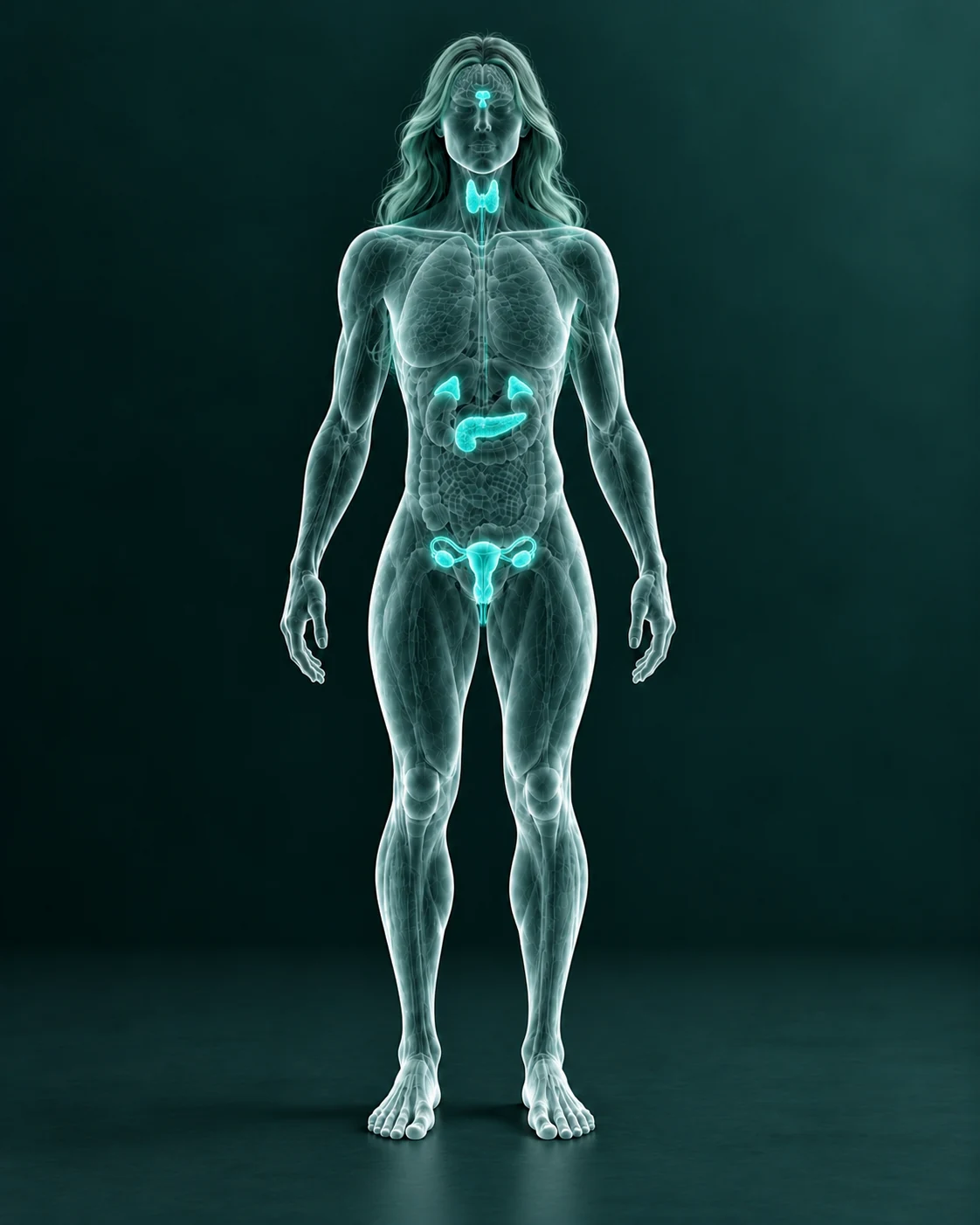
What else is it used for?
Each group carries its own evidence level.Approved means regulators have cleared it for that purpose. Investigational means it is in trials. Early research means it is being studied and is not established.
Korean phase 4 trial
Clinical use- Human trial149 analyzed (the paper says 149 enrolled; ClinicalTrials.gov lists 160): K-SARA -0.51 against +0.36 on placebo at 24 weeks (P=0.0321), a difference of under 1 point on a 40-point scale.
- Human trialEvery secondary outcome missed: K-SARA at 12 weeks (P=0.1151), clinician global ratings, autonomic symptoms, EQ-5D-5L quality of life, Tinetti balance and gait (P=0.5874) and all gait-lab measures.
- No dataOnly unadjusted subscores (stance P=0.0270, speech P=0.0130) and subgroups (inherited ataxia -1.28 against +0.03, P=0.0099) reached significance, and the groups differed in age (56.6 against 52.5 years).
Japanese phase 3, as labeled
Clinical use- Human trial427 patients with spinocerebellar degeneration: no clear difference on the individual ataxia tests at 28 weeks, but the global improvement and overall ataxia ratings significantly favored the drug.
- Human trialCumulative worsening at 28 weeks was 27.7% against 41.7% on placebo, but over 1 year there was no difference.
Japanese phase 3, as summarized in Korea
Clinical use- Human trial213 on the drug against 214 on placebo, mild to moderate disease: global improvement favored the drug (P<0.001), with improvement in 24.2% against 8.9% and worsening in 27.1% against 42.3% at 28 weeks.
- No dataCumulative worsening at 28 weeks was 26.7% against 42.0% here, with a log-rank P=0.078, while the label reports 27.7% against 41.7% as significant; daily-living improvement was not significant (P=0.247).
At the human TRH receptor
Research only- Lab studyBinding IC50 910 nM against 36 nM for TRH (about 25-fold weaker); calcium EC50 36 against 5.0 nM; IP1 EC50 150 against 3.9 nM.
- Lab studyMaximal IP1 signaling reached 180% of TRH's (P<0.001), so it acts as a superagonist; in rodents its TSH-releasing activity is lower than TRH's.
Safety after approval
Clinical use- Human observationAdverse reactions in 8.6% (271 of 3,152) in the use-results survey and 4.8% (107 of 2,252) in the long-term survey, most often nausea, dizziness and raised TSH in the first and raised TSH, T4 and prolactin in the second.
- Human observationOne serious case of neuroleptic malignant syndrome left lasting weakness of the breathing muscles; one case of an overactive thyroid resolved after stopping; one death from bleeding with low platelets was judged unlikely to be drug-related.
Taltirelin is often called 10 to 100 times more potent than TRH. That figure comes from its stimulant effects on the brain in animals; at the human TRH receptor in cell studies it binds about 25 times more weakly and needs higher concentrations to signal, though its maximal response is larger, and its TSH-releasing activity is weaker than TRH's. It is also reported as improving the primary ataxia score against placebo. That is true but overstated: taltirelin patients improved by 0.51 K-SARA points while placebo patients worsened by 0.36, a gap of under 1 point on a 40-point scale. The claim that most secondary outcomes missed understates it, since every secondary outcome the paper reports did. That trial was a phase 4 study after the February 6, 2015, Korean approval, not the basis for approval. A longer half-life than protirelin is plausible, but the only label figure is about 2 hours by mouth, with no head-to-head study in people. For the Japanese phase 3, the label gives cumulative worsening at 28 weeks of 27.7% against 41.7% (significant), while a Korean review gives 26.7% against 42.0% (P=0.078). Laboratory suppliers also list a taltirelin acetate; the approved drug is the tetrahydrate. Taltirelin is a different molecule from TRH (protirelin) itself.
The published record
Papers and trials about Taltirelin (Ceredist)
20 papers tagged human · 16 not reviews or lab · 2 clinical trial publications
1 registered trials · none with posted results
Furthest stage reached: Approved outside the US, Japan, South Korea
Counted from Europe PMC indexing, not read by a person; a human tag can land on reviews, commentary or lab papers; clinical trial publications is the narrower count.

At a glance
Four things to know about Taltirelin (Ceredist)
Evidence
Investigational
Category
Brain, mood and sleep
Common vial
Varies
Half-life
About 2 hours
How much, and do you cycle it?
The range, and whether you take breaks.5 mg per dose, 10 mg a day (Japanese and Korean labels), twice daily, after morning and evening meals. Taken every day with no planned break FDA label
The labels give 5 mg twice daily with no set end. Korea's restricted reimbursement criteria call for reassessing the K-SARA score at 6 months and then every 12 months, and stopping if the score rises by 3 or more points or reaches 20.
How long does it stay in the body?
The half-life, and where the figure comes from.About 2 hoursFDA label
Single oral doses of 0.5 to 40 mg in healthy men: peak at about 3 hours and half-life about 2 hours, with peak level and exposure in proportion to dose. The 5 mg tablet and dissolving tablet matched (2.0 ± 0.3 and 2.0 ± 0.5 hours). No build-up over 2 weeks of repeated dosing, and binding to plasma proteins was not detected. Unchanged drug and its acid metabolite each made up 1 to 2% of the dose in 24-hour urine, even though the label names kidney excretion as the main route.
Source: Ceredist Japanese package insert, pharmacokinetics section (via KEGG MEDICUS)
You can compare this against the whole library to see where it sits.
What does it cost?
Typical dose and cost, in plain numbers.Taltirelin (Ceredist) is not injected
It is taken by mouth (tablet). Taken by mouth as 5 mg of taltirelin hydrate twice a day, after the morning and evening meals, with no step-up; the Japanese and Korean labels allow adjustment for age and symptoms. Supplied as a 5 mg tablet and a 5 mg orally disintegrating tablet; the Korean label notes the dissolving tablet can be taken without water and is then swallowed with saliva or water once it breaks up. Taken after food, the peak level was about 77% and total exposure about 75% of fasting values. No numeric adjustment is given for kidney impairment or older age, only caution, since one patient with severe kidney impairment had about 4.2 times the usual blood level. The Korean trial used the same 5 mg twice daily for 24 weeks.
Taltirelin (Ceredist) starts at $46.00 across 1 vendor.
1 listing, last read Oct 20, 2026. Shipping and card fees are not included.
How do you store it?
Before mixing, and after.Room temperature. Cool, dry, out of light.
Taltirelin (Ceredist) is taken as a pill or capsule. Keep it in its original container at room temperature, away from heat, humidity, and direct sun. No fridge or mixing needed. Check the expiration date on the bottle.
What are the side effects and cautions?
Known cautions and warnings for this compound.Who should avoid it
- Severe kidney impairment: blood levels rose about 4.2-fold in one such patient, and the label lists this under special populations; for older people it advises care with the dose, since kidney function declines with age
- Pregnancy: the label allows it only when the benefit is judged to outweigh the risk
- Breastfeeding: the label advises against it, since the drug passed into milk in rats
- Not studied in children: no clinical trials have been run in them
- Not studied in people with marked cognitive impairment (K-MMSE 20 or lower), excluded from the Korean trial
Stop and get help
- Convulsions, or high fever with muscle stiffness, possible neuroleptic malignant syndrome (each under 1% on the label)
- Yellowing of the skin or eyes, possible liver injury or jaundice (under 1%)
- Unusual bruising or bleeding, possible low platelets, or fainting with a sudden drop in blood pressure, possible shock-like reaction (each frequency unknown)
Common effects
- Japanese phase 3: adverse reactions in 28 of 199 patients (14.1%), most often dizziness or unsteadiness (5), stomach discomfort (4), nausea (3) and loss of appetite (3)
- After approval, adverse reaction rates of 8.6% (271 of 3,152) and 4.8% (107 of 2,252) in two Japanese surveys, most often nausea, dizziness and raised TSH in the first and raised TSH, T4 and prolactin in the long-term survey
- Korean trial: any adverse event in 28.57% against 22.50% on placebo (P=0.3828), with nervous system events in 6.49% against 1.25%, gut events in 5.19% against 2.50% and injury or procedural events in 9.09% against 2.50%; the authors judged none caused by the drug
- Label, 0.1% to under 5%: nausea, vomiting, diarrhea, headache, dizziness, tremor, blood pressure or pulse changes, raised liver enzymes and changes in TSH, thyroid hormones and prolactin
Where this page says nothing is established, that means nobody has studied it, not that a compound is safe.
Is Taltirelin (Ceredist) approved?
And where the numbers on this page come from.Not in the United States. Taltirelin (Ceredist) has no FDA approval, so there is no legal route to obtain it as a medicine there. It is approved in Japan and South Korea.
- Approval statusInvestigational
- RouteBy mouth (tablet)
- Checked21 October 2026
- Approved outside the USJapan, South Korea: Japan approved Ceredist Tablets on July 3, 2000 and Ceredist OD Tablets on June 24, 2009 for ataxia in spinocerebellar degeneration, and generic tablets are sold there. South Korea licensed C-Trelin OD Tablet 5 mg (now held by HLB Pharmaceutical) on February 6, 2015 for the same use, with conditional insurance coverage from December 2025. Not approved in the US or EU.This does not change the United States position above.
- DoseFrom the drug label. The manufacturer tested this range and a regulator reviewed it.
- Vial sizeFrom what vendors typically list; not a recommendation.
- SourcesCeredist Japanese package insert (Tanabe Pharma, revised December 2025), via KEGG MEDICUSPMDA re-examination report, Ceredist (2012)Cho JW et al., Journal of Movement Disorders 2025;18:35-44Erratum, Journal of Movement Disorders 2026;19:244-245ClinicalTrials.gov, Korean phase 4 trial (NCT04107740)HIRA reimbursement review dossier, C-Trelin OD Tablet 5 mg (Korea)Dailypharm, C-Trelin reimbursement (January 22, 2025)FDA GSRS substance record, taltirelin (UNII DOZ62MV6A5)FDA GSRS substance record, taltirelin tetrahydrate (UNII 525OEO6W15)KEGG DRUG D01925, taltirelin hydrateKEGG MEDICUS, taltirelin products in JapanThirunarayanan N, Raaka BM, Gershengorn MC, Frontiers in Endocrinology 2012;3:120
What has happened recently
Approved in Japan on July 3, 2000 as Ceredist Tablets 5, renamed Ceredist Tablets 5 mg on January 31, 2012, to improve ataxia in spinocerebellar degeneration; an orally disintegrating tablet, Ceredist OD Tablets 5 mg, was approved on June 24, 2009 with the same use and dose. The 10-year re-examination result, reported on April 11, 2012, was Category 1, with no change to the approval, and generic versions are sold by Sawai, Nihon Generic and Kyowa (tablets and orally disintegrating tablets) and by Nichi-Iko (orally disintegrating tablets only). South Korea licensed C-Trelin OD Tablet 5 mg on February 6, 2015 for ataxia caused by spinocerebellar degeneration, as a prescription drug without reimbursement; its first holder, C-Tri, was refused coverage in January 2018 for lack of evidence of clinical usefulness, and the company, renamed twice, became HLB Pharmaceutical in October 2020. HLB reapplied for coverage using its phase 4 trial, and a reimbursement subcommittee reviewed it on May 23, 2025 with restricted criteria, including age 20 or older, a K-SARA score under 20, the ability to walk, reassessment at 6 months and then every 12 months, and periodic TSH and prolactin checks. In July 2025 the Drug Reimbursement Evaluation Committee found coverage appropriate if HLB accepted a price no higher than that of the comparator drug, protirelin, and C-Trelin was listed with conditional coverage in December 2025. No FDA or EMA filing has been found, and it is not approved in the US or EU.
You can compare this against the whole library, or read how to check a seller.
What else is like Taltirelin (Ceredist)?
Others in Brain, mood and sleep, side by side.If you're weighing Taltirelin (Ceredist), it's worth reading Trofinetide (Daybue), Ziconotide, and Selank in the same class.
A modified TRH built to survive being swallowed and reach the brain. Approved in Japan since 2000 for ataxia; a Korean trial published in 2024 found an effect of under 1 point on a 40-point scale.
- Dose
- 5 mg per dose, 10 mg a day (Japanese and Korean labels)
- How often
- Twice daily, after morning and evening meals
An approved oral treatment for Rett syndrome, built from the first three amino acids of IGF-1 with one methyl group added.
- Dose
- 5,000 to 12,000 mg twice daily by weight (label)
- How often
- Twice daily
The FDA-approved cone-snail peptide for severe chronic pain, delivered only into the spinal fluid.
- Dose
- 2.4 up to 19.2 mcg per day by continuous pump (label)
- How often
- Continuous infusion
A peptide that eases anxiety while keeping you clear-headed.
- Dose
- 0.25 up to 0.5 mg per day
- How often
- 1-2x daily
Guides for this compound
- mcg vs mg: The Peptide Dosing Mistake to Avoid
Your vial says mg and your protocol says mcg. Here is the conversion and how to check it.
- How to Read a Peptide COA
What the purity number does and does not tell you, and how to spot an edited report.
- How to Vet a Peptide Vendor
Independent COAs, HPLC purity, and the red flags that mean walk away.
Sources
- Ceredist Japanese package insert (Tanabe Pharma, revised December 2025), via KEGG MEDICUS(2025)5 mg twice daily after meals; half-life about 2 hours and peak at about 3 hours; food lowers exposure to about 75%; phase 3 adverse reactions 14.1%; convulsions, neuroleptic malignant syndrome and liver injury each under 1%.
- PMDA re-examination report, Ceredist (2012)(2012)Approved July 3, 2000 (tablets) and June 24, 2009 (OD tablets); Category 1 result on April 11, 2012; adverse reactions in 8.6% and 4.8% in the two post-marketing surveys.
- Cho JW et al., Journal of Movement Disorders 2025;18:35-44(2024)Korean phase 4 trial, 149 analyzed: K-SARA -0.51 against +0.36 at 24 weeks (P=0.0321); every secondary outcome not significant; any adverse event 28.57% against 22.50%.
- Erratum, Journal of Movement Disorders 2026;19:244-245(2026)Corrected the K-MMSE exclusion cutoff to 20 or lower and one Table 1 label.
- ClinicalTrials.gov, Korean phase 4 trial (NCT04107740)(2021)Completed, 160 enrolled at 8 sites in South Korea from March 4, 2019 to February 8, 2021; sponsor HLB Pharmaceutical; no results posted.
- HIRA reimbursement review dossier, C-Trelin OD Tablet 5 mg (Korea)(2025)Korean approval February 6, 2015 (product now held by HLB Pharmaceutical); restricted reimbursement criteria; Japanese phase 3 improvement rate 24.2% against 8.9%.
- Dailypharm, C-Trelin reimbursement (January 22, 2025)(2025)Approved in Korea in 2015 but not reimbursed, at KRW 4,900 a tablet; the phase 4 trial enrolled 160 people.
- FDA GSRS substance record, taltirelin (UNII DOZ62MV6A5)(2026)C17H23N7O5, MW 405.41; three defined stereocenters; filed as a chemical.
- FDA GSRS substance record, taltirelin tetrahydrate (UNII 525OEO6W15)(2026)C17H23N7O5.4H2O, MW 477.47; the marketed hydrate.
- KEGG DRUG D01925, taltirelin hydrate(2026)Taltirelin hydrate (JP19), Ceredist; TRH receptor agonist and derivative of protirelin; CAS 201677-75-0.
- KEGG MEDICUS, taltirelin products in Japan(2026)Ceredist plus generic tablets and OD tablets from Sawai, Nihon Generic, Kyowa and Nichi-Iko.
- Thirunarayanan N, Raaka BM, Gershengorn MC, Frontiers in Endocrinology 2012;3:120(2012)Human TRH receptor in HEK-EM 293 cells: binding IC50 910 against 36 nM for TRH; maximal IP1 response 180% of TRH's.
Beyond these, 94 records are indexed. Browse the records