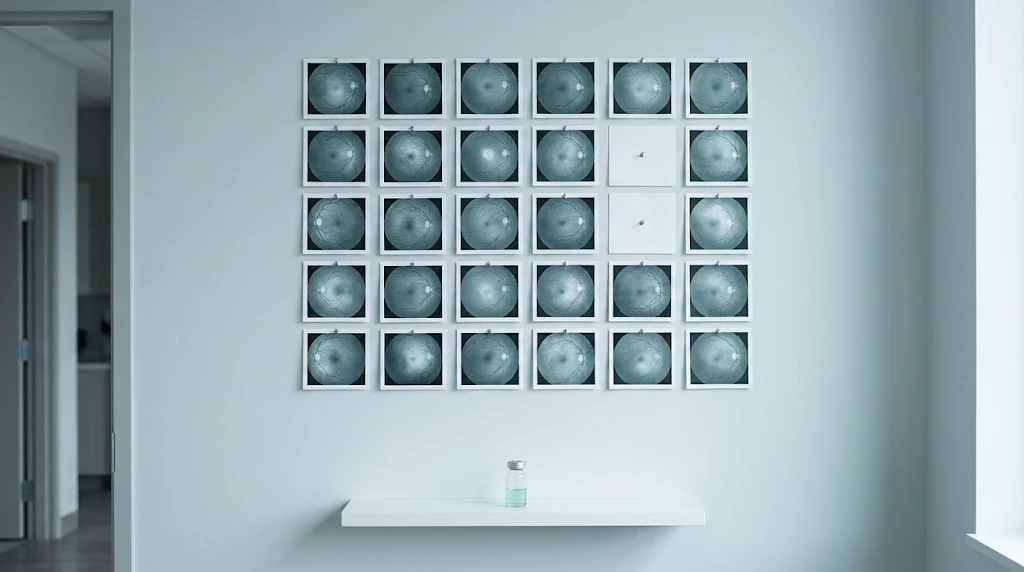
Denmark's patient compensation body has now paid 31 people who lost vision after taking semaglutide sold as Wegovy, Ozempic or Rybelsus.1 The condition is NAION, short for non-arteritic anterior ischemic optic neuropathy, a rare loss of blood flow to the optic nerve that can take the sight in one eye.2 The body's count, last updated November 18, 2026, shows 94 claims. Twenty-nine were rejected and 34 are undecided.1
Twelve months earlier, the same body had decided five cases and paid four.3 Bloomberg reported on November 19, 2026 that the awards now total about 15 million Danish kroner, roughly $2.3 million.4 Those figures landed ten days after the FDA told the makers of every approved GLP-1 drug in the US to add a NAION warning to their labels.2
Each award is a decision about one person's case, made on a more-likely-than-not standard. Scientists need far more than that to say a drug causes a condition, and FDA reviewed the trial data this month and still calls the risk potential.2
What did Denmark actually decide?
Denmark decided that in 31 individual cases it is more likely than not that semaglutide caused the person's NAION. That is the test the body states on its own page: "Det skal være overvejende sandsynligt, at medicinen er skyld i den sygdom," meaning it must be predominantly probable that the medicine is to blame for the disease.1
The body is Patienterstatningen, the Danish Patient Compensation association. It weighs patient claims on behalf of the state, and the state funds the awards.5 Patients do not sue a drugmaker and do not have to show anyone did anything wrong. Each case is assessed individually with input from medical consultants.13
In twelve months the claim count has more than doubled:
| Danish NAION claims on semaglutide | November 21, 2025 | November 18, 2026 |
|---|---|---|
| Claims received | 43 | 94 |
| Recognized and paid | 4 | 31 |
| Rejected | 1 | 29 |
| Not yet decided | 38 (43 less the 5 decided) | 34 |
| Total awarded | about 800,000 kroner, "could rise" | about 15 million kroner (reported) |
| Source | Patienterstatningen release3 | Patienterstatningen count1; total from Bloomberg4 |
Of the 60 cases decided so far, 31 were recognized, a little over half. If the reported total is right, the average award is near 480,000 kroner, around $74,000. That average is our arithmetic, and the body has not published amounts per person.
Does this prove Ozempic causes vision loss?
No, and the Danish body does not claim it does. Its page notes that people with diabetes or obesity are usually at raised risk of NAION already. So every case needs an individual judgment about whether the drug was the more likely cause.1
"More likely than not" is a legal standard for one person's claim. A causal finding in science needs something different: enough events in a controlled comparison that chance and shared risk factors can be ruled out. The best controlled data so far are thin. FDA's pool of 126 randomized trials found 10 probable NAION events on GLP-1 drugs and 5 on comparators, a rate of 6.4 against 3.8 per 100,000 person-years.2 FDA called that a potential increased risk, said the underlying cause "is not completely understood," and found no mechanism in animal studies.2
The FDA numbers and the Danish awards answer different questions. The trial pool asks how often the drug causes NAION across tens of thousands of people, and its answer is still uncertain. A Danish reviewer asks whether, for one person with a known start date and known risk factors, the drug is the likeliest explanation. The 31 awards add to the record on that second question only.
Why can Danish patients get paid when the side effect is on the label?
Danish patients can be paid because the law covers rare and serious side effects, whether or not they are listed. The body says the law gives a right to compensation for side effects that are both rare and serious, and that a side effect appearing on the patient leaflet makes no difference to eligibility.1 It puts NAION at statistically fewer than 1 in 10,000 patients, and says that rarity is what lets these claims qualify.1
That figure matches Europe's earlier conclusion, and the European review itself started in Denmark: the EU safety committee opened it in January 2025 at the Danish Medicines Agency's initiative.6 On June 6, 2025, the European Medicines Agency's safety committee called NAION a very rare side effect of semaglutide, affecting up to 1 in 10,000 users.7 The Danish page dates the formal listing of the side effect to October 2, 2025.1
The body does not compensate NAION that appears long after the drug was stopped, and it says research shows no increased risk after more than 14 months of use without NAION.13 The first four awards could also grow if a patient's vision loss later costs them earning capacity, for example someone who can no longer drive or read.3
What has Novo Nordisk said?
Novo Nordisk has not accepted a causal link. When the first Danish awards were announced in November 2025, a company spokesperson told Reuters that patient safety is its top priority and that it believes the benefit-risk profile of semaglutide remains favorable.5 After the FDA action this month, Novo said the data "do not establish a cause-and-effect relationship."8 Both are company positions.
Is anything similar happening in the US or elsewhere?
In the US there is no equivalent public scheme, so the same question is being fought in court. Hundreds of US lawsuits allege that GLP-1 drugs caused NAION, naming both Novo Nordisk and Eli Lilly, and both companies deny any significant relationship.9 The federal cases are consolidated before Judge Karen S. Marston in the Eastern District of Pennsylvania as MDL 3163, and in July 2026 she allowed early discovery and motions on cross-cutting issues. A legal trade report described those as general causation and preemption.1011 No trial date appears on the court's page.10
Sweden has also paid one case. Its industry-owned pharmaceutical insurer decided in 2025 to compensate one patient for NAION after semaglutide, did not disclose the amount, and had four more reports under investigation as of November 25, 2025.6
What does this mean for someone using a GLP-1 from a gray-market vial?
Nothing published this week changed the underlying risk estimate, and for most people it remains very small. Denmark's reviewers have now found the drug the likelier explanation in 31 separate cases, a record about individual people that leaves the population-level estimate where FDA put it.
Every recognized Danish case involves branded semaglutide prescribed under a label.1 The Danish page says nothing about compounded or unapproved versions. A research vial of semaglutide, tirzepatide or retatrutide comes with no leaflet and no prescriber in the record, so nobody hands a gray-market user the symptom list.
FDA lists the symptoms as sudden painless vision loss in one eye, blind spots or tunnel vision, color distortion, and blurry or hazy central vision, and advises getting help right away.2 Its risk-factor list overlaps with common reasons for taking these drugs: diabetes, high blood pressure, sleep apnea, smoking, anemia and kidney disease.2 A person with several of those, or a past NAION episode, has the strongest reason to raise this with a clinician, and our guide to telling your doctor covers that conversation. Every Danish decision turned on timing, so a plain record of when you started, what you took and from which lot is what any eye doctor will ask for first.
The broader side-effect picture is in our GLP-1 side effects guide.
What is still unknown?
- Whether GLP-1 drugs cause NAION. FDA says potential; Denmark's awards are individual legal judgments.21
- Whether tirzepatide or other GLP-1 drugs produce Danish claims. The Danish page covers semaglutide only.1
- Whether dose or speed of weight loss matters. Neither FDA nor the Danish body has published an analysis by dose.21
- Any per-person award amount. The body publishes counts, not payments.1
What happens next?
The Danish count updates every Wednesday, and 34 claims are still waiting.1 In the US, the companies now have to revise their labeling under the FDA requirement. FDA gave no date for the new labels.2 The next development that would change the science is a study large enough to show whether the excess tracks with dose.
Common questions
Has anyone been paid for vision loss from Ozempic or Wegovy?
Yes. Denmark's patient compensation body has recognized 31 NAION claims from semaglutide users as of November 18, 2026.
How much has Denmark paid?
About 15 million Danish kroner in total, roughly $2.3 million, according to Bloomberg. The Danish body publishes counts, not amounts per person.
Does this mean semaglutide causes NAION?
No. Each award is a legal judgment that the drug was more likely than not the cause in one person. FDA still calls the risk potential.
How many claims has Denmark rejected?
Twenty-nine. Another 34 are undecided, out of 94 received.
What is NAION?
A loss of blood flow to the front of the optic nerve. It usually causes sudden, painless vision loss in one eye, and the loss can be permanent.
Which drugs do the Danish claims involve?
Semaglutide sold as Wegovy, Ozempic and Rybelsus. The page does not cover tirzepatide or other GLP-1 drugs.
Why would Denmark pay if NAION is on the label?
Danish law compensates rare and serious side effects regardless of whether they are listed. NAION counts as rare at fewer than 1 in 10,000 patients.
How rare is NAION on semaglutide?
Very rare. Europe's safety committee put it at up to 1 in 10,000 users, and FDA's trial pool showed 6.4 against 3.8 cases per 100,000 person-years.
Can Ozempic cause blindness?
Rarely, it may cause permanent vision loss in one eye through NAION. FDA calls this a potential increased risk, and Denmark has paid 31 people whose cases it judged more likely than not to be drug-related.
Did the FDA say GLP-1s cause blindness?
No. On November 9, 2026, FDA required a warning about a potential increased risk of NAION. It found no mechanism in animal studies.
Are there US lawsuits over NAION?
Yes, hundreds, against Novo Nordisk and Eli Lilly, consolidated in federal court as MDL 3163 in Pennsylvania. Both companies deny a significant link, and no court has ruled on causation.
Has anywhere besides Denmark paid out?
Sweden's pharmaceutical insurer compensated one patient in 2025. The amount was not disclosed.
What did Novo Nordisk say?
It says the data do not establish cause and effect, and that semaglutide's benefit-risk profile remains favorable.
Does this affect compounded or research semaglutide?
Not directly. The Danish claims concern branded products, and nothing on the page addresses compounded or unapproved versions.
What symptoms should I watch for?
Sudden painless vision loss in one eye, blind spots, tunnel vision, color distortion, or blurry central vision. FDA says to get help right away.
Who is most at risk?
People who already carry NAION risk factors: diabetes, high blood pressure, sleep apnea, smoking, anemia, kidney disease or a past episode.
Will more Danish claims be decided?
Yes. Thirty-four are pending, and the body updates its count every Wednesday.
Sources
- Patienterstatningen (Danish Patient Compensation). "Erstatning for alvorlig øjensygdom efter Wegovy og Ozempic." Focus page, counts last updated November 18, 2026. https://patienterstatningen.dk/presse-og-nyheder/fokusomraader/erstatning-for-alvorlig-oejensygdom-efter-wegovy-og-ozempicRead at source, in Danish, through a fetch tool that caps quotation near 125 characters; translations are ours. Source of the 94/31/29/34 counts, the "overvejende sandsynligt" standard, the rare-and-serious rule, the fewer-than-1-in-10,000 figure, the 14-month and after-stopping limits, and the October 2, 2025 listing date. It does not publish award amounts or name the statute. ↩ ↩ ↩ ↩ ↩ ↩ ↩ ↩ ↩ ↩ ↩ ↩ ↩ ↩ ↩ ↩
- U.S. Food and Drug Administration. "FDA Requires Safety Labeling Changes for Glucagon-Like Peptide-1 Receptor Agonists (GLP-1 RAs) Due to Potential Increased Risk of Rare But Serious Eye Condition." Drug Safety Communication, November 9, 2026. https://www.fda.gov/drugs/drug-safety-communications/fda-requires-safety-labeling-changes-glucagon-peptide-1-receptor-agonists-glp-1-ras-due-potential
- Patienterstatningen. "De første patienter får erstatning for alvorlig øjensygdom efter Wegovy og Ozempic." News release, November 21, 2025. https://patienterstatningen.dk/presse-og-nyheder/nyheder/2025/nov/de-foerste-patienter-faar-erstatning-for-alvorlig-oejensygdom-efter-wegovy-og-ozempic
- Joseph James. "Denmark has paid 31 Wegovy and Ozempic users over rare vision-loss claims." Medical Daily, November 19, 2026. https://www.medicaldaily.com/denmark-compensation-semaglutide-naion-vision-loss-481442
- Jacob Gronholt-Pedersen. "Denmark compensates patients for vision loss linked to Novo Nordisk drugs." Reuters, November 21, 2025, as republished by AOL. https://www.aol.com/articles/denmark-compensates-patients-vision-loss-125831738.html
- Helene Wallskär. "Även svensk patient fick ersättning för NAION." Läkemedelsvärlden, November 25, 2025. https://www.lakemedelsvarlden.se/ersattning-for-naion-efter-semaglutid/
- European Medicines Agency. "PRAC concludes eye condition NAION is a very rare side effect of semaglutide medicines Ozempic, Rybelsus and Wegovy." June 6, 2025, revised June 13, 2025. https://www.ema.europa.eu/de/news/prac-concludes-eye-condition-naion-very-rare-side-effect-semaglutide-medicines-ozempic-rybelsus-wegovyRead at source in this desk's November 11, 2026 run; not re-read today. Covers semaglutide only. ↩
- Christy Santhosh and Sneha S K. "FDA orders new eye risk warnings for Ozempic, Zepbound." Reuters, November 9, 2026, as republished by the Honolulu Star-Advertiser. https://www.staradvertiser.com/2026/11/09/breaking-news/fda-orders-new-eye-risk-warnings-for-ozempic-zepbound/Read via a reproduction in this desk's November 11, 2026 run; not re-read today. Source of the Novo Nordisk cause-and-effect statement, a company position. ↩
- Emily Van de Riet. "Hundreds of lawsuits allege GLP-1s like Ozempic, Wegovy and Mounjaro caused permanent vision loss." Gray News via WCAX, September 22, 2026. https://www.wcax.com/2026/09/22/hundreds-lawsuits-allege-glp-1s-like-ozempic-wegovy-mounjaro-caused-permanent-vision-loss/Read at source. Gives no exact count and no court detail; based on USA Today reporting we did not open. ↩
- U.S. District Court for the Eastern District of Pennsylvania. MDL 3163, In re: GLP-1 RAs NAION Products Liability Litigation, case page and orders list. https://www.paed.uscourts.gov/node/5110 and https://www.paed.uscourts.gov/mdl/mdl3163/orders
- Mealey's. "GLP-1 Eye Injury MDL Judge Approves Early Discovery On Causation, Preemption." July 7, 2026. https://www.mealeys.com/mealeys/articles/2497890Read at source, excerpt only (paywalled). ↩
Citing this page: Peptide Decoding. Has Anyone Been Paid for Ozempic Vision Loss? What Denmark's 31 Awards Mean. Counts from Patienterstatningen as updated November 18, 2026; FDA Drug Safety Communication of November 9, 2026. Reviewed November 22, 2026. https://peptidedecoding.com/news/denmark-naion-compensation