
Everyone quoted 20.1% from the eloralintide trial. The arm that produced 16.4% is the one that changes what you would do with it.
That was the arm that climbed to the top dose in two steps instead of starting there. It lost about four percentage points less weight, and the people in it had roughly a third of the nausea and half the fatigue.1 Whether that trade is one you would take is what the phase 3 programme now has to settle.
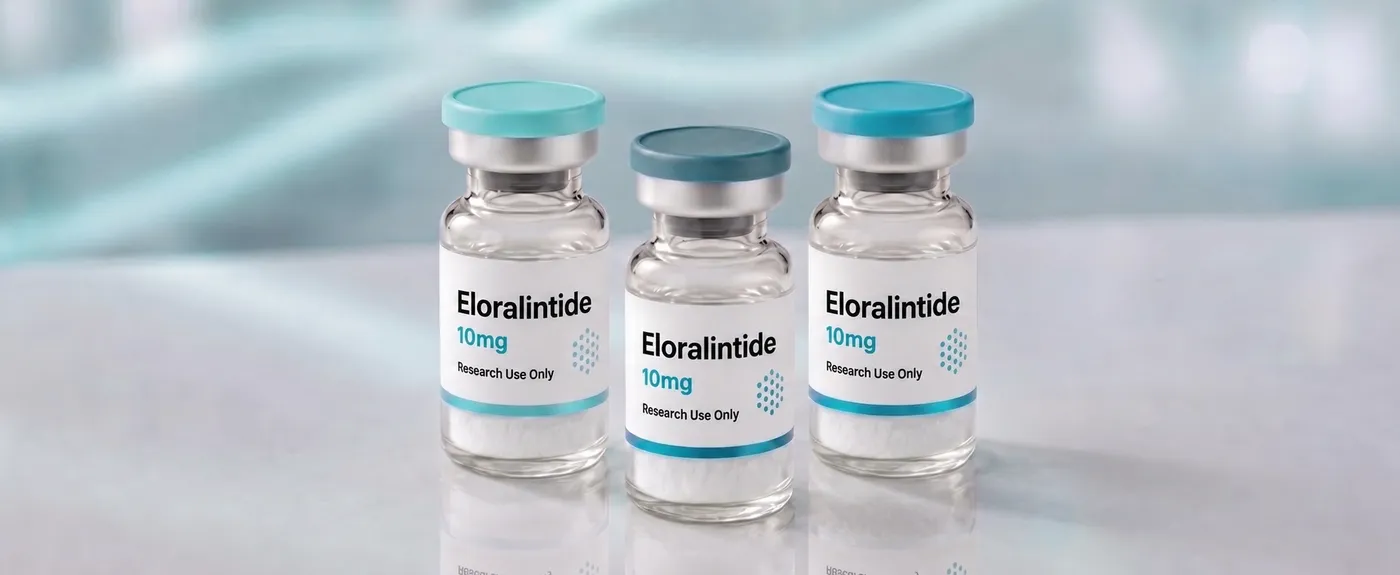
Eloralintide is an experimental once-weekly injection from Eli Lilly. It works through amylin, not the incretin hormones that semaglutide and tirzepatide act on. It has no approval anywhere, phase 3 runs into 2028 and beyond, and vials carrying the name are already being sold.
What is eloralintide?
A selective amylin receptor agonist, given once a week under the skin, previously known as LY3841136.1 In forums and search boxes it usually turns up shortened to Elora. Lilly uses that name for nothing.2
Amylin is a hormone your pancreas releases alongside insulin when you eat. It slows the stomach, blocks glucagon and signals fullness. Older amylin drugs hit both the amylin and the calcitonin receptor. Eloralintide was engineered to be selective, activating the amylin 1 receptor about twelve times more strongly than the calcitonin receptor, and attached to a fatty diacid so it binds albumin and lasts a week.1
That selectivity is Lilly's whole argument. Their claim is that a cleaner molecule gives you the weight loss without as much of the trouble.
How much weight did people lose?
It depends which number you mean, and the trial reported two.
The efficacy estimand estimates what would have happened if everyone had stayed on treatment for 48 weeks. On that basis, weight loss ran from 9.5% to 20.1% against 0.4% on placebo. The treatment-regimen estimand counts people regardless of whether they stopped, and on that basis the same arms ran from 7.3% to 17.5% against 2.3%.1
| Weekly dose | If everyone stayed on it | Counting everyone |
|---|---|---|
| 1 mg | -9.5% | -7.3% |
| 3 mg | -12.4% | -10.5% |
| 6 mg | -17.6% | -13.8% |
| 9 mg | -20.1% | -17.5% |
| 6 mg then 9 mg | -19.9% | -15.8% |
| 3 mg then 6 then 9 | -16.4% | -14.6% |
| Placebo | -0.4% | -2.3% |
The first column is the one in every headline. The second is closer to what happens when people are people.
Weight had not plateaued at 48 weeks, so the curve was still falling when the trial ended. In the 10-week follow-up after treatment stopped, every group regained some of it.1
Why the escalation arms matter more than the headline
Three arms reached the 9 mg dose by different routes, and the gaps between them are wider than the gap in weight loss.
Starting at 9 mg produced 20.1%, with nausea in 33% and fatigue in 43%. Sitting at 6 mg for 20 weeks first produced 19.9%, with nausea in 54% and fatigue in 46%. Climbing 3, then 6, then 9 produced 16.4%, with nausea in 25%, fatigue in 21% and vomiting in one person out of 52.1
So the slowest climb cost about four points of weight loss and bought a side effect profile close to placebo on fatigue. The paper credits the 3 mg start with mitigating the fatigue.1
If this drug is approved, that schedule is what the label argument will be about.
What are the side effects of eloralintide?
Nausea and fatigue, in that order by frequency, though the fatigue is the finding that stands out.
Across everyone given eloralintide, 33% had nausea, 27% fatigue, 15% diarrhoea and 15% constipation. At the 9 mg starting dose, fatigue hit 43%, against 12% on placebo.1 The authors note plainly that this is more fatigue than incretin drugs usually produce, and that the ongoing trial with tirzepatide will show whether it repeats.1
A few other lines from the safety table did not make the press release. Constipation reached 24% at 9 mg. Alopecia, meaning hair loss, was reported by 9% to 10% of participants in the higher-dose arms and nobody on placebo. One in ten participants stopped because of an adverse event, and in the 6 mg arm it was one in five.1
The 6 mg arm is the odd one. Nausea ran 64% there, against 33% in the arm that started at 9 mg, and vomiting reached 25%.1 A lower dose producing more sickness than a higher one is not what dose alone predicts, and with 28 people in that arm against 54 in the 9 mg arm, it may be noise. It is also the arm with the worst dropout in the trial, so phase 3 will show whether it repeats.
No pancreatitis, no gallbladder events, no deaths.1
Does eloralintide protect muscle?
Partly, and no better than the drugs already approved.
A subset of participants had DXA scans. Most of the weight lost was fat, at roughly a 3:1 ratio of fat to lean mass, and the authors describe that as consistent with previous weight-loss studies.1 It is the same territory as the approved drugs, where lean tissue runs at 30 to 40% of total weight lost, covered in our guide on what happens after significant weight loss.
Anyone selling you an amylin compound on the promise that it spares muscle in a way GLP-1 drugs do not is ahead of the published data.
How is eloralintide different from a GLP-1 drug?
Beyond the mechanism, heart rate went down.
GLP-1 drugs raise it, reliably enough that it appears in their labels. In this trial, pulse fell in every eloralintide group, blood pressure fell, and high-sensitivity CRP, a marker of inflammation, dropped by up to 64%.1 What that means for cardiovascular risk is unknown and the authors say so.
Anyone who has stopped an incretin drug over a racing pulse will want to know that.
Is eloralintide better than tirzepatide?
No trial has compared them, and the paper is careful about this in a way the coverage was not.
Its own discussion sets eloralintide's 16 to 20% at 48 weeks beside semaglutide at up to 17% over 68 weeks, tirzepatide at up to 23% over 72 weeks, and cagrilintide at up to 12% over 68 weeks.1 Those come from separate trials with different populations, durations and estimands. That is exactly the comparison that produced wrong answers when CagriSema was finally run head to head against tirzepatide and missed its endpoint.
The trial that will actually answer it is already running, giving eloralintide alone or with tirzepatide to adults with obesity and type 2 diabetes.1
Who was in the eloralintide trial?
Mostly women, and the authors flag that as a limit on what the trial can tell you about anyone else. Participants were 78% women, 78% White and 18% Black or African American, average age 49, average weight 109 kg, and nobody had diabetes.1
The authors list the sex imbalance as a limitation and say the data may give an incomplete picture of how the drug performs in men.1 If you are a man reading the 20.1%, that figure rests on 11 male participants in that arm.
Is there an eloralintide dose?
Not an approved one. There is a trial protocol, and the two are not the same.
The protocol used 1, 3, 6 and 9 mg once weekly, plus the two escalation schedules.1 Those describe a Lilly-manufactured investigational product, self-injected from identical masked vials, with clinic visits and monitoring around it. Our dosage chart records them as trial protocol, the strongest source type available for a compound with no label, and still not a label.
Can you buy eloralintide?
It is on the grey market already, though barely. At our last price snapshot, three listings across tracked vendors carried the name, against 48 for cagrilintide.2 Sold under either spelling, Elora or eloralintide, it is the same claim about the same powder. That gap is the compound's age, and it will close.
A compound this new carries a specific problem for you as a buyer. There is no independent testing history behind it, so a certificate of analysis has nothing to be checked against and no pattern of past results to compare with. Our guides on reading a COA and on vetting a vendor cover what can be established and what cannot.
Who funded the eloralintide trial?
Eli Lilly funded it, designed it, monitored the sites, collated the data and ran the analysis. Seven of the ten authors are Lilly employees and stockholders, and the first draft of the paper was written by the lead author and the authors employed by the sponsor.1
None of that makes the results wrong. It is the ordinary condition of drug trials, and the data are public, peer reviewed and registered. It does mean no independent group has run this molecule yet.
What is still unknown about eloralintide
Almost everything that decides whether it becomes a medicine. Phase 3 is called ENLIGHTEN, and registry records list studies in obesity, in obesity with type 2 diabetes, in obstructive sleep apnoea and in knee osteoarthritis, completing between 2028 and 2030.3
Until those report: whether the weight loss holds beyond a year, whether the fatigue persists at scale, what happens in a population that is not three-quarters women, whether the heart rate effect means anything clinically, and what a rare adverse event looks like in thousands of people rather than 263.
Separately from all of it, nothing published describes what is in a vial sold under this name today.
If you are weighing it up now
Whether the trial is any use to you comes down to what can be checked today.
The escalation finding does not transfer. It came from a supervised trial using a known quantity of a known molecule, and it tells you about the drug, not about a vial someone sold you.
The published figures describe a product made by Lilly. Anything you are offered has an unknown relationship to that, and with almost no testing history behind the name yet, a certificate has nothing to be checked against.
The dates settle the rest. The first ENLIGHTEN readouts are not due until 2028, so anyone waiting for the open questions to be answered is waiting years, not months.
Common questions
What is eloralintide?
An investigational once-weekly injection from Eli Lilly, previously called LY3841136. It is a selective amylin receptor agonist, a different mechanism from semaglutide and tirzepatide.
Is eloralintide approved?
No, not in any country. Phase 3 trials began in 2026 and are scheduled to complete between 2028 and 2030.
How much weight did eloralintide produce?
In a 48-week phase 2 of 263 adults, between 9.5% and 20.1% depending on dose, against 0.4% on placebo, on the estimate that assumes everyone stayed on treatment. Counting everyone regardless of whether they stopped, the same arms produced 7.3% to 17.5%.
What dose was used in the trial?
One, 3, 6 and 9 mg once weekly, plus two escalation schedules that stepped up to 9 mg. Those are trial protocol figures for a supervised investigational product, not an approved dose.
Does eloralintide cause fatigue?
It was reported by 43% of participants who started at 9 mg, against 12% on placebo. The paper notes this is more than incretin drugs usually produce. Climbing to 9 mg in steps from 3 mg brought it down to 21%.
Does eloralintide preserve muscle?
DXA scans in a subset found roughly a 3:1 ratio of fat to lean mass loss. The authors call that consistent with previous weight-loss studies. There is no evidence yet that it protects lean tissue better than the approved drugs.
Is eloralintide better than semaglutide or tirzepatide?
No trial has compared them. A phase 2 of eloralintide with and without tirzepatide is running. Until it reports, any comparison is between separate trials with different designs.
Is Elora the same as eloralintide?
Yes. Elora is the short form people use in forums and searches. The compound's names are eloralintide and LY3841136, and no approved product exists under any of them.
What is amylin?
A hormone released by the pancreas alongside insulin after eating. It slows stomach emptying, suppresses glucagon and contributes to fullness, the effect these drugs are built around.
Is eloralintide the same as cagrilintide?
No. Both act at amylin receptors, but they are different molecules from different companies. Cagrilintide also hits the calcitonin receptor, and eloralintide was designed to avoid that.
Is eloralintide safe?
No regulator has reviewed it. In the phase 2, one in ten participants stopped because of an adverse event, there were no deaths, no pancreatitis and no gallbladder events, and the common complaints were nausea, fatigue, diarrhoea and constipation. A trial of 263 people cannot rule out rare harms.
Does eloralintide cause hair loss?
Alopecia was reported by 9% to 10% of participants in the higher-dose arms and by nobody on placebo. Hair loss also follows rapid weight loss generally, so the trial cannot separate the two.
How long does eloralintide last?
It is built for once-weekly injection, using a fatty diacid that binds albumin to extend its stay in the body. The trial ran a 10-week safety follow-up after the last dose because it clears slowly.
Can you buy eloralintide?
Research-labelled vials carrying the name are sold, far fewer than for older compounds. Nothing published describes what is in them.
Sources
- Billings LK, Hsia S, Bays H, Tidemann-Miller B, O'Hagan J, Tham LS, Butler A, Kazda C, Mather KJ, Coskun T. "Eloralintide, a selective amylin receptor agonist for the treatment of obesity: a 48-week phase 2, multicentre, double-blind, randomised, placebo-controlled trial." *The Lancet*, 2025;406:2631-43, published online 6 November 2025. [doi:10.1016/S0140-6736(25)02155-5](https://doi.org/10.1016/S0140-6736(25)02155-5), PMID 41207310. *Peer-reviewed phase 2 trial, read in full, with the per-arm nausea and fatigue rates re-checked against the PubMed abstract on 23 September 2026. Source for the trial design (NCT06230523, 263 participants at 46 US centres, randomised 2:1:1:1:2:1:2, 48 weeks, adults 18 to 75 without diabetes), both estimands, the escalation schedules (3 mg for 4 weeks then 6 mg for 4 weeks then 9 mg; or 6 mg for 20 weeks then 9 mg), the adverse event table including fatigue at 43% on 9 mg against 12% on placebo, vomiting at 25% in the 6 mg arm, alopecia at 9 to 10% in higher-dose arms, discontinuation for adverse events at 10% overall and 21% in the 6 mg arm, the absence of pancreatitis, cholecystitis and deaths, the DXA substudy finding of roughly 3:1 fat to lean mass loss, the reductions in pulse, blood pressure and CRP, the absence of a weight plateau at 48 weeks, partial regain during 10-week follow-up, baseline demographics, the authors' own cross-trial comparison with semaglutide, tirzepatide and cagrilintide, the stated limitation about the 78% female population, and the funding and authorship disclosures. Funded by Eli Lilly; seven of ten authors are employees and stockholders.* ↩
- Peptide Decoding vendor price data and dosage chart. [peptidedecoding.com/prices](https://peptidedecoding.com/prices). *The site's own tracker and search logs. At the snapshot dated 22 August to 6 September 2026, three listings across tracked vendors carried the eloralintide name, against 48 carrying cagrilintide. The dose figures are recorded on the dosage chart as trial protocol. The shortened form Elora appears in search queries reaching this site rather than on the vendor listings themselves, which use the full name. Re-run the counts before publishing.* ↩
- ClinicalTrials.gov records for the ENLIGHTEN phase 3 programme, including NCT07282600 (ENLIGHTEN-2, obesity or overweight with type 2 diabetes, recruiting), NCT07369011 (ENLIGHTEN-3, obstructive sleep apnoea, 800 participants estimated) and NCT07353931 (ENLIGHTEN-4, knee osteoarthritis), plus NCT07321886 in obesity or overweight without type 2 diabetes, which began in February 2026 with estimated completion in 2030. [clinicaltrials.gov](https://clinicaltrials.gov/study/NCT07282600). *Trial registry records, read via search result excerpts. Used for the phase 3 programme names, indications, status and dates.* ↩