
Tesamorelin vs HGH
Two approved drugs, and only one goes through your pituitary. Tesamorelin tells your pituitary to release its own growth hormone, so the body's own feedback system still applies. HGH is the hormone itself, injected directly, with no such limit. Both are FDA approved for specific conditions. Distributing HGH for anti-aging or athletic use is a federal felony carrying five years, and tesamorelin carries no equivalent provision.
- Growth hormone
- Both approved
- Only one is a felony off-label
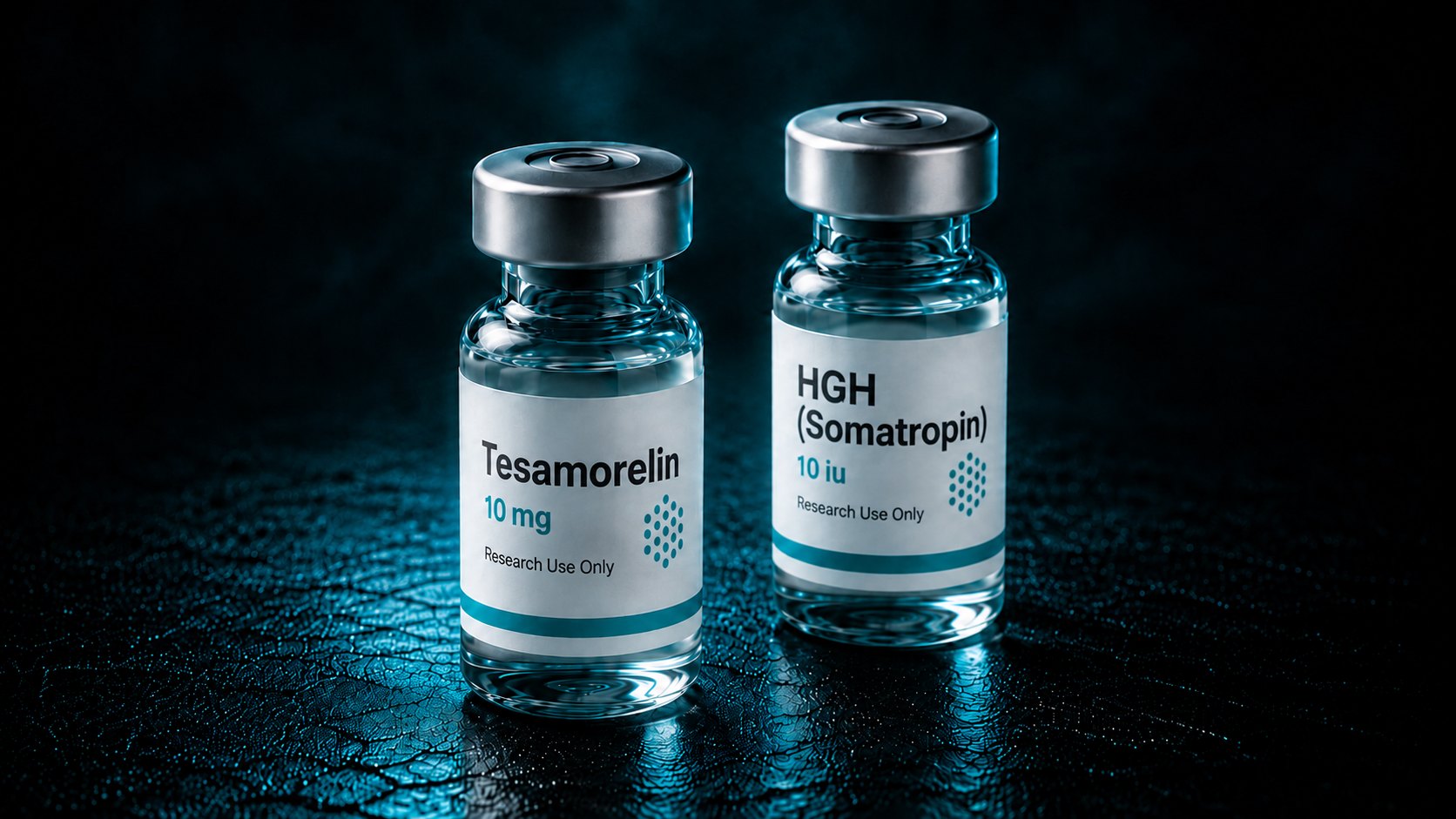
| Attribute | Tesamorelin | HGH |
|---|---|---|
| What it is | A GHRH analog | Growth hormone itself |
| Acts on | The pituitary | The whole body, directly |
| Subject to feedback | Yes | No |
| FDA approved | Yes, 2010 | Yes, several indications |
| Approved for | HIV-associated lipodystrophy | Deficiency states, and others |
| Off-label distribution | Ordinary off-label rules | Federal felony, five years [5] |
The feedback loop in row three explains most of row six.
HGH on this page means somatropin, the full 191 amino acid growth hormone. HGH Fragment 176-191 is a different compound, a 16 amino acid piece of the same hormone sold for fat loss, and nothing on this page applies to it.
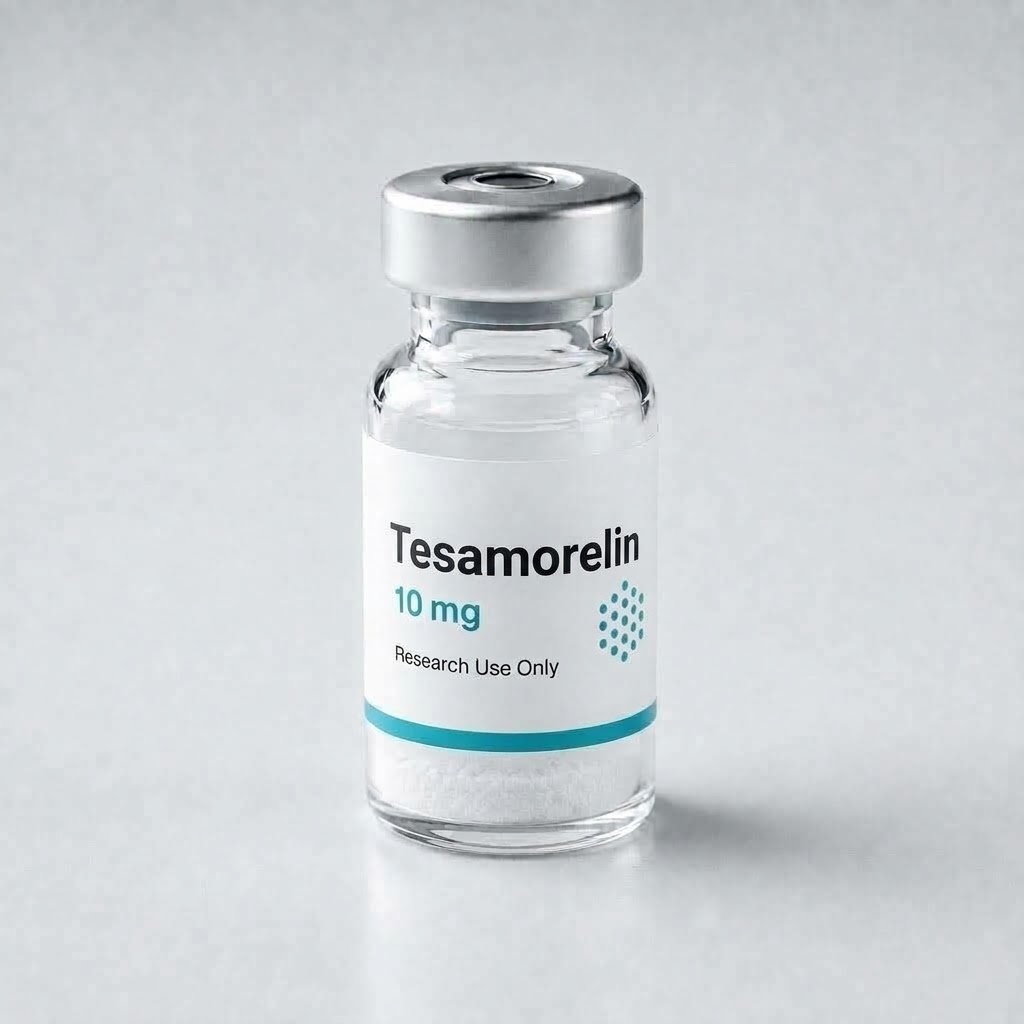
Tesamorelin
A stabilised analog of growth hormone-releasing factor, sold as Egrifta. It binds GHRH receptors in the pituitary and prompts the gland to release its own growth hormone in its normal pulses. In plain terms: a message to the organ that already makes the hormone.

HGH
Recombinant human growth hormone, sold generically as somatropin: the 191 amino acid protein itself, made in bacteria or yeast. It does not ask anything. It arrives in the bloodstream as the finished hormone. In plain terms: the thing tesamorelin is trying to get your body to produce.
Why does it matter which one your pituitary is involved in?
Tesamorelin works through the pituitary, so growth hormone comes out in pulses and the body's somatostatin brake still applies. Injected HGH bypasses that entirely. The feedback loop explains most of the difference between them, including why 47 percent of tesamorelin patients exceeded an IGF-1 threshold rather than far more.
Your pituitary releases growth hormone in bursts, mostly at night, and it stops when told to. A hormone called somatostatin applies the brake, and rising IGF-1 tells the system to ease off. The arrangement regulates itself.
Tesamorelin works inside that arrangement. It binds GHRH receptors in the pituitary and the gland releases its own growth hormone, in its own pulses, still under the same brake. [1] If IGF-1 climbs, the system responds the way it always does.
Injected HGH is not in that circuit at all. It arrives already made, so there is no pulse pattern to preserve and no brake that applies to it. Whatever dose goes in is the dose that acts.
That difference explains most of what follows: why tesamorelin's effects in trials stayed inside physiological ranges, why its side effect profile is milder, and why the law treats the two so differently.
It also sets the ceiling. Tesamorelin can only produce as much growth hormone as your pituitary is willing to release. If the gland is damaged or absent, it does nothing at all, which is why it was never a treatment for growth hormone deficiency and HGH is.
Tesamorelin works inside the circuit. HGH goes around it.
What does the evidence actually show?
Tesamorelin has two Phase 3 trials totalling 806 patients, with visceral fat down 15.2 percent against a 5 percent increase on placebo. HGH has decades of evidence in deficiency states and a separate body of work showing it does not deliver what anti-aging buyers expect.
Recombinant growth hormone is approved
It replaces growth hormone extracted from human cadaver pituitaries after that supply was linked to Creutzfeldt-Jakob disease.
The Rudman paper launches an industry
A small study in the New England Journal of Medicine reports lean mass gains in older men. That paper launched the anti-aging growth hormone industry, and the journal later published an editorial distancing itself from how it had been used. [4]
Off-label distribution becomes a felony
Congress amends the Food, Drug and Cosmetic Act. Distributing growth hormone for any use other than an approved indication becomes a federal felony carrying up to five years. [5]
The first Phase 3 trial
Falutz publishes in the New England Journal of Medicine. 412 patients with HIV and excess abdominal fat. Visceral adipose tissue fell 15.2 percent on tesamorelin and rose 5.0 percent on placebo. [2]
The anti-aging question, answered
Liu and colleagues publish a systematic review in Annals of Internal Medicine. Growth hormone in healthy older adults did not improve strength, and the authors conclude it cannot be recommended as an anti-aging therapy. [4]
FDA approval
For reduction of excess visceral abdominal fat in HIV patients with lipodystrophy. A pooled analysis of both Phase 3 trials, 806 patients, confirms a treatment effect of about 15.4 percent at 26 weeks. [2]
The effect holds at a year
Extension work confirms the effect holds at 52 weeks, around 18 percent, and that reduced visceral fat comes with improved triglycerides and liver enzymes. [2]
Liver fat enters the picture
Stanley publishes in JAMA. 50 HIV patients with abdominal fat accumulation, and the trial measures liver fat alongside visceral fat. Visceral fat fell a median 25 square centimetres against a 14 centimetre increase on placebo, and hepatic fat fraction fell 4.2 percent against 0.5. [6]
The liver trial, with biopsies
Run at the NIH and Massachusetts General. 61 adults with HIV and fatty liver disease, 12 months. Hepatic fat fell 37 percent in relative terms against placebo, 35 percent of the treated group dropped below the 5 percent threshold that defines the condition against 4 percent on placebo, and fibrosis progression was prevented. Published in Lancet HIV. [6]
One indication each way
Tesamorelin remains approved for one indication and is prescribed off-label for others. HGH remains approved for several, and distributing it outside them is still a felony.
The striking thing in the tesamorelin trials is what did not change. Visceral fat fell 15.2 percent while subcutaneous fat did not move, and neither did BMI. [2] The compound found the fat around the organs and left the fat under the skin alone, which is unusual enough that it is the basis of the approval.
That selectivity is the clinical argument for working through the pituitary rather than around it. The hormone came out in its own pattern, at its own concentrations, and did what the body's own growth hormone does.
There is a detail in the label that almost nobody mentions. Anti-tesamorelin antibodies were detected in 85 percent of treated patients, and patients with and without them had similar reductions in visceral fat and similar IGF-1 responses. [3] An antibody rate that high would usually end a drug programme. Here it appears not to have mattered.
Why is tesamorelin being studied for fatty liver?
A 2019 trial at the NIH and Massachusetts General gave tesamorelin to 61 people with HIV and fatty liver for 12 months, with biopsies. Liver fat fell 37 percent relative to placebo, a third of the treated group dropped below the diagnostic threshold, and fibrosis progression was prevented.
Visceral fat and liver fat travel together, so a drug that moves one tends to move the other. Tesamorelin's liver evidence started as a secondary measure in the fat trials and has since become the more interesting half of its record.
The 2019 trial is the one to know. 61 adults with HIV and a hepatic fat fraction of 5 percent or more, randomised to tesamorelin 2 mg daily or placebo for a year, run at the NIH and Massachusetts General. [6]
Liver fat fell by 4.1 percentage points in absolute terms against placebo, a 37 percent relative reduction. 35 percent of the treated group finished below the 5 percent fat threshold that defines the condition, against 4 percent on placebo. [6]
What makes it unusual is that they took biopsies. At baseline 43 percent of participants had fibrosis and 33 percent had steatohepatitis, and after a year fibrosis progression was prevented in the treated group. Histology is the standard liver trials are judged by and most never collect it. [6]
Blood glucose and HbA1c did not change, which matters because raising growth hormone activity can worsen glucose control. [6]
One limit runs through all of it. Every participant had HIV. Fatty liver in people with HIV behaves more aggressively than in the general population, and no trial has tested tesamorelin for liver fat in anyone else. The findings are real and their population is specific.
How do they compare, side by side?
Everything that differs.
| Attribute | Tesamorelin | HGH |
|---|---|---|
| Also called | Egrifta, TH9507 | Somatropin, rhGH |
| Type | GHRH analog | Recombinant hormone, 191 amino acids |
| Acts on | Pituitary GHRH receptors | Growth hormone receptors throughout the body |
| Release pattern | Pulsatile, the body's own | Whatever the injection delivers |
| Subject to somatostatin feedback | Yes | No |
| Works if the pituitary is damaged | No | Yes |
| Main approval | HIV lipodystrophy, 2010 [2] | Deficiency states and others, since 1985 |
| Pivotal evidence | Two Phase 3 trials, 806 patients [2] | Decades, across several indications |
| Effect on visceral fat | 15.2 percent reduction [2] | Reduces fat, not selectively |
| Effect on subcutaneous fat | None measured [2] | Not selective |
| Liver fat evidence | 37 percent relative reduction, with biopsies [6] | None comparable |
| Antibody formation | 85 percent, without loss of effect [3] | Occurs, varies by product |
| Off-label distribution | Ordinary rules | Federal felony [5] |
| Cost | High, specialty pharmacy | High, specialty pharmacy |
What are the key differences?
Tesamorelin needs a working pituitary and HGH does not. Tesamorelin cut visceral fat 15.2 percent while leaving subcutaneous fat and BMI unchanged, and HGH is not selective. Distributing HGH off-label carries five years and tesamorelin follows ordinary rules.
- Both raise growth hormone activity
- Both are FDA approved
- Both are injected daily
- Both raise IGF-1
- Both require a prescription and cost a great deal
Tesamorelin
HGH
Summary compiled from FDA labelling and published trials.
Why is one a felony and the other is not?
A 1990 amendment to the Food, Drug and Cosmetic Act made distributing growth hormone for any non-approved use a federal felony carrying up to five years. No equivalent provision exists for tesamorelin or any other GHRH analog.
Off-label prescribing is normal in American medicine. A doctor can prescribe most approved drugs for conditions they were not approved for, and that is legal and often appropriate.
Growth hormone is one of the few exceptions, and the exception is specific. A 1990 amendment to the Food, Drug and Cosmetic Act makes it a felony to distribute or possess with intent to distribute growth hormone for any use other than an approved indication. The term is up to five years, rising to ten where a person under 18 is involved. [5]
Congress wrote that because of what happened after 1990. The Rudman paper had just appeared, the anti-aging market formed around it almost immediately, and the law was a response to that market rather than to the hormone's risks.
Tesamorelin has no equivalent provision. It is a GHRH analog, not growth hormone, and the statute names growth hormone. Prescribing tesamorelin off-label follows the same rules as prescribing anything else off-label.
If you are being offered either one for anti-aging or athletic use, that legal difference is worth understanding before anything else. For HGH, the person selling it is committing a felony. For tesamorelin, they are not, which says nothing about whether the prescription is a good idea.
What has nobody answered?
Four gaps, starting with the comparison itself.
No trial has compared the two directly.Not in any population, for any outcome. Every comparison in circulation sets separate trials against each other.
Tesamorelin's long-term cardiovascular safety is unestablished.That is stated as a limitation on the FDA label itself, not inferred by us. [3]
Nobody has tested tesamorelin in people without HIV.The Phase 3 trials enrolled HIV patients with lipodystrophy, the liver trials enrolled HIV patients with fatty liver, and the growing off-label market is people with neither. [2][6] Fatty liver in people with HIV behaves differently from the general case, so the liver findings in particular do not transfer without testing.
Nobody knows what the 85 percent antibody rate means over years.The trials found no loss of effect inside 52 weeks. [3] Nothing establishes what happens in year three.
Which one should you choose?
If your pituitary does not work, tesamorelin does nothing and HGH is the treatment. If you have HIV with excess visceral fat or fatty liver, tesamorelin has 806 patients and a 61-patient liver trial behind it. For anti-aging, neither has evidence and distributing one of them carries five years.
Most of this decides itself on the clinical picture rather than on preference.
If you have growth hormone deficiency, tesamorelin is not an option. It works by asking the pituitary and a damaged gland cannot answer. [1] HGH is the treatment, and that is what it is approved for.
If you have HIV with excess visceral fat, tesamorelin is the drug with the approval and the trials, and the fat loss was selective to the visceral depot. [2]
If you have HIV with fatty liver, tesamorelin has a year-long randomised trial with biopsies behind it and HGH does not. [6]
For anti-aging, athletic performance or general body composition in healthy adults, neither has been tested and growth hormone specifically has been tested and found wanting. Liu and colleagues reviewed it in healthy older adults and found no strength improvement. [4] For that use, the thing to understand first is that distributing HGH carries five years. [5]
What are the side effects, and what are you buying?
Tesamorelin's common effects are injection site reactions, joint pain and swelling, with 47.4 percent of patients exceeding IGF-1 of two standard deviations at 26 weeks. HGH carries the heavier profile, and the gap is largely about the feedback loop.
Tesamorelin
From the approved label and the Phase 3 programme.
- Injection site reactions, joint pain, swelling and muscle aches [3]label
- 47.4 percent exceeded IGF-1 of 2 standard deviation scores at 26 weeks [3]label
- Anti-tesamorelin antibodies in 85 percent, without measurable loss of effect [3]label
- Long-term cardiovascular safety has not been established, stated as a limitation of use [3]label
HGH
Decades of use across approved and unapproved settings.
- Fluid retention, joint and muscle pain, carpal tunnel syndromelabel
- Insulin resistance and raised blood glucoselabel
- Acromegaly features with prolonged excess, since no feedback limits an injected doselabel
- Liu and colleagues found no strength improvement in healthy older adults [4]review
What you are actually buying
This is where the two diverge most sharply.
- Both are prescription products from specialty pharmacies when obtained legallypharmacy
- Distributing HGH outside approved indications is a felony carrying five years [5]statute
- Counterfeit HGH is widespread, and testing of seized peptides found purity between 5 and 75 percent plus arsenic and lead [7]analysis
- Tesamorelin sold outside a pharmacy is a research chemical with the same supply problems as anything else in that marketgrey market
*Where this page says nothing is established, it means nobody has studied it. It does not mean a compound is safe.
The IGF-1 figure deserves attention. Nearly half of treated patients went above two standard deviations at 26 weeks, which is the threshold at which the label advises considering dose reduction or discontinuation. [3] Working through the pituitary limits how high growth hormone goes. It does not mean nothing goes high. If you are prescribed either, IGF-1 monitoring is the measure that matters, and the tesamorelin trials checked it every three months. [3]
Are they banned in sport?
Both. Growth hormone and its releasing factors sit in section S2 of the Prohibited List, which names GHRH and its analogs explicitly alongside growth hormone itself.
Section S2 covers peptide hormones, growth factors and related substances, and it names both growth hormone and growth hormone releasing factors.
Tesamorelin is a GHRH analog, which is exactly what that section describes. HGH is growth hormone. Both are prohibited at all times, in and out of competition.
Growth hormone has been a named anti-doping target for decades, and the testing methods for it are among the more developed in the field.
Are they FDA approved?
Both, which separates this comparison from most on this site.
Tesamorelin is approved for one thing: reduction of excess visceral abdominal fat in HIV-infected patients with lipodystrophy. [2] The label also notes that long-term cardiovascular safety has not been established, which is unusual to find stated so plainly and worth reading as written.
HGH is approved for several conditions, including growth hormone deficiency in children and adults, Turner syndrome, chronic kidney disease in children, and short bowel syndrome, among others.
Both are real pharmaceutical products with real approvals. The question here is not whether they work. It is what they were approved to do, and what happens when they are used for something else.
That second part is where the law enters, and only for one of them.
Common questions
Is tesamorelin the same as HGH?
No. Tesamorelin is a GHRH analog that prompts your pituitary to release its own growth hormone, and HGH is the hormone itself, injected directly. [1] Tesamorelin needs a working pituitary and HGH does not.
Which is stronger, tesamorelin or HGH?
HGH, in the sense that there is no ceiling on it. Tesamorelin can only produce as much growth hormone as your pituitary will release, while an injected dose of HGH acts regardless of what your body would have done. [1] Whether more is better is a separate question, and the trials in healthy older adults suggest it is not. [4]
Why is HGH illegal for anti-aging but tesamorelin is not?
Because a 1990 amendment to the Food, Drug and Cosmetic Act specifically names growth hormone, making distribution for non-approved uses a federal felony carrying up to five years. [5] No equivalent provision covers tesamorelin or other GHRH analogs, so it follows ordinary off-label rules.
Does tesamorelin actually reduce belly fat?
Visceral fat, yes, by about 15 percent over 26 weeks in its Phase 3 trials, against a 5 percent increase on placebo. [2] Subcutaneous fat, the layer under the skin, did not change, and neither did BMI. The two trials enrolled HIV patients with lipodystrophy rather than the general population.
Can you take tesamorelin if your pituitary does not work?
No, and that is the clearest limit on it. Tesamorelin works by asking the gland to release growth hormone, so if the gland is damaged or absent there is nothing to ask. [1] That is why HGH is the treatment for growth hormone deficiency and tesamorelin is not.
What are tesamorelin's side effects?
Injection site reactions, joint pain, swelling and muscle aches are the common ones. [3] Nearly half of treated patients exceeded IGF-1 of two standard deviations at 26 weeks, which is the point at which the label suggests considering a dose change, and long-term cardiovascular safety has not been established.
Do people develop antibodies to tesamorelin?
Yes, and it appears not to matter. Anti-tesamorelin antibodies were detected in 85 percent of treated patients, and those with and without them had similar reductions in visceral fat and similar IGF-1 responses. [3] What that means over several years is unknown.
Does tesamorelin help fatty liver?
In people with HIV, yes, with better evidence than most liver drugs have. A 12-month randomised trial with biopsies found liver fat fell 37 percent relative to placebo, 35 percent of the treated group dropped below the diagnostic threshold against 4 percent on placebo, and fibrosis progression was prevented. [6] Nobody has tested it for liver fat in people without HIV.
Can tesamorelin be used for weight loss?
Not in the way people usually mean. It reduced visceral fat, the fat around the organs, by about 15 percent, and left subcutaneous fat and BMI unchanged. [2] The scale does not move. Nothing in the trials supports it as a weight loss drug and it was never studied as one.
Is tesamorelin safer than HGH?
Its side effect profile is milder and the mechanism explains why, though neither has long-term safety data of the kind that would settle it. Working through the pituitary keeps release pulsatile and under the body's own feedback. [1] Tesamorelin's own label states that long-term cardiovascular safety has not been established. [3]
How much does tesamorelin cost?
It is a specialty pharmacy product and expensive, and current pricing varies enough by insurance and pharmacy that any figure here would mislead. Ask the prescribing clinic for a benefits check before starting.
Does HGH work for anti-aging?
Not on the evidence. Liu and colleagues reviewed growth hormone in healthy older adults and found it did not improve strength, concluding it cannot be recommended as an anti-aging therapy. [4] The 1990 Rudman paper that launched the market was small, and the journal that published it later distanced itself from how it had been used.
What is HGH approved for?
Growth hormone deficiency in children and adults, plus several growth-related conditions including Turner syndrome, chronic kidney disease in children and short bowel syndrome. Anti-aging, athletic performance and general body composition are not among them, and distributing it for those uses is a federal felony. [5]
What are the side effects of HGH?
Fluid retention, joint and muscle pain, carpal tunnel syndrome, insulin resistance and raised blood glucose are the common ones. With prolonged excess it can produce features of acromegaly, because an injected dose is not subject to the feedback that limits your own growth hormone. [1]
Is HGH legal to buy?
Not for anti-aging or athletic use. A 1990 amendment to the Food, Drug and Cosmetic Act makes distributing growth hormone for any non-approved use a federal felony carrying up to five years, rising to ten where someone under 18 is involved. [5] Possessing it on a valid prescription for an approved condition is lawful.
Is HGH the same as HGH Fragment 176-191?
No, and the names cause real confusion. HGH is somatropin, the full 191 amino acid hormone, approved for several conditions and a felony to distribute off-label. [5] HGH Fragment 176-191 is a 16 amino acid piece of the same hormone's tail, sold for fat loss, approved nowhere, and not covered by that statute. Nothing on this page applies to the fragment.
Are they banned in sport?
Both. Section S2 of the Prohibited List names growth hormone and its releasing factors explicitly, so tesamorelin and HGH are both prohibited at all times.
What this page is built on
- 01Mechanism. Tesamorelin is a stabilised analog of growth hormone-releasing factor that binds GHRH receptors on pituitary somatotrophs, stimulating pulsatile growth hormone secretion and a consequent rise in IGF-1. Because release occurs through the pituitary, it remains subject to normal somatostatin-mediated negative feedback. Recombinant human growth hormone is the 191 amino acid hormone itself, acting directly at growth hormone receptors and bypassing pituitary regulation entirely. PubChem CID 16137828 for tesamorelin. Mechanistic summary.
- 02Tesamorelin Phase 3 programme. Falutz J, Allas S, Blot K, Potvin D, Kotler D, Somero M, Berger D, Brown S, Richmond G, Fessel J, Turner R, Grinspoon S. Metabolic effects of a growth hormone-releasing factor in patients with HIV. N Engl J Med. 2007. PMID 18057338. Falutz J, Potvin D, Mamputu JC, et al. Effects of tesamorelin in HIV-infected patients with abdominal fat accumulation. PMID 20101189. Falutz J, Mamputu JC, Potvin D, et al. Pooled analysis of two multicenter, double-blind placebo-controlled Phase 3 trials with safety extension data. PMID 20554713. Also Stanley TL, et al., PMID 22495074, and Fourman LT, et al., PMID 28832410. Peer reviewed. 412 patients in the first trial, visceral adipose tissue down 15.2 percent against a 5.0 percent rise on placebo. Pooled n=806, treatment effect about 15.4 percent at 26 weeks and around 18 percent at 52 weeks, with no significant change in subcutaneous fat or BMI. Mean IGF-1 rose about 106 ng/mL, within the physiological range.
- 03EGRIFTA (tesamorelin) prescribing information, FDA label, application 022505. Regulatory document. Anti-tesamorelin IgG antibodies were detected in 85 percent of treated patients, with similar visceral fat reductions and IGF-1 responses with and without them. 47.4 percent had IGF-1 greater than 2 standard deviation scores after 26 weeks. The label advises considering discontinuation where IGF-1 remains persistently high, and states that long-term cardiovascular safety has not been established as a limitation of use. 740 HIV-infected patients were exposed in the Phase 3 programme, monitored every three months. Common adverse reactions include injection site reactions, arthralgia, peripheral oedema and myalgia.
- 04Liu H, Bravata DM, Olkin I, et al. Systematic review: the safety and efficacy of growth hormone in the healthy elderly. Ann Intern Med. 2007;146(2):104-115. The 1990 Rudman paper in the New England Journal of Medicine is the study usually cited by the anti-aging market; the journal subsequently published an editorial distancing itself from that use. Systematic review. Concluded that growth hormone in healthy older adults did not improve strength and cannot be recommended as an anti-aging therapy.
- 0521 U.S.C. 333(e). Food, Drug and Cosmetic Act, as amended in 1990. Federal statute. Distribution or possession with intent to distribute human growth hormone for any use other than the treatment of a disease or recognised medical condition, where authorised by the Secretary and pursuant to the order of a physician, is a federal felony punishable by up to five years, rising to ten where the offence involves a person under 18. No equivalent provision applies to GHRH analogs including tesamorelin.
- 06Stanley TL, Fourman LT, Feldpausch MN, et al. Effects of tesamorelin on non-alcoholic fatty liver disease in HIV: a randomised, double-blind, multicentre trial. Lancet HIV. 2019;6(12):e821-e830. DOI 10.1016/S2352-3018(19)30338-8. PMID 31611038. Trial NCT02196831, run at the National Institutes of Health and Massachusetts General Hospital. Also Stanley TL, Feldpausch MN, et al. Effect of tesamorelin on visceral fat and liver fat in HIV-infected patients with abdominal fat accumulation: a randomized clinical trial. JAMA. 2014. Trial NCT01263717. Peer reviewed. 61 adults with HIV and hepatic fat fraction of 5 percent or more, tesamorelin 2 mg daily or placebo for 12 months, with biopsies. Hepatic fat fraction fell 4.1 percentage points absolute, a 37 percent relative reduction; 35 percent of the treated group finished below the 5 percent threshold against 4 percent on placebo; fibrosis progression was prevented. Fasting glucose and HbA1c did not differ. The 2014 JAMA trial enrolled 50 patients; visceral fat fell a median 25 square centimetres against a 14 centimetre increase on placebo, and hepatic fat fraction fell 4.2 percent against 0.5. All participants in both trials had HIV.
- 07Janvier S, Cheyns K, Canfyn M, Goscinny S, De Spiegeleer B, Vanhee C, Deconinck E. Impurity profiling of the most frequently encountered falsified polypeptide drugs on the Belgian market. Talanta. 2018;188:795-807. DOI 10.1016/j.talanta.2018.06.023. Peer-reviewed analytical study. Purity between 5 and 75 percent, with arsenic and lead detected.