
Petrelintide vs Semaglutide
Semaglutide produced 16.9 percent weight loss in STEP 1. Petrelintide produced 10.7 percent in ZUPREME-1. That gap is not a failure, because petrelintide is built to trade weight loss for tolerability, and ZUPREME-1's best dose caused no vomiting at all against 6 percent on placebo.
- Petrelintide not approved anywhere
- Never compared head to head
- No dosing guidance on this page
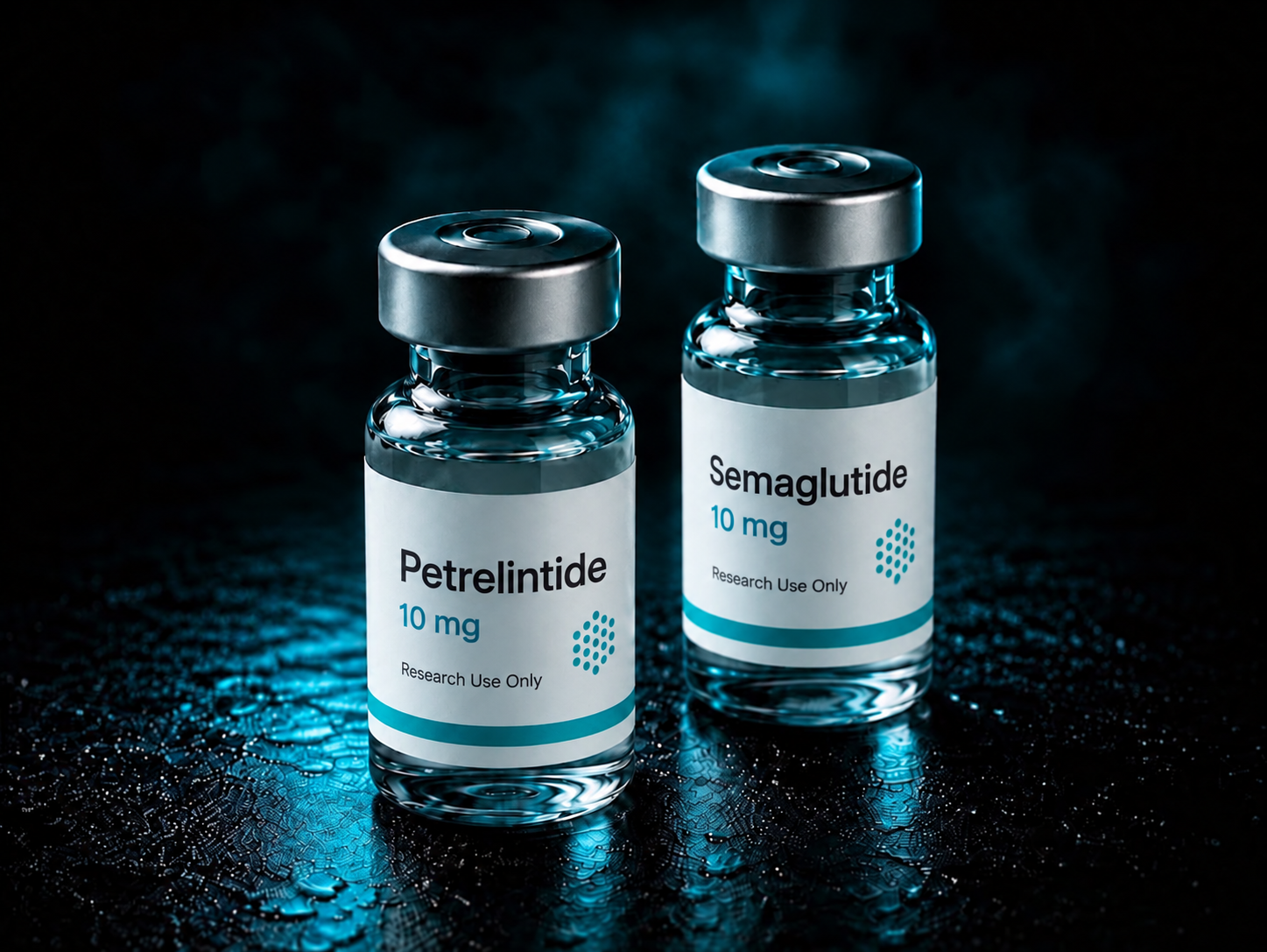
One of these is trying to lose the weight-loss race on purpose.
Every other page comparing weight-loss drugs ranks them by percentage, and here the ranking is settled in the first paragraph. Petrelintide's case rests entirely on what the drug costs the person taking it.
| Attribute | Petrelintide | Semaglutide |
|---|---|---|
| Hormone copied | Amylin, from the pancreas | GLP-1, from the gut |
| Approved | Nowhere | Wegovy, Ozempic, Rybelsus |
| Pivotal published trial | ZUPREME-1, phase 2, 42 weeks [1] | STEP 1, phase 3, 68 weeks [2] |
| Participants | 493 [1] | 1,961 [2] |
| Best weight loss | 10.7% at 5 mg [1] | 16.9% at 2.4 mg [2] |
| Its placebo arm | 1.7% [1] | 2.4% [2] |
| Nausea at that dose | 23% [1] | 44.2% [2] |
| Vomiting at that dose | 0% [1] | 24.8% [2] |
| Stopped for side effects | 5%, same as its placebo [1] | 7.0% vs 3.1% placebo [2] |
| Tested against the other | Never | Never |
| Vendors selling it | 0 | 85 [9] |
Vendor figures are from our 5 October 2026 capture of 158 sellers and move constantly. [9]
Petrelintide
A long-acting copy of amylin, a hormone your pancreas releases alongside insulin when you eat. Amylin slows stomach emptying and acts on the brainstem to signal fullness. It is nearer to a satiety signal than an appetite suppressant.
Semaglutide
A long-acting copy of GLP-1, a hormone your gut releases after eating. It slows stomach emptying, prompts insulin release when blood sugar is high, and acts on appetite centers in the brain. The current standard, with three approved products.
Which one produces more weight loss?
Semaglutide, by about 5 to 6 percentage points in STEP 1 against ZUPREME-1, and nobody involved disputes it. Semaglutide 2.4 mg produced 16.9 percent weight loss over 68 weeks in STEP 1, against 2.4 percent on placebo. [2] Petrelintide's best dose produced 10.7 percent over 42 weeks in ZUPREME-1, against 1.7 percent on placebo. [1] Subtract each trial's own placebo arm and semaglutide delivers 14.5 points of weight loss against petrelintide's 9.0. [1][2] That makes semaglutide roughly 1.6 times as effective on the measure both trials were built around.
Hence the interest. Every other page comparing weight-loss drugs ranks them by percentage, and here the ranking is settled in the first paragraph. Petrelintide's case rests entirely on what the drug costs the person taking it.
Two things make the gap smaller than the headline numbers imply, and one makes it larger. ZUPREME-1 ran 26 weeks shorter. That flatters semaglutide. ZUPREME-1 was a phase 2 dose-finding trial, not a phase 3, so its numbers carry wider intervals. ZUPREME-1's best result also came from the middle of its dose range, not the top. Petrelintide has probably already shown what it can do. [1]
Deck: STEP 1's 16.9% against ZUPREME-1's 10.7%, and 1 of those drugs is not trying to win.
Why is the 10.7 percent figure the middle dose and not the top one?
Because petrelintide stopped improving above 5 mg in ZUPREME-1, and then got worse. The ZUPREME-1 paper's dose table is the most important thing in it, and almost nothing written about the trial mentions it. The figure quoted everywhere, 10.7 percent, comes from the 5 mg arm. [1] ZUPREME-1 also tested 7 mg and 9 mg, and both lost less weight. [1]
| Dose, week 42 | Weight loss [1] | Reached 10% loss [1] | Nausea [1] | Vomiting [1] | Stopped for side effects [1] |
|---|---|---|---|---|---|
| 1.0 mg | 8.7% | 34.2% | 19% | 4% | 5% |
| 2.5 mg | 9.2% | 42.0% | 12% | 0% | 1% |
| 5.0 mg | 10.7% | 54.2% | 23% | 0% | 5% |
| 7.0 mg | 10.5% | 54.4% | 15% | 3% | 1% |
| 9.0 mg | 10.2% | 56.1% | 28% | 9% | 10% |
| Placebo | 1.7% | 8.6% | 6% | 6% | 5% |
In ZUPREME-1, going from 5 mg to 9 mg costs 0.5 percentage points of weight loss, adds 9 points of vomiting and doubles the rate of people stopping. [1] The dose that works best is not the biggest one on the list.
One caveat in the other direction. The proportion of people reaching 10 percent loss does keep climbing with dose, from 54.2 percent at 5 mg to 56.1 percent at 9 mg. [1] So the higher doses may move more people over a threshold while shifting the average slightly down. That is what you would expect if they help some people and drive others off the drug. In a phase 2 trial with roughly 80 people per arm, differences this small are also within the noise, and ZUPREME-1 reports confidence intervals wide enough to overlap across the top three arms. [1] The safe reading is that petrelintide's dose-response flattens somewhere around 5 mg, not that 5 mg is precisely optimal.
This also matters for how the tolerability claim is stated. Zealand's March 2026 release was reported as saying the proportion of participants with vomiting was lower than placebo across all petrelintide arms. [3] In the published paper, pooled petrelintide vomiting was 3 percent against 6 percent on placebo. [1] That supports the framing. The 9 mg arm recorded 9 percent, above placebo. [1] The pooled figure and the top-dose figure tell different stories and the pooled one is the one that travelled.
Deck: In ZUPREME-1, 9 mg lost 0.5 points less weight than 5 mg and sent 2x as many people home.
Are the two trials actually comparable?
More closely than usual, and that is rare enough to say out loud. Cross-trial comparison normally founders on mismatched populations. These two line up unusually well.
| Attribute | ZUPREME-1 [1] | STEP 1 [2] |
|---|---|---|
| Mean baseline weight | 107.1 kg | 105.3 kg |
| Mean baseline BMI | 36.7 | 37.9 |
| Entry criterion | BMI ≥30, or ≥27 with hypertension or dyslipidaemia | BMI ≥30, or ≥27 with a weight-related condition |
| Diabetes | Excluded | Excluded |
| Lifestyle program | Reduced-calorie diet, increased activity | Reduced-calorie diet, increased activity |
| Blinding | Double-blind, placebo-controlled | Double-blind, placebo-controlled |
| Duration | 42 weeks | 68 weeks |
| Phase | 2 | 3 |
Deck: ZUPREME-1's 107.1 kg against STEP 1's 105.3 kg, and 26 weeks of difference.
The estimands line up too, and the naming does not. ZUPREME-1's primary analysis is the efficacy estimand, meaning the effect if everyone had stayed on the drug. Its supplementary analysis is the treatment policy estimand, counting everyone who started. [1] STEP 1 reports the same two ideas, but makes treatment policy the primary and calls the other one the trial product estimand. [2] Zealand uses Lilly's word for one and Novo's word for the other. The underlying questions are the same.
The thresholds tell the same story with one blank. 85.5 percent of people on petrelintide 5 mg lost at least 5 percent of body weight, against 86.4 percent on semaglutide, so the two are level on the low bar. [1][2] At 10 percent they separate, 54.2 percent against 69.1 percent. [1][2] Above that there is nothing to compare, because ZUPREME-1 does not report the 15 and 20 percent thresholds at all, while STEP 1 put 50.5 percent of people past 15 percent and 32.0 percent past 20. [1][2] That absence is itself informative for a drug whose best arm averaged 10.7 percent.
ZUPREME-1's own data settles most of the 26-week objection. The 5 mg arm sat at 9.8 percent at week 28 and 10.7 percent at week 42, a gain of 0.9 points across 14 weeks. [1] Carried forward at that rate, week 68 would land near 12.4 percent, still short of STEP 1's 16.9. [2] That extrapolation is generous. The curve decelerates, so the real figure would come in lower. The duration mismatch does not close the gap. It will be settled properly soon. ZUPREME-3, the phase 3, runs maintenance dosing through week 64. [5]
| Measure | Petrelintide 5 mg, 42 wk | Semaglutide 2.4 mg, 68 wk |
|---|---|---|
| Assuming everyone stayed on drug | 10.7% [1] | 16.9% [2] |
| Counting everyone who started | 10.2% [1] | 14.9% [2] |
| Placebo-adjusted, stayed on drug | 9.0 points | 14.5 points |
| Placebo-adjusted, counting everyone | 8.3 points | 12.5 points |
The gap runs from 4.2 to 6.2 percentage points depending on which pairing you use, and semaglutide wins all four. [1][2]
What does the tolerability difference actually look like?
At petrelintide's best dose, no vomiting at all, against roughly one in four on semaglutide.
| At each drug's best dose | Petrelintide 5 mg [1] | Semaglutide 2.4 mg [2] |
|---|---|---|
| Nausea | 23% | 44.2% |
| Vomiting | 0% | 24.8% |
| Its placebo arm, vomiting | 6% | 6.6% |
| Stopped for adverse events | 5% | 7.0% |
| Its placebo arm stopped | 5% | 3.1% |
| Added dropouts over its own placebo | 0 points | 3.9 points |
Zero percent vomiting in a group of 83 people, in a trial whose placebo arm recorded 6 percent, is the single most striking number in either paper. [1]
Deck: ZUPREME-1's 0% vomiting against STEP 1's 24.8%, and 0 added dropouts against 3.9.
The bottom row is the one that matters most, because it is the closest thing either trial offers to a measure of whether people can live with the drug. Semaglutide pushed 3.9 percentage points more people off treatment than its own placebo did. [2] Petrelintide at 5 mg pushed none: 5 percent stopped on the drug and 5 percent stopped on placebo. [1][2]
That is also the mechanism linking tolerability back to weight loss. The reason a drug's two estimands diverge is people leaving, so semaglutide's figures sit 2.0 points apart while petrelintide's 5 mg figures sit 0.5 points apart. [1][2] A drug nobody quits has nearly the same number whichever way you count it.
Three limits sit on this. The 0 percent is one arm of one phase 2 trial with 83 people, and the 9 mg arm of the same trial recorded 9 percent, so the finding is dose-specific, not a property of the molecule. [1] Neither trial measured tolerability as a primary endpoint. Nausea at 23 percent against ZUPREME-1's 6 percent placebo arm is still four times the background rate, so "placebo-like" describes the vomiting and the dropouts, not the whole experience. [1]
Is petrelintide gentler on everything, or just the gut?
Just the gut, and on one measure semaglutide is the gentler of the two. The tolerability case above is the strongest part of petrelintide's argument and it is also narrow. Once you look past nausea and vomiting, the pattern breaks in places.
| Measure | Petrelintide [1] | Semaglutide [2] |
|---|---|---|
| Injection site reactions | 7% pooled, 11% at 9 mg | 5.0% |
| Its placebo arm | 6% | 6.7% |
| Serious adverse events | 3% | 9.8% |
| Its placebo arm | 4% | 6.4% |
| Gallstones | 2 cases judged related | 1.8% cholelithiasis vs 0.6% |
| Pancreatitis | 1 case judged related | 3 confirmed acute cases |
| Deaths | None | None reported |
Semaglutide produced fewer injection site reactions than petrelintide, 5.0 percent against 7 percent pooled, and semaglutide's rate sat below its own placebo arm's 6.7 percent. [1][2] Petrelintide's climbed with dose from 2 percent at 2.5 mg to 11 percent at 9 mg. [1] Anyone who has absorbed the idea that amylin is the gentler mechanism would predict the opposite. For scale, cagrilintide, the other amylin analog tested against semaglutide, recorded injection site reactions in 17 percent against 2.6 percent. Petrelintide is far better than its closest relative on this measure and still not better than semaglutide.
On serious adverse events petrelintide looks genuinely better. 3 percent against its placebo arm's 4 percent, where semaglutide recorded 9.8 percent against 6.4 percent. [1][2] Semaglutide's absolute rate is three times petrelintide's. Two caveats pull hard the other way: ZUPREME-1 enrolled 493 people for 42 weeks against STEP 1's 1,961 for 68 weeks, so petrelintide has had roughly a tenth of the exposure, and rare events need exposure to appear.
The class risks turned up in both. ZUPREME-1's investigators judged three serious events related to petrelintide: two cases of gallstones and one obstructive pancreatitis. [1] STEP 1 recorded cholelithiasis in 1.8 percent against 0.6 percent on placebo, and three confirmed cases of acute pancreatitis, all mild. [2] Gallstones are an expected consequence of rapid weight loss rather than a signature of either mechanism, and that reading fits both sets of figures. So petrelintide's advantage is specific. It is large where it exists, in vomiting and in people quitting, and it does not extend to injections, to gallstones or to pancreatitis.
Deck: 5.0% against 7%, and this is the 1 tolerability measure semaglutide wins.
What else did the two trials measure?
Waist, blood pressure and triglycerides all moved further on semaglutide. Heart rate went the other way.
| At week 42 or 68, best dose | Petrelintide [1] | Semaglutide [2] |
|---|---|---|
| Waist circumference | −10.8 cm (placebo −4.3) | −13.54 cm (placebo −4.13) |
| Systolic blood pressure | −3.8 mm Hg (placebo −0.9) | −6.16 mm Hg (placebo −1.06) |
| Triglycerides, ratio to baseline | 0.86 (placebo 0.91) | 0.78 (placebo 0.93) |
| HDL cholesterol, ratio to baseline | 1.06 to 1.15 | 1.05 (placebo 1.01) |
| Pulse | −2.0 beats per minute | Change not reported |
Semaglutide wins waist, blood pressure and triglycerides, and the margins track the weight difference without exceeding it. [1][2] Petrelintide's blood pressure and lipid outcomes were exploratory and most of its differences from placebo did not reach significance; only the 9 mg arm's triglyceride fall did, at p equals 0.0126. [1] Its HDL rise was significant at 5 mg and 9 mg. [1]
Heart rate is the one place the direction reverses, and it cannot be scored.Petrelintide lowered pulse by 1.0 to 2.9 beats per minute across arms against a 0.3 increase on placebo, though only the 1.0 mg arm reached nominal significance. [1] STEP 1 reported baseline pulse of 72 beats per minute in both groups and did not report the change, so there is no semaglutide figure to set against it. [2] The GLP-1 and multi-agonist drugs are associated with heart rate increases, and retatrutide's phase 2 recorded a dose-dependent rise, so a drug that nudges pulse downward is a point of interest. It is also not a comparison, and nothing here treats it as one.
Deck: Semaglutide takes waist, blood pressure and triglycerides. 3 for 3.
How do amylin and GLP-1 differ inside the body?
Two hormones you already make, arriving from different organs and reaching the brain by different routes.
Petrelintide
Petrelintide copies amylin, released by the pancreas alongside insulin in roughly fixed proportion. Amylin slows stomach emptying and acts on the brainstem to signal fullness. [1] It is nearer to a satiety signal than an appetite suppressant, though the practical difference between those is smaller than it sounds. Petrelintide is a 36 amino acid analog with an acylation that stretches its working life to roughly ten days. It also doses weekly. The ZUPREME-1 paper attributes that figure to earlier phase 1 work, not to its own data, and reports no pharmacokinetic results of its own. [1]
The engineering is the interesting part. Native amylin will not stay in solution, so it cannot be made into a drug directly. Pramlintide solved that in 2005 with amino acid substitutions and produced a compound needing two or three injections a day. [7] Petrelintide and the other modern amylin analogs add acylation, the same trick that made semaglutide weekly. Amylin was a plausible target for twenty years and a hard one to package. What changed was delivery, not biology.
Semaglutide
Semaglutide copies GLP-1, released by the gut after eating. GLP-1 slows stomach emptying, prompts insulin release when blood glucose is high, and acts on appetite centers in the brain. [6] A fatty acid chain binds it to albumin. That is what stretches a natural hormone measured in minutes into a weekly injection.
Why gut-hormone drugs might be harder on the gut is an obvious hypothesis and not an established fact. GLP-1 is a gut signal and its receptors sit in places that produce nausea and vomiting when activated; amylin acts primarily through the brainstem. That story fits the ZUPREME-1 and STEP 1 numbers, and no trial has tested it as a mechanism.
Deck: Wegovy copies 1 gut hormone, petrelintide 1 pancreatic one, by 2 different brain routes.
Has anyone compared them directly?
No, and the ZUPREME phase 3 program now running will not either.
Zealand and Roche started three registrational trials in September 2026. ZUPREME-3 enrolls about 3,900 adults with obesity or overweight plus a weight-related condition and no diabetes, with maintenance dosing through week 64. ZUPREME-4 covers about 600 people with type 2 diabetes and ZUPREME-5 about 2,500 with established cardiovascular disease, running up to three years. [5]
All of it is against placebo. ZUPREME-3's comparator is placebo plus a reduced-calorie diet and increased activity. [5] No petrelintide trial anywhere compares it against semaglutide, tirzepatide or any other approved obesity drug. The comparison will stay an inference across trials even after ZUPREME-3 reports. [5] What phase 3 will fix is the duration mismatch, since week 64 is close enough to STEP 1's 68 weeks to make the numbers answer the same question. What it will not fix is that the two drugs have never been in the same room.
That is worth naming plainly: a placebo-controlled trial can establish that a drug works and cannot establish that it is gentler than a competitor. Petrelintide's entire commercial case is a comparison its own trials are not designed to make.
Deck: About 7,000 people across 3 ZUPREME phase 3 trials, and 0 of them take a GLP-1.
What happened in the diabetes trial?
Less weight loss, as expected, and the tolerability finding held.
ZUPREME-2 reported topline results on 7 October 2026 in 220 US adults with overweight or obesity and type 2 diabetes, all on metformin with or without an SGLT2 inhibitor. Across three doses over 28 weeks, weight loss ran 7.4 to 9.2 percent against 2.0 percent on placebo on the efficacy estimand. [4] HbA1c fell by up to 0.65 points while placebo rose 0.23, giving placebo-adjusted reductions of 0.61 to 0.88 points. [4] Discontinuation for gastrointestinal adverse events was 1.9 percent against 1.7 percent on placebo. [4]
Weight loss being lower in people with diabetes is the normal pattern in this class, not anything specific to amylin. Semaglutide shows the same drop, from roughly 15 percent in STEP 1 to about 9.6 percent in its diabetes population. [2]
ZUPREME-2 is a press release, not a paper. No peer-reviewed publication has followed, nausea and vomiting rates went unreported, and nothing above can be checked against a methods section. [4] ZUPREME-1 is the evidence base for this comparison. ZUPREME-2 is a signal pointing the same way.
Deck: ZUPREME-2's 7.4 to 9.2% in diabetes, against STEP 1's 14.9% in obesity.
What can you actually buy?
Semaglutide from 85 vendors. Petrelintide from none.
| Compound | Listings | Vendors | Median per mg |
|---|---|---|---|
| Semaglutide | 180 | 85 | $8.00 |
| Cagrilintide | 105 | 69 | $11.90 |
| Eloralintide | 11 | 11 | $12.00 |
| Petrelintide | 0 | 0 | n/a |
Our 5 October 2026 capture covers 158 vendors and 7,762 listings, and petrelintide appears in none of them. [9]
Deck: In our 2026 capture, 0 of 158 sellers list petrelintide.
Most unapproved weight-loss compounds show the opposite pattern, where being unapproved is no obstacle at all. Amylin analogs are not hard to sell: cagrilintide appears in 105 listings across 69 vendors. Eloralintide entered phase 3 at around the same time as petrelintide and appears in 11 listings across 11 vendors. [9] Stage of development alone does not explain the absence, and no plausible reason for it turned up.
Treat the zero as a snapshot, not a fact about the world. Our listing counts move within days, this one is three weeks old at publication, and a compound at zero is the easiest kind of figure to be wrong about. If you are reading this and petrelintide is on sale, the capture date above is the thing to check.
What that absence does for a reader. For once the answer to "can I get this" is no. That removes the usual question of whether a vial holds what the label claims. A 2018 analysis of seized peptide products found purity ranging from 5 to 75 percent, and that is the background behind any gray-market purchase of any compound on this site. [10] Semaglutide's 180 listings sit squarely in that market. [9] Petrelintide, for now, does not.
Which is approved, and for what?
Semaglutide has three approved products and a cardiovascular indication. Petrelintide has nothing.
| Indication | Petrelintide | Semaglutide |
|---|---|---|
| Weight loss | No | Wegovy [6] |
| Type 2 diabetes | No | Ozempic, Rybelsus |
| Cardiovascular | ZUPREME-5 running, no results [5] | Yes, in people with obesity and established cardiovascular disease [11] |
SELECT randomized 17,604 adults and found a 20 percent relative reduction in major adverse cardiovascular events on semaglutide. [11] No other drug here has outcome evidence of that weight, and findings like it take years and tens of thousands of participants.
Semaglutide carries a boxed warning for thyroid C-cell tumors based on rodent studies. [6] In January 2026 the FDA asked for the warning about suicidal thoughts and behavior to be removed from the obesity versions of this drug family after a review found no increased risk, and labels were updated in February 2026. [12] Petrelintide has no label, so it carries no warnings. That reflects an absence of regulatory review rather than an absence of risk.
Both are prohibited at all times in sport under the World Anti-Doping Agency code's S4 category covering metabolic modulators. Approval status makes no difference.
Deck: Wegovy, Ozempic and Rybelsus, plus 17,604-person SELECT data, against 0 approvals.
What has nobody answered?
Four questions, and the first is the one the whole category turns on.
Nobody has shown that better tolerability produces better results in practice.The argument for petrelintide is that people will stay on it, and the evidence for that is ZUPREME-1, a 42-week trial in which nobody was trying to stay on it for life. [1] Real-world semaglutide discontinuation runs far above STEP 1's 7 percent, and whether an amylin analog holds people better over years is untested. [1][2]
The fat-versus-lean question has been measured and not published.ZUPREME-1 and STEP 1 both left body composition out of their primary endpoints, but ZUPREME-1 ran an MRI substudy in 191 participants whose results the paper says will be published separately. [1][2] Amylin analogs are often claimed to preserve lean mass better than GLP-1 drugs, and for petrelintide that claim now has data collected against it and nothing released. This is the most worthwhile thing to watch for on this compound.
Nobody has tested the two together, or either against the other.Petrelintide's phase 3 program is placebo-controlled throughout. [5] CagriSema showed that combining an amylin analog with semaglutide gains less than the two drugs' separate results would suggest, because both partly pull the same lever, so a petrelintide plus semaglutide combination is not a safe assumption either.
Nobody knows what happens after stopping.STEP 1's extension found substantial weight regain after semaglutide was withdrawn. [2] No equivalent withdrawal data exists for petrelintide, and ZUPREME-1's 42-week result says nothing about year three. [1]
Petrelintide is not the strongest amylin analog
A reader who concludes from this page that amylin is the gentler, weaker mechanism would be generalizing from one compound. Eloralintide, from Eli Lilly, reported phase 2 weight loss between 9.5 and 20.1 percent across doses at 48 weeks against 0.4 percent on placebo, and went to phase 3 in December 2025. [13] If that upper figure holds, amylin monotherapy reaches into semaglutide's range and petrelintide is not the ceiling of its own class.
That eloralintide figure needs checking before anyone leans on it. It carries over from our cagrilintide comparison, where it was flagged as needing its full citation confirmed, and we have not verified it against a primary source. It is here because leaving it out would make petrelintide look like the best amylin has to offer. It is not.
Deck: Lilly's eloralintide reported up to 20.1%, so 10.7% is not the amylin ceiling.
Questions people ask
Is petrelintide better than semaglutide?
Not for weight loss. Semaglutide produced 16.9 percent against petrelintide's 10.7 percent, and placebo-adjusted the gap is 5.5 points. [1][2] Petrelintide's case is tolerability.
Why would anyone take the one that works less well?
Because at 5 mg it caused no vomiting and pushed no extra people off treatment compared with its placebo, while semaglutide caused vomiting in 24.8 percent and added 3.9 points of dropouts. [1][2]
Have petrelintide and semaglutide ever been compared directly?
No. All three of its phase 3 trials are placebo-controlled. [5]
Is petrelintide FDA approved?
No. Petrelintide is not approved in any country and is in phase 3. [5]
What is the highest petrelintide dose?
ZUPREME-1 tested up to 9 mg weekly, and 9 mg lost less weight than 5 mg while doubling the dropout rate. [1] ZUPREME-1 recorded the most weight loss at 5 mg. [1]
Why do different sites give different petrelintide numbers?
Because 10.7 percent is the 5 mg arm at week 42 on the efficacy estimand. [1] The 5 mg arm reads 9.8 percent at week 28 and 10.2 percent on the treatment policy estimand. [1]
What is amylin?
A hormone the pancreas releases alongside insulin. It slows stomach emptying and signals fullness through the brainstem. [1]
Is amylin gentler than GLP-1?
On the ZUPREME-1 and STEP 1 numbers, yes for vomiting and dropouts, no for injection site reactions, and both drugs produced gallstones and pancreatitis. [1][2] The mechanism usually offered, that GLP-1 receptors sit where nausea is generated while amylin acts through the brainstem, is a hypothesis no trial has tested.
Can I buy petrelintide?
Not from any of the 158 vendors in our 5 October 2026 capture. [9] That may have changed, so check the date.
Is petrelintide the best amylin analog?
No. Lilly's eloralintide reported up to 20.1 percent in phase 2, though we have not verified that figure against a primary source. [13]
Does petrelintide help blood sugar?
ZUPREME-2 reported HbA1c reductions of 0.61 to 0.88 points placebo-adjusted in people with type 2 diabetes. [4] That is a press release rather than a published paper.
Did both trials exclude people with diabetes?
ZUPREME-1 and STEP 1 both did. [1][2] ZUPREME-2 is the diabetes trial. [4]
Were the two trials the same length?
No. 42 weeks against 68. [1][2] Its phase 3 runs maintenance dosing to week 64, close enough to make the comparison fairer. [5]
How often is each injected?
Both are once weekly. Petrelintide's acylation gives it a working life of roughly ten days, a figure ZUPREME-1 borrows from earlier phase 1 work and does not measure itself. [1]
Does petrelintide cause injection site reactions?
Yes, 7 percent pooled and 11 percent at 9 mg, against 6 percent on its placebo. [1] Semaglutide recorded 5.0 percent, so this is the one tolerability measure semaglutide wins. [2]
Does petrelintide preserve muscle better than semaglutide?
Unknown. ZUPREME-1 ran an MRI substudy in 191 participants and the paper says those results will be published separately. [1]
Does petrelintide raise heart rate the way the GLP-1 drugs do?
It lowered pulse by 1.0 to 2.9 beats per minute across arms against a 0.3 rise on placebo, with only the lowest dose reaching nominal significance. [1] STEP 1 did not report the change, so there is no direct comparison. [2]
Which has better heart data?
Semaglutide. SELECT found a 20 percent relative reduction in major cardiovascular events across 17,604 adults. [11] Petrelintide's cardiovascular trial has no results yet. [5]
How much weight do people regain after stopping?
STEP 1's extension found substantial regain after semaglutide was withdrawn. [2] No withdrawal data has been published for petrelintide.
Is petrelintide's trial peer reviewed?
ZUPREME-1 is, in The Lancet Diabetes & Endocrinology in September 2026. [1] ZUPREME-2 is not. [4]
What this page is built on
- 01Garvey WT, Ard J, Connery L, Frias JP, le Roux CW, Pietiläinen KH, Dinesen M, Hagen BF, Larsen L, Hesse D, Kendall DM. Petrelintide, a human amylin analogue for the treatment of obesity (ZUPREME 1): a randomised, double-blind, placebo-controlled, phase 2 trial. Lancet Diabetes Endocrinol. Published online 29 September 2026. DOI 10.1016/S2213-8587(26)00213-5. NCT06662539; EU CTIS 2024-512549-18. The primary source for every petrelintide figure on this page, read in full. 714 screened, 493 randomized 5:1, 485 dosed. Arms of 1.0, 2.5, 5.0, 7.0 and 9.0 mg weekly plus pooled placebo, roughly 80 per arm. 42 weeks of treatment plus 9 weeks of safety follow-up, primary endpoint at week 28. Diabetes excluded, along with HbA1c ≥6.5%, cardiovascular disease, eGFR <60 and recent major depression. Mean baseline weight 107.1 kg (SD 20.3), BMI 36.7 (SD 5.5). Efficacy estimand at week 42: −8.7, −9.2, −10.7, −10.5, −10.2% by dose against −1.7% placebo. Treatment policy estimand at week 42 for 5 mg: −10.2%. Absolute loss at 5 mg −11.2 kg. Reached ≥5%: 84.8, 75.3, 85.5, 86.1, 81.7% against 23.5% placebo; ≥10%: 34.2, 42.0, 54.2, 54.4, 56.1% against 8.6%. Discontinued for adverse events 5, 1, 5, 1, 10% against 5% placebo, pooled 4%. Nausea 19, 12, 23, 15, 28% against 6%; vomiting 4, 0, 0, 3, 9% against 6%, pooled 3%. A prespecified hybrid estimand could not be analysed and is not reported. Injection site reactions 6, 2, 7, 9 and 11% by dose against 6% placebo, pooled 7%. Serious adverse events 3% pooled against 4% placebo, with two cholelithiasis cases and one obstructive pancreatitis judged related, and no deaths. Waist circumference at week 42 −10.0, −7.9, −10.8, −10.2, −9.4 cm against −4.3. Systolic blood pressure −4.0, −2.8, −3.8, −3.4, −3.0 mm Hg against −0.9, exploratory and mostly not significant. Triglyceride ratio to baseline 0.88, 0.86, 0.86, 0.82, 0.79 against 0.91, significant only at 9 mg (p=0.0126). HDL ratio 1.06 to 1.15 against 1.01, significant at 5 and 9 mg. Pulse −2.9, −2.2, −2.0, −1.0, −1.9 beats per minute against +0.3, nominally significant only at 1.0 mg. An MRI substudy of 191 participants was run and the paper states its results will be published separately. The roughly ten-day half-life is cited to earlier phase 1 work, not measured here. The 15% and 20% weight-loss thresholds and hypoglycemia are not reported.
- 02Wilding JPH, Batterham RL, Calanna S, et al. Once-Weekly Semaglutide in Adults with Overweight or Obesity. N Engl J Med. 2021;384(11):989-1002. DOI 10.1056/NEJMoa2032183. NCT03548935. STEP 1. 1,961 adults randomized 2:1, 68 weeks, 2.4 mg weekly reached by week 16. Treatment policy estimand −14.9% against −2.4% placebo, difference −12.4 points (95% CI −13.4 to −11.5). Trial product estimand −16.9%. Reached ≥5% 86.4%, ≥10% 69.1%, ≥15% 50.5%, ≥20% 32.0%. Absolute −15.3 kg. Discontinued for adverse events 7.0% against 3.1%. Nausea 44.2% against 17.4%, vomiting 24.8% against 6.6%. Waist circumference −13.54 cm against −4.13, difference −9.42 (95% CI −10.30 to −8.53). Systolic blood pressure −6.16 mm Hg against −1.06. Triglyceride ratio to baseline 0.78 against 0.93; HDL ratio 1.05 against 1.01. Serious adverse events 9.8% against 6.4%. Gallbladder disorders 2.6% against 1.2%, cholelithiasis 1.8% against 0.6%. Acute pancreatitis confirmed in 3 participants (0.2%) against 0, all mild. Injection site reactions 5.0% against 6.7%. Change in pulse is not reported, only baseline, 72 beats per minute in both groups. Diabetes excluded; mean baseline weight 105.3 kg, BMI 37.9, 74.1% women. Read in full from the author-posted PDF. The 9.6% diabetes-population figure comes from our semaglutide compound page, not from this paper.
- 03Zealand Pharma. Positive phase 2 results for petrelintide. Company release, 5 March 2026. The topline announcement, six months ahead of the paper. Source for the company's tolerability framing, including the statement reported in trade coverage that vomiting was lower than placebo across all petrelintide arms, a claim the published 9 mg figure does not support. Also the source for pooled discontinuation of 4.8% against 4.9% on placebo, and for the claim that female participants lost considerably more weight than male participants. No figures were given for that. A company release, not peer reviewed.
- 04Zealand Pharma. ZUPREME-2 topline results in overweight or obesity and type 2 diabetes. Company release, 7 October 2026. 220 adults in the United States on metformin with or without an SGLT2 inhibitor, 28 weeks, three doses against placebo. Weight loss 7.4 to 9.2% against 2.0% on the efficacy estimand. HbA1c down up to 0.65 points against a 0.23 point rise on placebo, placebo-adjusted 0.61 to 0.88. Discontinuation for gastrointestinal adverse events 1.9% against 1.7%. Topline only. No peer-reviewed publication, no nausea or vomiting rates, no per-arm numbers, and dose amounts not disclosed. Read through trade coverage of the release.
- 05Zealand Pharma. Initiation of the registrational phase 3 ZUPREME program. Company release, 22 September 2026. NCT07843498, NCT07843485, NCT07843472. ZUPREME-3, about 3,900 adults with obesity or overweight plus a weight-related condition and no diabetes, 12-week escalation then maintenance to week 64, comparator placebo plus reduced-calorie diet and increased activity. ZUPREME-4, about 600 with type 2 diabetes. ZUPREME-5, about 2,500 with established cardiovascular disease, primary assessment at week 64 and an event-maintenance phase up to three years. No active comparator is named for any of the three. Participant numbers and the ZUPREME-3 design read through trade coverage; the comparators for ZUPREME-4 and ZUPREME-5 are not stated in what we could read.
- 06WEGOVY and OZEMPIC prescribing information. Novo Nordisk. FDA labels. Approved indications, the boxed warning for thyroid C-cell tumors based on rodent studies, and listed adverse reactions. Sourcing tier: not opened this session. Label wording carries over from our semaglutide compound page and should be checked against the current labels before publishing, since both were revised in February 2026.
- 07SYMLIN (pramlintide) prescribing information. Amylin Pharmaceuticals. FDA label, 2005. The first approved amylin analog, for use alongside insulin and not for weight loss. Two to three injections daily. Carries a boxed warning for severe hypoglycemia. Cited for the engineering history, not for any efficacy figure. Sourcing tier: not opened this session; carried over from our pramlintide compound entry, which cites the accessdata.fda.gov label.
- 08Petrelintide and the evolving role of amylin agonism in obesity. Lancet Diabetes Endocrinol. 2026. DOI 10.1016/S2213-8587(26)00216-0. The linked commentary published alongside ZUPREME-1. We located the citation but could not read the article, so nothing on this page is sourced to its content. Listed because a reader following the trial will meet it.
- 09Peptide Decoding vendor price capture, 5 October 2026. 7,762 listings across 158 vendors. Semaglutide 180 listings / 85 vendors, median $8.00 per mg across 124 clean single-vial listings. Cagrilintide 105 / 69, median $11.90 across 67. Eloralintide 11 / 11, median $12.00 across 7. Petrelintide: no listings at all. Sourcing tier: computed at source from the 5 October capture in this session. A snapshot, three weeks old at publication, and these figures move within days.
- 10Janvier S, Cheyns K, Canfyn M, et al. Impurity profiling of the most frequently encountered falsified polypeptide drugs on the Belgian market. Talanta. 2018;188:795-807. DOI 10.1016/j.talanta.2018.06.023. Purity of seized peptide products ranged from 5 to 75%. Not a study of either compound on this page; cited for what unregulated peptide supply chains deliver in general. Sourcing tier: not opened this session; carried over from our four-way comparison's verified-citations pass.
- 11Lincoff AM, et al. Semaglutide and Cardiovascular Outcomes in Obesity without Diabetes (SELECT). N Engl J Med. 2023;389(24):2221-2232. 17,604 adults. 20% relative reduction in major adverse cardiovascular events. Sourcing tier: not opened this session; citation and figure carried over from our four-way comparison's verified-citations pass. The author list is truncated here because only the first author was recorded there.
- 12FDA. Request for removal of the suicidal behavior and ideation warning from GLP-1 receptor agonists. Drug safety communication, January 2026. Labels updated February 2026 after a review found no increased risk. Sourcing tier: not opened this session; carried over from our semaglutide compound entry, which holds the fda.gov URL.
- 13Eloralintide phase 2 results. Eli Lilly, December 2025. Reported weight loss of 9.5 to 20.1 percent across doses at 48 weeks against 0.4 percent on placebo, and advanced to phase 3. Unverified. This carries over from our cagrilintide comparison, where it was already flagged as needing its full citation confirmed, and we have not checked it against a primary source. Cited only to show that petrelintide is not the strongest amylin analog.