
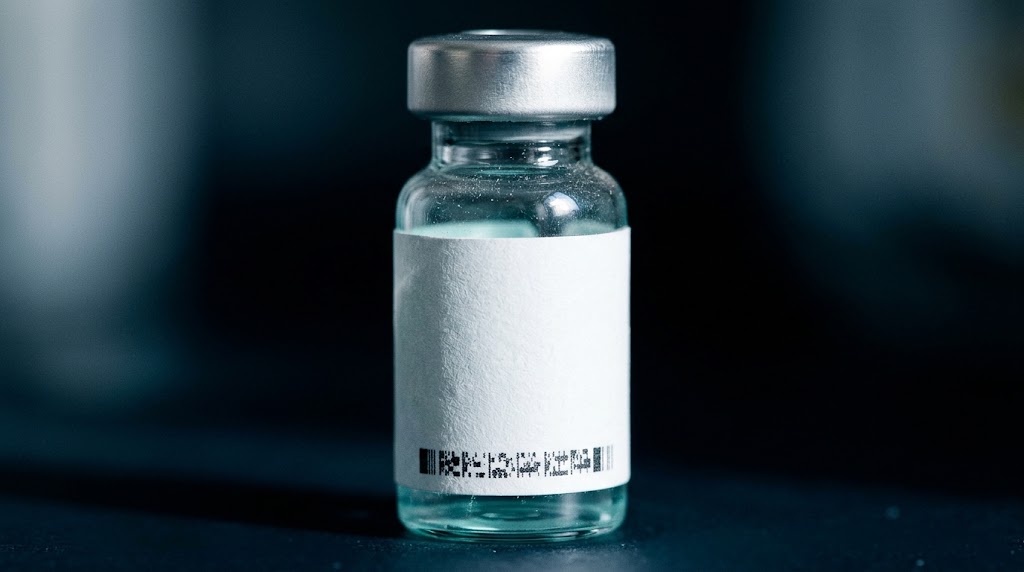
Normal for this category, and the blank space is not an oversight by whoever shipped it. Peptides do expire, in the sense that any molecule breaks down given enough time and poor storage. Nobody has measured when.
Expiration dates are a regulatory output. One rule requires a date, another says what has to be done to earn it, and a third says where it has to be printed. None of those rules reaches the vial in your hand.
Why does an approved drug carry an expiration date?
An approved drug carries an expiration date because a federal regulation requires one. Under 21 CFR 211.137, a drug product "shall bear an expiration date determined by appropriate stability testing," and the date exists so the product still meets its standards of identity, strength, quality and purity at the time somebody uses it.1
Placement is regulated too. The date "shall appear on the immediate container and also the outer package, if any," unless it is "easily legible through such outer package."2 For single-dose containers packed in individual cartons, it "may properly appear on the individual carton instead of the immediate product container."2 Keeping the date in a file somewhere does not satisfy the rule, and neither does printing it only on a box that gets thrown away.
What has to happen before a date can be printed?
Before a date can be printed, a written stability program has to run to specifications set out in the same part of the regulations. 21 CFR 211.166 requires a program whose results "determine appropriate storage conditions and expiration dates," and it lists what the program must contain.3
Four of its requirements matter for what follows. Sample sizes and test intervals must rest on "statistical criteria for each attribute examined."3 Test methods must be reliable, meaningful and specific. Testing happens on "the drug product in the same container-closure system as that in which the drug product is marketed."3 And where a product is reconstituted before use, it is tested both at dispensing and after reconstitution.3
None of those four is a formality. Statistical criteria rule out testing one vial once. Specificity of method rules out a test that would miss a degradation product. Container-closure testing ties the result to the exact package. Reconstitution testing makes the sealed product and the mixed product two separate questions with two separate answers.
An adequate number of batches has to go through this before a date is set, and accelerated studies "may be used to support tentative expiration dates provided full shelf life studies are not available."3 Tentative is the operative word there. Tentative dates still have to be confirmed by real-time data.
Why does a research-labeled vial have none?
A research-labeled vial escapes all of it, because those regulations govern drug products made under current good manufacturing practice. A vial sold for laboratory use is not an approved drug product, so no rule obliges anyone to run a stability program on it, and no rule obliges anyone to print a date.
Follow the chain and the gap is obvious at every link. Approval brings a product inside the manufacturing regulations. Those regulations require the stability program. The program produces the date. The labeling rules say where the date is printed. A research vial sits outside the first link, so none of the three that follow ever apply to it, and the missing date at the end is the visible part of an absence that started much earlier.
That absence is therefore accurate. A seller who printed a date would be making a claim nothing behind the vial supports, and a seller who prints nothing is telling the truth about what is known.
Does "research use only" explain the gap?
Not in the way the phrase suggests. That sentence has a real regulatory home, and it is not the drug regulations at all. 21 CFR 809.10(c)(2)(i) requires that a product in the laboratory research phase of development, not represented as an effective in vitro diagnostic, carry the prominently placed statement "For Research Use Only. Not for use in diagnostic procedures."4
That rule governs in vitro diagnostic products: test kits, reagents, laboratory assays. Its second half is about diagnosis and not about injection. A peptide vial carrying a research-use label has borrowed the shape of a phrase from a framework built for something else entirely, and the borrowing does not import any of that framework's obligations, including dating.
Are any approved products exempt from dating?
Three categories, named in the regulation. Homeopathic drug products "shall be exempt from the requirements of this section."1 Allergenic extracts labeled "No U.S. Standard of Potency" are exempt. And "new drug products for investigational use are exempt from the requirements of this section," provided stability studies during clinical use show they meet appropriate standards.1
The third exemption repays attention. Compounds in clinical development, held by a sponsor running trials under an FDA application, are exempt from printing an expiration date. So even inside the regulated system, investigational status and dating do not go together. A gray-market vial is further out still: not approved, not investigational, not subject to the rule in the first place.
If a vendor does print a date, what is behind it?
Whatever that vendor decided, and no regulation defines it. A printed date on a research vial is not false in the way a fabricated purity figure is false, because no standard governs what it should mean. It is a number with no definition attached.
Two sellers can print two different dates for the same compound in the same size vial without either being wrong, because neither is making a regulated claim. Such a date tells you something about the seller's filing practices and nothing about the molecule.
It also sits beyond checking. A purity claim can be tested by sending a sample to a laboratory, and people do. Checking a shelf-life claim would mean storing vials for the stated period and testing them at intervals. Doing so amounts to running the stability program. The one claim a buyer cannot independently verify is the one with no standard behind it.
Is a lot number worth more than a date?
On an undated vial a lot number is worth considerably more, and the regulations treat it as the load-bearing marking. Packaging and labeling operations for an approved product must include "identification of the drug product with a lot or control number that permits determination of the history of the manufacture and control of the batch."5 Traceability is the whole purpose. The number exists so that a specific vial can be tied back to a specific production run, and so that anything later discovered about that run reaches the right units.
The same number does a smaller version of that job on a research vial. It connects what you are holding to the certificate of analysis issued for that lot, and without it the certificate describes material you cannot prove you received. A vial with a printed date and no lot number carries the decorative marking and not the functional one.
Lot numbers can also be checked, where dates cannot. Give a lot number and you have made a statement that can be matched against a document. The COA guide covers how to do that matching and what a mismatch means.
Is the date on a certificate of analysis an expiration date?
No. Certificates of analysis carry a test date, meaning the day a sample was run, and that is a different kind of fact. It describes what a sample contained on one day. An expiration date describes how long material will keep meeting its specification under stated conditions. Establishing that takes months of real-time data.
A test date also says nothing about when the material was made. A lot could be synthesized, lyophilized, filled and tested within a week, or tested months after filling, and the certificate reports only the day of the test. So even the one date on the document leaves the age of the powder open.
The COA guide covers how to read the rest of that document. One point from it belongs here: a COA reports on the lot tested, so whether your vial came from that lot is a separate question again.
Does the 28-day rule fill the gap?
No rule fills that gap, because the 28 days answers the second of those two questions and leaves the first untouched. An in-use period starts at reconstitution, and it concerns microbial risk and how long a preservative holds. Shelf life is the clock before any of that, running on sealed dry powder in an unopened vial.
Somebody who buys powder, stores it for eight months and then mixes it has used a rule that was never about those eight months. No document covering that vial says anything about those eight months. The 28 days starts counting as though they did not happen.
How many dates does a mixed product need?
Two, under the regulations, and a research vial has neither. Where a drug product is reconstituted at the time of dispensing, 21 CFR 211.137 requires that "its labeling shall bear expiration information for both the reconstituted and unreconstituted drug products."1 The stability program has to match: products reconstituted as the labeling directs are tested at dispensing and again after reconstitution.3
Those two dates answer different questions. The unreconstituted date covers sealed powder sitting in a box, where the main threats are moisture and time. The reconstituted date covers a liquid with a punctured stopper, where microbial risk and the preservative's capacity take over, and it is usually measured in days against months or years for the dry form.
A peptide vial that arrives as powder and gets mixed at home is exactly the product shape that rule was written for. It has no date for the dry state, no date for the mixed state, and no stability program behind either. What fills the gap in practice is a convention borrowed from preserved multi-dose products. The 28-day guide traces that convention to its actual source.
What does an expiration date actually claim?
That the product meets its specification through that date, under the storage conditions printed with it. Dates "shall be related to any storage conditions stated on the labeling," so the two travel together and a date read without its storage condition is only half a statement.1 A product held outside those conditions has not had its date extended or shortened by some known amount. It has fallen outside what the date was established for.
What the date does not say is that anything happens the following morning. Its claim runs up to the date and stops. Past it, the manufacturer is not asserting failure, only declining to assert compliance, and that distinction gets lost in how people talk about expiry.
Would stability data from a published paper give a vial a date?
No, and two separate requirements block it. Stability programs test the product "in the same container-closure system as that in which the drug product is marketed," so the date belongs to that formulation in that vial with that stopper and not to the molecule in the abstract.3 Sample sizes and test intervals also have to rest on "statistical criteria for each attribute examined," which a single published experiment at a handful of timepoints does not supply.3
A paper reporting how a peptide behaves in solution describes that peptide in that buffer in that laboratory's container. Two vendors filling the same compound into different vials with different stoppers and different residual moisture do not inherit a date from each other, let alone from a journal.
Does any of this tell you whether your vial is still good?
Your vial's label cannot tell you, and the practical position follows from that. It carries no date, no storage condition tied to a date, and no stability program standing behind either. Age is not even knowable from the outside: the vial carries no fill date either, so a buyer cannot tell whether the powder was lyophilized last month or three years ago, and a lot number only answers that question if the seller will say when the lot was made.
What remains is physical evidence and the handling history. The storage guides on this site deal in observable things for that reason: whether the powder looks right, what a warm delivery does and does not do, and what the sealed dry state protects against. Those signals are weaker than a date. They are also the only ones a buyer actually has.
What would settle it?
Nothing settles it short of real-time stability data on the specific product, in the specific vial, published by whoever sells it. Approved products are required to have exactly that, and nobody in this market produces it.
The regulation also describes what finishing the job looks like, and partial answers in this market get presented as whole ones. Accelerated studies can support a tentative date only where full shelf-life data are unavailable, and where a tentative date runs past what real-time data support, studies continue "including drug product testing at appropriate intervals" until the date is verified or a final one is set.3 A single accelerated experiment is the start of that process rather than a substitute for it.
Until then an undated vial means one thing only: its shelf life is unknown. Nothing on the label invites a reading in either direction, and an absence is not a reassurance.
Common questions
Do peptides expire?
Peptides degrade over time like any other molecule, so in the physical sense they expire. What no research-labeled vial has is a date marking when, because establishing one requires the stability program that 21 CFR 211.166 describes and that nobody in this market runs.
Can a peptide go bad without looking any different?
Degradation does not always show. Cloudiness, clumping and color change are signs of some failures and not of others. The cloudy vial guide treats appearance as a partial signal and not a verdict. A vial that looks right is not thereby in specification.
Why is there no expiration date on my peptide vial?
No regulation requires an expiration date on a research-labeled vial. Expiration dating under 21 CFR 211.137 applies to drug products made under good manufacturing practice, and a vial sold for laboratory use is not one, so nothing obliges a seller to establish a date or print it.
Does a missing date mean the vial is fake?
No, a missing date is not a sign of a counterfeit, and the opposite inference is closer. Printing a date would assert something no stability program supports, so an undated vial is consistent with a seller who has not run one and is not pretending otherwise.
Can a seller legally print an expiration date anyway?
Nothing defines what such a date would mean, and the absence of a definition is the problem. Two sellers can print different dates for the same compound in the same vial size without either being wrong, because no regulated standard governs the claim.
Is the date on my COA an expiration date?
No, a certificate of analysis gives a test date and not an expiration date, describing what one sample from one lot contained on one day. An expiration date describes how long material keeps meeting specification, and it takes real-time data to establish.
Do approved drugs ever lack an expiration date?
Three categories are exempt under the regulation: homeopathic products, allergenic extracts labeled "No U.S. Standard of Potency," and new drug products for investigational use. Approved products outside those exemptions carry one.
What does an expiration date guarantee?
An expiration date guarantees that the product meets its standards of identity, strength, quality and purity through the stated date, under the stated storage conditions. It makes no claim at all about the day after.
Does an expired drug become dangerous?
The regulation does not say so, and it does not address the question. A date marks the end of the period the manufacturer is prepared to assert compliance for. Predicting harm is a different thing entirely.
Where does the date have to appear on a package?
The date must appear on the immediate container and the outer package, unless it is easily legible through the outer package. Single-dose containers in individual cartons may carry the date on the carton instead.
What testing produces an expiration date?
Expiration dates come out of a written stability program with statistically justified sample sizes and test intervals, reliable and specific test methods, and testing in the same container-closure system the product is marketed in. Accelerated studies can support only a tentative date.
Why does the container matter so much?
Stability depends on the whole package, not the molecule alone, so the regulation requires testing in the marketed container-closure system. A date earned in one vial with one stopper does not transfer to a different vial from a different seller.
Does the 28-day rule act as an expiration date?
No. The 28 days is an in-use period that starts at reconstitution and concerns microbial risk, while an expiration date runs on the sealed unreconstituted product. The 28-day guide covers the first and nothing covers the second for a research vial.
Does "for research use only" have a legal meaning?
Yes, and it belongs to diagnostics. 21 CFR 809.10(c)(2)(i) requires that exact statement on in vitro diagnostic products in the laboratory research phase, and the full sentence ends "Not for use in diagnostic procedures."
Would published stability research give my vial a shelf life?
No. Stability belongs to a specific formulation in a specific container, so the regulation requires testing in the marketed container-closure system. A paper describes its own material in its own container.
Is an undated vial better or worse than a dated one?
Neither, on the evidence available. A date from a seller with no stability program carries no more information than no date, and the absence at least describes the situation accurately.
Sources
- 21 CFR 211.137, Expiration dating. Read at source in the annual Code of Federal Regulations, title 21, volume 4, via govinfo. https://www.govinfo.gov/content/pkg/CFR-2024-title21-vol4/xml/CFR-2024-title21-vol4-sec211-137.xml. Paragraphs (a) the dating requirement and its purpose, (b) the link to stated storage conditions, (c) dating for reconstituted and unreconstituted products, (e) the homeopathic exemption, (f) allergenic extracts, and (g) the exemption for new drug products for investigational use. ↩1 ↩2 ↩3 ↩4 ↩5
- 21 CFR 201.17, Drugs; location of expiration date. Read at source in the annual Code of Federal Regulations, title 21, volume 4, via govinfo. https://www.govinfo.gov/content/pkg/CFR-2024-title21-vol4/xml/CFR-2024-title21-vol4-sec201-17.xml. Placement on the immediate container and outer package, the legibility exception, and the carton allowance for single-dose containers. ↩1 ↩2
- 21 CFR 211.166, Stability testing. Read at source in the annual Code of Federal Regulations, title 21, volume 4, via govinfo. https://www.govinfo.gov/content/pkg/CFR-2024-title21-vol4/xml/CFR-2024-title21-vol4-sec211-166.xml. The written stability program and its required elements, including statistical criteria for sample size and test intervals, reliable and specific test methods, testing in the marketed container-closure system, testing of reconstituted products, and the limits on accelerated studies supporting tentative dates. ↩1 ↩2 ↩3 ↩4 ↩5 ↩6 ↩7 ↩8 ↩9
- 21 CFR 809.10(c)(2)(i), Labeling for in vitro diagnostic products. Read at source in the annual Code of Federal Regulations, title 21, volume 8, via govinfo. https://www.govinfo.gov/content/pkg/CFR-2024-title21-vol8/xml/CFR-2024-title21-vol8-sec809-10.xml. The required statement for a product in the laboratory research phase of development that is not represented as an effective in vitro diagnostic product. ↩1
- 21 CFR 211.130, Packaging and labeling operations. Read at source in the annual Code of Federal Regulations, title 21, volume 4, via govinfo. https://www.govinfo.gov/content/pkg/CFR-2024-title21-vol4/xml/CFR-2024-title21-vol4-sec211-130.xml. Paragraph (c), identification of the drug product with a lot or control number permitting determination of the history of the manufacture and control of the batch. ↩1