
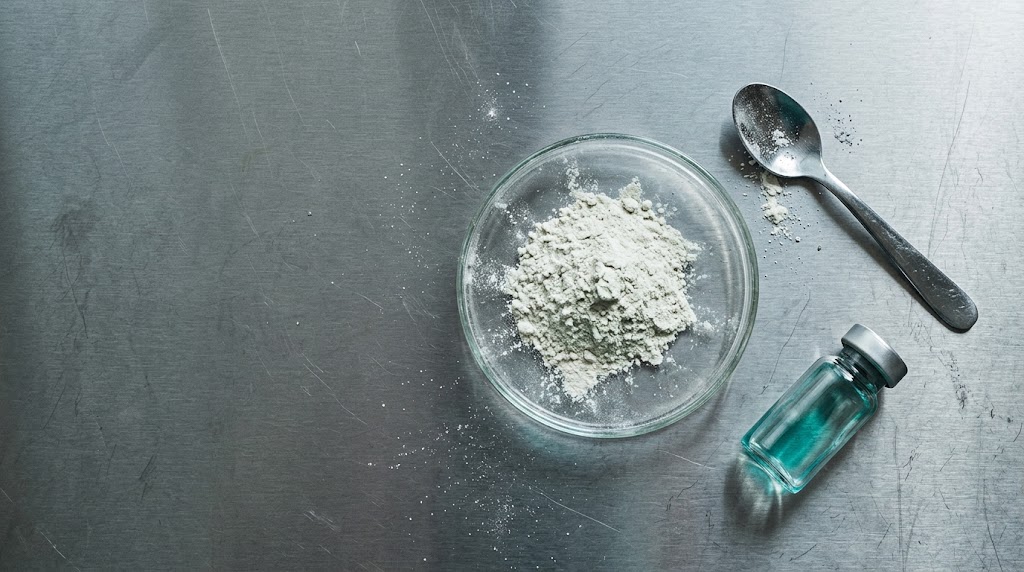
Collagen peptides are peptides. The word on the tub is correct.
Little else about them is like the rest of this site. They come from animal hide. You drink them. You can buy them at the store. Everything this site covers about defined sequences, purity figures and research-use labels belongs to a different kind of product, and almost none of it carries across.
Are collagen peptides actually peptides?
Yes. The plain-language guide sets out the line they clear: a chain of under roughly fifty amino acids is a peptide, and longer chains are proteins. Collagen hydrolysate is made of chains well under that limit, so it qualifies without any stretching of the word. Research papers call the shorter fragments bioactive peptides, meaning sequences that might do something in the body beyond supplying raw amino acids.1
One difference matters more than the label does. Semaglutide is a single defined sequence. It is built to a specification. Every vial is supposed to hold that one molecule and nothing else. Collagen hydrolysate is a mixture of many thousands of different fragments, produced by chopping up animal collagen with enzymes, and no two production runs hold exactly the same set. Reviews of the field say outright that the fragment content of retail products is poorly characterized.1 Both are peptides in the way that a brick and a pile of gravel are stone.
That shows up in testing. A vial of a defined peptide can be tested against a reference standard, and a certificate of analysis will state a purity figure for one named molecule, and the COA guide walks through reading one. Collagen powder has no single molecule to be pure of. Reviewers name significant knowledge gaps on the digestion, bioavailability and activity of the fragments these products contain.1 A purity number for collagen hydrolysate would describe how little non-collagen material got in, and nothing about which fragments you are drinking.
What is collagen hydrolysate?
Animal collagen broken into short pieces and dried into a powder. Raw material is usually cowhide, pigskin or fish skin and scales. Enzymes cut the long collagen strands into fragments, the water is removed, and what is left dissolves into a drink. Labels say collagen peptides, hydrolyzed collagen or collagen hydrolysate, and all three names describe the same process at the same stage.
Gelatin sits halfway along that process. Collagen broken down part way sets into a gel as it cools, the way gelatin does in a dessert. Broken down further, it stops gelling and dissolves in cold liquid instead. Collagen peptide powder stirs into iced coffee for that reason. Gelatin does not.
Nobody checks the words on the tub before it reaches a shelf. Collagen powder is sold in the United States as a dietary supplement, and under that arrangement firms "are responsible for evaluating the safety and labeling of their products before marketing," in the FDA's own words.2 The agency keeps the power "to take action against any adulterated or misbranded dietary supplement product," which is a power it uses after the sale rather than before it.2 So the accuracy of the word peptide on a collagen label rests on the manufacturer, and happens in this case to be accurate.
Source animal varies between products. So does the enzyme used, the cut length and the resulting fragment mix. Formal comparisons between one hydrolysate and another are often missing from the literature, even when two products are tested in the same paper.1
Why can you swallow these when most peptides cannot be?
Most peptides are destroyed in the gut, and for that reason almost everything else on this site is injected, and the capsules guide covers how badly oral versions usually fare. Collagen peptides begin at the other end of that problem. They are already digestion products, so there is far less left for the gut to take apart.
Their chemistry helps as well. Collagen is unusually rich in hydroxyproline, an amino acid that most proteins barely contain. Absorption work focuses on a handful of short sequences. The 2024 crossover tracked "selected collagen peptides (Pro-Hyp, Hyp-Gly, Gly-Pro-Hyp, Pro-Gly, Gly-Pro)," five fragments of two or three amino acids each, and three of the five carry hydroxyproline.3 Proline sitting next to hydroxyproline resists the enzymes that cut most peptide bonds. That resistance is the mechanistic case for why anything survives the trip at all.3
None of which makes collagen peptides a good model for other peptides. Whatever protects them is specific to collagen's own amino acid pattern.
Do collagen peptides reach the bloodstream intact?
Some collagen peptides do reach the bloodstream intact, and the human evidence for it is thinner than the claim resting on it. A randomized, double-blind crossover study published in Frontiers in Nutrition in 2024 measured those five peptides in plasma after people drank collagen hydrolysate, with a seven-day washout between study days.3 The trial gave an "oral single-dose (10 g) dissolved in 200 mL water," and drew blood before the drink and then "at 60, 120, 180, 240, and 360 min post."3 Six hours is the whole window that study looked at. Pro-Hyp "was the most abundant peptide present in the circulation after intake of CH," while "Gly-Pro-Hyp and Pro-Gly were formed and absorbed into the blood at a much lower concentration."3 Gly-Pro was the least abundant in blood despite being the most concentrated in the products before anyone drank them.3
Six healthy non-smoking volunteers took part, "3 women and 3 men."3 The authors say it themselves: "the pilot scale sample size limits the generalization of the observed differences."3
One number out of this paper travels badly. The study reports that total circulating hydroxyproline exceeded the free form by 36 to 47 percent. Its wording is that "a considerable fraction of Hyp remains in peptide-bound form in the circulation."3 Read carefully, that describes hydroxyproline already in the blood and how much of it was still attached to something. It is not the share of a swallowed dose that arrives as intact peptide. No study cited here reports that share, including this one.
What have the skin trials found?
A measurable effect on hydration and elasticity, in trials that are short. A 2023 systematic review in Nutrients pooled "26 RCTs involving 1721 patients."4 It reported an overall effect size of "0.63 (95% CI 0.38, 0.88)" for skin hydration across 18 studies, and "0.72 (95% CI 0.40, 1.03)" for skin elasticity across 19.
Neither interval touches zero. So the pooled result is not a coin flip. Anyone calling oral collagen inert is arguing against the better-evidenced end of this subject.
Something else shows up in the study counts. The review pooled 26 trials in total, and the hydration figure rests on 18 of them while the elasticity figure rests on 19.4 Neither headline number draws on the whole evidence base, because not every trial measured both things, and a reader who sees "26 RCTs involving 1721 patients" next to an effect size will reasonably assume otherwise.
Trial length matters more than either effect size. Supplementation in the included studies "ranged from 2 to 12 weeks."4 Skin aging is the outcome people buy collagen for, measured over years, and twelve weeks is the longest look anyone in that pool took.
What does an effect size of 0.63 actually mean?
Not a 63 percent improvement, though that is how a figure like this usually gets reported. Effect sizes of this kind are standardized measures. It expresses the gap between groups in units of how much the measurements varied, so it says how cleanly the two groups separated and says nothing in millimeters, percent or shades of anything.
Values around 0.6 are conventionally read as a moderate separation. What it does not tell you is whether a moderate separation on a skin-hydration probe is a change you would see in a mirror. Nutrients reports the statistic and leaves it untranslated, because the underlying trials measured instrument readings.4
That gap between a clean statistical signal and a noticeable result is where most collagen marketing lives.
How reliable is that skin evidence?
Less reliable than the pooled figures suggest, and the field has begun saying so in print. A 2026 paper in the Journal of Cosmetic Dermatology carries the title "Hydrolyzed Collagen for Skin Aging Meta-Analyses Are Unreliable."5 Its full text is not reachable from here, so it appears on this page for the argument its title makes and for nothing else. No figure from it is quoted.
That review records a problem pointing the same way. It found bias from missing outcome data in thirteen of its twenty-six included studies, and notes that "a small sample size may have resulted in a slight RoB," where RoB is risk of bias.4 Half the evidence base had incomplete outcome reporting. A gap like that flatters a pooled estimate instead of deflating it.
What about joints?
Evidence for joints is weaker than for skin. Reviewers say so themselves. A 2023 review in Medicines describes collagen hydrolysates as "potential treatments for OA," which is the language of an open question and not of a finding.1 It discusses eleven human studies, including a six-month trial in 250 people with knee osteoarthritis and a 24-week trial in 147 athletes.
Its own assessment carries the weight here. The review states that "the mechanisms behind their activity are still not fully established."1 It also names "significant knowledge gaps regarding the digestion, bioavailability, and bioactivity of CH-derived BAPs."1 It calls for "Further transparent evidence-based work." A review that asks for better evidence is telling you what it thinks of the evidence it has.
Who paid for this research?
Collagen manufacturers paid for most of this research, in the studies above that name a funder. Knowing it changes how you weigh them.
The Frontiers absorption study "was funded by Rousselot BV, Belgium," a collagen producer.3 Five of its authors were employed by Rousselot. Four more worked for two contract research firms. On the joint review, one author is affiliated with a collagen supplement company.1 The Nutrients skin review is the exception: it reports funding from a hospital.4
Industry funding does not make a result wrong. It does mean the questions were chosen by someone who sells the answer, and the same standard applies here as to any compound in this library whose evidence traces back to one interested party.
Are collagen peptides regulated like a drug?
No. In the United States they are sold as dietary supplements, and no agency reviewed them for effectiveness before they reached a shelf.
The labeling arrangement above is the whole of the oversight. Sellers decide what the tub claims. The FDA can act once the product is already selling.2 So a collagen powder occupies a different regulatory world from an approved drug and from a vial labeled for research use, and the legality guide covers the second of those.
Claims on the front of the tub run under their own rules. Wording like "supports healthy skin" is a structure and function claim. Such a claim "may describe the role of a nutrient or dietary ingredient" in normal body function, and the FDA states plainly that these claims "are not pre-approved by FDA."6 The manufacturer notifies the agency of the wording "no later than 30 days after marketing the dietary supplement with the claim," which is to say after the product is on sale.6 The label then has to carry a disclaimer saying the FDA has not evaluated the claim. It must also say the product is not intended to "diagnose, treat, cure or prevent any disease," because "only a drug can legally make such a claim."6
On a collagen tub, the disclaimer and the claim above it say opposite things. Both are legally required. Together they are the clearest statement of where this category sits.
Is a collagen peptide the same kind of product as BPC-157?
No, on every axis that matters. One is a food ingredient taken from animal tissue, eaten as a powder, sold openly in supermarkets, with pooled randomized evidence behind a modest skin measurement. The other is a defined synthetic sequence, injected, sold under a research-use label, with no completed published randomized efficacy trial.
That shared word causes real confusion, running in both directions. A vendor selling something that is not a peptide and a supermarket selling something that is both trade on how loose the term has become, and the not-everything-is-a-peptide guide covers the first case. Topical peptides are a third category again, and the skincare guide covers those.
What would settle it?
Longer trials would settle it, funded independently and reporting outcomes people recognize. Twelve weeks of probe readings answers a narrower question than the marketing asks, and the field has no trial running the length of the claim.
Absorption needs a study larger than six people, run by someone who does not sell collagen, reporting what share of a swallowed dose arrives in the blood as intact peptide. Published absorption work stops short of that figure.
Retail products are the third unknown. Nothing cited here reports the fragment profile of a retail powder. The reviews say formal comparisons between one hydrolysate and another are often missing.1 Until someone publishes what is in the tubs people actually buy, a trial of one hydrolysate speaks for that hydrolysate and not for the category.
Common questions
Are collagen peptides real peptides?
Yes, collagen peptides are short amino acid chains, and the ones measured in human blood run two and three residues long. A tub holds a mixture of thousands of them and not one defined sequence.
Do collagen peptides work for skin?
Pooled trials report effect sizes of 0.63 for hydration and 0.72 for elasticity, in studies lasting 2 to 12 weeks. A 2026 paper argues in its title that those meta-analyses are unreliable. Nothing in that pool ran long enough to speak to aging over years.
Does an effect size of 0.63 mean 63 percent better?
No, an effect size of 0.63 is not a 63 percent improvement. It is a standardized measure of how cleanly two groups separated, expressed in units of variation, and it carries no percentage and no visible-change equivalent.
Are collagen peptides absorbed?
Partly, and the evidence is one small study. A six-person crossover detected Pro-Hyp and four other collagen-derived peptides in plasma after ingestion, with Pro-Hyp the most abundant. Blood was sampled out to six hours after a single drink. Its authors call the sample size a limit on generalizing from it.
How much of the dose gets in as actual peptide?
Nobody has published the share of a 10 g dose that reaches the blood as intact peptide. The 36 to 47 percent figure that circulates describes how much circulating hydroxyproline was peptide-bound, not how much of a dose was absorbed intact.
Is collagen the same as gelatin?
Collagen and gelatin are the same protein at different stages of breakdown. Gelatin gels as it cools, and hydrolyzed collagen is broken down further, does not gel, and dissolves in cold liquid.
Can you inject collagen peptides?
Collagen powder sold as a supplement is not made, tested or labeled for injection. It is a food ingredient and sterility is not part of its specification. Injectable collagen products are a separate category of regulated dermal fillers.
Do collagen peptides help joints?
The reviews call them a potential treatment and name significant knowledge gaps on digestion, bioavailability and activity. Eleven human studies exist, among them a six-month trial in 250 people with knee osteoarthritis. The mechanism is still unestablished. That is why the reviews ask for better work.
Which collagen type matters, I, II or III?
Trials rarely separate them cleanly, and the review literature discusses source material more than type number. Type I and type III collagen come from hide and skin, type II from cartilage, and the joint studies tend to use the cartilage-derived material. Nobody has published a comparison that would support choosing by type.
Are marine collagen peptides better?
No published comparison shows marine collagen outperforming bovine or porcine. Source material differs between products, and the reviews note that formal comparisons between hydrolysates are often absent.
Is collagen peptide powder FDA approved?
No, collagen peptide powder is not FDA approved. It is sold as a dietary supplement, a category where firms carry responsibility for safety and labeling and the FDA acts after marketing. Claims like "supports healthy skin" are not pre-approved either. Labels have to say so.
Why do most peptides need injecting if these do not?
Collagen peptides are already digestion products, so less remains for the gut to break down, and the proline to hydroxyproline bond resists the usual enzymes. Most therapeutic peptides are defined sequences that do not survive the journey.
Does the powder contain the peptides that were studied?
Pro-Hyp and the other studied fragments form during digestion as well as during manufacturing, and products differ between runs. What is in a given tub has not been published.
Should this change what I think of peptides generally?
Collagen cuts both ways as a precedent. A swallowed peptide product with pooled randomized data beats most injectables in this library on evidence, and the outcome it is evidenced for is smaller than the claims built around it.
Sources
- Collagen Hydrolysates: A Source of Bioactive Peptides Derived from Food Sources for the Treatment of Osteoarthritis. Medicines, 2023, DOI 10.3390/medicines10090050. One author affiliated with a collagen supplement company; no funding statement located in the text read. Read at source. https://www.mdpi.com/2305-6320/10/9/50 ↩1 ↩2 ↩3 ↩4 ↩5 ↩6 ↩7 ↩8 ↩9
- US Food and Drug Administration, Dietary Supplements. Read at source. https://www.fda.gov/food/dietary-supplements ↩1 ↩2 ↩3
- Absorption of bioactive peptides following collagen hydrolysate intake: a randomized, double-blind crossover study in healthy individuals. Frontiers in Nutrition, 2024, DOI 10.3389/fnut.2024.1416643. Six participants; funded by Rousselot BV, with five authors employed by Rousselot and four by contract research firms. Read at source. https://www.frontiersin.org/articles/10.3389/fnut.2024.1416643/full ↩1 ↩2 ↩3 ↩4 ↩5 ↩6 ↩7 ↩8 ↩9 ↩10
- Effects of Oral Collagen for Skin Anti-Aging: A Systematic Review and Meta-Analysis. Nutrients, 2023, DOI 10.3390/nu15092080. 26 randomized controlled trials, 1,721 patients; review funded by Taipei Municipal Wanfang Hospital. Read at source. https://www.mdpi.com/2072-6643/15/9/2080 ↩1 ↩2 ↩3 ↩4 ↩5 ↩6
- Hydrolyzed Collagen for Skin Aging Meta-Analyses Are Unreliable. Journal of Cosmetic Dermatology, 2026, DOI 10.1111/jocd.71208. Title, journal, year and DOI verified at source via the OpenAlex API. Full text not reachable from here and no figure from it is quoted on this page. ↩1
- US Food and Drug Administration, Structure/Function Claims. Read at source. https://www.fda.gov/food/food-labeling-nutrition/structurefunction-claims ↩1 ↩2 ↩3