Our pickEvolve BioPep
Store saysYes: 96 records, each with a batch or lot.


Price transparency
The most-sold size is 5 mg. Most stores charge $34.99 to $138.00 for one, and the middle price is $55.00.
A lab-designed peptide with big cancer claims and no human trial in 25 years.
The PNC-27 market today
31 catalogs read · listings older than 30 days left out of the figures
01
Card one is our pick. Every card is labeled.
Card one came out on top. We earn nothing from it. Cards two and three are the stores we partner with that sort highest. We earn a commission from them.
Our pickStore saysYes: 96 records, each with a batch or lot.
PartnerStore saysYes: about 65 product sections carrying roughly 150 certificates.
PartnerStore saysPublished per product and per vial size, with older reports kept, each tied to a lot number and a laboratory ID.
Requires an account to see prices.
Every figure here is reconstructible from the full table below. Links noted "We earn from this link" carry a sponsored tag; a commission never changes a card's position, and a partner that wins the rule stays in first place. Prices exclude shipping and were read on the dates shown.
02
Vials come in different sizes, so price per mg is the only column that compares like with like. Other forms are listed below it, each in its own list.
These listings have not been read again in the last 30 days. They stay listed, sorted last, and are left out of every figure on this page until the store is read again.
We earn from these links. It never changes a price or a position here.
03
Each priced the way it is sold, in its own list. None of these count toward the per mg figures above.
04
Partner codes for Peptide Decoding readers. We may earn a commission when one is used. It never changes how prices are sorted.
3 of the 31 stores listed for PNC-27 publish a discount code, worth 10% to 25% off. Cheapest price per mg comes first.
from $8.00 per mg before the code
from $8.15 per mg before the code
from $11.00 per mg before the code
05
What each site was showing when we read it, and how it prices against the rest.
Does not name a testing lab.
Coverage record →Names its testing lab: Vanguard Laboratory and Ethos Analytics.
Coverage record →Does not name a testing lab.
Coverage record →Names its testing lab: Freedom Diagnostics.
Coverage record →Names its testing lab: Vanguard Laboratory and MZ Biolabs.
Coverage record →Names its testing lab: Chromate.
Coverage record →Names its testing lab: ILS Laboratories and Kovera Labs.
Coverage record →Names its testing lab: Freedom Diagnostics.
Coverage record →Names its testing lab: Vanguard Laboratory and North American Diagnostics.
Coverage record →Names its testing lab: SafeCert Labs, AV Analytics and BioRegen.
Coverage record →06
A cheap milligram is only cheap if the vial holds it.
Every per mg number here divides the price by the milligrams printed on the vial. Testing labs regularly find vials that weigh less than the label says.
Shipping is often flat, so it hurts small orders most. Several vendors add a card fee and discount for crypto. Two offers a dollar apart can swap places at checkout.
A bigger vial costs less per mg and expires on the same schedule. Once mixed, most people work to about 28 days in the fridge, so the saving only counts if you finish it.
07
At the 5 mg vial, the size most stores list.
Ignoring the few freak listings at each extreme, the dear end of the PNC-27 market costs 3.9 times what the cheap end does, per milligram.
Half the stores charge more than this per mg at this size and half charge less. It moves with sales, which is why every row carries a date.
Stores with an exact, in-stock price at this size. Under three and we publish no median.

08
The market median at the most-listed size, capture by capture.
Market median at 5 mg: $28.40 per mg on Sep 12, 2026, $11.00 on Nov 27, 2026, 13 stores comparable today.
| Date | Median per mg | Low per mg | Stores |
|---|---|---|---|
| Nov 27, 2026 | $11.00 | $6.00 | 13 |
| Nov 23, 2026 | $11.00 | $6.00 | 13 |
| Nov 22, 2026 | $11.00 | $6.00 | 13 |
| Nov 21, 2026 | $11.00 | $6.00 | 13 |
| Nov 15, 2026 | $11.00 | $6.00 | 13 |
| Nov 13, 2026 | $11.00 | $6.00 | 13 |
| Nov 12, 2026 | $11.00 | $6.00 | 13 |
| Nov 11, 2026 | $11.00 | $6.00 | 15 |
Research peptide prices fell 1.4% in October 2026. See the October 2026 price report →
09
Regulatory status changes what a price means.

Not approved anywhere and never tested in a human trial. It appears in the National Cancer Institute drug dictionary, which records compounds with proposed activity and is not an endorsement or a sign of approval. Vendor pages sometimes cite that listing as if it were. The peptide was designed around the year 2000, so the absence of a trial after twenty-five years is itself information.
Full PNC-27 record →There is no pharmacist behind it, no dispensing record, and nobody on the hook for what is inside. The lab report is the whole quality system, which is why it sits next to the price here.
Research use only is a claim the seller has to keep making. A vendor that adds dosing instructions, health claims, or personal-use wording has stepped outside the framework it relies on, and that says something about the seller.
What customs and carriers do varies by state and by shipper. This describes how these products are sold and is not legal advice.
10
What actually shows up, and the vial math that decides which size is the better buy.

Freeze-dried powder keeps for a long time in the freezer and for months in the fridge. Once liquid goes in, most people work to about 28 days in the fridge, away from light.

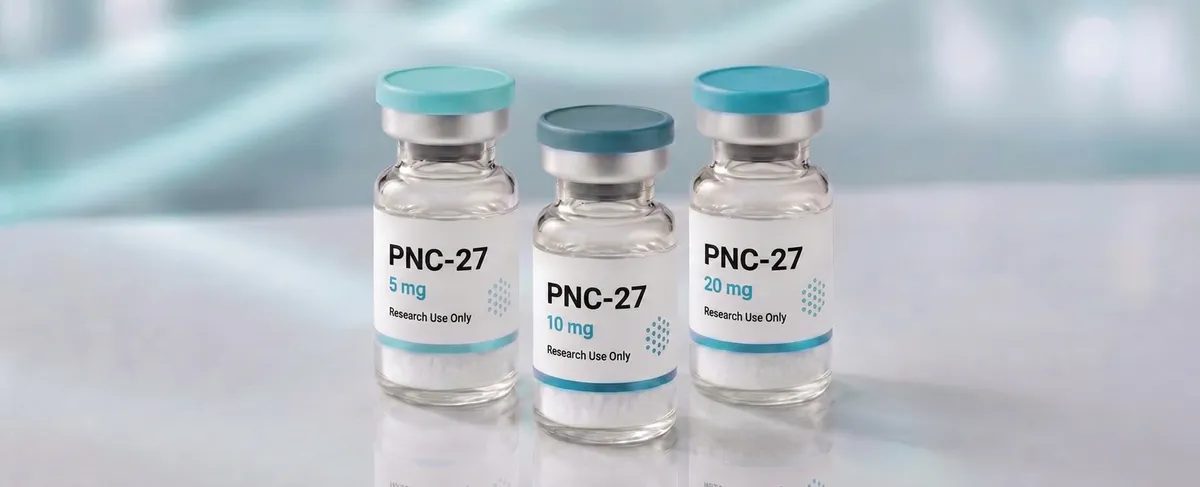
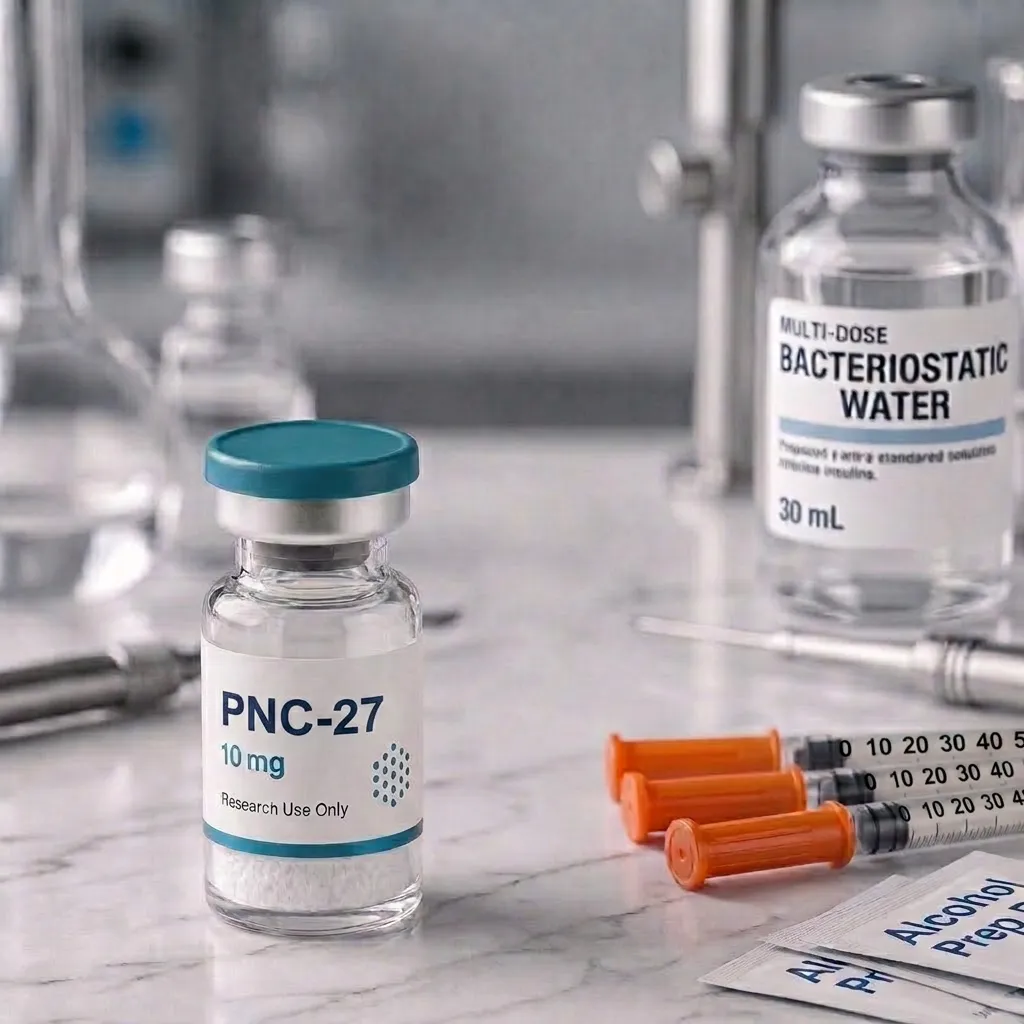
What arrives is powder in a sealed vial. Water goes down the inside wall rather than onto the powder, and the vial is swirled instead of shaken. Neither the water nor the syringes are in the prices above.

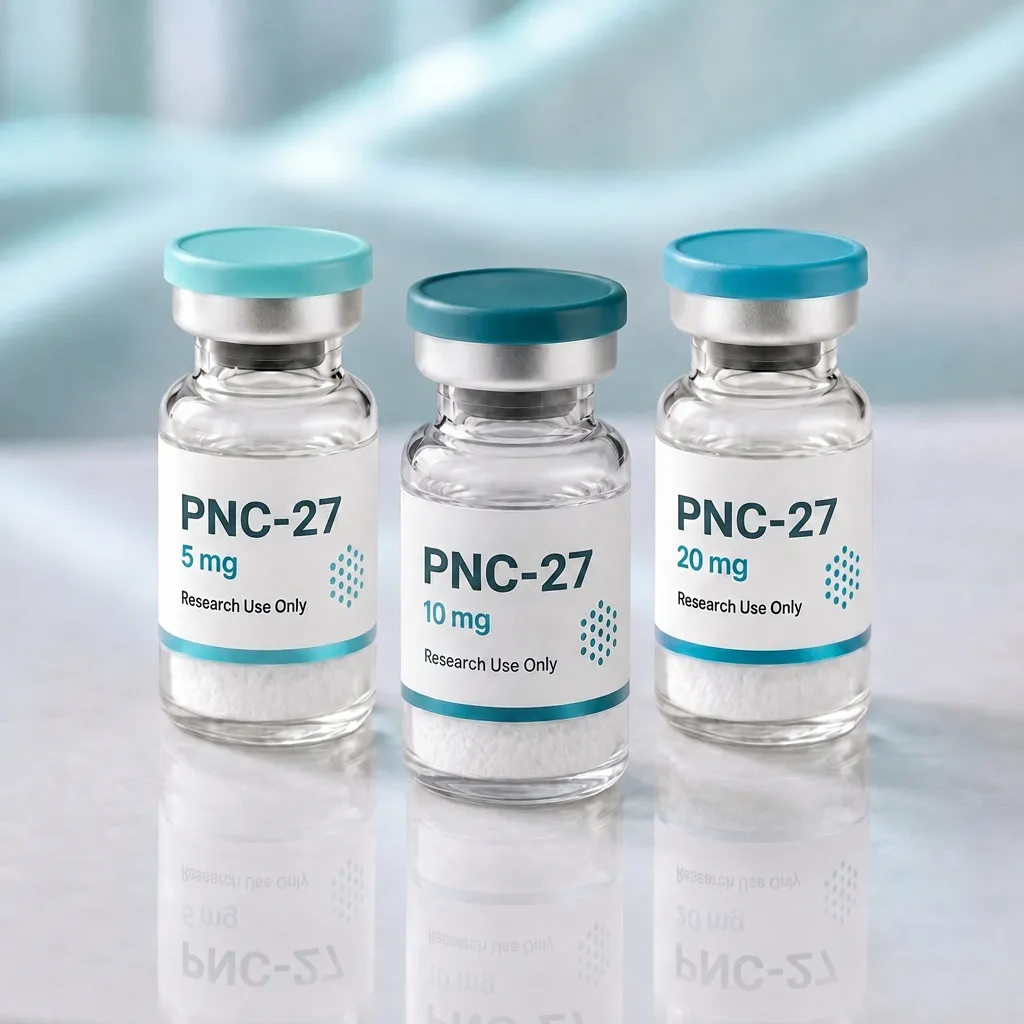
A larger PNC-27 vial costs less per mg and expires on the same schedule once mixed. The saving is real only when the vial runs out inside that window.
Nothing on this page tells you what to take. Full walkthroughs live in the guides.
11
What decides the order of the rows, and who gets to be in them.
Rows sort on one number. There is no combined score and no weighting, so no vendor can be pushed up the table by a rating you cannot check.
Vendors that publish nothing stay in the table, marked. Taking them out would make the market look tidier than we found it.
Prices are read off public catalog pages and saved with the date. A listing not read in 30 days moves to its own box under the table and is left out of the figures until it is read again.
Commissioned links are marked on the row and listed on the disclosure page. They never move a listing up or down the table.
Prices on this site are read from vendor websites on the dates shown. A starting tag means the vendor publishes only a from price for that product. A wall means the seller hides the price behind an account, and we publish that fact rather than hide the gap.
We report prices and never rate or score an offer. There is no value grade, no ranking of vendors by our opinion. A row carries its size, its price, its price per milligram, and any plain fact about the listing worth knowing. Where a page shows picks, they are ordered by a fixed rule, published testing evidence first and then price per milligram, and the rule is the same for every vendor.
When a vendor's site disappears, its rows stay in the tables as a dated record, drop out of every count, price range and ranking, and lose their links. Ninety days after a vendor's site disappears, its rows leave these tables and remain in our records.
Some vendors pay this site a commission when you buy through our links. Every one of those links is marked, and every vendor with that arrangement is labeled on the vendor page. Commissions never change the prices we show, the order of any table, a vendor's badge, or anything in the audit record. The data is collected the same way for every vendor, paid or not.
We accept no payment for coverage, placement, or ratings. Warning letters come from fda.gov. If a paying vendor earns a bad mark, the mark stays.

12
Cost, sizes, and how this table works.
The most-sold size, 5 mg, typically runs $34.99 to $138.00 a vial across 13 vendors, with a median of $55.00. Across 28 vendors it typically runs $7.00 to $27.60 per milligram, with the cheapest sticker price at $29.99. Prices exclude shipping, card fees, and bacteriostatic water.
Yes. 3 of the 31 stores listed for PNC-27 publish a discount code for Peptide Decoding readers, worth 10% to 25% off. Each code is in the "Our code" column of the price table and in the discount codes list on this page. These are partner codes: we may earn a commission when one is used, and that never changes how prices are sorted.
Vial size, sale cycles, payment method discounts, and how much testing evidence a seller publishes all move the number. A cheap milligram is only cheap if the vial holds what the label claims, which no price column can tell you.
Sorting never reads whether a vendor pays us. Any commissioned link is marked on the row and listed on the disclosure page, and it never changes where a listing lands in the table.
Not approved anywhere and never tested in a human trial. It appears in the National Cancer Institute drug dictionary, which records compounds with proposed activity and is not an endorsement or a sign of approval. Vendor pages sometimes cite that listing as if it were. The peptide was designed around the year 2000, so the absence of a trial after twenty-five years is itself information.
Every price is read off a public catalog page and stored with its date; this compound was last read Nov 23, 2026. Nothing is overwritten, so a stale row says so rather than pretending to be current.
13
Same catalog sweep, same read dates.