Peptide Decoding
All comparisons

Follistatin vs ACE-031

One was tested, worked, and was stopped. The other has no human protein-injection trial.

  • Muscle
  • One halted trial, one untested route
  • Neither approved
Published September 27, 2026
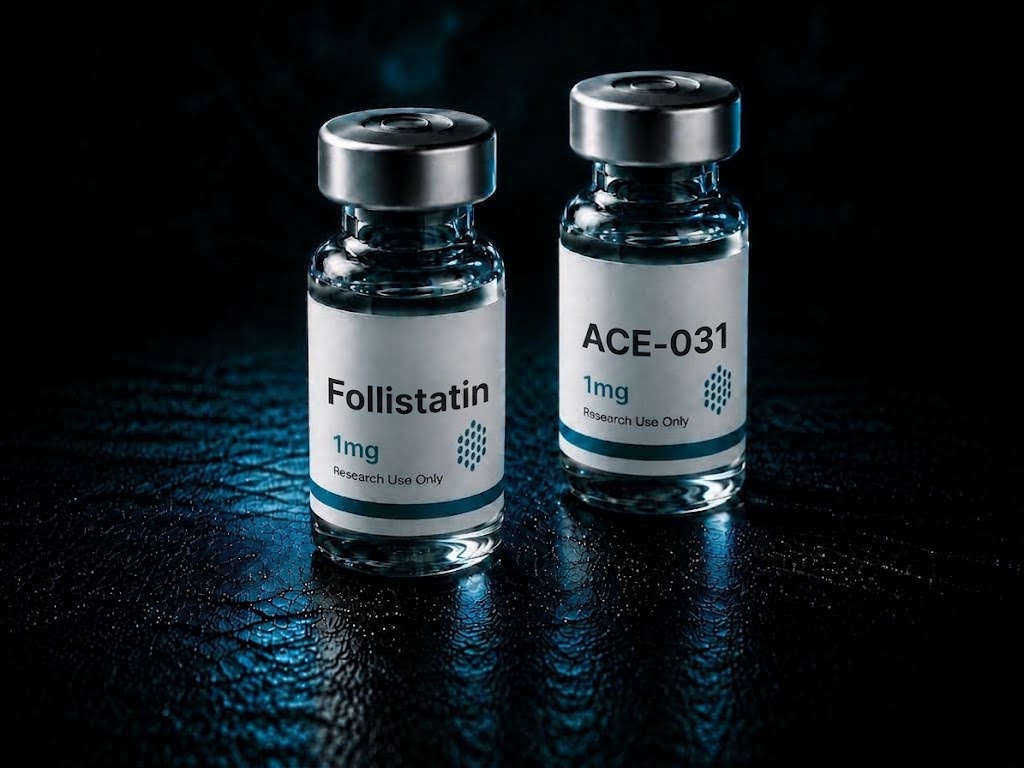
Follistatin and ACE-031 research vials on a dark blue surface
The short answer

One worked and was stopped. The other has never been tested by injection.

ACE-031 increased lean mass in humans and its trial was terminated anyway, over nosebleeds and dilated skin vessels traced to a second protein it blocked by accident. Follistatin's human evidence comes from small gene therapy studies, and that is a different intervention from injecting the protein. Neither is approved. The lesson from ACE-031's failure produced a myostatin drug that works, and it is neither of these.

Follistatin and ACE-031 facts
AttributeFollistatinACE-031
What it is

A naturally occurring glycoprotein

An engineered receptor decoy, not a peptide [1]

How it blocks myostatin

Grabs the hormone itself

Blocks the receptor the hormone uses [1]

Human evidence

Small gene therapy studies [6]

Phase 1 and Phase 2 [2][3]

Injected protein tested in humans

No [6]

Yes [2]

Did it build muscle

Unknown in humans

Yes [2]

Status

Not approved, never submitted

Development discontinued 2013 [4]

ACE-031 was stopped despite working. A narrower molecule succeeded later.

Section 01

What are they?

Follistatin is a natural glycoprotein that binds myostatin directly. ACE-031 is an engineered decoy receptor that catches anything headed for the ActRIIB receptor. Both aim to remove the brake on muscle growth, one level apart.

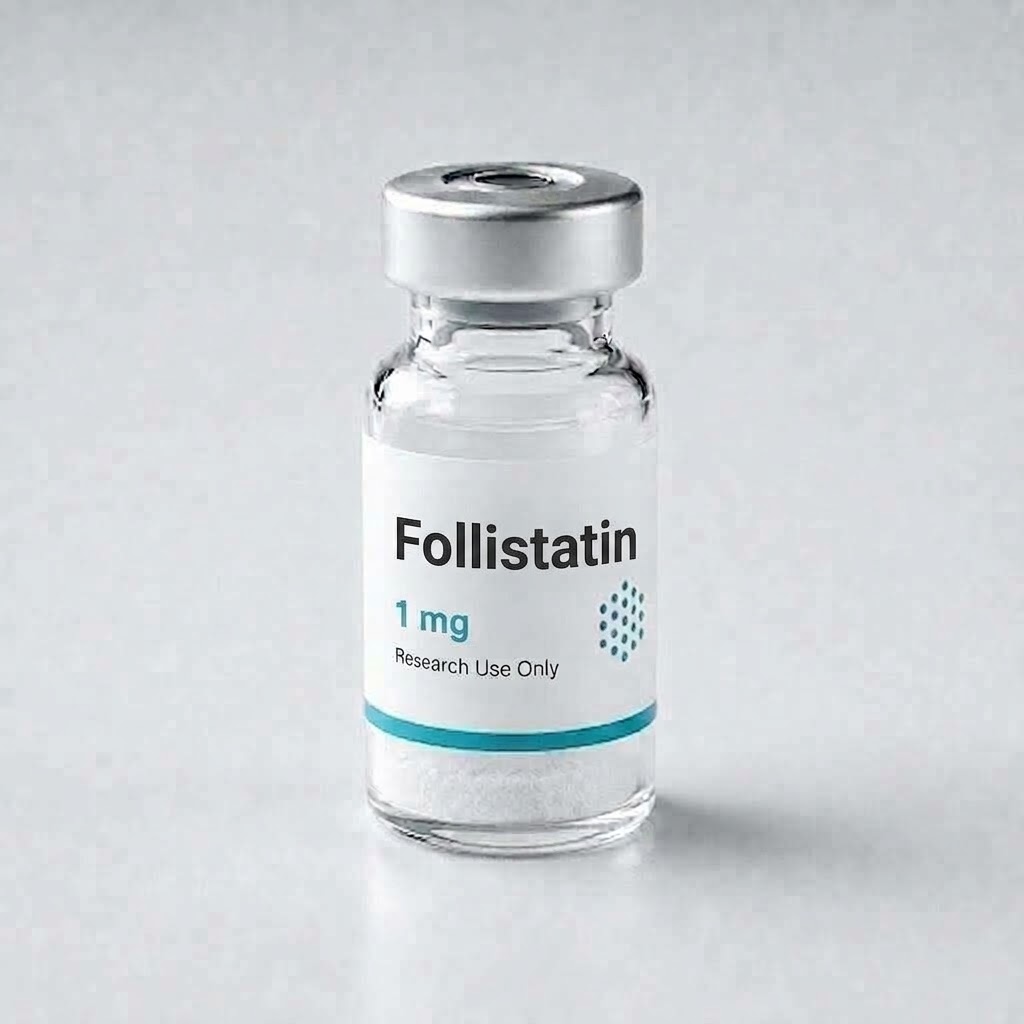
Research vial labeled Follistatin
Binds the hormone · Natural · Untested by injection

Follistatin

A glycoprotein your body makes that binds myostatin and holds it out of action. Myostatin is the brake on muscle growth, so removing it should let muscle grow. In plain terms: a natural molecule that grabs the brake and holds it.

TypeGlycoprotein, made in your body
TargetMyostatin and activins directly
Human evidenceGene therapy, two small trials
Injected form testedNo
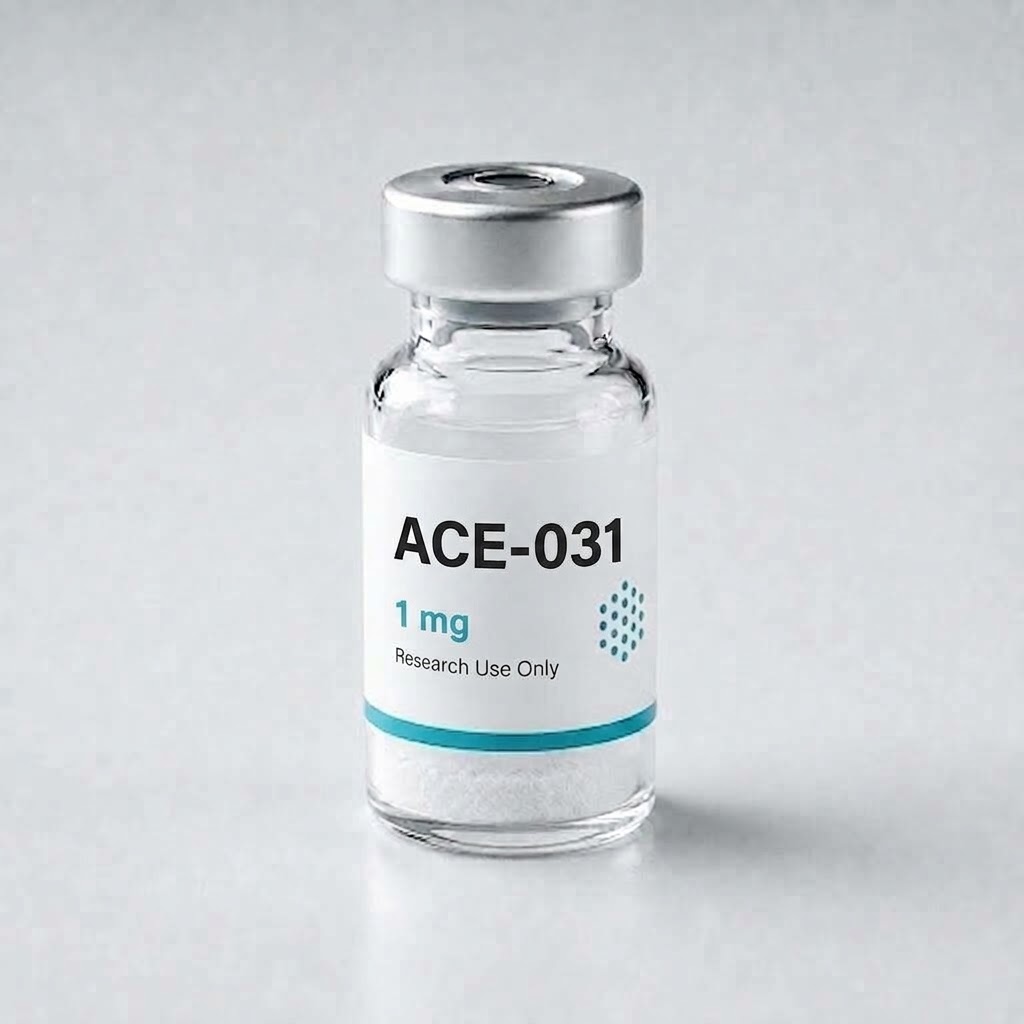
Research vial labeled ACE-031
Blocks the receptor · Engineered · Discontinued

ACE-031

A laboratory-built fusion of part of a receptor stuck to an antibody fragment. It floats in the blood and soaks up anything that would have docked at that receptor. In plain terms: a decoy that catches myostatin before it reaches the muscle, and catches other things too.

TypeActRIIB-Fc fusion protein
TargetEverything that uses the ActRIIB receptor
Human evidencePhase 1 and Phase 2
StatusDiscontinued in 2013

One catches the hormone itself, and the other blocks the door it arrives through, which other hormones also use.

Section 02

Why was ACE-031 stopped?

ACE-031 blocks the ActRIIB receptor, and BMP9 and BMP10 use that same receptor to keep blood vessels stable. Trial participants developed nosebleeds, bleeding gums and dilated skin vessels, and the trials were halted in 2011.

Muscle growth is held back by a hormone called myostatin. Remove it and muscle grows, as cattle, dogs, mice and a small number of people with natural myostatin mutations all demonstrate. Every compound in this category is trying to remove it.

There are two ways to do that, and they are not equivalent.

Follistatin works on the hormone. It binds myostatin directly and holds it inactive. Whatever else uses the same receptor is untouched, because follistatin never goes near it. It also binds activins, a related family, so it is not perfectly selective either.

ACE-031 works one level down, on the receptor. It is a soluble copy of the ActRIIB receptor fused to an antibody fragment, floating in the bloodstream and catching anything headed for that receptor. [1]

The problem is what else uses that door. ActRIIB is not myostatin's private entrance. BMP9 and BMP10 use it too, and those proteins keep blood vessels stable. Block the receptor and you block them alongside myostatin. [1][5]

That is what happened in the trials. Participants developed nosebleeds, bleeding gums, and small dilated blood vessels visible in the skin. [3][4]

The pattern was also recognisable. Those symptoms match hereditary haemorrhagic telangiectasia, a genetic bleeding disorder. Loss-of-function mutations in BMP9 were subsequently confirmed as a cause of that disorder in humans. [5]

So the side effect was not bad luck. The drug reproduced a known genetic disease by blocking the same signalling the disease disrupts.

  • Same goal, different level. Both aim at myostatin. One works on the hormone, the other on its receptor.
  • The receptor is shared. Myostatin, BMP9 and BMP10 all use ActRIIB.
  • Follistatin is not perfectly selective either. It also binds activins, and nobody has established what that does in a person.

ONE SHARED RECEPTORActRIIBTHREE APPROACHING SIGNALS
01 / Follistatin
MyostatinCaptured by follistatin
BMP9Reaches receptor →
BMP10Reaches receptor →

It also binds activins. A narrower mechanism is not proof of safety.

02 / ACE-031
MyostatinCaptured by decoy
BMP9Captured by decoy
BMP10Captured by decoy

Three signals caught before reaching the cell: the off-target problem.

Catching the hormone, or blocking the door everything uses.
Section 03

How do they compare, side by side?

Detailed comparison of Follistatin and ACE-031
AttributeFollistatinACE-031
Also called

FS-344, follistatin-344

Ramatercept, ActRIIB-Fc

Molecular type

Glycoprotein

Fusion protein, receptor extracellular domain plus IgG1 Fc

Made how

Recombinant, or delivered by gene therapy

Recombinant, in mammalian cell culture

Mechanism

Binds myostatin and activins

Decoy for the ActRIIB receptor

Off-target reach

Activins

BMP9 and BMP10 [1][5]

Half-life

Not established for the injected protein [6]

About 10 to 14 days [2]

Human trials

Gene therapy studies, including six-patient cohorts [6]

Phase 1 in 48 adults, Phase 2 in boys with Duchenne [2][3]

Muscle effect in humans

Modest functional signal, open label [6]

Lean mass up a measurable lean-mass increase [2]

Why development stopped

Never started as an injectable drug

Terminated over vascular bleeding events [3][4]

Approved

No

No, discontinued 2013 [4]

What vendors sell

Recombinant protein or peptide fragments

Identity varies: tested black-market products were not the trial molecule [7]

Section 04

What does the evidence actually show?

ACE-031's Phase 1 produced a measurable lean-mass increase in 48 women. Its Phase 2 in boys with Duchenne was terminated in 2011 and the programme abandoned in 2013. The 2015 Becker study delivered the gene by viral vector to six patients.

1990s onward
Myostatin

Myostatin is identified as the brake on muscle growth. Cattle and dogs with natural mutations in the gene are visibly more muscular, and the same has been documented in a small number of people. The category begins here.

2000s
ACE-031

Acceleron Pharma develops ACE-031, a soluble ActRIIB receptor fused to an antibody fragment, designed to trap myostatin before it reaches muscle. Shire partners on development. [4]

2009 to 2010
ACE-031

Phase 1 in 48 healthy postmenopausal women. Dose-dependent increases in lean body mass, up to a measurable lean-mass increase at the highest dose, with fat mass falling in the top dose group and bone formation markers rising. [2]

That result is the reason everything after it happened, because it showed the mechanism working in people.

2010 to 2011
ACE-031

Phase 2 in ambulatory boys with Duchenne muscular dystrophy, with an open-label extension. [3]

February to April 2011
ACE-031

Both trials are stopped. Participants develop nosebleeds, bleeding gums and telangiectasias, small dilated blood vessels visible at the skin. The independent data monitoring committee cannot rule out worsening with continued exposure. The extension study is recorded on ClinicalTrials.gov as terminated based on preliminary safety data. [3]

The events resolved when dosing stopped. [4]

2013
A genetic explanation arrives

Loss-of-function mutations in BMP9 are confirmed as a cause of a human vascular anomaly and bleeding syndrome. [5] ACE-031 blocks BMP9 through the shared receptor, which explains the bleeding pattern directly.

2 May 2013
ACE-031

Acceleron and Shire announce they have concluded their collaboration and will not restart the programme. Additional non-clinical and toxicology work had been done in the interim, and the companies stated the findings did not support further development. [4]

2015
Follistatin

Mendell and colleagues publish a human follistatin gene-therapy study. Six patients with Becker muscular dystrophy, treated by AAV gene therapy, delivering the follistatin gene instead of injecting the protein. Open label, with a modest functional signal. [6]

2024
The sequel

Acceleron's successor molecule, engineered to avoid the off-target binding that stopped ACE-031, is approved as sotatercept, marketed as Winrevair, for pulmonary arterial hypertension. [8]

The lesson from the failure produced an approved drug. It was not the muscle indication.

2024 to 2026
The lesson applied

Apitegromab, approved in September 2026 for spinal muscular atrophy, is an antibody that binds the inactive precursor of myostatin rather than the receptor or the active hormone, meets its primary endpoint in a Phase 3 trial in spinal muscular atrophy. 188 patients, with a 1.8 point difference on the motor function scale against placebo at 52 weeks. The vascular effects that stopped ACE-031 were not reported. [10]

By targeting the precursor, it leaves activin A, BMP9, BMP10 and TGF-beta alone. That is the specific engineering answer to the specific problem. [10]

Today

ACE-031 is discontinued and sold online as a research chemical. Follistatin protein has no human injection trial located and is sold the same way.

ACE-031 was stopped for blocking more than its intended target, not because it failed to build muscle.

Phase 1 showed a 3.3% lean-mass increase at the highest dose, with fat falling and bone markers rising. [2] By the standards of this category that is a real result in humans, and almost nothing else on this site can match it.

Then boys in the Phase 2 started getting nosebleeds. Not a vague safety signal: nosebleeds, bleeding gums, and spider veins in the skin, in a pattern that matched a known genetic bleeding disorder. [3][4] Two years of extra toxicology followed, and the sponsors concluded the findings did not support going on. [4]

All of which the mechanism accounts for. ACE-031 blocks a receptor, and myostatin is not the only thing that uses it. BMP9 and BMP10 come through the same door, and they keep blood vessels stable. [1][5]

The sequel is the part nobody tells. Acceleron went back and built a more selective molecule that avoided the off-target binding, and it is approved as Winrevair for a lung condition. [8]

Somebody else solved it for muscle. Apitegromab binds the inactive precursor of myostatin, sparing BMP9, BMP10 and activin A entirely. It met its Phase 3 endpoint in spinal muscular atrophy with no vascular effects of the sort that stopped ACE-031 reported. [10]

So the honest reading of ACE-031 is not that myostatin inhibition failed. Blocking a shared receptor was the wrong way in, and the field found a better one.

3.3%

higher mean total-body lean mass at day 29 in the highest-dose group, the result that made it promising [2]

2 years

between the trials being halted and the programme being formally abandoned [4]

0

human trials of injected follistatin protein [6]

Section 05

How does each one work?

Follistatin binds myostatin itself, leaving the receptor free. ACE-031 is a soluble copy of the ActRIIB receptor that circulates for 10 to 14 days and catches myostatin, activins, BMP9 and BMP10 alike.

The target. Myostatin, also called GDF-8, limits how much muscle you build. It is a negative regulator, and animals and people lacking it are more muscular. Blocking it should allow more growth, and that logic is sound and well supported in animals.

Follistatin's approach. It is a natural glycoprotein that wraps around myostatin and holds it inactive before it reaches any receptor. Because it acts on the ligand instead of the receptor, it leaves the receptor free for everything else.

It also binds activins, a related family involved in reproduction, inflammation and other processes. So it is selective relative to ACE-031, and not selective in absolute terms, and nobody has measured what activin suppression does in a person over time.

ACE-031 sits one level down. It is the outer portion of the ActRIIB receptor fused to an antibody fragment, and the antibody part keeps it circulating for ten to fourteen days. [2] It works as a decoy, catching myostatin in the bloodstream before it can dock at a real receptor on muscle.

Why the decoy approach catches too much. A receptor is a door, and several proteins use it. ActRIIB accepts myostatin, activins, and BMP9 and BMP10. [1] BMP9 in particular maintains the stability of blood vessel walls, so blocking it produces bleeding. [5]

A decoy cannot tell which protein it is catching. That is the structural problem with the approach, and the reason the successor molecule was engineered to be choosier about what it binds. [8]

One consequence for anyone comparing the two. Follistatin's narrower reach is a genuine mechanistic argument in its favour. It is an argument, not evidence, because nobody has injected the protein into a person in a trial. [6]

Field note

Do myostatin inhibitors work?

Apitegromab binds the inactive precursor of myostatin, sparing BMP9, BMP10 and activin A, and met its Phase 3 endpoint in spinal muscular atrophy with no vascular effects of the sort that stopped ACE-031 reported. Bimagrumab blocks the receptor like ACE-031 and reports adverse events in 41 to 64 percent of patients.

Reading this page as "myostatin inhibition does not work" would be the wrong conclusion. The mechanism works. The problem was selectivity, and the field solved it by aiming at more precise targets.

Four approaches, arranged by how precisely each aims.

Approach What it binds Off-target reach Where it got to
ACE-031 The receptor Myostatin, activins, BMP9, BMP10 Halted 2011, discontinued 2013 [4]
Bimagrumab The receptor Same family Phase 2 in obesity, adverse events in 41 to 64 percent of patients [11]
Follistatin Active myostatin and activins Activins Never tested by injection [6]
Apitegromab Latent and pro-myostatin only Spares activin A, BMP9, BMP10, TGF-beta Phase 3 success; FDA approved 2026 [10]

The contrast matters, but it is not a head-to-head trial. The two compounds targeting activin type II receptors have broader effects and reported tolerability concerns. The compound that binds the inactive precursor catches only myostatin, and it is the one that reached approval for spinal muscular atrophy.

Apitegromab's result is worth stating properly. SAPPHIRE enrolled 188 patients with spinal muscular atrophy, aged 2 to 21, all already on an approved treatment. At 52 weeks the 10 mg/kg group improved by 1.8 points on the Hammersmith motor function scale against placebo, and 34.2 percent achieved a three point or greater improvement against 13.5 percent on placebo. [10]

After a 2025 Complete Response Letter related to a third-party fill-finish facility, the FDA approved it as Isembyld on September 11, 2026. [10]

Bimagrumab makes the counterpoint. It targets the activin type II receptors, the same broad approach as ACE-031, and its obesity results are striking: combined with semaglutide it produced 17.8 kilograms of weight loss at 48 weeks against 14.2 on semaglutide alone, with far less lean mass lost. [11]

Its adverse event rate across trials runs between 41 and 64 percent. Blocking the receptor still costs something.

What that means for the two compounds on this page. ACE-031 is the cautionary version of an approach that has since been superseded. Follistatin sits on the correct side of the selectivity question, binding the hormone rather than the receptor, and it has still never been injected into a person in a trial. Being on the right side of an argument is not the same as having evidence.


Field note

What are the key differences?

ACE-031 has Phase 1 and Phase 2 data and a documented reason it was stopped. Follistatin has small gene therapy studies and has never been injected in a trial. Both are prohibited in sport under section S4.3.

Shared: both target myostatin · both are proteins rather than small peptides · neither Follistatin nor ACE-031 is approved anywhere · both are sold as research chemicals · neither has been tested by injection for muscle building in healthy people

Follistatin

Level of action The hormone
Off-target reach Activins
Human evidence Gene therapy, six patients
Injected form tested No
Muscle effect in humans Unestablished
Known safety signal None, because none has been looked for
Why it is not a drug Never developed as an injectable
Sold as Recombinant protein and fragments

ACE-031

Level of action The receptor
Off-target reach BMP9 and BMP10
Human evidence Phase 1 and Phase 2
Injected form tested Yes
Muscle effect in humans Demonstrated, 3.3% mean lean-mass increase at the highest dose
Known safety signal Nosebleeds, gum bleeding, telangiectasia
Why it is not a drug Discontinued after those events
Sold as Products of uncertain identity; tested samples differed from the trial molecule

Summary compiled from published trials, trial registry records and company announcements.

Section 06

What has nobody answered?

No human trial of injected follistatin protein was located. Nobody has established what products sold as ACE-031 contain, and a published analysis found 14 black-market samples did not contain a confirmed ActRIIB-Fc fusion. And neither has been tested in healthy people for muscle building.

No human trial of injected follistatin protein was located.

The 2015 Becker study delivered the gene by viral vector, a different intervention with different pharmacology. [6] Every claim made for injected follistatin is extrapolation from animals and from small gene therapy studies, not injected-protein trials.

Nobody knows whether follistatin's narrower reach avoids the problem.

The mechanistic argument is reasonable: bind the hormone and you leave BMP9 alone. It has not been tested, and activin suppression carries its own unexamined questions.

Analytical testing has found that black-market ACE-031 products can differ from the trial molecule.

ACE-031 as tested is a large fusion protein produced in mammalian cell culture. An analysis of 14 black-market products found none confirmed as the ActRIIB-Fc fusion tested in trials. [7]

Neither compound has been tested for muscle building in healthy adults.

ACE-031's Phase 1 was in postmenopausal women and its Phase 2 in boys with muscular dystrophy. [2][3] Neither population is the one buying it.


Section 07

What are the side effects, and what are you buying?

ACE-031 caused nosebleeds, gum bleeding and telangiectasias, all resolving on discontinuation, traced to blocking BMP9 alongside myostatin. Injected follistatin protein has no human safety data located; gene-delivery studies are a different route.

Evidence register3 fields · 12 entriesCompiled from trial records, published analyses and US market conditions
01Documented

Why ACE-031 was stopped

These are the events that terminated a trial in children, not theoretical concerns.

  • Epistaxis, meaning nosebleeds, in several treated subjects [3][4]

    Documented
  • Telangiectasias, small dilated blood vessels visible in the skin [3][4]

    Documented
  • Gum bleeding on minor brushing [4]

    Documented
  • All resolved on discontinuation, and the monitoring committee could not rule out worsening with continued exposure [3][4]

    Documented
02Mechanism

Why those events happened

This is understood, which is unusual for a halted programme.

  • ActRIIB is shared by myostatin, activins, BMP9 and BMP10 [1]

    Mechanism
  • BMP9 maintains blood vessel wall stability [5]

    Mechanism
  • Loss-of-function BMP9 mutations cause a human bleeding and vascular disorder [5]

    Mechanism
  • Increased bleeding risk would plausibly compound with anticoagulants, antiplatelets or NSAIDs

    Mechanism
03Unstudied

Follistatin, and both for their sold purpose

Nobody has run these studies. That is different from a clean result.

  • Injected follistatin protein in a human being, for anything [6]

    Unstudied
  • Whether binding the hormone avoids the vascular problem

    Unstudied
  • Either compound for muscle building in healthy adults

    Unstudied
  • What the products sold under these names actually contain [7]

    Unstudied

The ACE-031 safety picture is unusually well characterised for a discontinued compound, and that is worth valuing rather than dismissing. The events were specific, they were reproduced across trials, the mechanism explaining them was confirmed by independent genetic work, and the sponsor ran two more years of toxicology before giving up. [3][4][5]

Follistatin has none of that, in either direction. Its safety record is not clean. It is absent.

Where this page says nothing is established, that means nobody has studied it, not that a compound is safe.


Section 08

Are they banned in sport?

Section S4.3 of the 2026 Prohibited List names myostatin inhibitors, activin receptor IIB antagonists and myostatin-binding proteins. Both compounds are covered and both are prohibited at all times.

Section S4.3 of the 2026 Prohibited List covers agents preventing activin receptor IIB activation, and names myostatin inhibitors explicitly, including myostatin-binding proteins and agents reducing or ablating myostatin expression. [9]

Both compounds on this page are covered. ACE-031 is an activin receptor IIB antagonist by design, and follistatin is a myostatin-binding protein.

Both are prohibited at all times, in and out of competition.

Myostatin inhibitors have been a named anti-doping target since before either compound reached the market, because the muscle effect is exactly what the rules exist to prevent.


Section 09

Are they FDA approved?

Neither Follistatin nor ACE-031 is approved anywhere. Acceleron and Shire formally discontinued ACE-031 on 2 May 2013 after two further years of toxicology work. Follistatin has never been submitted for approval as an injectable drug.

ACE-031 is not approved anywhere and its development was formally discontinued. Acceleron Pharma and Shire halted the trials in early 2011 and announced on 2 May 2013 that they had concluded their collaboration and would not restart the programme. The molecule was subsequently renamed ramatercept and shelved. [4]

That matters more than an ordinary absence of approval. A sponsor with the data, the resources and a working mechanism looked at the safety findings and chose to stop.

Follistatin has never been submitted for approval as an injectable drug. Its human work includes gene therapy studies under a research protocol. [6] There is no approved product and no application pending.

Compounding is not FDA approval. This page does not establish a blanket legal status for every pharmacy route; no FDA-approved injectable follistatin or ACE-031 product exists.

One point is specific to ACE-031. The tested molecule is a large fusion protein, the extracellular domain of a receptor joined to an antibody fragment, produced in mammalian cell culture. A published analysis of 14 black-market products found none confirmed as the same Fc fusion used in the trials. [7] Do not assume a vendor label identifies what is inside a vial.

The successor is approved. Sotatercept, marketed as Winrevair, came out of the same programme after re-engineering to avoid the off-target binding. It is approved for pulmonary arterial hypertension, not for muscle. [8]


Section 10

Common questions

Why was ACE-031 stopped?

Because trial participants developed nosebleeds, bleeding gums and telangiectasias, small dilated blood vessels in the skin. The trials were halted in early 2011 and the programme was formally discontinued in May 2013 after two further years of toxicology work.[3][4] It was not stopped for lack of effect.

Did ACE-031 actually build muscle?

Yes. A Phase 1 trial in 48 healthy postmenopausal women found a 3.3% increase in mean total-body lean mass and a 5.1% increase in thigh muscle volume at day 29 in the highest-dose group compared with placebo.[2] The muscle effect is one of the better-documented results in this category.

Is follistatin safer than ACE-031?

Nobody knows, and the mechanistic argument favours it. Follistatin binds myostatin directly and leaves the ActRIIB receptor free, so it should not block BMP9. That is what caused ACE-031's bleeding.[1][5] Nobody has injected follistatin protein into a person in a trial, so no safety data exists to check that against.[6]

Has follistatin been tested in humans?

Once, and not as an injection. Mendell and colleagues delivered the follistatin gene by viral vector to six patients with Becker muscular dystrophy in an open-label study.[6] Gene therapy and injecting a protein are different interventions, and the injected form has no human data.

What are the side effects of myostatin inhibitors?

The documented human side effects come from ACE-031: nosebleeds, gum bleeding and telangiectasias, traced to blocking BMP9 alongside myostatin.[3][5] Those are specific to blocking the receptor. Whether binding the hormone instead avoids them has not been tested.

Is ACE-031 sold online the real thing?

Do not assume so. A published analysis of 14 black-market products found 12 contained full-length activin receptor IIB instead of the tested Fc fusion; two did not show the expected receptor signal.[7] In one published analysis, none of the 14 products tested was confirmed to contain the trial molecule.

Did myostatin inhibition fail?

No. ACE-031 failed, and the approach that replaced it worked. Apitegromab binds the inactive precursor of myostatin instead of the receptor, which leaves BMP9, BMP10 and activin A untouched, and it met its Phase 3 endpoint in spinal muscular atrophy.[10] Blocking the shared receptor was the problem, not blocking myostatin.

What is the best myostatin inhibitor?

Apitegromab has by far the strongest evidence, with a positive Phase 3 in spinal muscular atrophy and FDA approval for that condition in 2026.[10] It is an intravenous antibody given in a clinic, not something sold as a research chemical. Bimagrumab has striking obesity results alongside semaglutide and adverse events in 41 to 64 percent of patients.[11] Neither is follistatin or ACE-031.

Does follistatin actually work for muscle growth?

Not established in humans. The animal data is robust and a human study delivered the gene by viral vector to six patients, a different intervention from injecting the protein.[6] No human pharmacokinetic or efficacy data exists for injected follistatin.

What is follistatin-344?

It is the 344 amino acid isoform of follistatin, and the one most commonly sold. A human gene therapy study used FS-344 as the delivered gene, not as an injected protein.[6] The isoform names describe length, and none of the isoforms has been tested as an injection in a person.

Are they banned in sport?

Yes, both. Section S4.3 of the 2026 Prohibited List names myostatin inhibitors, including activin receptor IIB antagonists and myostatin-binding proteins, prohibited at all times.[9]

What happened to the company that made ACE-031?

It re-engineered the molecule to stop it binding BMP9 and BMP10, and that successor is approved as Winrevair for pulmonary arterial hypertension.[8] The failure produced an approved drug, in a different disease.

The published record

What Europe PMC and ClinicalTrials.gov hold for each, on the same rule.

Follistatin has 515 records to ACE-031's 17. 169 original human studies against 10. Follistatin has 15 registered trials to ACE-031's 4.

Follistatin: WADA: Prohibited at all times, in and out of competition. S4.3 Myostatin-binding proteins (e.g. follistatin, myostatin propeptide). Non-Specified.

ACE-031: WADA: Prohibited at all times, in and out of competition. S4.3 Agents preventing activin receptor IIB activation: decoy activin receptors (e.g. ACE-031). Non-Specified.

The published recordFollistatin

Research index

3,230

Papers and trials about Follistatin

257 papers tagged human · 169 not reviews or lab · 16 clinical trial publications

15 registered trials · 1 with posted results

Compare this against the whole library →

Prohibited at all times, in and out of competition. S4.3 Myostatin-binding proteins (e.g. follistatin, myostatin propeptide). Non-Specified.Regulators
In animals245
In the lab40
Reviews67
Senior author shareSpread across many groups

Evidence summary

Counted from Europe PMC indexing, not read by a person; a human tag can land on reviews, commentary or lab papers; clinical trial publications is the narrower count. 500 papers and 15 trials indexed in detail.

The published recordACE-031

Research index

17

Papers and trials about ACE-031

14 papers tagged human · 10 not reviews or lab · 2 clinical trial publications

4 registered trials · 1 with posted results

Compare this against the whole library →

Prohibited at all times, in and out of competition. S4.3 Agents preventing activin receptor IIB activation: decoy activin receptors (e.g. ACE-031). Non-Specified.Regulators
In animals8
In the lab0
Reviews0
Senior author shareSpread across many groups

Evidence summary

Counted from Europe PMC indexing, not read by a person; a human tag can land on reviews, commentary or lab papers; clinical trial publications is the narrower count.

Field note

References

  1. 01

    ActRIIB ligand-trap receptor biology and BMP9/10 binding. See ACE-031 clinical trial and BMP9 vascular genetics.

  2. 02

    Attie KM et al. A single ascending-dose study of muscle regulator ACE-031 in healthy volunteers. Muscle Nerve. 2013. PMID 23169607. At day 29 the highest-dose group had 3.3% higher mean total-body lean mass and 5.1% higher thigh muscle volume, both P=0.03; 48 participants.

  3. 03

    Campbell C et al. Myostatin inhibitor ACE-031 treatment of ambulatory boys with Duchenne muscular dystrophy. Muscle Nerve. 2017;55:458–464. PMID 27462804. NCT01099761; extension NCT01239758.

  4. 04

    Acceleron and Shire ended their ACE-031 collaboration May 2, 2013. ClinicalTrials.gov programme record.

  5. 05

    Wooderchak-Donahue WL et al. BMP9 mutations cause a vascular-anomaly syndrome with phenotypic overlap with hereditary hemorrhagic telangiectasia. Am J Hum Genet. 2013;93:530–537. PubMed search.

  6. 06

    Mendell JR et al. A phase 1/2a follistatin gene therapy trial for Becker muscular dystrophy. Molecular Therapy. 2015;23(1). Six participants received AAV1.CMV.FS344 gene delivery by intramuscular injection, not follistatin protein. PMID 25322757. A second six-person AAV study in inclusion body myositis was published in 2017: PMID 28279643.

  7. 07

    Gel Electrophoretic Detection of Black Market ACE-031. Drug Testing and Analysis. 2025. PMID 40312924. In 14 tested products, 12 contained full-length activin receptor IIB instead of the studied Fc fusion; the other two lacked the expected receptor signal. This does not establish the contents of every vendor's product.

  8. 08

    FDA. WINREVAIR (sotatercept-csrk) approval label. Approved for pulmonary arterial hypertension in 2024, not muscle growth.

  9. 09

    World Anti-Doping Agency. 2026 Prohibited List, section S4.3 (agents preventing activin receptor IIB activation / myostatin inhibitors). Check the latest list for future updates.

  10. 10

    SAPPHIRE, NCT05156320. The FDA approved apitegromab-mstn (Isembyld) for spinal muscular atrophy on September 11, 2026. Muscular Dystrophy Association announcement.

  11. 11

    Bimagrumab obesity studies and combined semaglutide treatment. ClinicalTrials.gov search. Cross-study adverse-event percentages are not interchangeable with ACE-031 trial rates.