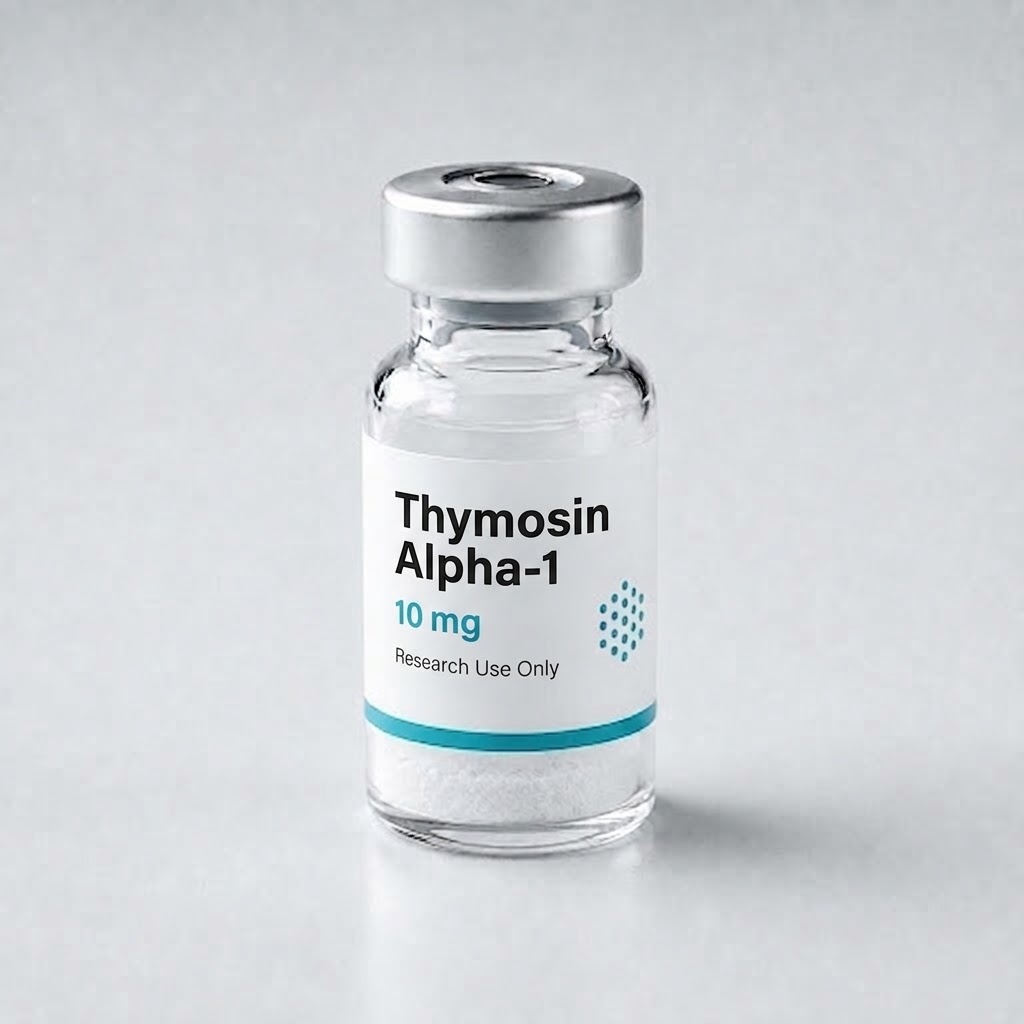
28 aa · Approved abroad
Thymosin Alpha-1
A fragment of a protein called prothymosin alpha. It acts on the cells that organise your immune response. Sold as Zadaxin in more than 35 countries and never approved in the United States.

Thymosin alpha-1 and thymosin beta-4 are structurally unrelated. They share a name because both were pulled from the same thymus extract in the 1960s, and nothing else. TB-500 is seven amino acids copied out of beta-4's forty-three. Beta-4 and TB-500 are both named on the anti-doping list and alpha-1 is not. No completed trial has tested either for tendon, muscle or ligament injury, which is what they are sold for.
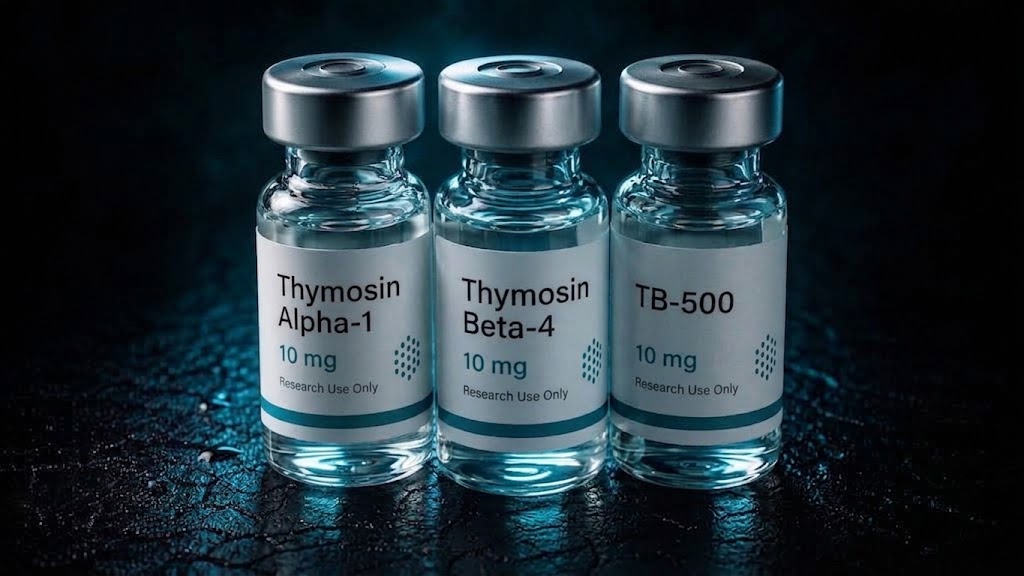
Alpha-1 and beta-4 share a name by accident and nothing else. TB-500 is seven amino acids copied out of beta-4. Only one of the three is approved anywhere, and not in the United States.
| Attribute | Thymosin Alpha-1 | Thymosin Beta-4 | TB-500 |
|---|---|---|---|
| Length | 28 amino acids | 43 amino acids | 7 amino acids [3] |
| Related to the others | No [1] | Parent of TB-500 | 7 residues of beta-4 [3] |
| What it does | Immune signalling | Binds actin, tissue repair | Presumed to do what beta-4 does |
| Approved | 35 countries, not the US [2] | Nowhere [4] | Nowhere |
| Human trials | More than 11,000 subjects [2] | Eye drops and topical gel [4][5] | None [3] |
| Tested by injection | Yes [2] | Phase 1 and a Phase 2b, neither for the uses it is sold for [6] | No [3] |
| On the 2026 WADA list | Not named [7] | Named [7] | Named [7] |
Scroll the table sideways to see all three
The alpha and beta thymosins are different proteins. See section 02.
A fragment of a protein called prothymosin alpha. It acts on the cells that organise your immune response. Sold as Zadaxin in more than 35 countries and never approved in the United States.
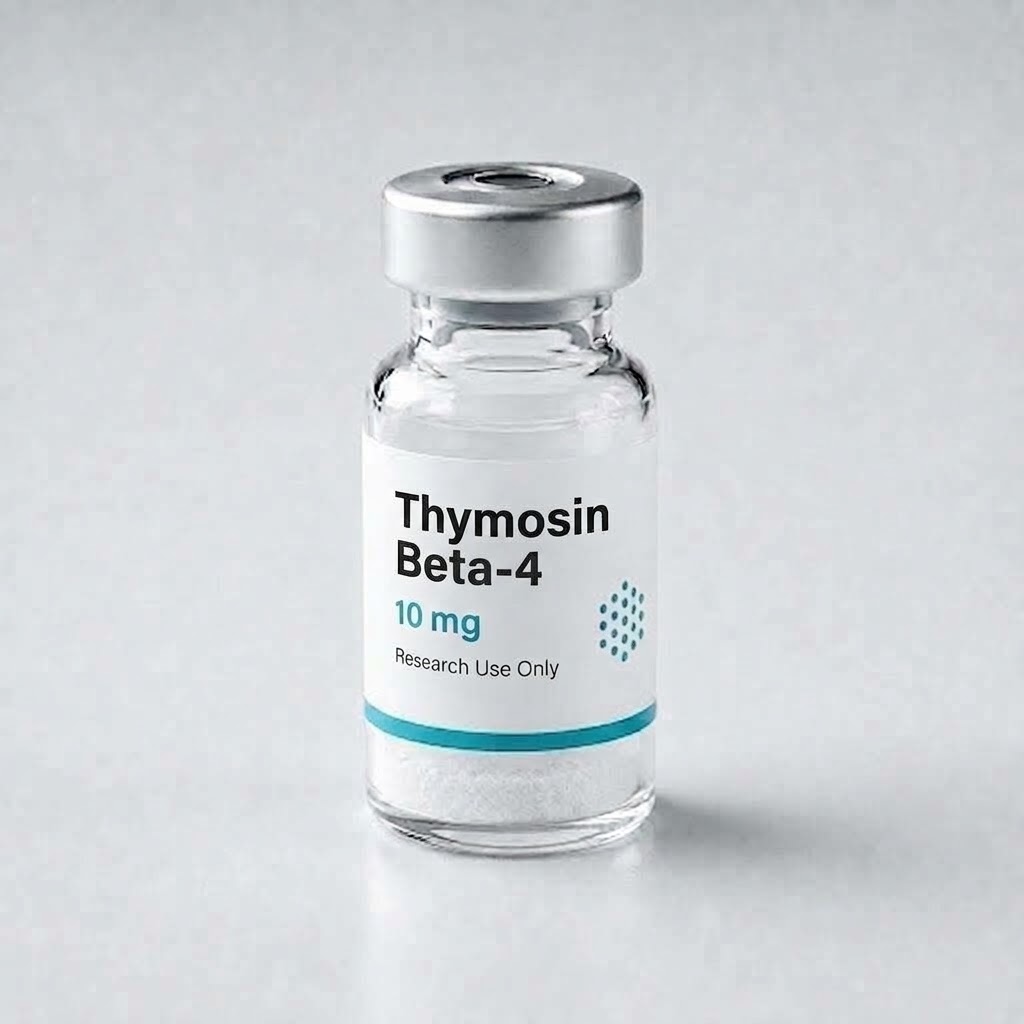
A completely different protein that binds actin, the structural filament inside cells, and is involved in cell movement and tissue repair. Tested in humans as eye drops and as a skin gel.
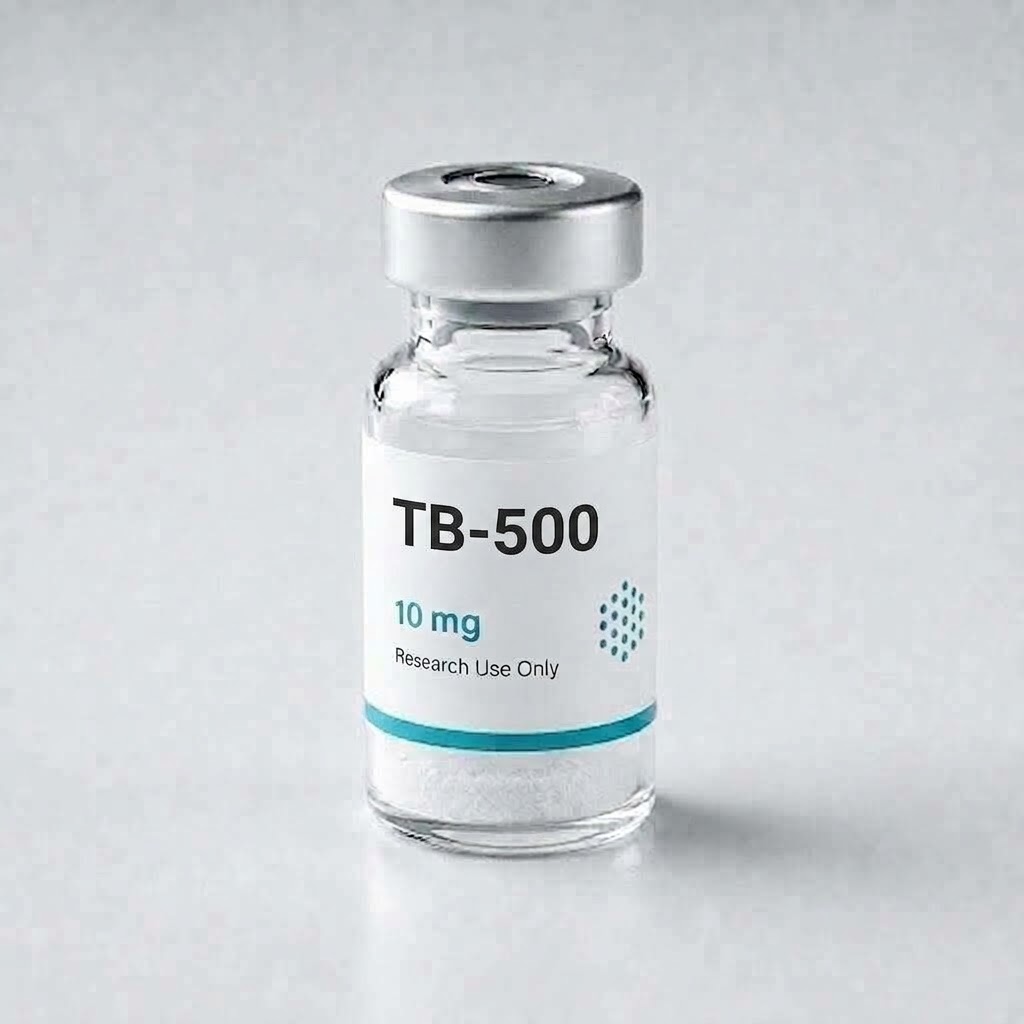
Seven amino acids copied from positions 17 to 23 of thymosin beta-4. Sold as an injectable for tendon and muscle repair, and never tested in a person.
In the 1960s researchers extracted a mixture of proteins from the thymus, a gland in the chest involved in immune development, and called the mixture thymosin. When they separated it, they labelled the fractions by how the proteins behaved in the lab: alpha for one group, beta for another.
Those labels described where the proteins came from and how they were sorted, not what they are. Thymosin alpha-1 and thymosin beta-4 turned out to be unrelated molecules doing unrelated jobs. The shared name is a historical accident that has outlived its usefulness. [1]
Thymosin alpha-1 is a 28 amino acid piece of a protein called prothymosin alpha. Its job is signalling: it activates the cells that present threats to the rest of the immune system.
Thymosin beta-4 is a 43 amino acid protein that binds actin, the filament that gives cells their shape and lets them move. It is involved in wound healing and tissue repair, and it turns up in almost every tissue in the body, not just the thymus.
TB-500 is not a thymosin at all in the way the other two are. It is a seven amino acid sequence copied out of beta-4, acetylated at one end. [3]
A correction belongs here before anything else. TB-500 is widely described as a 17 amino acid fragment. It is seven, taken from positions 17 to 23 of the parent protein. [3] The number 17 is the starting position, not the length, and the two got confused somewhere and then copied endlessly.
The left branch and the right branch share a name and nothing else.
The tree makes one thing obvious. Alpha-1 and beta-4 sit on separate branches with no connection beyond the extract they were found in. TB-500 sits underneath beta-4 as a fragment of it, seven residues out of forty-three.
The fragment is where the evidence problem starts. Every human trial of thymosin beta-4 used the whole 43 amino acid protein. [4][5] None used TB-500. So the trial data people cite for TB-500 belongs to a molecule six times its size.
That pattern appears elsewhere in this library, and it is unusually clean here because the fragment and the parent have different names and are sold separately.
Thymosin alpha-1 has the largest evidence base of any compound on this site. More than 11,000 subjects across over 30 clinical trials, with post-marketing surveillance covering more than 600,000 treated patients. [2]
Its strongest result is in chronic hepatitis B, where 40.6 percent of treated patients achieved a complete virological response against 9.4 percent of untreated controls. That is what an approval in 35 countries was built on. [2]
Its largest trial found nothing. TESTS, published in the BMJ in 2025, randomised 1,106 patients with sepsis and found no reduction in 28-day mortality. An earlier 361-patient trial had found a nine point mortality difference sitting on the boundary of significance, which is what justified the bigger study. [2]
Thymosin beta-4 has been tested as eye drops and as a skin gel. As RGN-259, a 0.1 percent ophthalmic solution, it went through Phase 2 and Phase 3 trials in dry eye and in neurotrophic keratopathy, a rare corneal disease.
The Phase 2 results in severe dry eye were positive: 35.1 percent reduction in ocular discomfort and 59.1 percent reduction in corneal staining against vehicle control, in nine patients. [5]
Both Phase 3 trials missed their primary endpoints. In neurotrophic keratopathy, complete healing occurred in 6 of 10 treated patients against 1 of 8 on placebo at four weeks, at p equals 0.0656. Healing reached significance later, at day 43, and ocular comfort improved. [4] In dry eye, ARISE-3 did not meet its pre-specified co-primary endpoints, with improvements appearing only in a specific symptom on sub-analysis. [6]
Injectable thymosin beta-4 has been tested, and not for anything people buy it for. RGN-352, the injectable formulation, completed a double-blind placebo-controlled Phase 1 in 80 healthy volunteers, split between single-dose and fourteen-day arms, with no adverse events attributed to it. [6] A separate Phase 2b of recombinant thymosin beta-4 in acute myocardial infarction has been completed in China. [6]
Its US Phase 2 never started, and the reason is unusual. The planned trial in heart attack patients was placed on an FDA clinical hold over manufacturing problems at an outside contractor, not over safety or efficacy, and the trial was never initiated. The candidate has been described as Phase 2-ready ever since. [6]
What has never been tested is the indication. No completed Phase 2 or Phase 3 trial has examined injectable thymosin beta-4 or TB-500 for tendon, muscle or ligament injury. [6] That is the use the entire research-chemical market is built on.
TB-500 has no human trial of any kind. [3] It is the one of the three that people actually inject.
Thymosin alpha-1 has been tested by injection extensively, and for hepatitis B and sepsis. [2] Thymosin beta-4 has completed ophthalmic trials as eye drops, a Phase 1 by injection in 80 healthy volunteers, and a Phase 2b by injection in heart attack patients in China. [4][5][6]
No completed trial of either has examined tendon, muscle or ligament injury. [6] That is the entire basis of the market for TB-500, and it is the one indication nobody has studied.
TB-500 itself has never been in a published human trial for anything. [3] Its seven residues come out of a 43 amino acid protein, and every result people cite for it belongs to that protein, tested for eyes, skin or heart attacks.
The gap is not that the molecule is untested. The trials simply answer questions nobody buying it is asking.
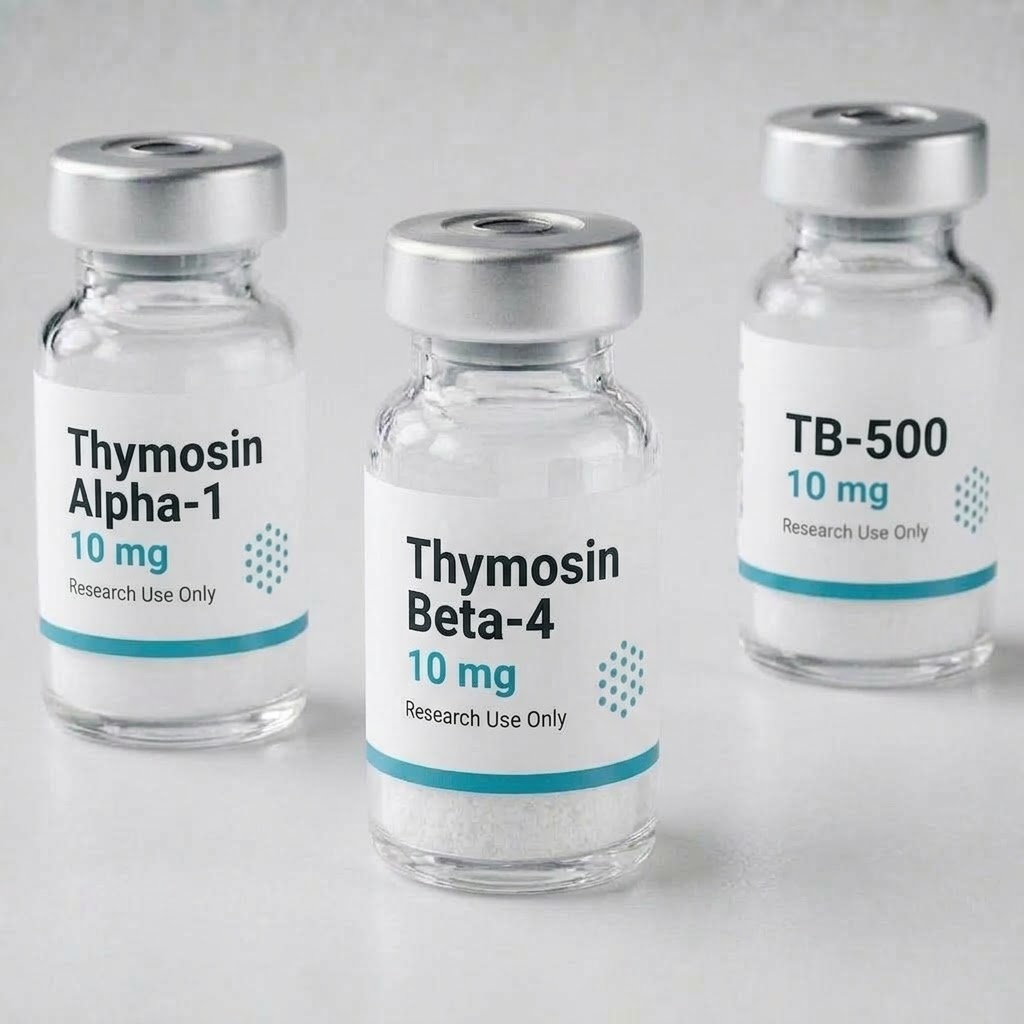
| Attribute | Thymosin Alpha-1 | Thymosin Beta-4 | TB-500 |
|---|---|---|---|
| Also called | Thymalfasin, Zadaxin, Tα1 | Tβ4, timbetasin, RGN-259 as eye drops | Ac-LKKTETQ |
| Length | 28 amino acids | 43 amino acids | 7 amino acids |
| Parent protein | Prothymosin alpha | None, it is the protein | Thymosin beta-4 |
| Mechanism | Activates dendritic cells through toll-like receptor signalling [2] | Sequesters actin, promotes cell migration and repair [4] | Presumed to share beta-4's mechanism, untested |
| Routes tested in humans | Injection [2] | Eye drops, topical gel, and injection [4][5][6] | None [3] |
| Route as sold | Injection | Injection, as research chemical | Injection |
| Best result | 40.6 vs 9.4 percent in hepatitis B [2] | 6 of 10 vs 1 of 8 healed, p equals 0.0656 [4] | None exists |
| Largest trial | 1,106 patients, null [2] | Two ophthalmic Phase 3s, both missed primaries [4][6] | None |
| Approved | 35 countries, not the US [2] | Nowhere, orphan designation held [6] | Nowhere |
| 2026 WADA list | Not named [7] | Named under S2.3 [7] | Named under S2.3 [7] |
Scroll the table sideways to see all three
Researchers extract a protein mixture from the thymus and call it thymosin. Fractions are labelled alpha and beta by laboratory behaviour. The two groups turn out to be unrelated. [1]
Goldstein and colleagues isolate and characterise thymosin alpha-1 from thymus tissue, describing it as a regulator of immunity. [2]
Zadaxin launches and goes on to be approved in more than 35 countries, mostly for chronic hepatitis B and as an immune adjunct in cancer patients. It is never successfully submitted in the United States. [2]
The pivotal hepatitis B trial. 98 patients, complete virological response in 40.6 percent against 9.4 percent in untreated controls. Its strongest result. [2]
Romani and colleagues publish in Blood, showing the peptide activates dendritic cells through toll-like receptor signalling. [2]
Esposito and colleagues characterise products sold as TB-500 and confirm the molecule is Ac-LKKTETQ, seven amino acids corresponding to positions 17 to 23 of thymosin beta-4. Published in Drug Testing and Analysis. [3]
Two Phase 2 ophthalmic trials publish. In severe dry eye, RGN-259 produced 35.1 percent reduction in ocular discomfort and 59.1 percent reduction in corneal staining against vehicle. Nine patients. [5]
ETASS, in severe sepsis. 361 patients, 28-day mortality 26.0 percent against 35.0 on control. Significance on the boundary, at p equals 0.062 unstratified and 0.049 by log rank. [2]
ARISE-3, the Phase 3 in dry eye, does not meet its pre-specified co-primary endpoints. Improvements appear in one symptom on sub-analysis. [6]
SEER-1, the Phase 3 in neurotrophic keratopathy. Complete healing in 6 of 10 treated against 1 of 8 on placebo at four weeks, p equals 0.0656, missing the primary endpoint, with significance reached at day 43 and improvements in comfort. 18 patients of a planned 46. [4]
TESTS, in the BMJ. 1,106 patients with sepsis, double blind, placebo controlled. No reduction in 28-day mortality. The largest trial of the compound ever run. [2]
TB-500 comes off the FDA's Category 2 compounding list in April when nominations are withdrawn, and in July the advisory committee recommends it for the compounding list, 8 votes to 6 with one abstention. A recommendation is not approval, and rulemaking takes many months. [8]
One approved abroad, one in trials by routes nobody uses commercially, and one with nothing.
Thymosin alpha-1 organises. It does not attack anything or repair anything. It acts on dendritic cells, the ones that pick up fragments of a pathogen and present them to the rest of the immune system, pushing the response toward the pattern that handles viruses. [2]
Its logic is restoration instead of stimulation, and that is why it was tested in sepsis, where the immune system often becomes exhausted and stops responding.
Thymosin beta-4 binds actin. Actin is the filament that gives a cell its shape and lets it move. Beta-4 holds free actin in reserve and releases it where it is needed, and that affects how cells migrate into a wound. That is the basis for the repair and healing claims. [4]
It also appears to reduce inflammation and promote new blood vessel growth, and it is present in most tissues, not concentrated in the thymus.
TB-500 is assumed to do what beta-4 does. The seven residue sequence includes the actin-binding region of the parent protein, so the assumption is mechanistically reasonable. [3]
Nobody has tested it. A fragment behaving like its parent is a hypothesis until somebody measures it, and the shorter molecule will have different stability, distribution and clearance regardless.
Why the indication question runs through all of this. Thymosin beta-4's development programme targeted eyes, skin and cardiac injury, where the protein can be applied to the surface that needs it or delivered into circulation for a systemic event. Reaching a specific damaged tendon after an intravenous or subcutaneous dose is a different problem, and no completed trial has tested whether it happens. [6]
Shared: all three come from work on one thymus extract · all three are sold as injectables in the US research chemical market · none is FDA approved · none has been tested by injection for the uses it is sold for
| Attribute | Thymosin Alpha-1 | Thymosin Beta-4 | TB-500 |
|---|---|---|---|
| Family | Alpha thymosins | Beta thymosins | Fragment of beta-4 |
| Related to the others | No | Parent of TB-500 | Child of beta-4 |
| Job | Immune coordination | Actin binding, repair | Presumed repair |
| Evidence volume | Very large | Moderate | None |
| Best trial design | Randomised, placebo controlled | Randomised, placebo controlled | None |
| Largest trial result | Null | Missed primary endpoint | None |
| Route tested | Injection | Eye drops, gel, injection | None |
| WADA | Not named | Named | Named |
Scroll the table sideways to see all three
Summary compiled from published trials and regulatory records.
Nobody has tested either beta compound for the injury it is sold for.No completed Phase 2 or Phase 3 trial has examined injectable thymosin beta-4 or TB-500 in tendinopathy, muscle strain or ligament injury. [6] The injectable trials that do exist studied healthy volunteers and heart attack patients.
Nobody has tested TB-500 in a person, at all.Not for tendons, not for muscle, not for anything. [3] Everything written about it in humans is inference from its parent protein tested by another route.
Nobody knows whether the fragment behaves like the protein.TB-500 contains beta-4's actin-binding region. That makes the assumption reasonable and does not make it demonstrated. Stability, distribution and clearance all differ with length.
Nobody has explained why thymosin alpha-1's largest trial failed.The 361-patient result and the 1,106-patient result point in different directions, and the subgroups suggested by the larger trial need a trial built around them. [2]
Unusually large for anything covered on this site.
Eye drops and topical gel, not injection.
Nobody has run these studies. That is different from a clean result.
Three different positions, none of them an approved US product.
Thymosin alpha-1's safety record deserves its weight. Very few compounds discussed here have been given to hundreds of thousands of people under monitoring, and the consistent finding across four decades is that it does not do much harm. [2]
Whether it works is a separate question, and its largest trial says it did not work for the condition tested.
For thymosin beta-4 the safety data is real and belongs to eye drops and a gel. Nothing about it transfers to an injection. For TB-500 there is no human safety data at all.
Section S2.3 of the 2026 Prohibited List covers growth factors and related substances, and names thymosin beta-4 and its derivatives, giving TB-500 as the example. [7] Both are prohibited at all times, in and out of competition.
Thymosin alpha-1 is not named on the list. The name similarity is exactly the trap: alpha and beta thymosins are unrelated proteins, and the prohibition applies to the beta family. Absence from the list is not permission, and WADA states that a compound can be caught by having a similar structure or effect to something listed, so ask your own authority instead of reasoning from the list.
Everything in S2 is a non-specified substance, carrying a default four year ban for a first violation. The Canadian anti-doping authority has sanctioned an athlete for four years for BPC-157 and TB-500 together.
Zadaxin has been marketed since the 1990s, primarily for chronic hepatitis B and as an immune adjunct in cancer patients. The usual explanation for its absence from the US market is commercial, not scientific. [2]
Approval elsewhere carries no legal weight in the US. What is sold here is compounded or research grade, and neither is Zadaxin.
Its ophthalmic form holds orphan drug designation and has completed Phase 2 and Phase 3 trials without an approval following. [6]
It was placed in Category 2 of the FDA's 503A bulk substances list in September 2023, came off in April 2026 when nominations were withdrawn, and was recommended for the compounding list by the advisory committee in July 2026 at 8 votes to 6 with one abstention. [8]
That recommendation is not approval. It is not a finding that TB-500 is safe or effective. It is non-binding. The FDA must accept it and run a formal rulemaking process that typically takes eight to twenty-four months, and TB-500 cannot legally be compounded today.
Worth noticing what the committee was voting on. TB-500 has no published human trial of any kind.
No, and they are not even related. They are structurally different proteins doing different jobs, grouped under one name only because both were extracted from the same thymus preparation in the 1960s. [1] Alpha-1 is a 28 amino acid immune signal. Beta-4 is a 43 amino acid actin-binding protein found throughout the body.
No. TB-500 is seven amino acids copied from positions 17 to 23 of thymosin beta-4, which is 43 amino acids long. [3] They are sold separately and every human trial of beta-4 used the full protein.
No, it is seven. The confusion comes from its starting position in the parent protein, residue 17, being mistaken for its length. Analysis of products sold as TB-500 confirmed the sequence as Ac-LKKTETQ, seven residues. [3]
Thymosin alpha-1, by a wide margin, with more than 11,000 trial subjects and approvals in 35 countries. [2] Its largest trial found no benefit, so a bigger evidence base is not the same as a better answer. Beta-4 has two Phase 3 trials that both missed their primary endpoints. [4][6] TB-500 has no human trial at all. [3]
No. No published human trial of TB-500 exists, for any indication. [3] The evidence people cite for it comes from thymosin beta-4, a protein six times longer, tested as eye drops and as a skin gel rather than by injection. [4][5]
It has been injected in trials, though not for the reasons people buy it. A Phase 1 in 80 healthy volunteers found it safe and well tolerated, and a Phase 2b in acute myocardial infarction has been completed in China. [6] The planned US Phase 2 in heart attack patients was never initiated after an FDA clinical hold over manufacturing problems at a contractor. No completed trial has tested it for tendon, muscle or ligament injury. [6]
Thymosin beta-4 and its derivatives including TB-500 are named under section S2.3 of the 2026 Prohibited List and prohibited at all times. [7] Thymosin alpha-1 is not named. The name similarity is a trap, since the two are unrelated proteins and only the beta family is listed.
No. An advisory committee recommended in July 2026 that it be added to the list of substances compounding pharmacies may use, at 8 votes to 6 with one abstention. [8] That is advisory, it concerns compounding rather than drug approval, rulemaking takes many months, and TB-500 cannot legally be compounded today.
What Europe PMC and ClinicalTrials.gov hold for each, on the same rule.
Thymosin Alpha-1 has 531 records to Thymosin Beta-4's 58. 145 original human studies against 15. Thymosin Alpha-1 has 64 registered trials to Thymosin Beta-4's 1.
Thymosin Alpha-1: FDA: Category 3 · FDA: Nominated but withdrawn; previously category 2
Thymosin Beta-4: FDA: Use evaluated: wound healing · FDA: Nominated but withdrawn; previously category 2 · FDA: Briefing package prepared for the July 23, 2026 session · WADA: Prohibited at all times, in and out of competition. S2.3 Growth factors and growth factor modulators: Thymosin-beta4 and its derivatives e.g. TB-500. Non-Specified. · FDA: Considered at the July 23, 2026 session
The published recordThymosin Alpha-1
Papers and trials about Thymosin Alpha-1
275 papers tagged human · 145 not reviews or lab · 41 clinical trial publications
64 registered trials · 2 with posted results
Compare this against the whole library →
Category 3RegulatorsCounted from Europe PMC indexing, not read by a person; a human tag can land on reviews, commentary or lab papers; clinical trial publications is the narrower count. 467 papers and 64 trials indexed in detail.
The published recordThymosin Beta-4
Papers and trials about Thymosin Beta-4
26 papers tagged human · 15 not reviews or lab · 1 clinical trial publications
1 registered trials · none with posted results
Compare this against the whole library →
Use evaluated: wound healingRegulatorsCounted from Europe PMC indexing, not read by a person; a human tag can land on reviews, commentary or lab papers; clinical trial publications is the narrower count.